| | In today’s edition: Kuwait greenlights a rail link to Riyadh, Bahrain sees its trade flows slump, an͏ ͏ ͏ ͏ ͏ ͏ |
| |  Kuwait City Kuwait City |  Kuala Lumpur Kuala Lumpur | Mecca |
 | Gulf |  |
| |
|
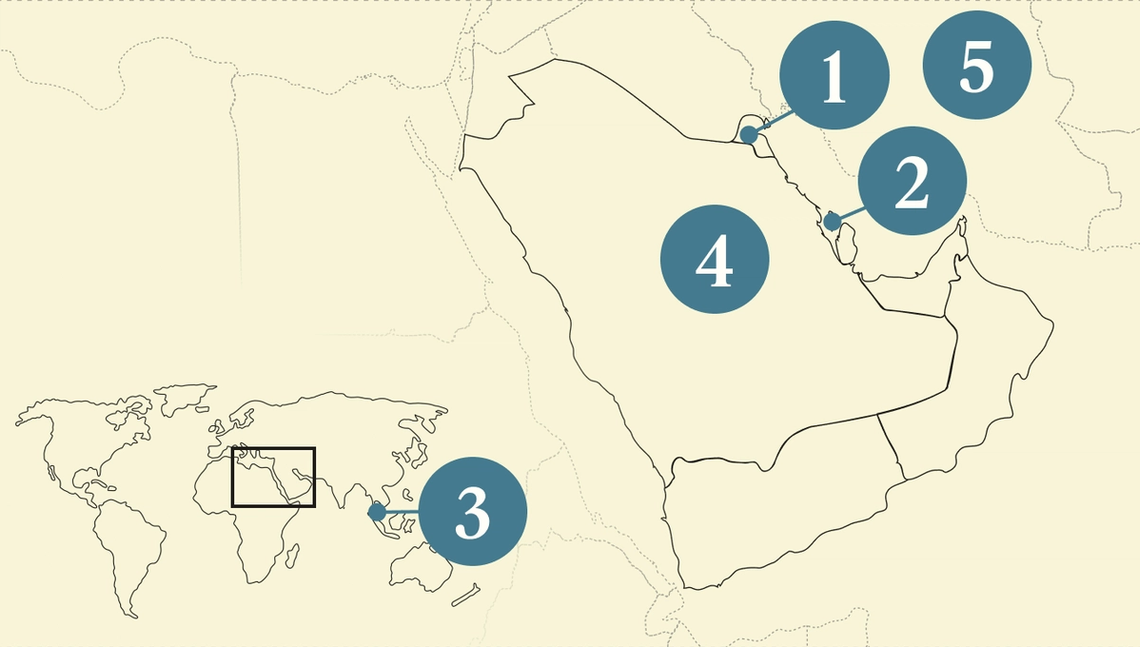 - Gulf’s rail renaissance
- Bahrain trade flows fall
- Aramco exits Asian refinery
- Gulf stocks recover
- Iran restores internet access
 Stoning Satan and sacrificing livestock. |
|
Gulf pushes on with rail links |
 Fahad Shadeed/Reuters Fahad Shadeed/ReutersKuwait has approved the route for a 500-kilometer (310-mile) high-speed rail line to the Saudi capital Riyadh — part of the gathering momentum to develop new regional transport and logistics links that enable trade to bypass the Strait of Hormuz. Work on the route is due to start later this year and be ready by 2030. Once the track is laid, the journey should take less than two hours, making it competitive with direct flights. In late 2025, plans were announced for a similar train service between Riyadh and Doha. These lines are separate to the Gulf Cooperation Council railway project designed to connect all six Gulf states: This month, Saudi Arabia Railways issued a tender for design services for the 672-kilometer section that will run along the east coast of the kingdom, connecting it with Bahrain, Kuwait, Qatar, and the UAE (from where the line will continue on to Oman). The UAE, meanwhile, recently completed the first passenger rail station on its national network, in Fujairah — a city that has risen in prominence during the Iran war due to its port’s location outside the Strait of Hormuz. |
|
Bahrain suffers wartime trade slump |
 Stringer/Reuters Stringer/ReutersThe value of Bahrain’s trade fell by 14.5% in the first quarter of the year because of the impact of the Iran war. The value of imports slumped 17% and non-oil exports fell by 10% — a combination leading to a perverse upside for the kingdom by lowering its trade deficit. Bahrain has the region’s smallest economy, and the one most vulnerable to the conflict, with no easy trade routes that skirt the Strait of Hormuz. Oil exports account for half of government revenues in normal times, but they are now on hold. Aluminium Bahrain’s plant was hit by Iranian drones in March and has also found itself cut off from its usual supply and export routes. On the plus side, it has supportive neighbors. The UAE opened a $5.4 billion currency swap line in April and S&P Global Ratings expects Bahrain will continue to benefit from support from its richer Gulf allies. Sovereign wealth fund Mumtalakat booked record profits last year, in part because of the sale of its stake in F1 team McLaren Racing to a UAE fund. — Dominic Dudley |
|
Aramco unloads Malaysia refinery stake |
 A worker passes the Pengerang plant in Malaysia in 2019. Edgar Su/Reuters. A worker passes the Pengerang plant in Malaysia in 2019. Edgar Su/Reuters.Saudi Aramco is offloading its 50% stake in a large refinery and petrochemicals project in Malaysia, transferring ownership to the country’s national oil company Petronas. The financial details have not been disclosed, but are likely to be significant — when the PRefChem joint venture was announced in 2017, Aramco pledged to invest some $7 billion. The JV involves a 300,000 barrels-a-day refinery in Pengerang, which produces jet fuel and other products, and an adjacent petrochemicals plant. In a statement, Aramco said the decision to exit the venture was based on the “evolving strategic priorities of both parties.” While the impact of the Iran war may have been a factor, the Saudi oil giant had already been eyeing potential asset sales. This time last year, Reuters reported that it was looking for ways to free up funds and had asked investment banks to pitch ideas for asset disposals. The company has also arranged multibillion-dollar leasing deals for its pipeline networks recently. |
|
Markets shut for Eid miss global rally |
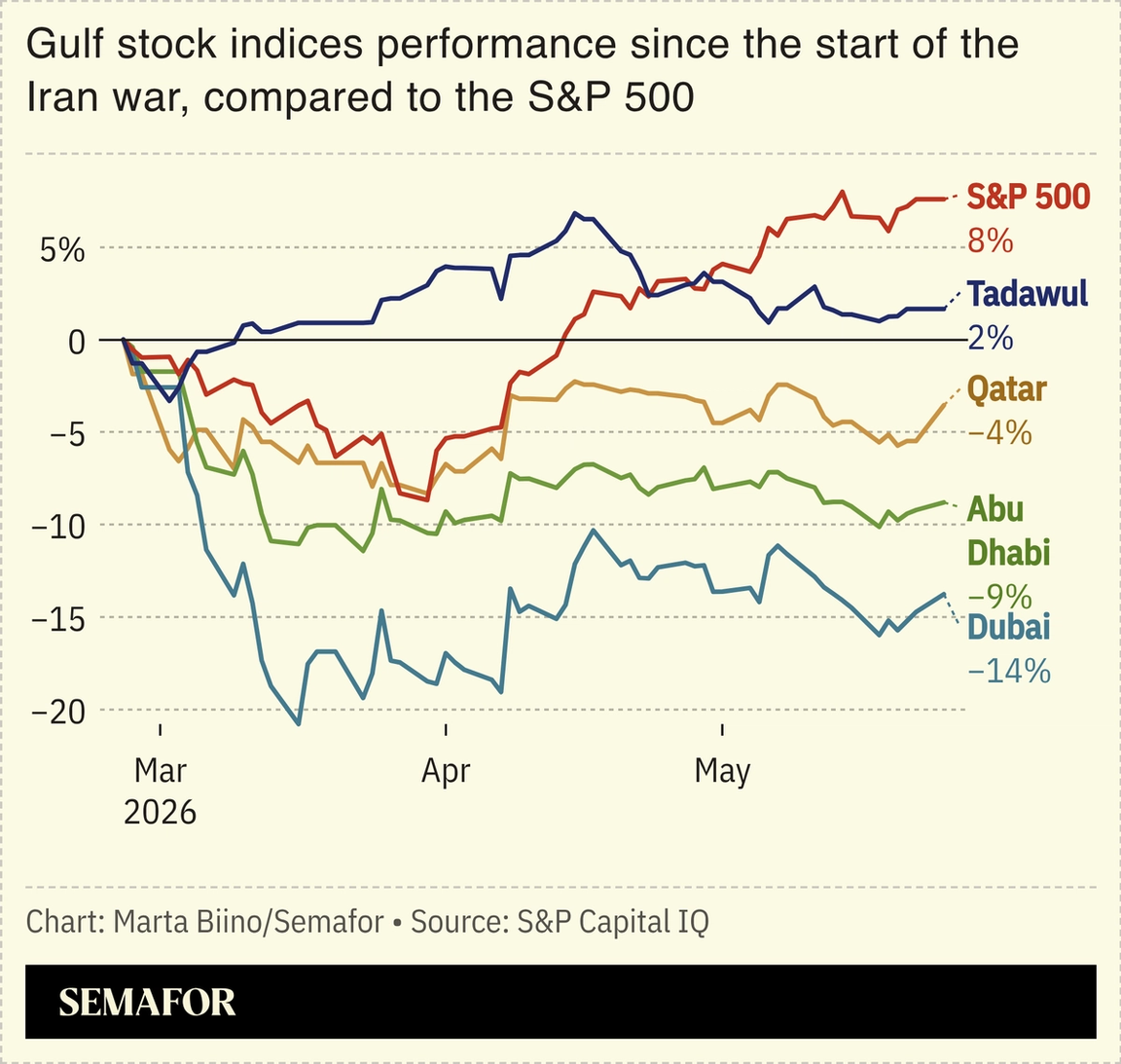 Gulf stock markets are closed for Eid, missing a global rally fueled by AI optimism and hopes that US-Iran negotiations will reopen the Strait of Hormuz and avert an inflationary energy shock. Some Gulf markets have recovered from the initial sell-off after the conflict began on Feb. 28: Kuwait, Oman, and Saudi equities are trading above prewar levels, but Abu Dhabi, Dubai, and Qatar remain lower, reflecting the deep disruption to their aviation, real estate, services, and tourism sectors. The divergence also highlights how Saudi Arabia, with its Red Sea ports and lower exposure to attacks, is positioned to emerge from the conflict in a relatively stronger position than many of its Gulf peers. |
|
Iran starts restoring web access |
 Majid Asgaripour/WANA (West Asia News Agency) via Reuters Majid Asgaripour/WANA (West Asia News Agency) via ReutersIran is starting to restore internet access after a nearly three-month blackout. Tehran cut its public off from the web shortly after the US and Iran struck the country in late February, instead promoting a heavily curtailed network of domestic platforms. The restrictions reshaped Iran’s economy, as tech companies were forced to close and online merchants struggled. Some politicians and business figures, though, were able to use the internet, sometimes by paying a premium. Still, the web will likely remain heavily censored, experts warned; Tehran is reportedly using Chinese hardware to strengthen its censorship capabilities, further proof that Beijing is exporting the technology that powers its cutting-edge firewall. |
|
 Who gets to define the global story? Semafor Co-Founder and CEO Justin B. Smith joins Asia Society Hong Kong to discuss how original reporting and live journalism events can elevate global perspectives for today’s most influential decision-makers and equip them to navigate a rapidly evolving world economy. Justin will also share what it takes to build a new media company in a shifting industry, and why audiences are increasingly seeking deeper, cross-cultural insight to make sense of a changing global landscape. Semafor readers can register at a discounted rate with code 50SFOFF. May 29 | Hong Kong | Learn More |
|
 Ibraheem Abu Mustafa/Reuters Ibraheem Abu Mustafa/ReutersToday, nearly 2 million people are stoning the devil. At Mina’s Jamarat complex, pilgrims throw seven pebbles at each of three stone walls, commemorating the Prophet Abraham’s rejection of Satan. The ritual has long been one of the Hajj’s most dangerous because of the crowds involved, with more than 1,000 people killed in stampedes over the past two decades. But it is getting safer: Saudi Arabia has adapted the site into a five-level complex with multiple entry and exit points to better manage the flow of pilgrims. Also today is the animal sacrifice that gives Eid Al-Adha its name. More than a million animals are slaughtered during Hajj. Historically, much of the meat was buried or burned because it could not be consumed in time. Since 1983, Saudi authorities have overseen a program to freeze and distribute the meat to poorer communities across 27 countries. |
|
| |