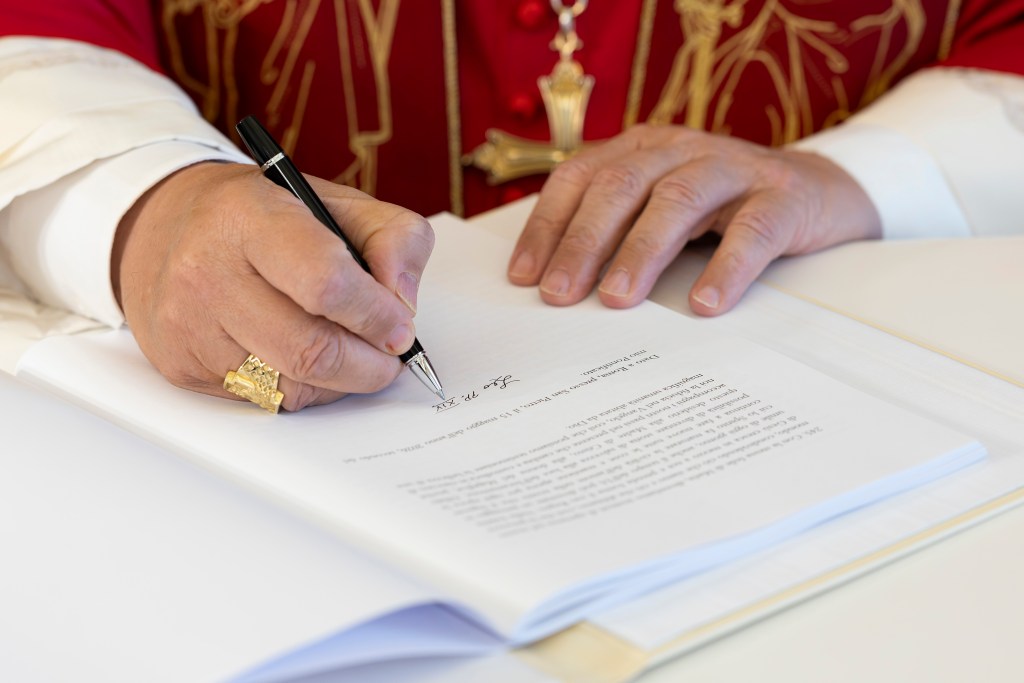
 Pope Leo XIV signs "Magnifica humanitas" at the Apostolic Palace on May 25, 2026 in Vatican City, Vatican. Simone Risoluti/Vatican Media/Vatican Pool/Getty Images
Just when you thought everyone had offered their opinion about artificial intelligence, here comes the pontiff.
On Monday, Pope Leo XIV published an encyclical about AI, dubbed “
Magnifica humanitas,” that’s got believers and non-believers alike talking. (An “encyclical,” you ask? Think of it as a papal memo.)
The document, published in eight languages, aims to be a moral guide for the Intelligence Age. Over its 42,300 words, the Pope calls for government regulation of private AI companies; protection of workers whose jobs are threatened by AI; education for students to think critically about the technology; protection of children from AI-generated violent, sexual, or disinformation content; and safeguards to ensure that humans retain responsibility for use of AI weapons.
“Humanity, created by God in all its grandeur, is today facing a pivotal choice: Either to construct a new Tower of Babel or to build the city in which God and humanity dwell together,” wrote the Apple Watch-wearing Pope.
According to a Politico report, executives from Amazon, Google, and Meta met with Vatican officials for an hour-long “lobbying push” on April 29. Meanwhile Anthropic co-founder Chris Olah
was invited to speak at the presentation of the encyclical in Vatican City.
The influence of the document is expected to be far-reaching, informing digital policy discussions in nations around the world—even in the U.S., whose Trump administration has been openly critical of God’s divine representative on Earth.
Said Vice President J.D. Vance, a converted Catholic, last week: “I think it's going to be a very, very important document.”
—AN