|
|
|
|
If you’re reading this on the web or someone forwarded this e-mail newsletter to you, you can sign up for Globe Climate and all Globe newsletters here. |
|
|
|
|
Good afternoon, and welcome to Globe Climate, a newsletter about climate change, environment and resources in Canada. |
|
|
|
|
By working at all costs to stop forests from burning, we might have created something worse. Now, we must rethink preparedness in an era where wildfires are exacerbated by climate change. |
|
|
|
|
Now, let’s catch you up on other news. |
|
|
|
|
|
|
|
|
|
|
|
|
|
|
|
|
|
|
- Oil and gas: Ottawa-Alberta pipeline deal includes a cancellation fee critics say is too low
- Environment:
Yukon’s rusty rivers linked to permafrost thaw
- Guide: Tick season is here. How can you protect yourself?
- Oceans: B.C., First Nations, Ottawa sign agreement to create ‘Realm of the Salmon’ coastal reserve
-
Pollution: Fibreglass particles a potential ‘forever’ contaminant, new research warns
- Agriculture: Will farmers go electric as diesel prices rise?
-
Arts: Multidisciplinary climate play cicadas is ambitious and daring, but also a mess
|
|
|
|
|
|
|
|
|
|
|
|
|
|
|
|
|
|
|
|
Godelive Ohelo looks out at a wildfire burn scar from her apartment in Fort McMurray on April 28. Jesse Winter/The Globe and Mail
|
|
|
|
|
A decade after Fort McMurray, what did we learn? |
|
|
|
|
For this week’s deeper dive, a closer look at the lessons we have learned, and are still learning, in the past 10 years of fire emergencies across the country. |
|
|
|
|
Ten years ago, the Horse River wildfire hit Fort McMurray, Alta., with a ferocity few were prepared for. |
|
|
|
|
It changed the way Canadians, and the rest of the world, thought about fires. More than 88,000 people were forced to flee and more than 2,400 buildings were destroyed. We learned that wildfires, exacerbated by climate change, are capable of releasing as much energy as a nuclear weapon. |
|
|
|
|
|
|
|
|
|
|
When neighbourhoods were rebuilt, the city ensured that each was connected to at least two evacuation routes. Urban planners also ringed them with parks and greenbelts, creating vital defensible space between homes and the forest. Firefighters are now armed with the knowledge of how to better fend off a blaze. Some residents are more prepared today with evacuation bags at the ready. |
|
|
|
|
|
|
|
|
|
The neighbourhood of Beacon Hill in Fort McMurray was razed to the ground by the 2016 Horse River wildfire. May, 2026, marks the 10-year anniversary. Jesse Winter/The Globe and Mail
|
|
|
|
|
“Fort McMurray proved that wasn’t a one-off,” Jamie Coutts told Jesse. Coutts was the fire chief of Slave Lake, Alta., when he watched his own town burn. The most important lesson is that wildfires are not a problem we can solve, only one we can learn to live with, he said. |
|
|
|
|
Jesse covers Western Canada for The Globe and Mail’s B.C. bureau, and has focused on wildfires in his coverage the past few years. He’s the author of Wild Fire: Dispatches from a Country Ablaze, and his adapted essay for The Globe takes an even further step back. |
|
|
|
|
“Media coverage of wildfires often drives simplistic narratives about wildfire as wholly bad – a thing we need to tame, control, stamp out. The truth is much more complex, and that story hides our own complicity in the destruction now frequently wrought not by traditional wildfires, but by megafires,” he writes. “Fewer routine healthy fires have paved the way for the destructive monsters that are entirely unstoppable.” |
|
|
|
|
|
|
|
|
|
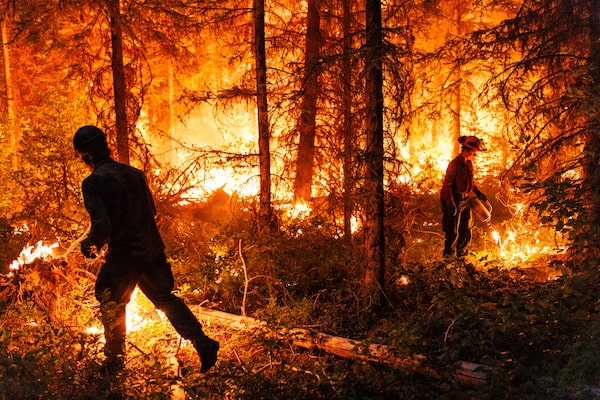
Tyler Moylan and Charlie Helton ignite the forest with drip torches near Vanderhoof, B.C. If left unchecked, dense underbrush like this could allow a real wildfire to spread quickly. Jesse Winter/The Globe and Mail
|
|
|
|
|
Wildfires are as inevitable as rain, and just as necessary for the health of many North American ecosystems. Indigenous peoples learned how to co-exist with fire here thousands of years before the first settlers arrived. Fort McMurray, Tsah Creek, Jasper and a dozen fires in between taught us that that megafires are often the result of trying to put out wildfires at almost any cost. |
|
|
|
|
“I set out determined to understand our fastest-growing blazes, our narrowest close calls, and the monster fires that really should scare us. I learned that we can either rethink most of what we know about wildfires, and fast, or we can watch as more of our homes goes up in flames,” he wrote. |
|
|
|
|
|
|
|
|
|
|
|
|
|
|
|
|