| | In this edition: Senegal’s political crisis, AfDB meets amid Iran war backdrop, and Kenya’s tax push͏ ͏ ͏ ͏ ͏ ͏ |
| |  Brazzaville Brazzaville | Dakar |  Porto-Novo Porto-Novo |
 | Africa |  |
| |
|
 - AfDB talks amid Iran war
- S. Africa eyes AGOA change
- Fintechs brace for change
- Ebola threat level raised
- Benin’s new president
- Opportunity to industrialize
 The Week Ahead, and a South African poetry collection wins a top prize. |
|
 Senegal’s President Bassirou Diomaye Faye set off a political avalanche by firing his popular prime minister, Ousmane Sonko. Faye probably calculated that the move, announced late on Friday, could bury his own political career but was worth the risk to break an impasse that has prevented the country plotting a path out of its debilitating debt crisis. The pair have disagreed over the handling of public debt that the International Monetary Fund estimates reached 132% of GDP at the end of 2024 after the government said it had discovered undisclosed debts worth around $13 billion. The revelation prompted the IMF to suspend a $1.8 billion loan facility. The drama unfolding in Senegal highlights the challenges of transitioning from being a populist, personality-driven political movement into government. When Faye won Senegal’s 2024 presidential election, it was widely understood as a victory engineered by Sonko, his political mentor who had been barred from contesting the election himself after a defamation conviction. Sonko won the mandate but Faye took office. The alliance between the two men was always based on a delicate understanding: Faye would occupy the presidency while Sonko remained the movement’s dominant political force and strategist. That arrangement led to them running what were in effect parallel administrations at the helm of a $40 billion economy. The divergence in their views was clearest — and most damaging — on the IMF’s recommendation for Senegal to restructure its debt. Sonko rejected the idea of a formal program; Faye has signalled a more flexible approach. To govern effectively, an administration needs a sense of direction and an understanding of who calls the shots. Faye has tried to bring clarity. Having dissolved his government, he will hope to build an administration in his image. But the avalanche is gathering pace: The parliament speaker resigned on Sunday, clearing the way for Sonko, his ally, to run for the position — an ideal vantage point from which to challenge Faye’s authority. As the head of the largest party in parliament, Sonko could frustrate Faye’s legislative agenda. And if they contest the next election, the smart money is on Sonko winning. After all, he created the Faye presidency and is best placed to end it. |
|
AfDB kicks off annual meeting |
 Dr. Sidi Ould Tah, President of the African Development Bank. Luc Gnago/Reuters. Dr. Sidi Ould Tah, President of the African Development Bank. Luc Gnago/Reuters.The African Development Bank began its annual meeting today in Brazzaville under the cloud of an Ebola outbreak in central Africa and continental economic fallout from the Iran war. The week-long gathering is the first since Mauritania’s former Finance Minister Sidi Ould Tah was elected the lender’s president a year ago. He has made enhanced access to “affordable capital” the core of his agenda for Africa’s largest development lender. Tah wants to push the bank to narrow the continent’s financing gap of $400 billion by diversifying fundraising to include a broader set of fund managers, such as private sector companies. Africa’s development finance receipts have fallen sharply with cuts to international aid budgets by Western powers, most notably the US. The continent is also facing new stresses caused by energy shortages related to the Iran war, with rising fuel prices raising the cost of living in much of the continent and driving discontent. |
|
S.Africa seeks 15-year AGOA extension |
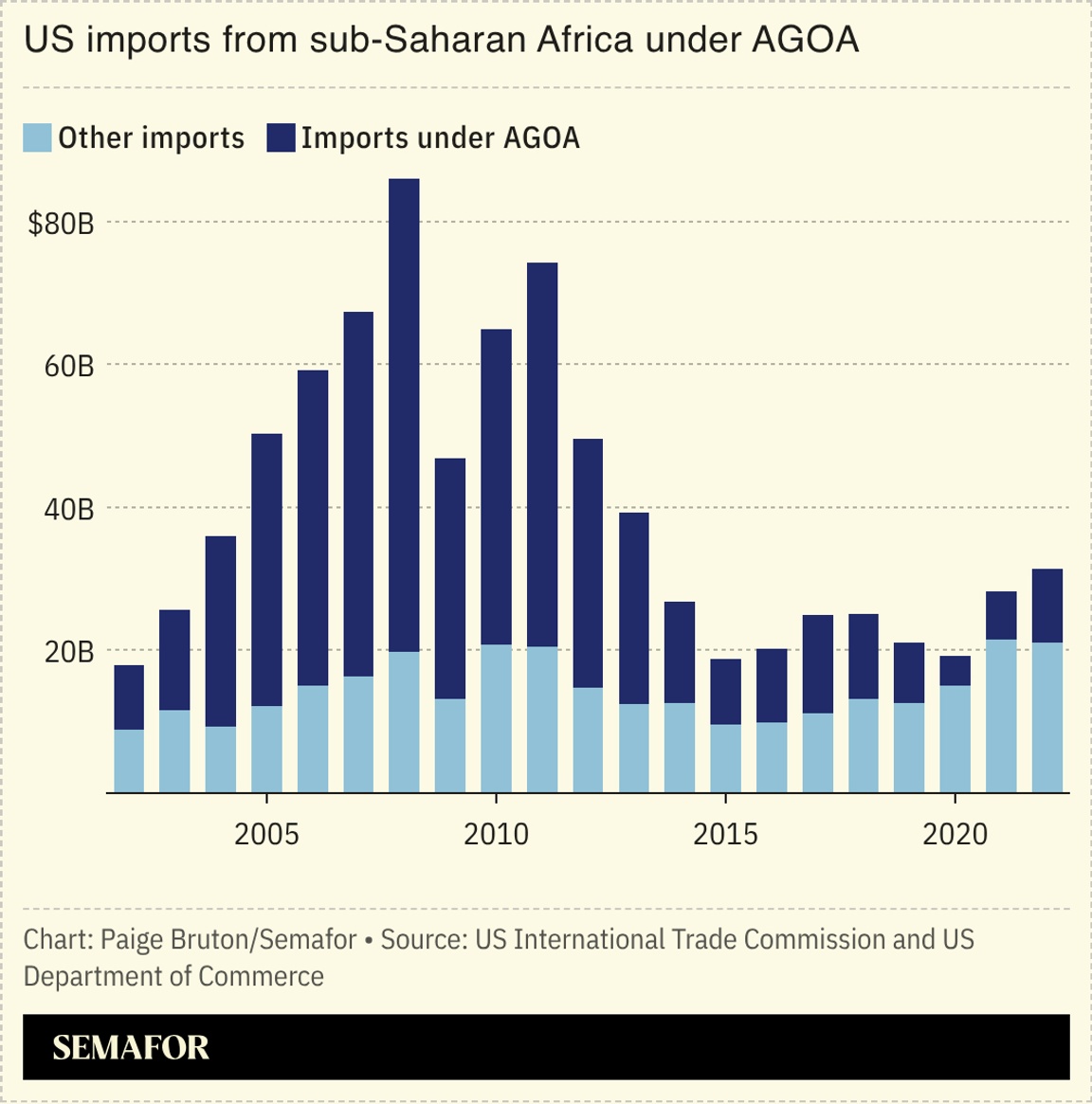 South Africa made critical minerals the cornerstone of a push for a 15-year extension of the US African Growth and Opportunity Act, warning that short extensions undermine investor confidence and disrupt regional manufacturing plans. The AGOA trade deal gives African countries duty-free access to the American market. In a filing to the Office of the US Trade Representative, Pretoria said it is already home to 12 of the 50 top critical minerals identified by the US as well as the process capacity to support American manufacturers. South Africa — which has the world’s largest deposits of platinum group metals, manganese, and chromium — also wants eligibility rules updated to reflect inequality, not just income thresholds. AGOA had lapsed in September, but the US in February signed a retroactive extension until year-end. The trade deal has become part of a proxy fight over wider US-South Africa tensions — from Pretoria’s domestic Black empowerment politics, and its alignment with BRICS, to its genocide case against Israel. — Tiisetso Motsoeneng |
|
Kenya’s tax plans ‘threaten fintechs’ |
| |  | Martin K.N Siele |
| |
 Thomas Mukoya/Reuters Thomas Mukoya/ReutersNew taxes proposed by Kenya’s government risk hampering the growth of fintechs and mobile money services, with Safaricom’s M-Pesa likely to be the worst hit. A new 16% value-added tax would be imposed on services by payment providers under a revised finance bill. The legislation also proposes a 25% excise duty on mobile phones, and withholding tax on card payments. The National Treasury’s plan could impact both the market share and usage of M-Pesa — Kenya’s biggest fintech platform, economists and policy analysts told Semafor. They pointed out that the platform, used by around 90% of Kenyans, already faces widespread criticism over its high transaction fees. Experts said many consumers could be driven back to cash transactions to avoid costly charges, a shift that risks hurting the country’s position as a leader on the continent in mobile money and fintech. With over 80% of Kenya’s tax revenues going toward debt servicing costs, the government has been under pressure to raise funds for development projects and social programs. Ruto, who is eyeing reelection next year, will want to avoid a repeat of youth-led protests that followed attempts to hike taxes in 2024. |
|
WHO raises Ebola threat warning |
 Gradel Muyisa Mumbere/Reuters Gradel Muyisa Mumbere/ReutersThe World Health Organization raised the threat posed by Ebola in the DR Congo to “very high” as the virus spread in the central African nation. The epidemic is believed to have killed at least 200 people, though experts have warned of a significant undercount of both deaths and cases, pointing to contagion reported in the main regional hubs including in neighboring Uganda. Fragile health systems, roiling intrastate conflicts, and attacks on treatment facilities have compounded the challenge of containing the virus. The new strain has also exposed health experts’ lack of preparedness for Ebola variants other than the common Zaire one. “Because of its rarity, [the Bundibugyo strain] just wasn’t on anybody’s radar,” a researcher told Bloomberg. This item first appeared in Semafor’s twice-daily Flagship briefing. Subscribe here. → |
|
|
Benin’s president sworn in |
 Benin’s President Romuald Wadagni with his wife Nathalie Villette-Wadagni. Charles Placide Tossou/Reuters. Benin’s President Romuald Wadagni with his wife Nathalie Villette-Wadagni. Charles Placide Tossou/Reuters.Benin’s new president promised to ensure citizens benefitted from the growing strength of the economy. Romauld Wadagni, 49, was sworn in on Sunday, having previously served as finance minister under his predecessor. That administration produced economic growth of 7.5% last year, the highest level since 1990. The economy under Wadagni is projected to grow at 7% this year with inflation staying around the 2% mark, according to the IMF. But the new president said “national growth only makes sense when it becomes visible in people’s everyday lives.” More than a third of Benin’s population lives below the poverty line and food insecurity remains high in the country. Wadagni also comes in after a failed coup attempt last year. Bordered to the north by junta-ruled Burkina Faso and Niger, Benin has suffered an increase in jihadist attacks, with 15 soldiers killed at an army base in March. — Alexander Onukwue
|
|
View: Reconsidering Africa’s industrialization |
 Siphiwe Sibeko/Reuters Siphiwe Sibeko/ReutersAfrica’s long-standing argument that no region can prosper while exporting raw materials and importing finished goods is finally being echoed in Europe itself, a former Liberian minister argued in a Semafor column. Europe’s new openness to African industrialization — as heard from French President Emmanuel Macron on his recent visit to Kenya — is less about morality than self-interest as Europeans grow anxious about dependence on Chinese manufacturing, writes W. Gyude Moore. The question now is whether African governments can use this moment to secure real structural gains. The opportunity will not be secured through rhetoric alone. As Moore puts it, “partnership will mean little without the difficult foundations of industrialization” — lower-cost capital, energy infrastructure, technology transfer and support for African industrial policy that can turn strategic interest into lasting economic transformation. |
|
|