| | In today’s edition: Saudi Arabia sets up a drone factory, but postpones work at NEOM.͏ ͏ ͏ ͏ ͏ ͏ |
| |  | Gulf |  |
| |
|
 - Closer to a deal
- Hitting pause on The Line
- Saudi drone buildup
- Qatar’s discreet diplomat
- Fewer Iranian pilgrims
 The world’s largest temporary city. |
|
Inching toward a peace deal |
 Stringer/Reuters Stringer/ReutersThere’s a deal in the making and, based on the market reaction and more tankers moving through the Strait of Hormuz (and others lining up to follow), it seems shipping companies and investors believe this round of talks is real. While still short on details, the agreement could gradually reopen the strait and address Iran’s nuclear program, ahead of another 30 to 60 days of negotiations between Tehran and Washington toward a broader deal. There has been an uptick in oil and gas ships exiting the Gulf, led by Abu Dhabi and Qatar, but the flow remains a small fraction of prewar traffic. Whatever the final wording of a deal, the baseline has shifted from US President Donald Trump’s demand for total capitulation. Tehran, as well as Trump critics, are framing the outcome as a victory for Iran — which appears to be maintaining control over the strait and remains adamant about levying a toll. Many experts, meanwhile, see this next phase as a pause, not peace: Former Qatari Prime Minister Sheikh Hamad bin Jassim Al Thani stressed multiple times during a recent 90-minute interview that another US-Israel confrontation with Iran was likely within the next decade, and that the Gulf will once again be caught in the middle. — Mohammed Sergie |
|
NEOM halts work on The Line |
| |  | Matthew Martin |
| |
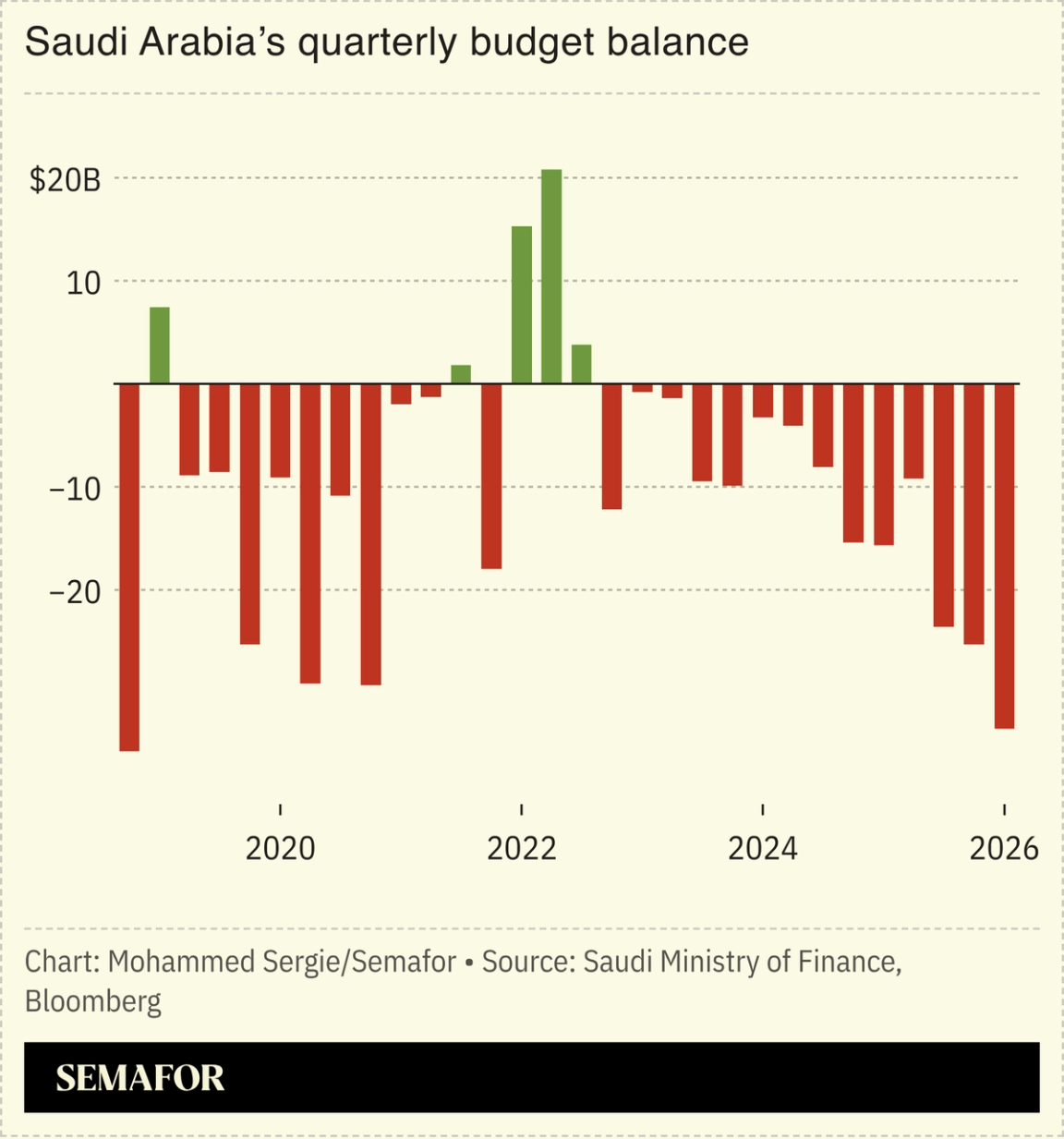 NEOM has delayed further work on The Line — the planned 170-kilometer (105-mile) long dual skyscraper once projected to cost more than $1 trillion — until after 2030, as the kingdom’s sovereign wealth fund shifts spending toward developing infrastructure like ports and data centers. NEOM — the company chaired by Crown Prince Mohammed bin Salman which is developing the northwest corner of Saudi Arabia — has also postponed plans to develop tourism destinations along the Red Sea coast until after 2030, according to people familiar with the matter. Trojena, the mountain ski resort which until recently had been due to host the next Asian Winter Games, will not receive new investment until after that date either, the people said. NEOM didn’t respond to requests for comment. Postponing development of one of the kingdom’s most iconic projects is the latest sign that Saudi Arabia is taking a more pragmatic view of its ambitions. Widening budget deficits, lower-than-expected foreign investment, and questions about the feasibility of some projects had forced authorities to reassess priorities even before the Iran war hit economic confidence. |
|
Riyadh develops kamikaze drones |
 Courtesy of SR2Vector Courtesy of SR2VectorA Saudi defense-tech firm has partnered with a US-based dronemaker to make weapons similar to Iran’s Shahed system, which Tehran has used to pummel Gulf countries over the past few months. The facility being built on the outskirts of Riyadh — a joint venture between Utah-based Vector Defense and Saudi-based startup SR2 Defense Systems — will manufacture a one-way attack drone developed by Vector, dubbed SKYWASP, that is capable of hitting targets up to 1,500 kilometers (930 miles) away. That’s about the distance from the kingdom’s northeast coast to Tehran. Gulf states are expected to ramp up defense spending in the wake of the Iran war as they look to shore up security and deterrence against future attacks. Saudi Arabia, which has one of the world’s biggest defense budgets but imports almost all of its military equipment, has set a goal of localizing 50% of that spending by 2030. — Matthew Martin |
|
Qatari Al Thawadi’s quiet influence |
 The White House/Flickr The White House/FlickrWhen US President Donald Trump said on Saturday that a deal with Iran had been “largely negotiated,” he cited a phone call with a crowded list of Middle East rulers. One ostensibly lesser name stood out: Qatar’s Ali Al Thawadi is a minister without his own department, but he too was namechecked by Trump, in a sign of just how important a cog he has become in the diplomatic machinery. Al Thawadi was in the Oval Office in September last year to watch Israeli Prime Minister Benjamin Netanyahu place a call to Qatar’s prime minister to apologize for bombing Doha. His relationship with Trump’s White House was cemented in January when he took up Qatar’s seat on the Gaza Executive Board. Described by Gulf watchers as “a discreet character, mostly operating in the background … a doer and implementer,” Al Thawadi often travels with Qatar’s prime minister on foreign trips; some analysts are now crediting him with helping to push Iran and the US toward an agreement. — Dominic Dudley |
|
Iranians attend Hajj despite war |
 Ibraheem Abu Mustafa/Reuters Ibraheem Abu Mustafa/ReutersThe Iran war is reshaping who performs Hajj this year, and how they get there: Iran’s allocation was cut to 30,000 pilgrims, nearly two-thirds fewer than usual. Their travel plans had shifted to using overland convoys through Iraq, before the ceasefire restored air access and enabled Iranian pilgrims to fly into Medina from April 25 (Iraq still sent all of its pilgrims overland). In 2016, no Iranian attended Hajj amid a rupture of diplomatic ties between the two countries and accusations from Tehran that Riyadh wasn’t doing enough to protect pilgrims. The fact that any Iranians are being allowed this year, despite the waves of drones and missiles fired at the country since late February, reaffirms Riyadh’s policy of not politicizing its guardianship of Islam’s holiest sites. Gulf leaders cited Hajj when urging US President Donald Trump to hold off on resuming strikes last week. — Manal Albarakati |
|
 — Mohamed Alabbar, billionaire and founder of Dubai property developer Emaar |
|
 Finance- Cantor, a unit of New York investment bank Cantor Fitzgerald, got the green light to conduct financial services from Abu Dhabi’s regulator as the firm looks to expand its office in the UAE capital to become its regional hub.
Real EstateTech |
|
 Ibraheem Abu Mustafa/Reuters Ibraheem Abu Mustafa/ReutersToday, millions of pilgrims begin arriving in Mina, a small valley five kilometers east of the Grand Mosque in Mecca, where they will spend several nights in what becomes, briefly, the largest temporary city on earth. The tents they sleep in bear little resemblance to what earlier generations encountered: Today’s structures sit on permanent steel frames, built from fire-resistant materials engineered to reflect heat, with air conditioning running throughout. The facilities remain in place year-round, maintained and upgraded between each season. For the Tawaf, the ritual circumambulation of the Kaaba that pilgrims will perform throughout this week, Saudi Arabia undertook a vast rebuilding of the Mataf, the marble floor surrounding the Kaaba, expanding it across four floors and more than doubling the number of pilgrims who can be accommodated. The marble floor was engineered to stay cool regardless of the heat outside, which last year reached 51 degrees Celsius (124 degrees Fahrenheit). — Manal Albarakati |
|
|


