| | In this edition, making sense of SpaceX’s IPO, and there are some big names missing from the Trump a͏ ͏ ͏ ͏ ͏ ͏ |
| |  | Technology |  |
| |
|
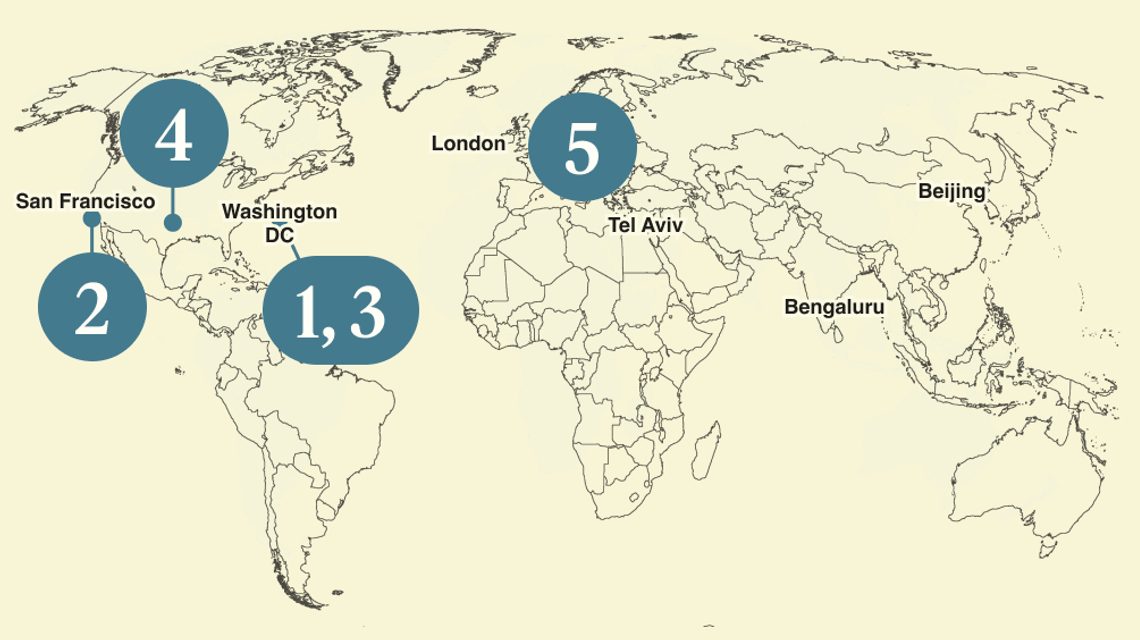 - Who’s left out of quantum
- Deel-makers
- Inside the delayed AI EO
- How Tinder uses AI to test features
- Self-driving cars go mainstream
 Making sense of SpaceX’s financials, and the award-winning story that appears to have used AI. |
|
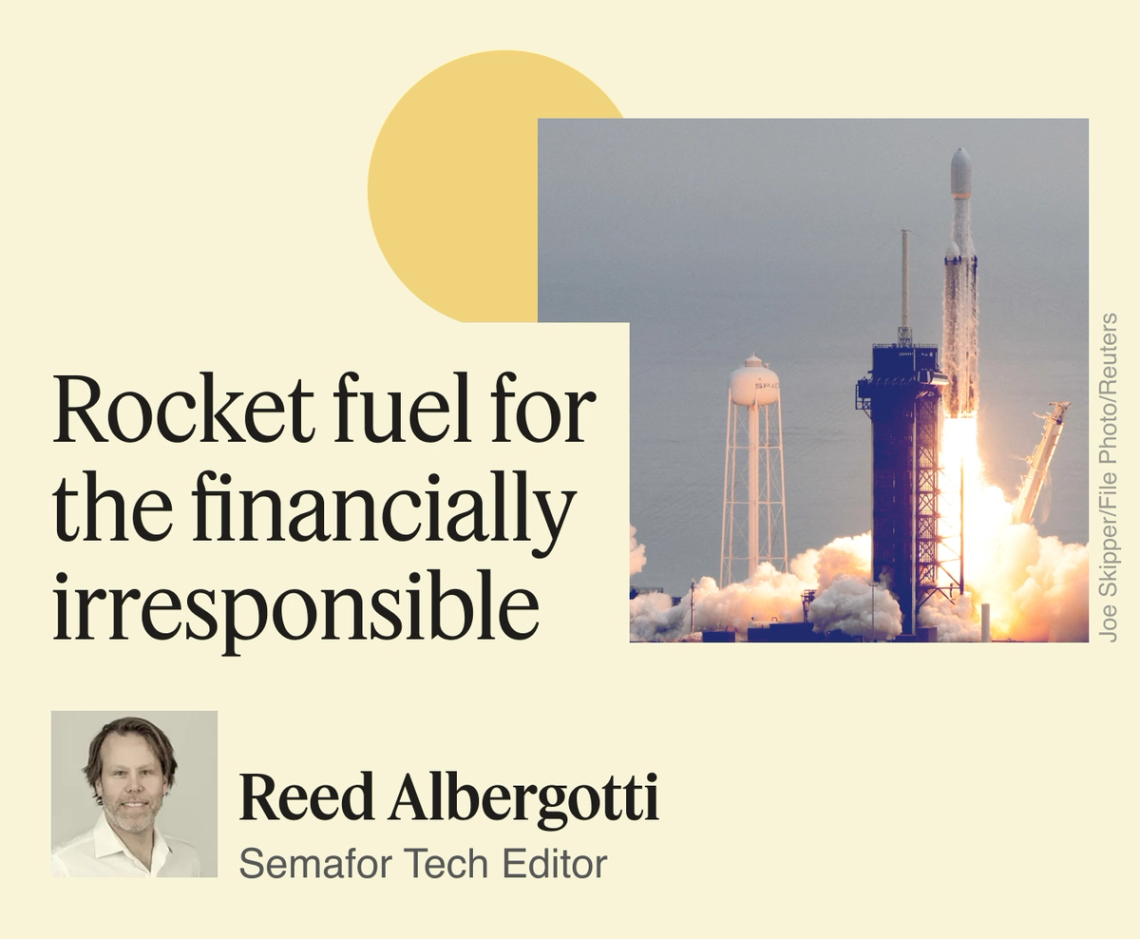 The thing about becoming a publicly traded company is that bankers have to figure out how to value businesses that often don’t fit into a neat box. But assessing how the rocket and satellite maker stacks up against other companies right now is ultimately a pretty silly exercise — and one that isn’t rooted in the actual promise of what buying shares in SpaceX today will yield in the future. SpaceX made $18.7 billion in 2025. With a speculative valuation target of something like $1.75 trillion, that’s a multiple of 93 times sales. That’s highly unusual — companies on the S&P 500 are trading at about three times sales. Nearly 70% of SpaceX’s revenue comes from Starlink, its satellite internet service, and that has led some to attempt to analyze it as a telecom provider. Sure, after stripping away the satellites, rockets, antennas, orbital mechanics, and civilization-scale ambition, SpaceX is basically a thing that gets you on the internet. But should we compare it to Comcast? Comcast uses wires that were buried under your street sometime between the American Revolution and the invention of the salad fork, and has way more customers than Starlink. I’m one of them. Every month, it charges me a confusing amount of money. I complain about it, and then I continue paying. I only pay for Starlink when my Comcast goes out or on road trips in California, where we’ll have space data centers before we get reliable cell signal. Comcast does not launch rockets. It does not occasionally create glowing debris over the Caribbean. And it’s only valued at $90 billion! And yet, something tells me Comcast may not have the same upside as SpaceX. So let’s try to find another comparison. SpaceX, which acquired xAI, is also in the business of building unsightly, noisy AI data centers like the one it built in Memphis in a record 122 days. Anthropic is now paying $1.25 billion per month to use Colossus. So, in a sense, SpaceX is also a landlord in Memphis, right? A comp for that could be Mid-America Apartment Communities, a Memphis-based real estate investment trust with more than 100,000 apartment units, which is how many GPUs Colossus has. You can live in an apartment. You cannot live in a GPU. And if SpaceX eventually buys Tesla, another company owned by Elon Musk, you’ll have to factor in its cars, humanoid robotics, energy storage, and robotaxis. In other words, to really get a clear picture of how to value SpaceX, you’d have to roll up some frankenstein amalgamation of Comcast, Lockheed Martin, Amazon Web Services, Nvidia, Verizon, NASA, a REIT, a defense prime, an airline, a cloud company, a railroad, and perhaps a science-fiction franchise. Even then, it would make no sense to look at it like a holding company. The closest comparison is probably Alphabet, which is its own version of a giant, weirdly unclassifiable company whose core business throws off cash while funding AI, cloud computing, autonomous vehicles, quantum computing, biotech, and assorted projects that sound fake until they become antitrust exhibits (Alphabet’s moonshots are, so far, metaphorical). Buying shares in SpaceX — like Tesla was once upon a time — is more like a call option on several enormous futures at once. You’re betting that a world with robots and rockets and AI is going to fundamentally change the economy. Today’s financials don’t really even matter. |
|
Big names missing from Trump’s quantum investment |
 A man takes a photo of a model of the IBM Q System One quantum computer in 2020. Steve Marcus/Reuters. A man takes a photo of a model of the IBM Q System One quantum computer in 2020. Steve Marcus/Reuters.What was most striking about the US government’s $2 billion in grants and investments across nine quantum computing companies were the names that were left off the list: Google, Microsoft, and IonQ. Cohen & Company Capital Markets’ Brandon Sun, who advises quantum companies on going public through SPACs, says the omission could amount to a “comparative disadvantage” for the quantum companies that don’t get the Trump administration’s blessing, an implicit nod that could serve as a precursor to further government contracts. Microsoft declined to comment. Google and IonQ didn’t respond to requests for comment. The Trump administration’s move to take equity stakes in tech companies marks a change from years past, when the US government would issue grants and contracts to seed smaller ventures. But there are still a lot of details to iron out. What the administration announced were actually letters of intent, rather than finished deals. We still don’t know whether the funding comes with strings attached, one person familiar with the matter told Semafor, like technological milestones needed to unlock funding, as was the case with USA Rare Earth. The US is trying to build up its domestic supply chain as quantum technology advances, Scott Crowder, vice president of quantum adoption at IBM, told Semafor. “Even though the discussion around [quantum computing] is still, ‘Does it exist,’ the next question that follows very rapidly is ‘How do you build 100 of them?’” he said. IBM predicts it will create its first effective, scalable system in 2029. “This is the time you need to make the investment to be ready for fault tolerant systems and manufacturing scale,” he said. — Rachyl Jones |
|
Stop applying to jobs online |
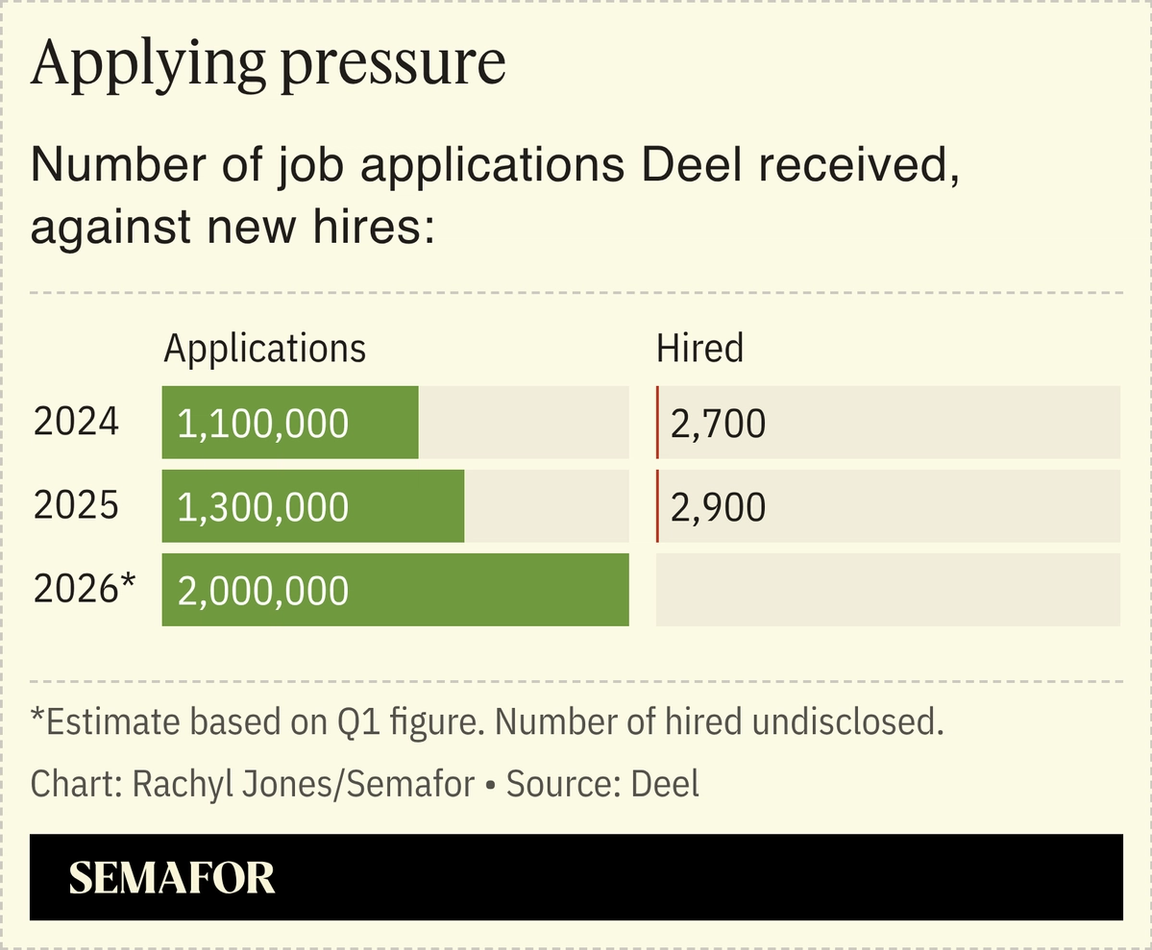 The acceptance rate for online job applicants has dropped so low that, in some cases, it now trails getting accepted to Harvard. Take payroll management company Deel, which employs 7,000 people and got 1.3 million job applications last year. After using AI to initially screen applicants, it hired only 2,900 people, or about 0.2% of applicants, the company told Semafor. This year it expects applications to nearly double. The use of AI by companies to whittle down the applicant pool has been broadly criticized, but the figures — often not publicly available — reveal just how difficult it is for applicants to stand out. Especially new grads, who are struggling to land jobs. Deel economist Lauren Taylor said she “would not recommend using AI from the job seeker side.” The wisdom is as old as time: focusing on fewer applications and aggressively networking in real life are more likely to yield results than hundreds of generic or automated applications. — Rachyl Jones |
|
Inside Trump’s AI order delay |
 Brian Snyder/Reuters Brian Snyder/ReutersThe Trump administration’s plans for an executive order regulating AI were put on hold this week after some of the tech industry’s biggest players, including Elon Musk, Mark Zuckerberg, and former White House adviser David Sacks persuaded the White House to call it off, according to people familiar with the matter. The push from industry was successful, these people said, because Musk and others were able to appeal to the accelerationist crowd. The executive order would have created some oversight for powerful new AI models — by setting up a voluntary system for companies to share their models with the government up to 90 days before their public release — but would not have created an official new licensing regime. — Reed Albergotti |
|
Match Group tests Tinder updates on avatars |
 Courtesy of Match Group/Joey Pfeifer/Semafor Courtesy of Match Group/Joey Pfeifer/SemaforWhen Match Group’s Spencer Rascoff wanted to know how customers would react to a new feature on its Tinder dating app that recommends matches based on musical tastes, he asked Abby, a bookish 19-year-old, who instantly replied with an emoji-laced stream of consciousness. “So, music? Wait, okay, I have two completely different reactions at the same time,” Abby wrote. “What exactly would it show? Like, exact songs or just vibes, because exact songs feel more personal, but also more ‘OMG, don’t judge me’ energy.” But Abby isn’t a human. It’s an AI avatar with an “anxious romantic” personality. The avatars, including “Jasmine the joyful butterfly,” and “Noah,” an earnest Christian nurse from Atlanta, are built from research into different types of customers using ChatGPT, and help the company better understand its users, Rascoff told Semafor’s Andrew Edgecliffe-Johnson. The approach is at the heart of Rascoff’s strategy for engaging more of the world’s 250 million active daters, driving his company back to growth at a time when much of its industry is suffering from “app fatigue.” |
|
Self-driving cars may go mainstream |
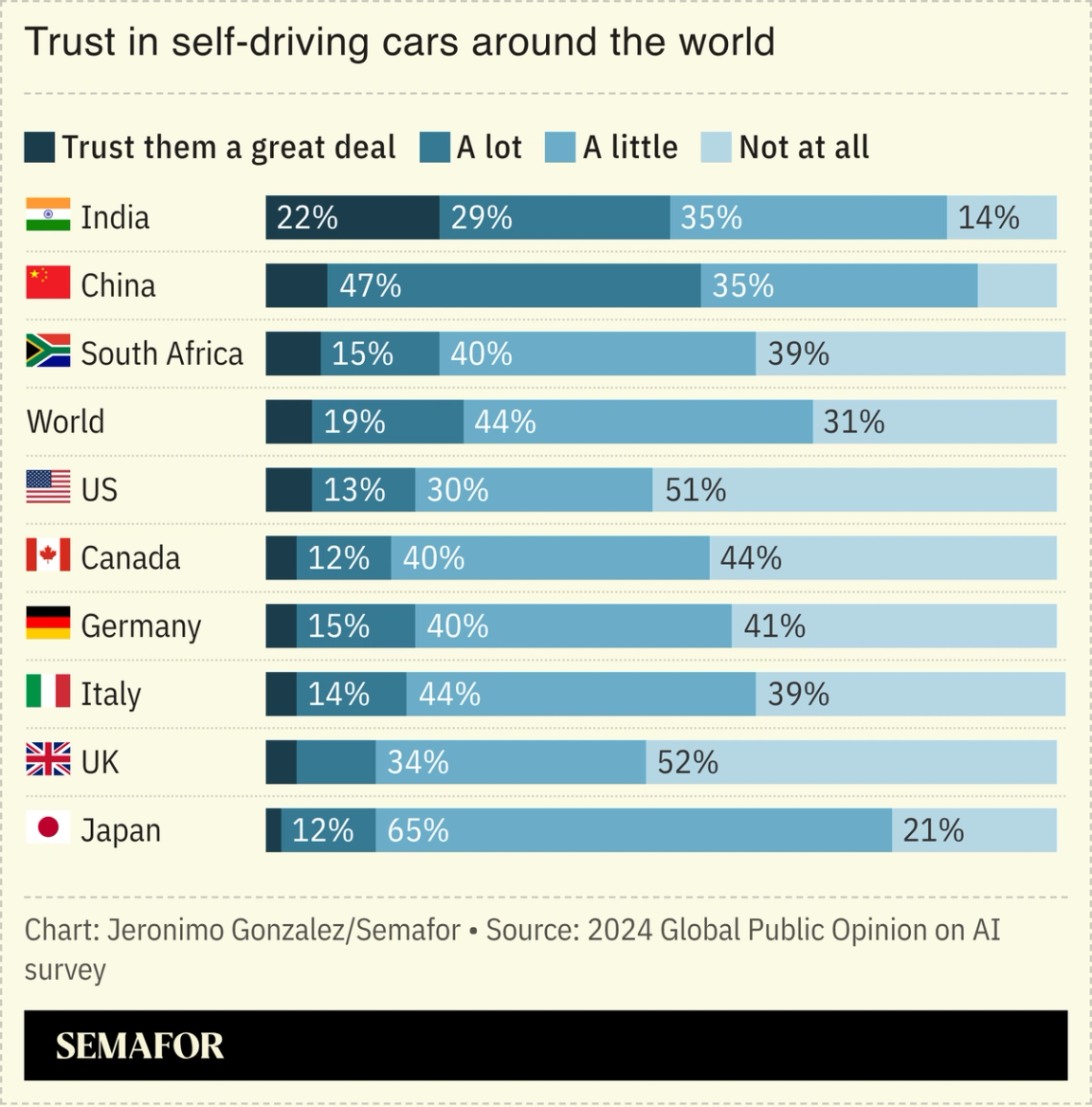 The European carmaker Stellantis announced a partnership with the UK startup Wayve to bring self-driving capabilities to Jeeps, Fiats, Dodges, and others, accelerating the rollout of the technology. Autonomous vehicles are spreading rapidly, but progress has been propelled by ride-hailing firms, partly because private cars must be able to drive anywhere, not just in a geofenced area. Wayve’s system learns about its environment from cameras, in theory doing away with the need for the hyper-detailed maps that Waymo uses. The first iteration would require driver supervision, but more advanced features would follow as regulations and public acceptance change. Stellantis is racing to keep up with the rapid change: This week, it also announced an EV-manufacturing partnership with Chinese firm Dongfeng. |
|
 Audie Cornish and Ari Shapiro spent years together in the buttoned-up, professional audio journalism world of NPR co-hosting All Things Considered. Now, they’re reuniting at CNN for something very different — podcasting. On this week’s episode of Mixed Signals, they join Max and Ben to talk about turning their off-mic chemistry into a show, navigating the pivots and shifts of today’s media landscape, and the surprising lessons amateur podcasters can learn from the audio pros who came before them. |
|
 Commonwealth Foundation Creatives/Facebook Commonwealth Foundation Creatives/FacebookAn apparently AI-written short story won a literary prize, in what one observer archly called “a major milestone.” A judge called Jamir Nazir’s The Serpent in the Grove “evocative.” But its style, replete with lists of three and unusual imagery such as “she had the kind of walking that made benches become men,” raised suspicions, and AI-detection software agreed. It is “damning” for Granta, which published the story, argued Literary Hub, but also a sign that “AI writing is getting harder to detect,” at least by awards judges. Still, it could be worse. A recent book about truth in the age of AI was revealed to contain apparently hallucinated AI quotes. It’s not just embarrassing — it’s ironic. |
|
|


