Hi! Doo doo doo doo doo doo… “Baby Shark” has officially surpassed 1 billion streams on Spotify, making it the first children’s song to hit the milestone. We are sorry to all the parents whose Spotify Wrapped got ruined along the way. Today we’re exploring:
|
- Catch up: Heinz is bringing back its glass ketchup bottle for a limited time.
- Making room: Airbnb is attempting to become an “everything app” for travel.
- Doped up: The Enhanced Games is a high-stakes demo for a company’s drug business.
|
Kraft Heinz is bringing back the glass ketchup bottle as it leans on sauces for growth |
Before you could squeeze Heinz ketchup from plastic vessels, its classic glass bottle was exactly the kind of American pantry staple that was iconic enough to end up in the Smithsonian and works by Andy Warhol. Now, for the first time in around a decade, that eight-sided bottle is back on shelves at Walmart for a limited run.
The release marks the condiment giant’s 157th anniversary, but it also lands at a moment when Kraft Heinz itself is trying to squeeze more growth out of its biggest product division after years of sluggish sales and turnaround attempts. |
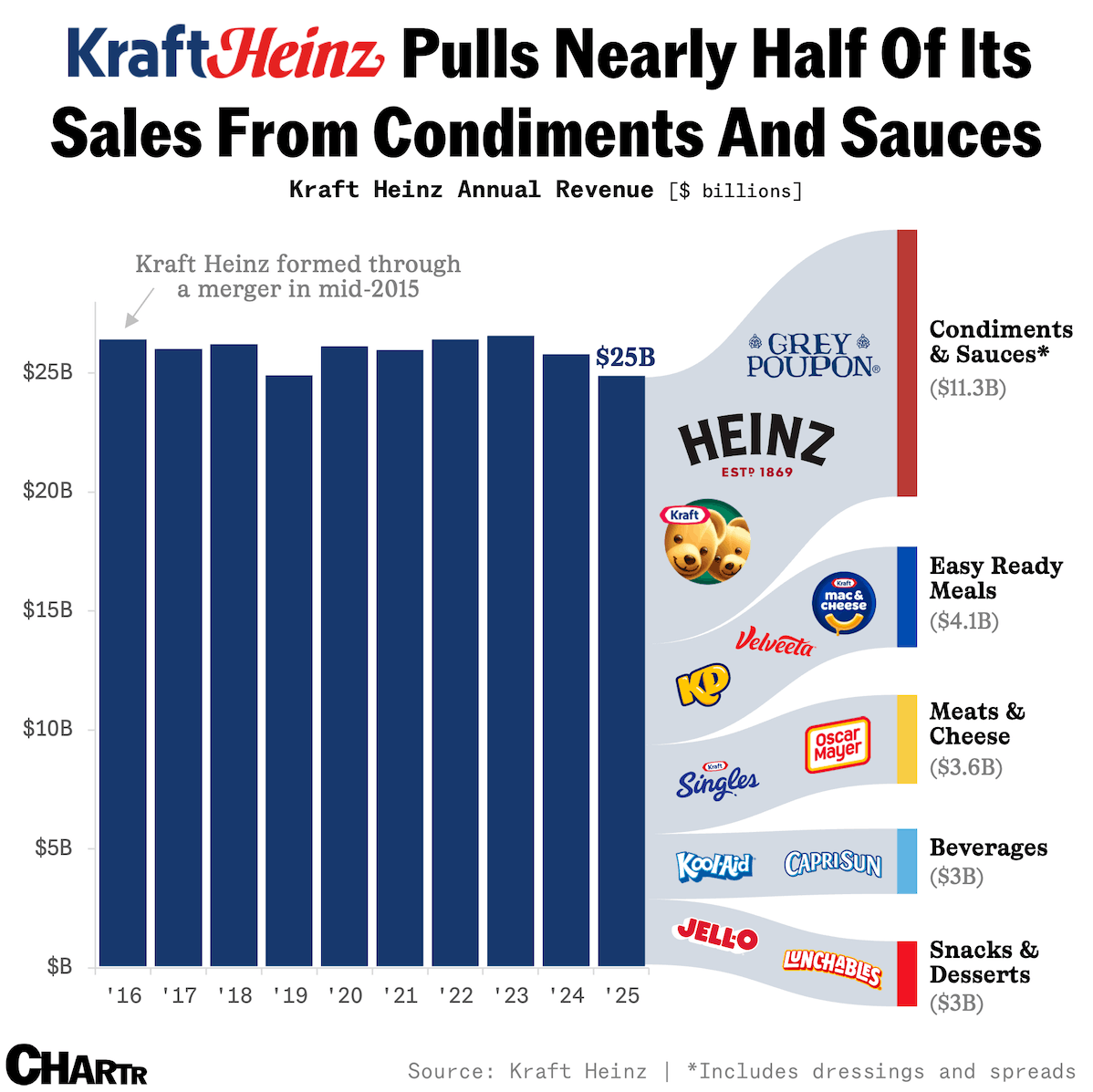
Following the 2015 mega-merger that combined Kraft’s US grocery staples with Heinz’s spreads, ketchup, and other sauces, Kraft Heinz has spent much of the past decade trying to prove the tie-up could justify the deal’s $45 billion price tag. Instead, annual sales have barely budged, hovering around the mid-$20 billion range, eventually pushing the company to explore separating its slower-growing grocery lines from the faster-growing condiments and sauces business.
|
Company reports show condiments, sauces, and spreads — including Heinz, Kraft Peanut Butter, and Grey Poupon — remain Kraft Heinz’s biggest product category, accounting for 45% of total sales last year. That strength continued to show up in the latest quarter, when Kraft Heinz beat Wall Street’s sales expectations, with new CEO Steve Cahillane pointing to market-share gains from its US sauces and condiments segment.
Earlier this year, Cahillane shelved the breakup plan, calling the challenges “fixable,” and instead committed $600 million to marketing, sales, and R&D to drive a turnaround. |
Airbnb is expanding its hotel offerings and adding car rentals to its app |
In a release published Wednesday, homestay platform Airbnb outlined its plan to feature hotels as a distinct category, as well as adding car rentals, grocery delivery, airport pickup, and a plethora of AI tools to its app.
While the first of those moves might feel like a stark reversal for a brand whose initial slogan was “forget hotels,” Airbnb has actually featured hotels listings for years. Now, it plans to integrate thousands more — but no big chains — with a price-match guarantee and 15% Airbnb credit for booking. |
Everything, everywhere, all-in-one |
Alongside its other travel-adjacent offerings, the stronger pivot into hotel listings puts Airbnb another step closer to becoming “the everything app for traveling and living,” according to CEO Brian Chesky in a recent interview.
For its most recent quarter, Airbnb reported “healthy” demand, though not enough to fully reverse the bookings slowdown the company has seen since the pandemic. Still, by continuing its aggressive expansion into services and experiences, Airbnb might be betting that providing add-on options for those booking short-term stays could help drive more revenue than addressing empty rooms.
|
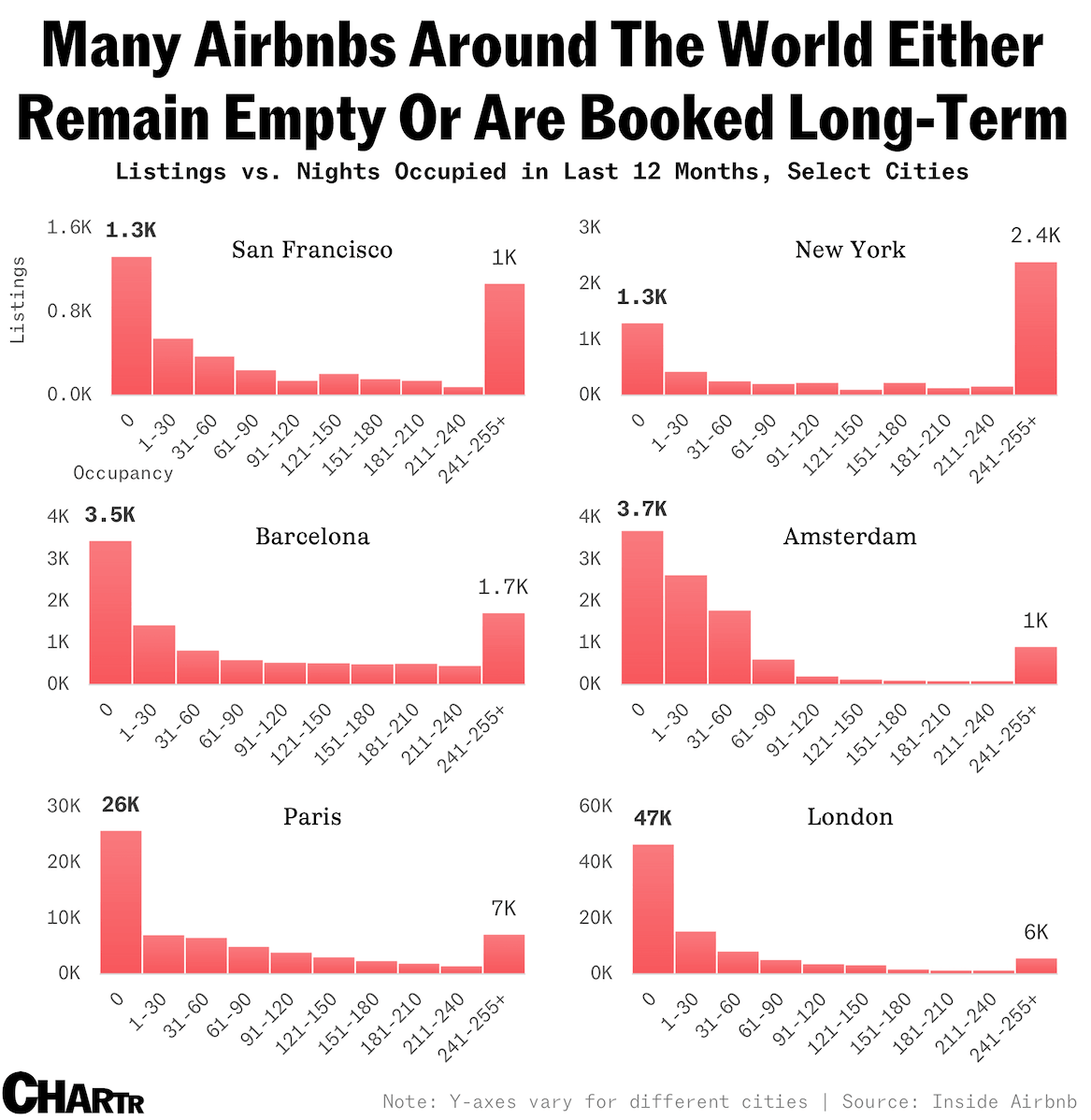
Examining occupancy data from Inside Airbnb across major global cities, a significant portion of listings in each — about half in London (~47K), 40% in Paris (~26K), and 36% in Amsterdam (~3.7K) — were completely unoccupied for the last 12 months at the time of writing.
There’s also a larger proportion of long-term Airbnb rentals in US cities with stricter Airbnb laws, such as San Francisco, where you can only rent out your primary residence, and New York (43% of listings occupied for over 241 nights), where there’s been a near-total ban on short-term private rentals since 2023.
As pressure from local governments like Barcelona’s weighs on the home-rental platform’s key offering, expanding into different business lines could be the best way for Airbnb to keep driving growth. |
|
|
|
The Central Bank Gold Rush? |
Global central banks are continuing to deepen their gold reserves.
Data from a World Gold Council and YouGov survey shows a record 95% of representatives expect global gold reserves to increase over the next year. Such persistent demand indicates long-term structural momentum — yet many retail investors are still using traditional methods to gain exposure.
Versamet (NASDAQ: VMET) utilizes a royalties-based approach, providing capital to mining projects in exchange for a percentage of production. This model allows for a stake in the ownership portion of gold mining, without the direct overheads of operations.
With a portfolio built on $750 million in acquisitions, Versamet offers a diversified gateway to the evolving gold market. |
|
|
|
The Enhanced Games isn’t just about sports — it’s a $31 million product demo |
When the starting gun fires in Las Vegas on May 24, the Enhanced Games will officially launch. More than 40 athletes — nearly all of them openly taking performance-enhancing drugs and supplements — will be taking part in a sporting spectacle posed as a challenge to legacy athletic competitions.
However, the business around Enhanced is no longer just about the event itself. The controversial games effectively serve as a marketing push for Enhanced’s consumer health business, with the company setting a goal to hit 60,000 subscribers by the end of the year. The bet is simple: Enhanced hopes millions of people will watch athletes shatter world records using biohacked treatments that aren’t approved by legacy athletic associations, and maybe want to try some for themselves.
This comes at a time when consumers are increasingly interested in peptides, the injectable supplements associated with the biohacking tech elite. The Food and Drug Administration is poised to ease restrictions on peptides later this year, which is expected to open the door for companies like Enhanced to cash in. Enhanced is currently the only other option for investors looking to ride the peptide wave in the public market.
|
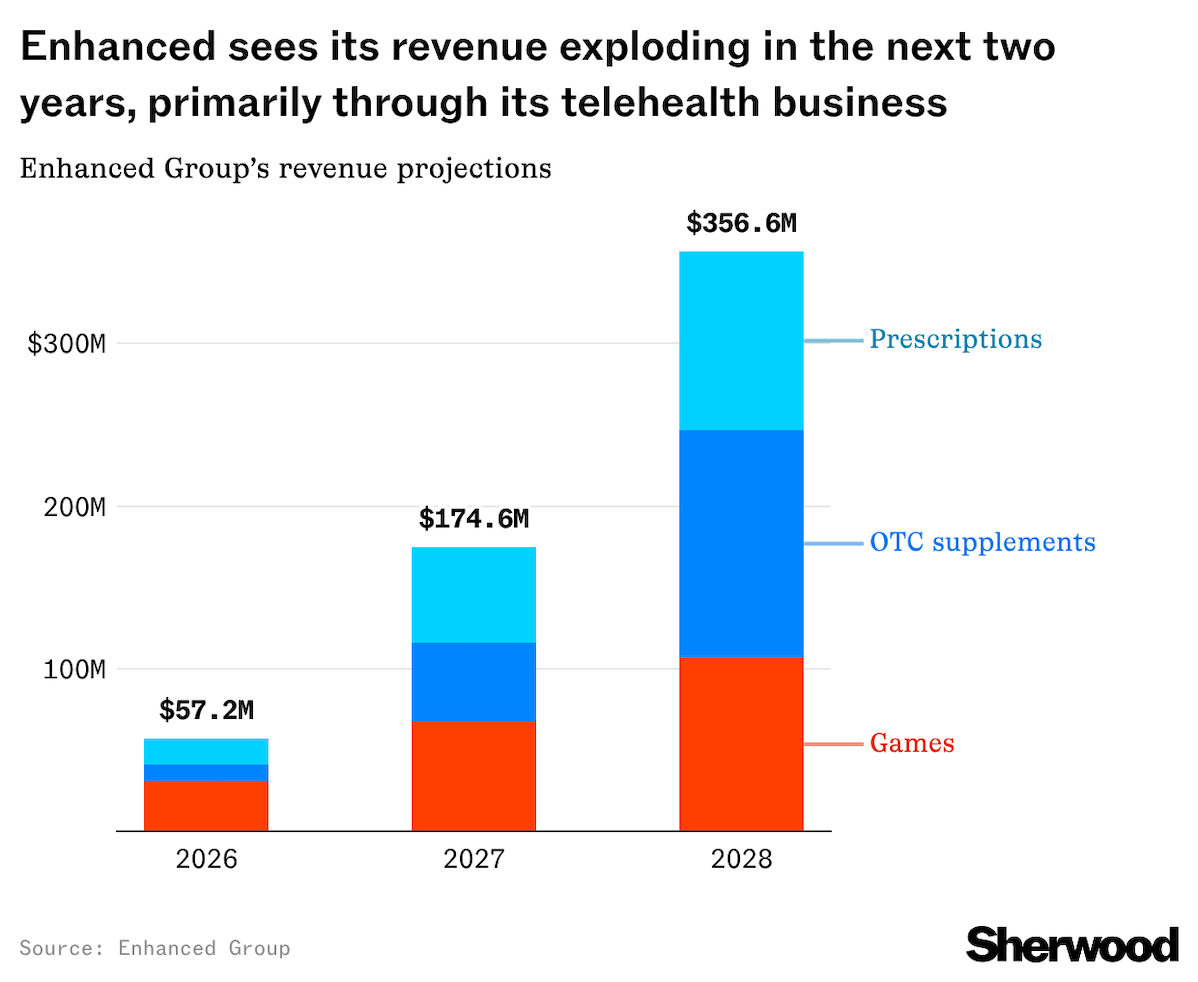
It’s not uncommon for telehealth companies to spend big on marketing. “We have not built a sporting event that needs to break even in year 1,” CEO Maximilian Martin said in an interview with Sherwood. Given the $31 million costs associated with the Games, achieving that financial goal might have been as challenging as some of the events themselves.
Indeed, as it readied for the competition, Enhanced burned $16.4 million in the first quarter of this year alone. It has also given a “going concern” warning, signaling that the company has reason to believe it may not be able to cover its costs within the next year. |
|
|
|
-
Ahead of Memorial Day weekend, Americans are feeling more pain at the pump, with the national average gas price rising to a four-year high of ~$4.56 a gallon.
-
Hit a Wal? While Walmart reported Q1 earnings that largely met analysts’ estimates, some disappointing guidance saw shares of America’s largest retailer sink over 7% on Thursday.
-
The Information just reported that OpenAI’s first-quarter revenue was ~$5.7 billion — roughly $1 billion more than Anthropic’s revenue for the same period.
-
Eli Lilly’s new weight loss drug helped people lose up to 30% of their body weight in a late-stage clinical trial, the drugmaker announced Thursday.
-
Arc de Trump: The US Commission of Fine Arts yesterday approved the president’s plans to build a 250-foot arch in Washington, DC.
|
|
|
|
Traditional mining is a logistical grind, but royalties company Versamet (Nasdaq: VMET) focuses on the long game. With an average mine life of 15 years across the portfolio, Versamet aims for long-term cash flow duration to drive growth and value. |
|
|
|
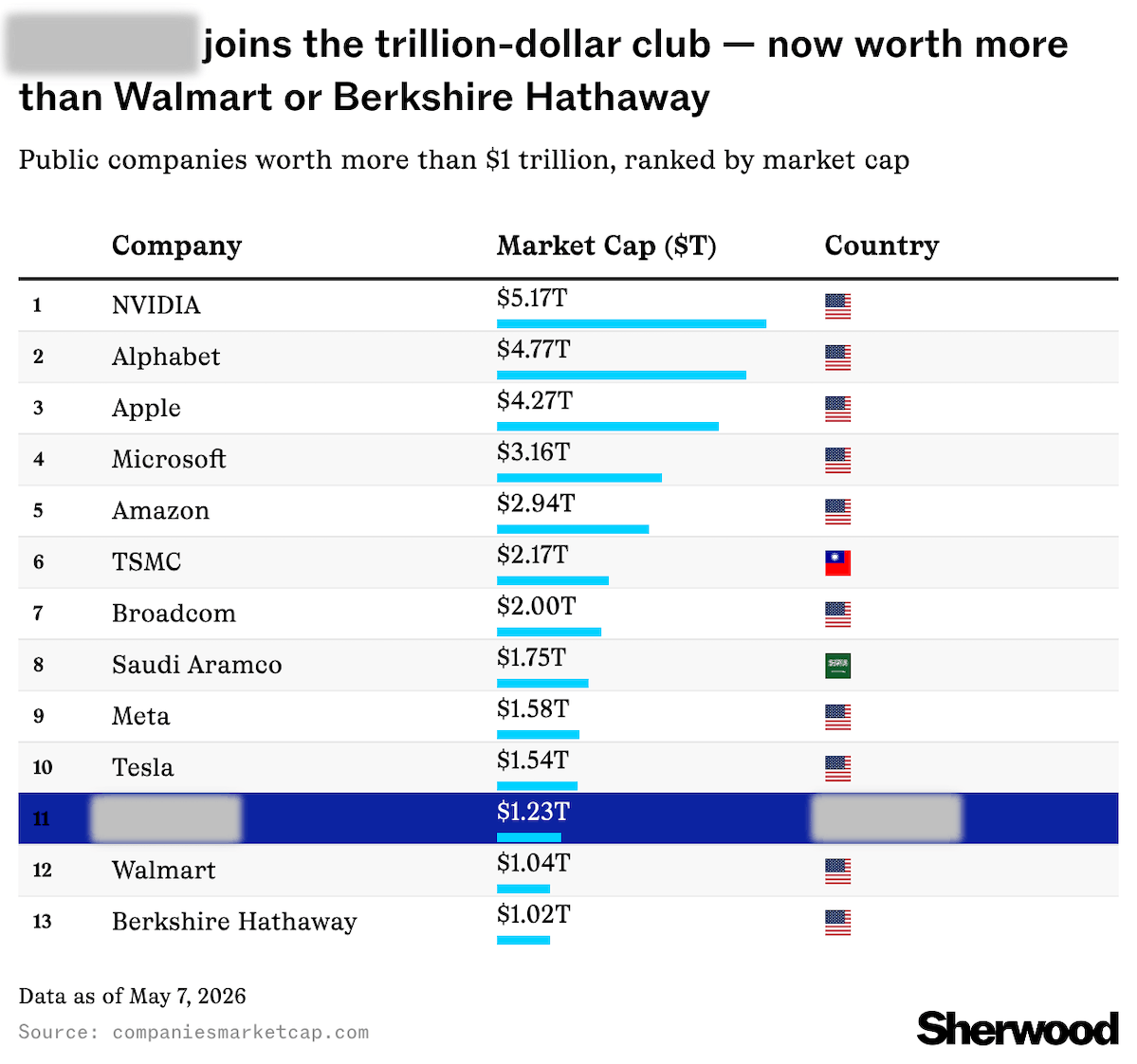
Off the charts: Which company recently crossed $1 trillion in market cap, helping propel its home country up the global stock market ranks? [Answer below]. (Hint: A last-minute union deal sent its shares to a record high yesterday) |
Not a subscriber? Sign up for free below. |
|
|
|
|