|
|
|
|
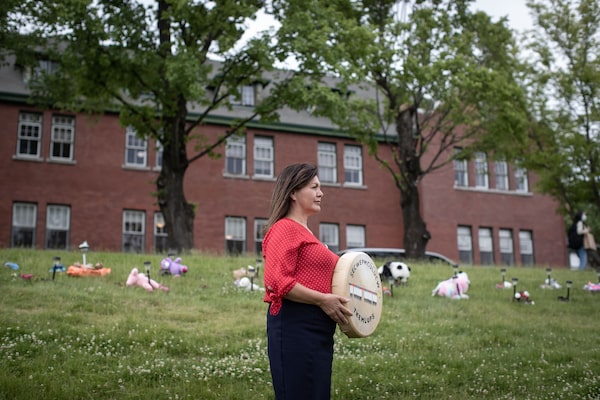
Good morning. Five years ago this week, radar technology located the remains of 215 former residential students. We return to Kamloops, B.C., to learn what has happened since. More on that below, along with news from Congo and Israel. But first: |
|
|
|
|
|
|
|
|
|
|
|
|
|
|
|
|
|
|
|
|
|
The former Kamloops Indian Residential School sits along the South Thompson River in B.C. Alison Boulier/The Globe and Mail
|
|
|
|
|
|
|
|
|
|
|
|
|
|
|
|
|
Boozhoo! I’m Willow Fiddler, the Indigenous Affairs reporter for The Globe. |
|
|
|
|
When the assignment of Tk’emlúps te Secwépemc First Nation came up last spring, I knew it was a story I had to be on the ground for, and it was the first thing I told my editor. |
|
|
|
|
When I arrived in the area in July, I was taken aback by how accessible the grounds were to the public. After all, it had only been four years since the news of 215 unmarked graves
leaked to the world through social media. Tk’emlúps issued a press release, but was ill-prepared to deal with the descending masses of worldwide supporters, denialists and media that would immediately land on the school steps. Tk’emlúps poet and residential school survivor Garry Gottfriedson described it to me as “hell.” |
|
|
|
|
|
|
|
|
As a guest on Tk’emlúps territory, I had already informed the appropriate leadership that I would be there. No response. I wasn’t surprised; it was expected and understandable given the media downpour the previous four years. |
|
|
|
|
In 2021, the news of the unmarked graves had started a period of national grieving. Ottawa established the National Day for Truth and Reconciliation,
and in 2022 Pope Francis apologized to residential school survivors. But the relentless international attention also brought skepticism and denialism. |
|
|
|
|
Now, five years later, the country is still trying to understand what it is they found among the apple trees. Along with my colleague Patrick White, we set out to learn more. |
|
|
|
|
|
|
|
|
|
In 2021, the news of unmarked graves at former residential schools started a period of national grieving. Alison Boulier/The Globe and Mail
|
|
|
|
|
Aside from the fenced-in apple orchard with placards prohibiting entry, the grounds extend from the impressive log powwow arbour structure up to the heritage museum, band office, and finally the historical brick school that is now home to the investigative work of a group called Le Estcwicwéy̓, which translates to The Missing. |
|
|
|
|
I walked the grounds, starting in the powwow arbour, an open-air pavilion usually for community gatherings, where I offered tobacco to the spirits and ancestors that had just danced with the nation in the annual Kamloopa powwow the weekend before. |
|
|
|
|
Making my way up to the museum and heritage park, I wandered over to the adjacent band office where I introduced myself to the receptionist. She took me to meet Kukpi7 Roseanne Casimir, who we happened to run into in the hallway. Casimir kindly referred me to Jeannette Jules, the former councillor and now manager of Le Estcwicwéy̓. |
|
|
|
|
I knew this was going to be a tough assignment because of the media blackout Tk’emlúps leadership had essentially put in place. With the exception of a couple of updates through press releases, it was clear their lips were sealed and any trust of the media was non-existent. For nearly five years, even Casimir had not responded to countless Globe interview requests. |
|
|
|
|
But behind the wall of silence, they were following federal guidance, conducting new searches and laying out a detailed plan to dig the site by 2027 – all on their own terms and timeline. |
|
|
|
|
|
|
|
|
|
Rosanne Casimir stands outside the former Kamloops Indian Residential School after speaking to reporters on June 4, 2021. DARRYL DYCK/The Canadian Press
|
|
|
|
|
It was somewhat shocking to learn how unprepared the Tk’emlúps nation had been and that the initial news of the search was a leak by a community member who posted it on social media without any authorization. But it also helps explain the resistance to media since. |
|
|
|
|
What I hope readers take away from this story is that Tk’emlúps is in charge of its investigation, as it should be. It can’t be up to the government to set any of the timelines when the work is being led by cultural protocols, and nor is it appropriate for the general public to pressure the First Nation. |
|
|
|
|
As Jules explained to me in one of our meetings, the government often imposes unrealistic and unreasonable timelines when it comes to money for First Nations. |
|
|
|
|
This is a process that has to be nation-led by the First Nations involved in finding their missing children. Anything that attempts to disrupt this is not serving the best interests of anyone in the country. |
|
|
|
|
|
|
|
|
|
|
|
|
|
|
|
|
‘It’s a tempest in a sap pot.’ |
|
|
|
|
|
|
|
|
|
Plessisville Mayor Marc Morin at the sugar shack of Pierre Fortier, a fifth-generation owner of a family-run sugar shack near the city. Renaud Philippe/The Globe and Mail
|
|
|
|
|
|
|