| | In this edition, making sense of Musk’s interplanetary manifesto, and it might be time we change the͏ ͏ ͏ ͏ ͏ ͏ |
| |  | Business |  |
| |
|
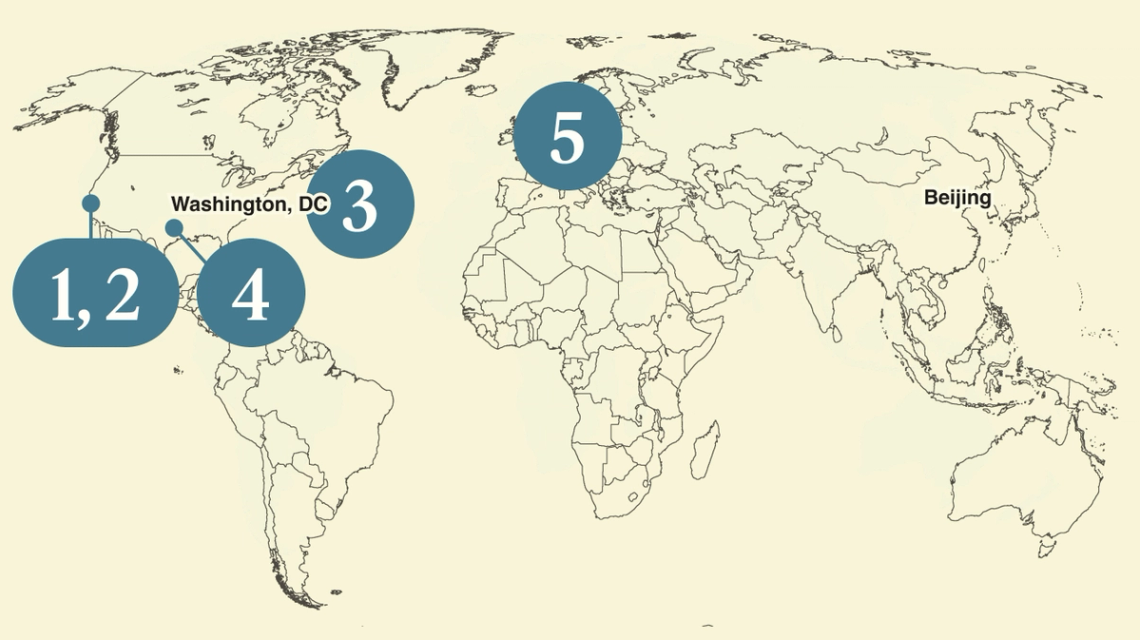 - Musk’s multiplanetary manifesto
- Bezos turns on philanthropy
- Monitoring the AI situation
- Frackers change their tune
- Novo’s patent play
|
|
 We need to talk about how we talk about AI. You’ve seen the videos of college commencement speakers including former Google CEO Eric Schmidt getting booed for hyping AI. Students understand how AI will rip through the knowledge economy better than most of us — they’ve been using it to write term papers for years — and they have every reason to hate and fear it. (My colleague Reed Albergotti’s advice for graduation speakers: Nobody has ever been booed for mentioning dogs or the importance of sunscreen.) The capital class needs a new vocabulary, too. Their current one is at turns rosy and robotic, maddeningly passive, and tin-eared. Shopify’s CEO said the company’s AI-caused hiring freeze is leading to “really fun discussions.” Jamie Dimon’s advice to people whose formative social years were spent glued to screens during the pandemic: “Learn EQ.” Terrified people just starting their careers are being told to be more curious, more adaptable, and better in meetings. They’ve never been invited to one! Standard Chartered’s CEO, announcing the phaseout of 7,800 jobs by 2030, talked about replacing “lower-value human capital,” then said his comments were taken out of context. They weren’t; they were just said in a different context — an event for shareholders. AI messaging sounds different for investors, who want profits, than for employees, who are a cost. A better script goes something like this: Most of us are going to use this technology to do the same amount of business with fewer people and fatter margins, because that’s what our shareholders pay us to do. If we stumble into new businesses along the way, great; we’ll hire people to grow those. But most of us run incumbent companies with bad track records of incubating startups, so that probably won’t happen. Try Silicon Valley — they’re good at launching new things. Oh wait, they’re firing people faster than we are. We are not in a great position to retrain our existing workers, and even if we were, AI is widening the skills gap faster than we can retrain people. New jobs will get created, but they will mostly not go to the people who lost the old ones. We don’t have a plan for that. Try the government. Few politicians have better answers. “If we simply do a traditional government training program, we’re going to screw it up,” Democratic Sen. Mark Warner said last month at Semafor World Economy. “Boy, oh, boy.” Vice President JD Vance’s promise that AI will make us “more productive, more prosperous, and more free” echoes what globalization enthusiasts said in the 1990s. It took two decades for those promises to ring hollow to broad swaths of Americans, who revolted in a populist backlash. It will happen faster this time. “AI will be the number one issue of the 2028 election,” said Christopher McKelvy, co-founder of VC firm K. Ventures (and a member of the Kennedy clan). “We have to make the case for how this technology will improve the day-to-day life of the average American family. Until we do that, we shouldn’t expect anyone to vote for it.” The Class of 2026, and the parents who footed the bill for their education, will be a constituency for somebody. When the pitchforks come out, they won’t stop with the politicians. |
|
Musk’s interplanetary manifesto |
The IPO prospectus SpaceX dropped last night revealed how much the world’s largest public offering is underpinned by a founder firmly in control. Elon Musk, who previously complained he didn’t have a big enough say in Tesla, will control 85% of the vote at SpaceX through special shares (and will get another billion shares if SpaceX puts a million-person colony on Mars). The filing raised speculation that after SpaceX goes public, a purchase of Tesla isn’t far off. 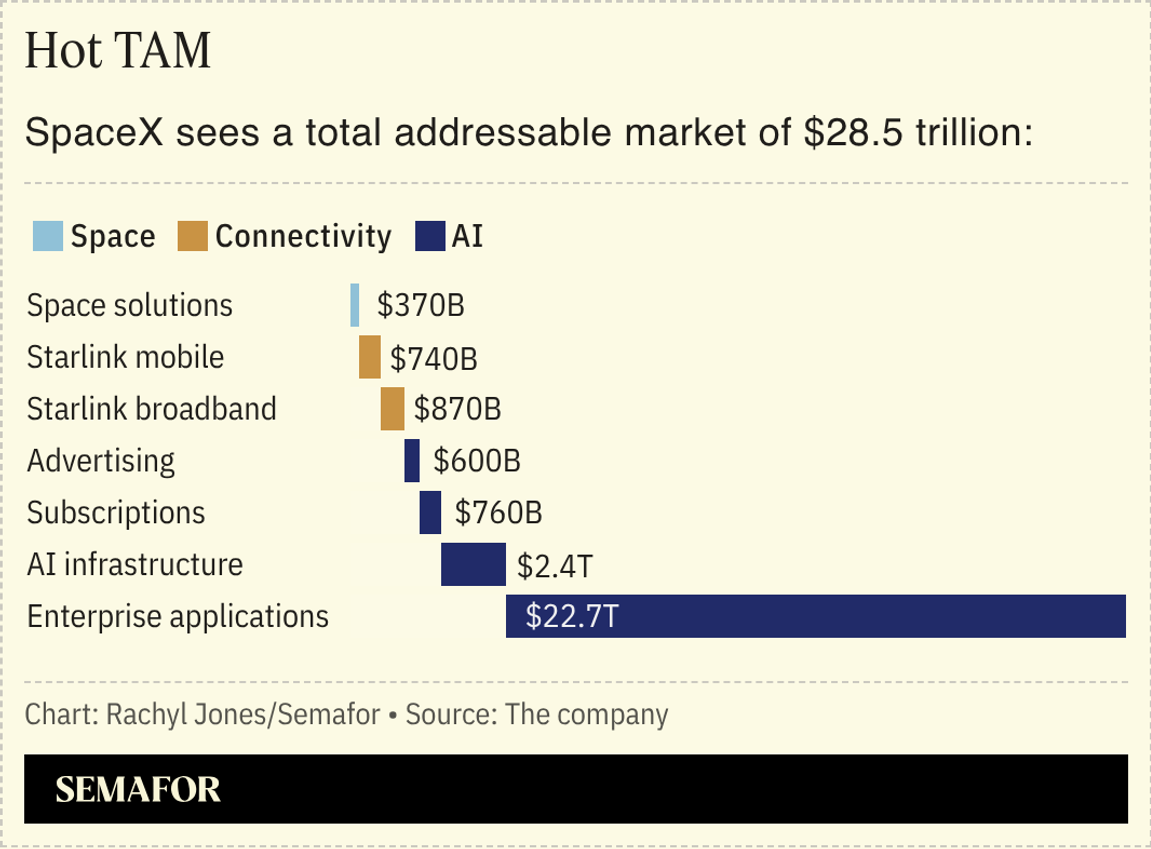 Here’s what else stuck out to us from the filing: Starlink makes all the money. The satellite arm’s adjusted profits of $7.1 billion last year were more than what the whole company netted ($6.6 billion). The AI arm, which includes X and Grok, lost $1.2 billion. 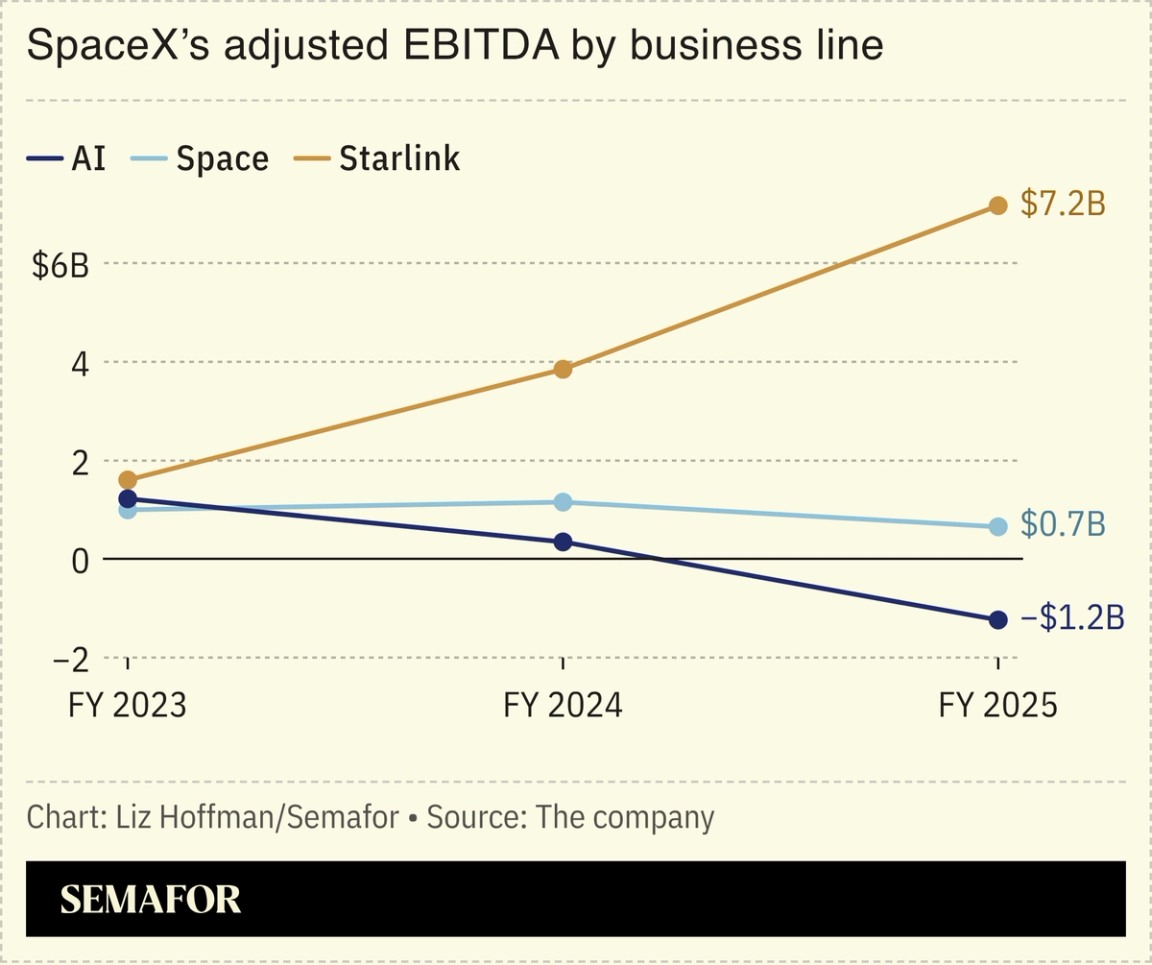 One very important customer. The US government accounts for a fifth of SpaceX’s revenue, which could get sticky: SpaceX warned investors it might prioritize its own “orbital compute goals” (read: flinging data centers into space) over new government work, which might “impact our relationship with regulators” and invite lawsuits. One very interesting customer. Anthropic, whose AI models compete directly with SpaceX’s, has agreed to pay SpaceX $1.25 billion per month over the next three years for compute capacity at its Colossus data center in Tennessee. AI companies are both rivals and revenue sources for each other, and compute is hard to come by. Brands did bail on X after Musk bought it. The social-media platform’s ad revenue fell by $595 million in 2024. Some advertisers returned, but subscription revenue on X has grown faster than ads. It’s serious about cellphones. SpaceX thinks Starlink Mobile could be a $740 billion business, connecting its satellites directly to cellphones to fill patchy spots in the networks of companies like AT&T and Verizon. The company bought $20 billion of spectrum last year, raising speculation — fueled by support from the Trump administration’s telecom regulator — that Musk might launch a direct competitor. Bankers be banking. The primary positioning of Goldman Sachs as the first listed underwriter set eyebrows higher across Wall Street, where Morgan Stanley has long been the bank closest to Musk. One possible explanation: Goldman led a $20 billion loan to SpaceX in March, a huge check from a firm not historically known for writing them. (David Solomon himself also slid into Musk’s DMs.) |
|
The end of billionaire virtue signaling? |
 Remo Casilli/Reuters Remo Casilli/ReutersSteel tycoon Andrew Carnegie, in The Gospel of Wealth, called it a disgrace to die rich. The robber barons were ruthless, but they also endowed universities, charities, and civic institutions that endure today. How will tech billionaires of the AI age be remembered? Jeff Bezos used his CNBC interview yesterday to pan philanthropy, arguing that “the value to society and civilization from my for-profit companies will be much, much larger than the good that I do with my charitable giving.” It marked a tone shift from previous pledges to give away the “majority” of his fortune. Musk quickly agreed, sharpening questions about how today’s superrich plan to leave their mark. “There’s more skepticism today towards philanthropy,” billionaire and ROI-minded philanthropist John Arnold said on a recent episode of Semafor’s Compound Interest. “I think some of it’s merited… the feedback loop is so much longer, if it exists at all, than you see in the business world.” Mark Cuban told Semafor of his fellow billionaires: “They think they’re saving the world” with their own “laissez-faire approach.” AI is minting a new generation of billionaires, and what they do with that wealth will have huge consequences. Stripe executive Nan Ransohoff, in a new essay this week, is betting on a third wave of American philanthropy, but one that looks more like the 19th century industrial fortunes given away than the metrics-heavy charitable giving of tech moguls like Bill Gates, which wasn’t “designed for questions of civilizational flourishing, meaning, and what makes a good life,” she said. “Squishier instruments like taste” will dominate. |
|
A closer eye on frontier AI models |
 Jonathan Ernst/Reuters Jonathan Ernst/ReutersPresident Donald Trump was expected to sign an executive order as soon as today that would ask AI companies to share new models with the US government before releasing them to the public. The White House postponed the signing on Thursday, Axios reported, but it had already briefed firms including OpenAI and Anthropic on the order’s contours, people familiar with the briefings told Semafor, and had planned to host CEOs for an event marking its release. The briefings outlined an order that stopped short of requiring the AI labs to give the government a first look, the people said, following the release last month of Anthropic’s powerful Mythos model that set off cybersecurity alarm bells. But it’s a recognition that frontier models could pose a systemic risk to national security and the economy (the Treasury Department could be involved in the review, Politico reported). It’s also another example of the Trump administration reaching deeper into private enterprise. On Thursday, it said it was taking more equity stakes in tech companies, including IBM, in a bid to boost the quantum-computing industry. |
|
US frackers join the fray |
 Manon Cruz/Reuters Manon Cruz/ReutersAfter resisting Trump’s calls to drill more oil, US producers are changing their tune. When Semafor’s Tim McDonnell talked to Kaes Van’t Hof, CEO of Texas independent producer Diamondback Energy, only a month ago, he was circumspect about adding rigs to rescue a global economy reeling from the loss of barrels from the Gulf. Oil markets were still predicting a quick reopening of the Strait of Hormuz, making it hard to justify the cost and raising the risk of being overextended when prices inevitably fell. Oil CEOs have been on this roller coaster long enough — and gotten an earful from enough shareholders — to be more conservative, now. “Operators are starting to get more comfortable that more barrels are needed in this market,” Van’t Hof told Tim yesterday, adding that Diamondback is bumping up its capex budget and raising its annual production target by about 3%. |
|
Novo’s curious patent lapse |
 Hollie Adams/File Photo/Reuters Hollie Adams/File Photo/ReutersGeneric versions of Ozempic went on sale this week in Canada — somehow the world’s second-largest GLP-1 market — raising questions about whether Novo Nordisk’s failure to renew its Canadian patent and prevent the entry of generic companies into the country was a bit of cunning corporate strategy or an expensive oversight. Novo and Eli Lilly have already faced stiff competition from smaller “compounders” of weight-loss drugs. But entry from generics, which can be manufactured on a larger scale than drugs mixed in smaller pharmacies, will test whether the GLP-1 leaders can protect their name-brand goods and whether consumers and insurers will pay up for them. Correspondence reviewed by Science magazine suggests that Novo failed to pay a $250 filing fee in Canada that would have extended its patent, which the CEO of one generic manufacturer called an “epic paperwork screwup.” Others pointed out that letting the patent lapse avoids statutory price caps on patented drugs. A Novo spokesperson told Semafor that the company’s “intellectual property decisions are carefully considered at the global level,” but declined to comment further. Novo still maintains a powerful patent in the US, by far the world’s largest market for obesity drugs. Big pharma companies might reasonably bet that their name brands will win out. AbbVie’s sales of Humira have fallen by two-thirds since a generic version hit the market in 2023, but the company still sold $4.5 billion worth of the drug last year. — Rohan Goswami |
|
 On Wednesday, June 10, Semafor Tech will convene in San Francisco to explore the breakthroughs pushing technology into a new phase of economic and geopolitical consequence, from quantum computing and fusion energy to humanoid robotics. The challenge extends beyond tracking innovation to understanding its downstream effects across industries, institutions, and power structures. Semafor Tech Editor Reed Albergotti will host on-the-record conversations with Jeetu Patel, President & Chief Product Officer, Cisco; Aaron Levie, Co-Founder & CEO, Box; Charina Chou, Chief Operating Officer, Google Quantum AI; Max Hodak, Co-Founder & CEO, Science Corporation; and Pete Shadbolt, Co-Founder & Chief Scientific Officer, PsiQuantum, as they explore how breakthrough technologies are reshaping industries, redefining competitive advantage, and transforming the global economy. June 10 | San Francisco | Request Invite |
|
|