| | Oil prices jumped to around $100 a barrel after Iran’s president said his country would not be cowed͏ ͏ ͏ ͏ ͏ ͏ |
| |  | Energy |  |
| |
|
 - Running out of tools
- EVs accelerate
- Republicans split on ethanol
- Record renewables
- Fuel crisis fuels protests
 Putin leaves Beijing without a gas pipeline breakthrough, while the US resumes LNG shipments to China. |
|
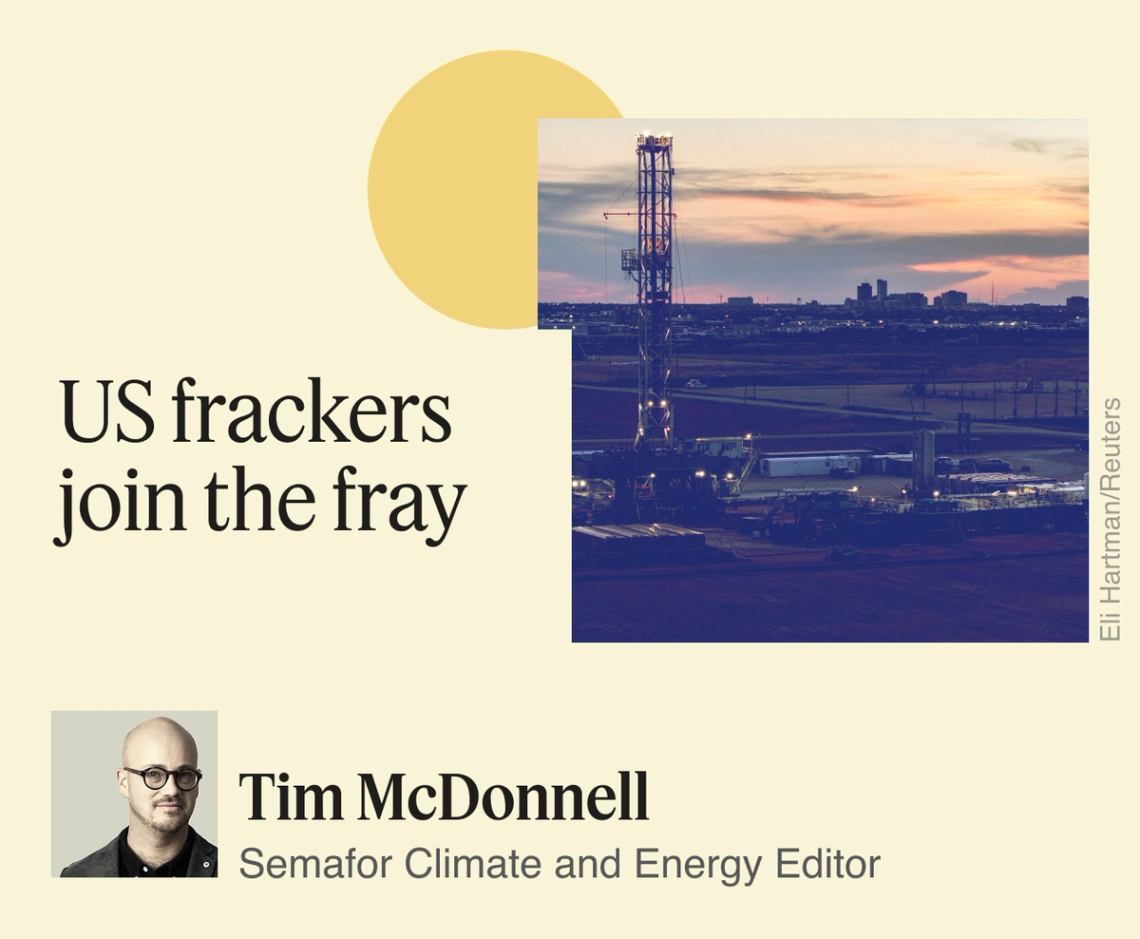 US oil companies are finally ready to listen to the siren song brought on by the war in Iran — a sign consumers shouldn’t hold their breath for lower prices soon. When I talked to Kaes Van’t Hof, CEO of Texas independent producer Diamondback Energy, only a month ago, he was circumspect about responding to US President Donald Trump’s call for companies like his to drill their way to the rescue of a global economy reeling from the loss of barrels from the Gulf. The trouble then, he said, was that oil futures prices for later this year still pointed to a relatively quick reopening of the Strait of Hormuz, making it hard for him to justify the capex needed to add rigs. That view was widely shared across the industry. But now the tune is changing. “Operators are starting to get more comfortable that more barrels are needed in this market,” Van’t Hof told me yesterday, adding that Diamondback is bumping up its capex budget and raising its annual production target by about 3%. During price spikes like these — the US benchmark price is nearly 30% above where it was pre-war — oil execs have to walk a fine line. If they sit on their hands, they risk leaving profit on the table. But if they scramble to mobilize workers and equipment every time the price ticks up, they risk being overextended when it inevitably ticks back down. They’ve all been on this roller coaster long enough, and gotten an earful from enough shareholders, to usually be pretty conservative. The biggest companies, like Exxon and Chevron, are especially cautious about rushing to bring new wells online, in part because they have the efficiencies of scale to be plenty profitable even at lower prices. And so far, they’re continuing to stick to their pre-war production targets. But smaller companies that have more to gain or lose are hitting the accelerator. “There’s a bit of hurrying happening now,” Matt Johnson, CEO of the oil industry data provider Primary Vision, told me. |
|
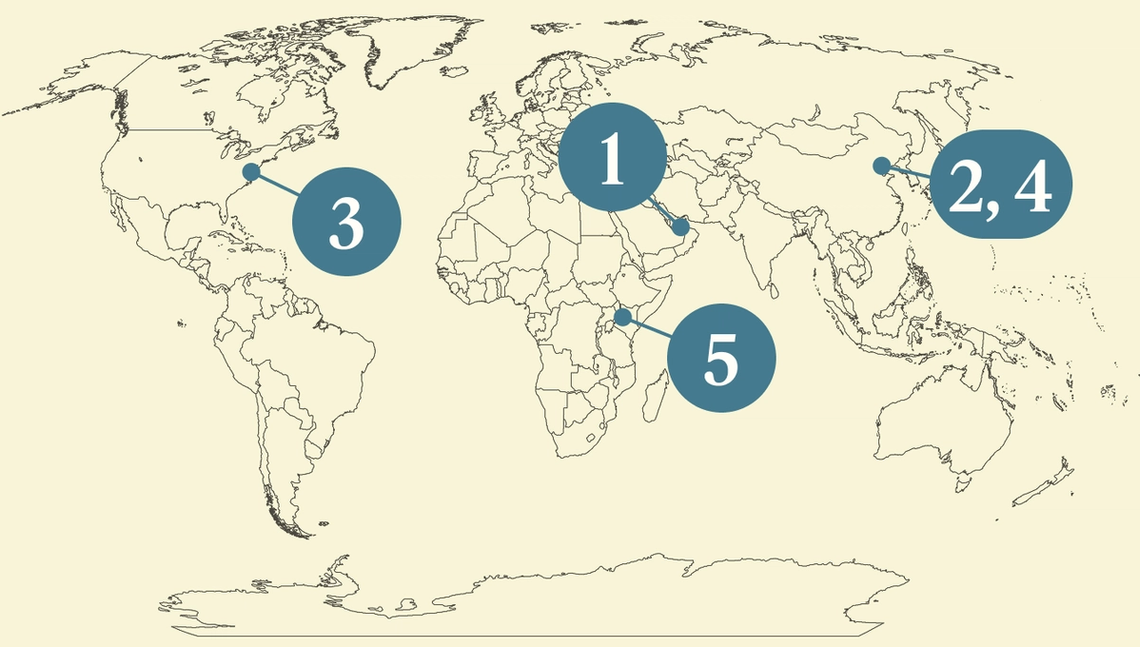
 Stringer/Reuters Stringer/ReutersOil prices jumped to around $100 a barrel after Iran’s president said his country would not be cowed into surrendering. Three supertankers — two headed to China, and another headed to South Korea — managed to pass the Strait of Hormuz on Wednesday, the largest single-day volume of oil to move through the chokepoint since the war began. But as Tehran reviews Washington’s latest proposal to end the war, Masoud Pezeshkian said it was a “delusion” that Iran would be forced into submission. The two sides remain far apart on many critical issues, especially whether hostilities can end and the strait fully reopen only after Tehran agrees to concessions on its nuclear program, as DC is seeking, or if a ceasefire must happen before nuclear talks can commence in earnest, which is Tehran’s position. Until the sequencing issue is resolved, oil markets will remain tight. Average gasoline prices are now above $4 per gallon in all 50 US states, and as former White House energy advisor Amos Hochstein wrote in the Financial Times Wednesday, “the toolkit that worked before [to bring prices down] is largely spent.” |
|
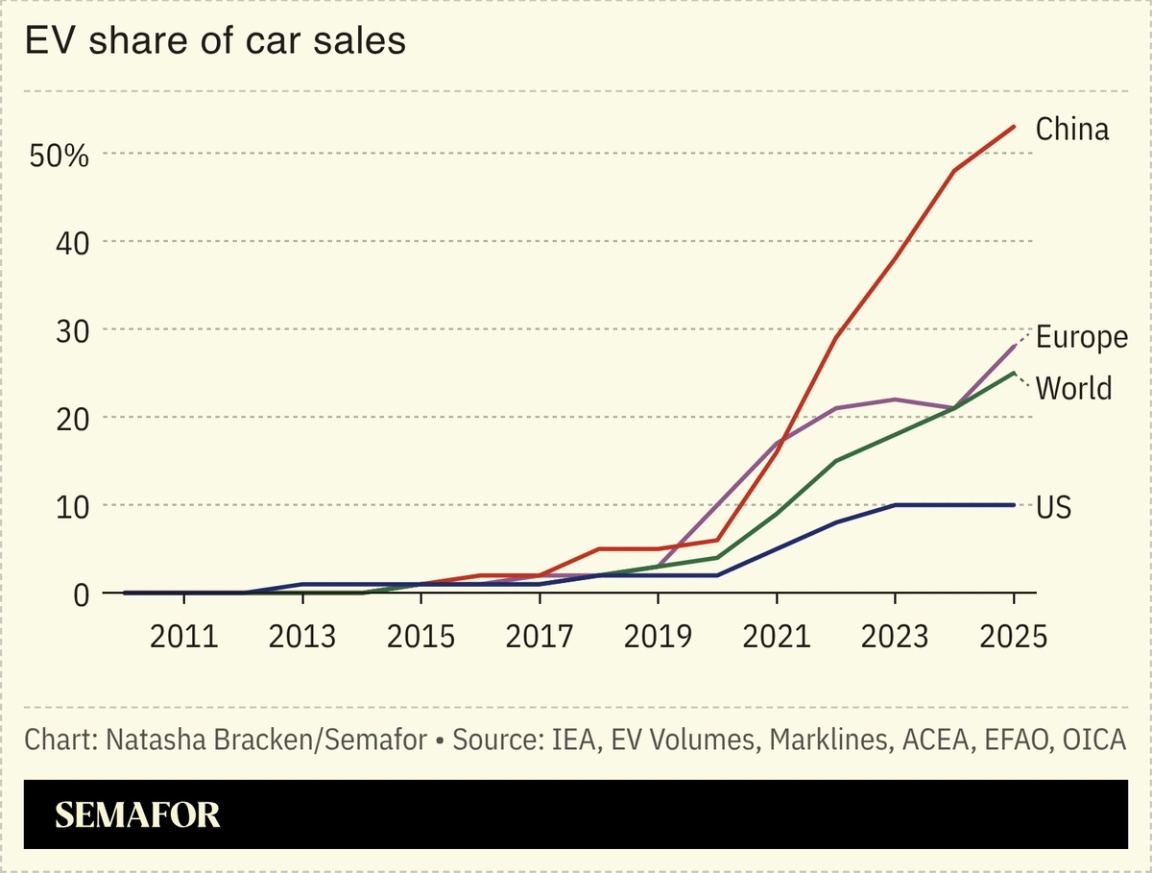 EV sales are soaring on the back of the Iran war and ever-falling battery prices. In a new report, the International Energy Agency forecast that nearly 30% of cars sold globally this year would be electric or plug-in hybrid. That’s despite an 8% drop in global EV sales in the first quarter, largely due to policy changes in China, by far the biggest market, and the US. Beijing still accounted for nearly three-quarters of electric cars produced globally in 2025, and supplied much of the world with its EV exports doubling to a new record high. In the US, where the expiration of EV tax credits seemed to have hit the domestic market harder, first-quarter EV sales remained flat from the previous quarter, and dropped 23% from a year ago, Rhodium Group’s Clean Investment Monitor found. Much of the rest of the world is still seeing significant growth: European sales of EVs and plug-in hybrids are expected to account for one in three cars sold in 2026; while sales across Asia-Pacific (excluding China) and Latin America are projected to rise by more than 50% and 45%, respectively. |
|
Republicans split on ethanol |
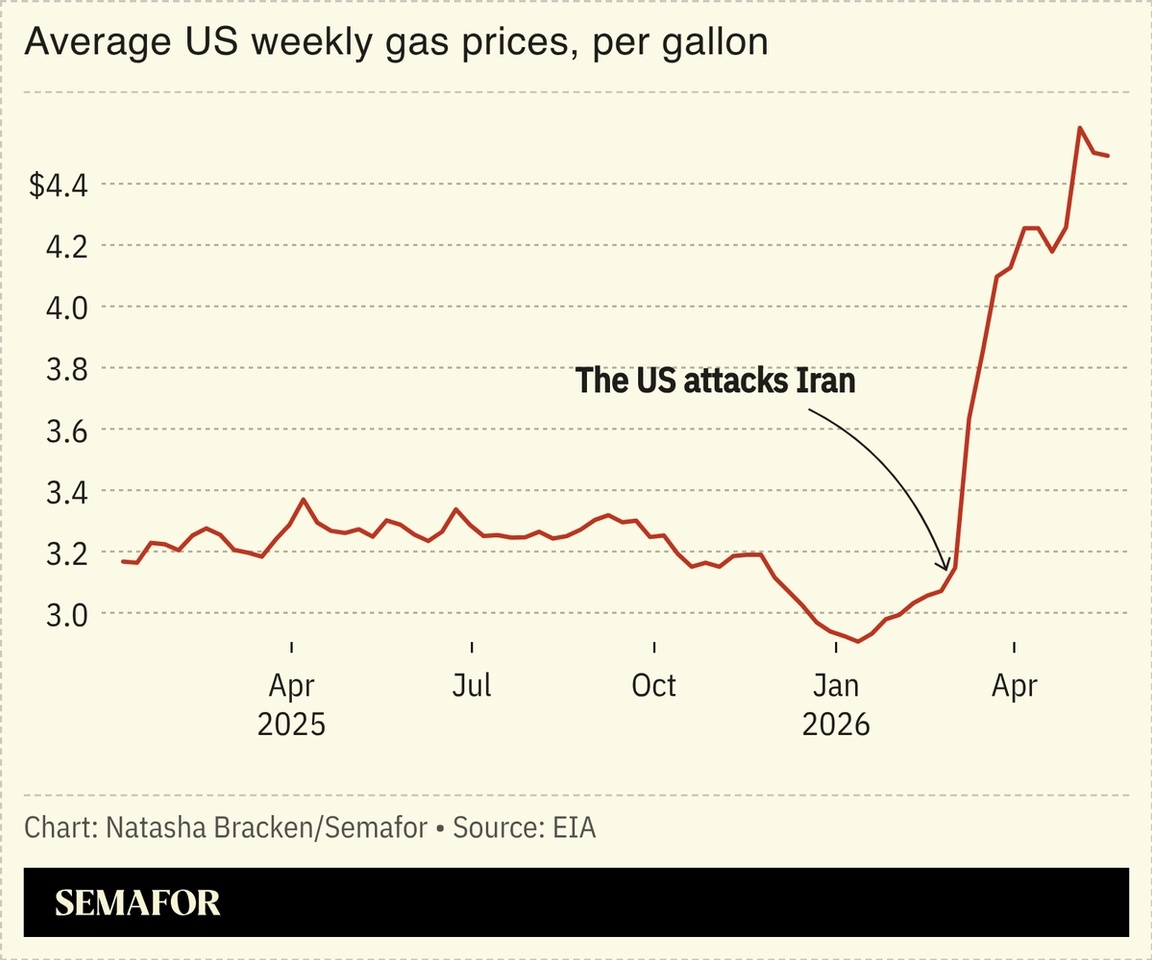 High US gasoline prices are increasing pressure on the Senate to pass legislation allowing a greater share of corn-based ethanol into the national fuel mix. Last week the House of Representatives passed a bill that would permit the year-round sale of E15, in which conventional gasoline is mixed with a 15% blend of ethanol (usually E15 is banned during summer months over concerns that it contributes to smog). It’s a rare issue that deeply divides Congressional Republicans, between supporters from corn-producing states and opponents representing states that either produce oil or host small refineries that can see their margins hurt by higher biofuel blends. On Wednesday, Majority Leader John Thune (R-S.D.), an E15 proponent, told reporters he’s “hopeful and confident that in the end we’ll be able to succeed” in passing an E15 bill, which he said would help lower gasoline prices. But Thune’s number two, Sen. John Barrasso (R-Wyo.) was adamant last week that he’s still against it. “It’s unlikely the Senate will take up this bill as a standalone vote like the House did — there’s too much opposition,” Drew Monroe, an analyst at the consulting firm Capstone, told Semafor. “It would need to be attached to a must-pass legislative vehicle; the government funding bills ahead of the Sept. 30 deadline are a potential path forward.” |
|
 More than a fifth of global electricity was generated by wind and solar in April, beating out natural gas for the first time. The jump is part of a long-term trend that is being accelerated by the war in Iran, research firm Ember reported, adding that April is often a strong month for renewables thanks to strong seasonal winds and sunny conditions in the Northern Hemisphere. But outside the power sector, coal is poised for an emissions-heavy resurgence, Bloomberg’s Javier Blas warned, driven by petrochemical factories in India and China. |
|
Fuel crisis fuels protests |
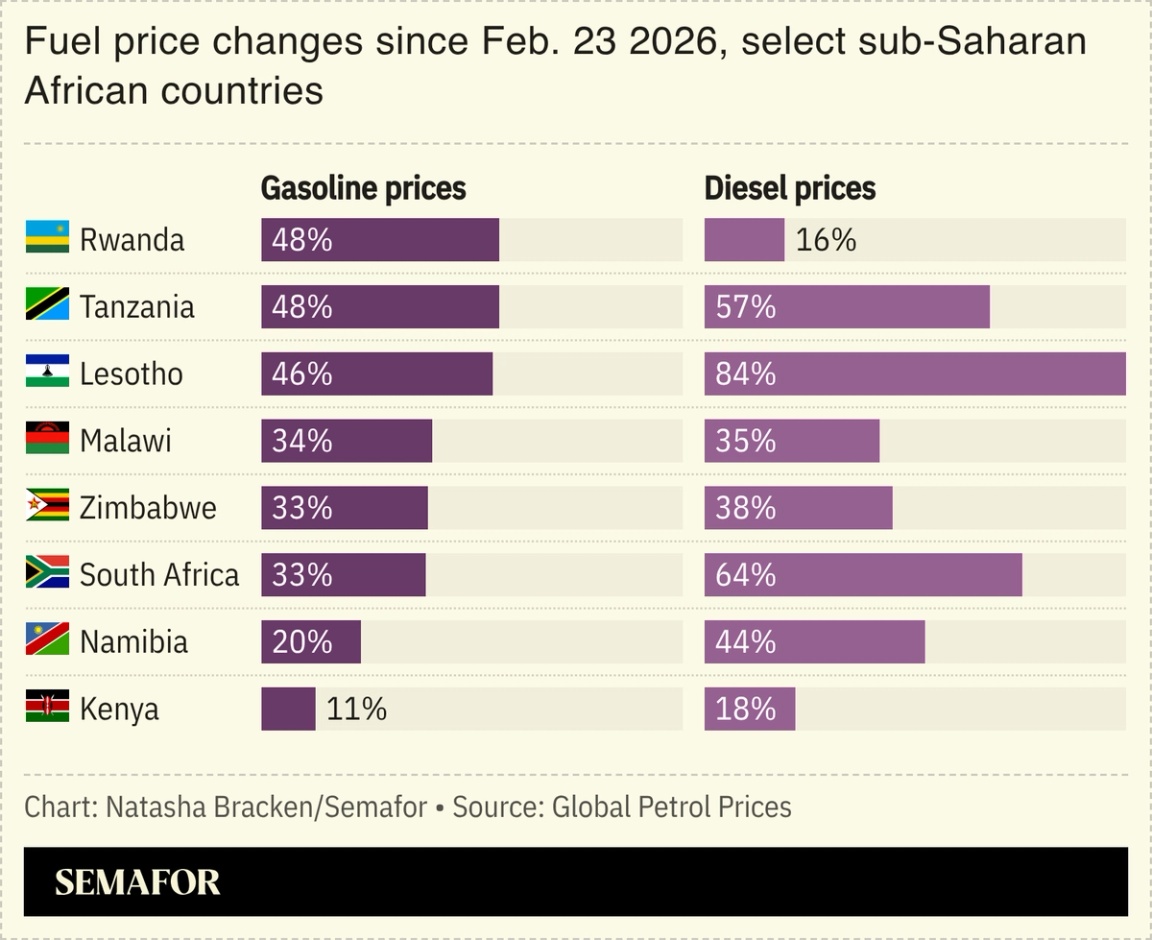 The fallout from the Iran war is deepening across Africa, as countries reliant on Middle Eastern fuel imports scramble to secure energy supplies and contain the impact of rising costs. Many African countries were relatively shielded from the continent-wide surge in energy prices thanks to government fuel subsidies. Increasingly strained budgets, however, have forced some to pass a portion of that burden onto consumers. In Kenya, price hikes triggered deadly protests, and ultimately pushed the government to reverse its decision, but the unrest proved to be the first visible signs of what could happen elsewhere should price hikes persist on the oil-dependent continent, one analyst told Bloomberg. It follows a similar move by Comoros, which suspended fuel price rises over the weekend following demonstrations. |
|
 New Energy- US corporations are set to buy clean energy this year at a record pace, largely driven by the AI boom and expiring tax credits.
- US energy storage capacity rose 32% to hit a new record high this quarter, despite worries that the Trump administration’s actions could slow clean energy development in the country.
 China Daily via Reuters China Daily via Reuters- Chinese solar exports to countries in Africa and Southeast Asia climbed year-on-year in April, despite worries that an anticipated price hike would dampen exports.
Fossil Fuels- Four LNG vessels left the US to sail to China, according to LSEG, the first to do so since President Donald Trump’s second term.
- The UK eased sanctions on Russian oil and gas, including one that banned purchases of jet fuel and diesel refined from Russian crude in a third country.
- Recent Ukrainian strikes, however, have forced all major oil refineries in central Russia to halt or scale back fuel output, Reuters reported.
- US crude inventories dropped to their lowest levels in almost a year, as Washington significantly ramped up oil exports to partly offset the global supply shock from the war in Iran.
- Saudi Arabia’s oil exports revenue rose to a more than three-year high, as higher energy prices and the country’s ability to divert fossil fuel shipments through the Red Sea cushioned the impact of the closure of the Strait of Hormuz.
Politics & Policy- US gas exporters are asking Europe to push back the enforcement of a new methane emissions law until 2028, warning the law could risk long-term contracts with European customers.
EVs- A US bipartisan bill introduced this week may require EVs and plug-in-hybrids to pay an annual fee of $130 and $35, respectively, to cover their share of the cost to repair roads.
- The BYD Shenzhen docked at Lázaro Cárdenas in Mexico on Dec. 21, arriving just before the Jan. 1 tariff deadline and saving the company millions in duties.
|
|
Anne-Sophie Corbeau, global research scholar at Columbia University’s Center on Global Energy Policy. 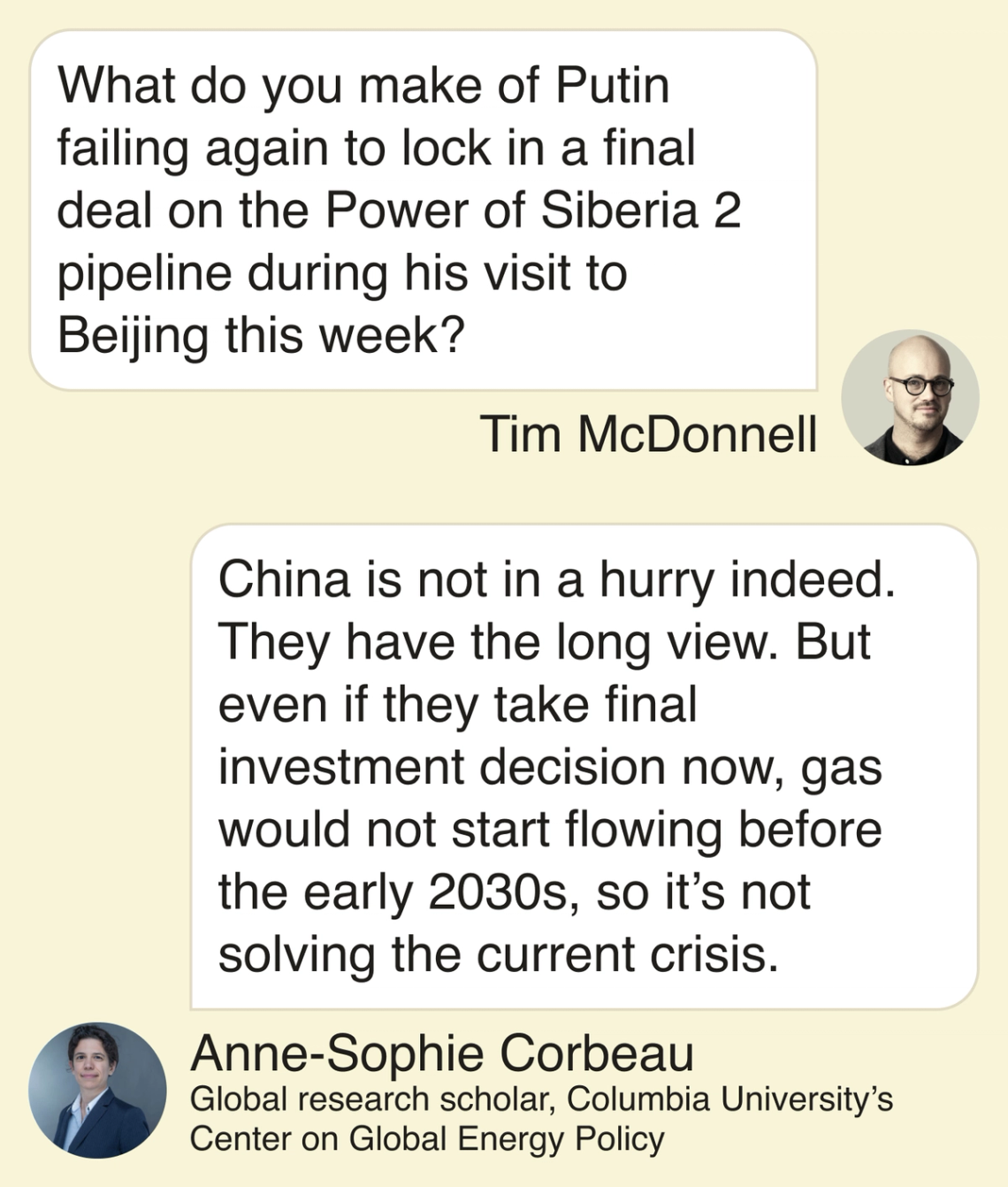 |
|
|


