Can’t stop, won’t (Game)Stop: Ryan Cohen is not taking “no” for an answer. After eBay rebuffed GameStop’s $55.5 billion unsolicited offer last week, a 13D filing on Tuesday showed that the video game and collectibles retailer increased its stake in eBay to 6.65% from 5% via options. In an interview with ProCap’s Anthony Pompliano last week, Cohen said, “I want the business,” and that “we’re going to do whatever we obviously need to do in order to bring this proposal in front of the true owners of the business.” And now it seems the game is afoot!
Stocks climbed broadly on Wednesday as a pullback in Treasury yields lifted sentiment. |
|
|
|
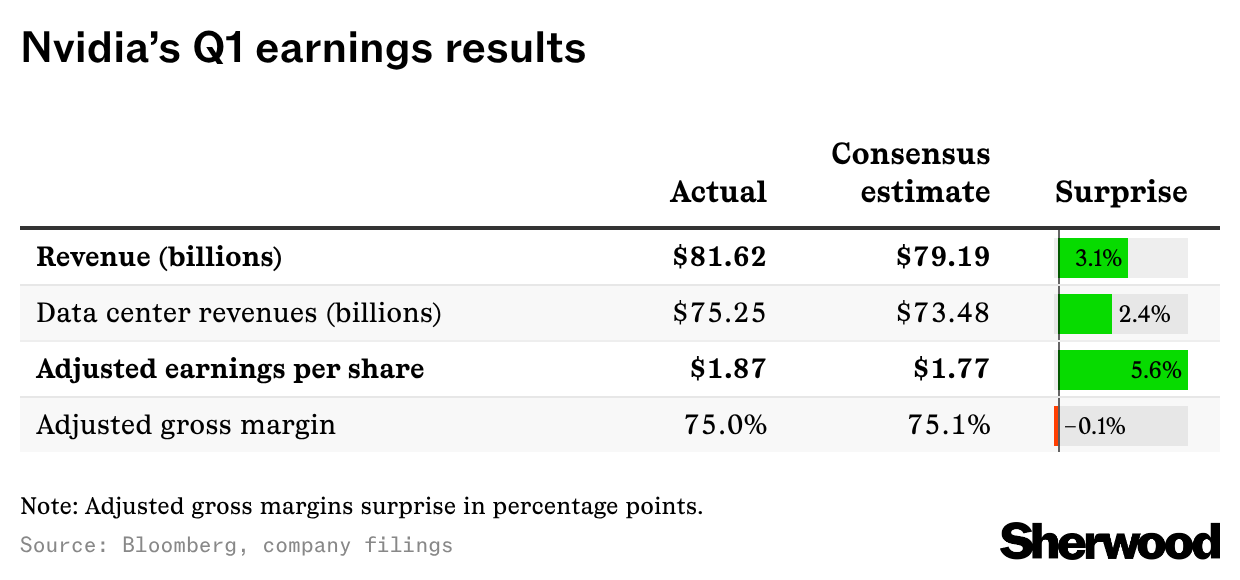
Nvidia did it. Again. The world’s most valuable company reported better-than-expected Q1 results along with strong sales guidance for Q2 after the bell on Wednesday.
Results for its fiscal Q1 2027 exceeded estimates across the board, the chip designer’s 15th consecutive top-line beat and 14th straight quarter in which the company posted better-than-expected adjusted earnings per share. Management also boosted its buyback authorization by $80 billion and raised the quarterly dividend to $0.25 from $0.01. As usual, the postmarket action whipsawed as investors digested the results and dialed in for CEO Jensen Huang’s remarks.
|
-
During the conference call, analysts listened for potential upside to Huang’s March announcement that sales of Blackwell and Rubin chips (as well as associated networking equipment) would top $1 trillion through 2027.
-
In particular, the outlook for its Vera CPUs as well as for products developed with Groq’s capabilities was in focus as potential fresh avenues for even more growth. Both address parts of the supply chain that are seemingly facing more constraints than GPUs — CPUs thanks to the particular compute requirements of AI agents, and memory as widening context windows reduce the speed of models and increase token usage.
-
In recent quarters, Nvidia has enjoyed an initial pop following earnings only to see that fizzle out thereafter — sometimes because of what Huang has said, and other times for seemingly no reason whatsoever.
|
|
|
|
Nvidia, the First Big Thing in the AI boom, was the second-best performer in the Magnificent 7 in 2026 heading into this report, up about 20%. However, it’s more of a laggard (and a dullard) relative to its semiconductor peers, as traders have been more aggressively bidding up companies tied to memory, networking, and CPUs that are benefiting from AI-induced shortages.
|
|
|
|
The Gold Play Most Investors Miss |
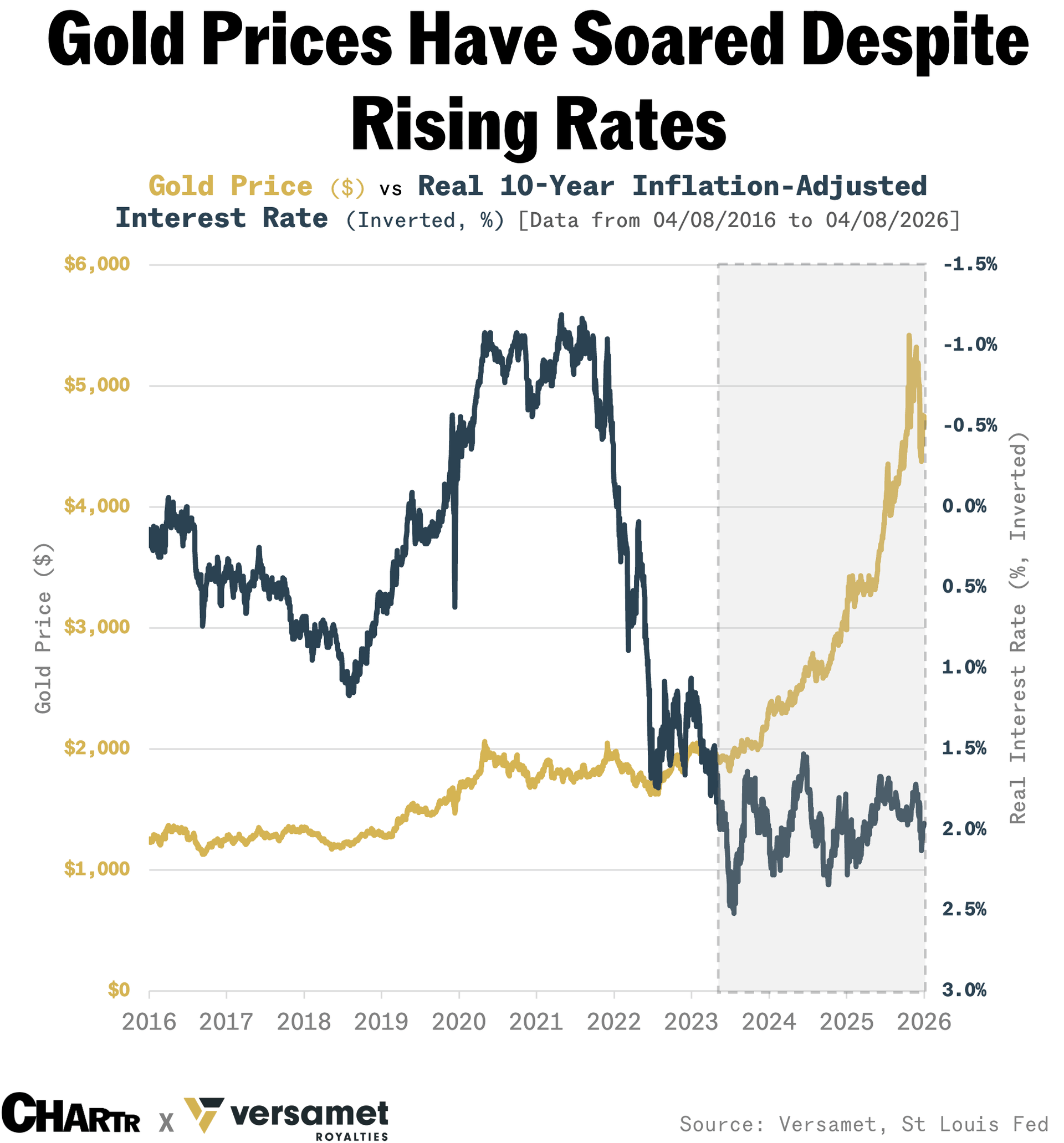
For years, conventional wisdom has held that when interest rates go up, gold prices come down. The past two years have debunked that trend. Gold prices have been soaring despite increased interest rates, driven by a structural shift in global demand. For investors, the rules are being re-written — and the need for a smart entry point has never been greater.
In a shifting macro environment, Versamet (Nasdaq: VMET) offers a way for investors to get exposure to gold through a high-margin royalty model.
Unlike traditional mining stocks, Versamet doesn't operate mines; they provide capital upfront and receive revenue as attributable Gold Equivalent Ounces (GEOs), helping to insulate the business from rising costs that often squeeze miners during inflationary periods.
Led by a team with an impressive track record in the royalties and mining sector, Versamet is building a portfolio of long-life assets designed for durability — regardless of where rates head next.
Want to learn more about the Versamet model? Read more here. |
|
|
|
On May 24, more than 40 athletes — nearly all of them openly taking performance-enhancing drugs and supplements — will dive into pools, bolt across the track, and lift barbells in the Enhanced Games. Over the past two years, the company behind the provocative event raised money from the likes of Peter Thiel and Donald Trump Jr. to deliver “a world-class sporting event.”
But the business is no longer about the event itself. Behind the sporting spectacle lies a high-stakes product demo for Enhanced Group’s longevity drug business. |
- The ultimate gamble is simple: Enhanced hopes millions of people will watch athletes shatter world records using unapproved, biohacked treatments and immediately want to buy some for themselves.
-
It’s a $31 million gamble: we broke down what the company is spending on prizes, athletes, and facilities, like a $6.6 million portable pool.
-
The athletes are also part of the product. Most of them are part of a clinical research study designed to generate a proprietary dataset on the safety and tolerability of performance-enhancing substances, which the company says is a “durable competitive advantage.”
-
CEO Maximilian Martin compared the business to Formula 1, where high-end engineering for elite racing “trickles down” to commercial road cars. “So what really is the key ingredient, the magic sauce, is the IP on how to prescribe to certain individuals that have certain objectives,” Martin said.
|
|
|
|
So far, the stock has a single analyst rating from Lucid Capital Markets, which rates the company a “buy” and has a price target of $15, citing booming demand for longevity treatments among the rising “mass affluent” class. “Love it or hate it, the Games and the marketing content that come out of them will likely be far more memorable than the standard fare of before-and-after weight loss photos,” the analyst wrote, and we have to agree. |
|
|
|
The annual Axios Harris Poll 100 highlighted that with rising prices and strained relationships between Americans and corporations, the companies with the highest-ranked reputations are “the ones Americans feel are helping them get ahead.” In general, Americans had positive attitudes toward market-driving tech juggernauts and car manufacturers (minus Tesla, which was No. 1 on the list of least reputable). Americans also had less favorable attitudes toward media giants and social media.
See the full list |
|
|
|
- Want to move beyond a buy-and-hold strategy? Portfolios that use Nasdaq’s proprietary market sentiment
|
|
|
|
|