| | In this edition: How Massie’s politics doomed him, how Cornyn lost Trump, and parsing a new generic ͏ ͏ ͏ ͏ ͏ ͏ |
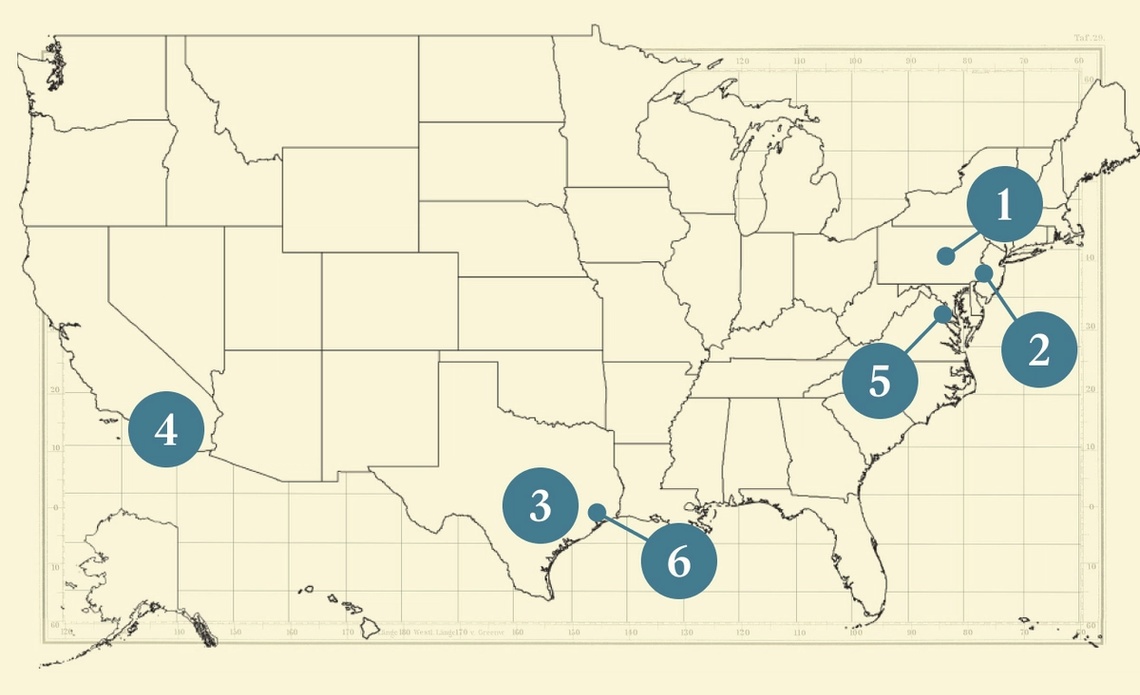
| |  TEMECULA, CA TEMECULA, CA |  HOUSTON, TX HOUSTON, TX | HEBRON, KY |
 | Americana |  |
| |
|
 - More Tuesday takeaways
- Cold as ICE
- Not now, John
- CA story
- Parsing the generic ballot
- Lone Star ad watch
|
|
 Early on Tuesday night, when Thomas Massie raised a glass of raw milk from the “Amish cartel” to honor his late wife, I flashed back to the Tea Party wave of Barack Obama’s first term. And I remembered: Massie was never supposed to be here. Before he became the president’s sharpest Republican critic in Congress, Massie was a libertarian scientist who hated government spending and the taxes that paid for it. He ran for his home county’s top elected position, and won it, to stop a new conservation tax. He ran for Congress in 2012 as a foe of regulation and backer of the Balanced Budget Amendment; debt held by the public was then an unthinkable $11 trillion. (It’s $31 trillion today.) Massie won that race because a fellow supporter of Republican Rep. Ron Paul, a Texan who ran as the Libertarian Party presidential candidate in 1988, and his son, Sen. Rand Paul, R-Ky., sunk half a million dollars of his inheritance into a super PAC. He joined Congress during the brief “Libertarian Moment,” when it was obvious to many GOP donors that the party’s future was culturally tolerant, critical of the police state, and dead set on entitlement reform. Most of those donors have moved on, or found new religion. The end of Massie’s House career — the “2028” chants at his party were about another job — leaves Rand Paul as the last libertarian Republican in Congress. It will conclude the alliance he formed with Rep. Ro Khanna, the ideologically expansive progressive with whom he co-wrote the Epstein Files Release Act. “We’ve taken out two dozen CEOs, an ambassador, a prince, a prime minister, a minister of culture — and that was just six months!” Massie said at his party in Hebron. Had Massie only broken with Trump over the Epstein files, or his refusal to support deficit spending, he likely would have won another term. (Ed Gallrein, his victorious challenger, correctly pointed out that Massie broke a term limit pledge.) In 2020, after he single-handedly delayed a COVID relief bill, Trump endorsed a weaker challenger, who Massie flattened. What finally beat Massie was his opposition to spending on Israel, and to military support for the Jewish state. That was consistent with his isolationism — he opposed all foreign aid. In 2024, AIPAC’s super PAC ran ads attacking Massie across the state, ostensibly to make it impossible for him to run for higher office. When he rolled through that primary, he got more confident that he had built a northern Kentucky beachhead for paleo-libertarianism, immune to the most powerful forces in politics. |
|
Progressive primary wins and Democratic setbacks |
 Hannah Beier/Reuters Hannah Beier/ReutersMassie’s defeat in Kentucky was the biggest story of the year’s busiest primary day so far. But much more happened on Tuesday, starting in Pennsylvania — where Gov. Josh Shapiro, who endorsed three Democratic House candidates with primary challengers, helped each of them win: Janelle Stelson in Harrisburg, Bob Harvie in Bucks County, and Bob Brooks in Allentown. Shapiro didn’t endorse a Democrat in Philadelphia, where state Rep. Chris Rabb gave progressives their latest win in a safe blue seat. (Republicans aren’t even contesting the 3rd Congressional District in November.) Rabb did not start the race as the favorite. State Sen. Sharif Street racked up labor endorsements. Retiring Rep. Dwight Evans backed Ala Stanford, a first-time candidate, to replace him. Rabb pushed past both of them, with the early help of Rep. Summer Lee, D-Pa., progressive endorsements, and a GOTV rally led by Rep. Alexandria Ocasio-Cortez, D-N.Y. |
|
ICE continues to rattle Democrats during primary season |
 Hannah Beier/Reuters Hannah Beier/ReutersBefore she lost on Tuesday, Democrats had high hopes for Stanford. They were captivated by her biography: the founder of the Philadelphia’s Black Doctors COVID-19 Consortium and the first Black woman to be trained as a pediatric surgeon in the US. Then came the candidate forums — and Stanford talked herself out of the race for Pennsylvania’s 3rd District. In a disastrous local TV interview, when asked what would replace ICE if it was abolished, she first asked the reporter to “pause.” When that didn’t work, she babbled about getting rid of the agency, then replacing it with one that had the same functions. It wasn’t Stanford’s only blunder, but one Philadelphia Democrat told Semafor that she experienced the biggest meltdown he’d ever seen. The fate of Immigration and Customs Enforcement, which progressive activists demanded to abolish after the killings of protesters in Minneapolis, has continued to rattle Democrats. Those who voted to praise ICE in a GOP-edited resolution, chiefly Rep. Angie Craig and Rep. Seth Moulton, are facing intraparty attacks on their votes in primaries. And Republican groups meddling in Democratic races are spending millions of dollars to promote left-wing candidates — who are easier to defeat in November — for saying they’d “abolish ICE.” |
|
Taking lessons from how Cornyn lost Trump |
 Kylie Cooper/Reuters Kylie Cooper/ReutersTrump’s endorsement of Ken Paxton over Sen. John Cornyn ended Republican lawmakers’ dreams that their party’s leader might support an incumbent they see as far more electable than the scandal-plagued state attorney general. And it turns out that senators can still be shocked that the president rewarded a close ally over their candidate. “It saddened me,” Sen. Jerry Moran, R-Kan., told Semafor. “I don’t know what you can complain about on John Cornyn, he’s such a significant part of what we’re able to get done here. And a leader; probably no senator that has done more to support other Republican senators. And I don’t know anything that he’s done that’s offensive in a significant way to the president. “Cornyn was publicly skeptical of Trump’s 2024 comeback bid, which MAGA World never forgot. He was also vulnerable, this year, on a line of attack Paxton perfected: Cornyn wanted to protect Senate rules, while the state attorney general was ready to rip them up to push Trump’s voter ID bill past a filibuster. (Days after the March primary, Cornyn flipped and said he’d support ending the filibuster to pass that law.) Democrats were confident that Paxton, battered by tens of millions of dollars in pro-Cornyn fundraising, was the better Republican to run against. “We already know who we’re running against: the billionaire mega-donors and their corrupt political system,” their nominee, state Rep. James Talarico, said in a statement. |
|
California Dems fight over electability and Israel |
 Mike Blake/Reuters Mike Blake/ReutersThe race for a new, Democratic-leaning seat in southern California has pit progressives against each other, after the Congressional Progressive Caucus endorsed Democrat Ammar Campa-Najjar in the 48th District. As the party splits between him and primary foe Marni von Wilpert, a San Diego city council member, Campa-Najjar’s allies worry that two Republicans could advance to the general election in a district Kamala Harris narrowly carried. “If elected, Ammar will be the only Member of Congress who has lived in Gaza, where 30 members of his family, including children, have died,” said the Progressive Caucus PAC co-chairs, Reps. Pramila Jayapal of Washington, Greg Casar of Texas, and Maxwell Frost of Florida, in a statement to Semafor. “Ammar is the only candidate campaigning on a progressive agenda in this race.” Their endorsement came after significant spending in the district by Democratic Majority for Israel on behalf of von Wilpert. The pro-Israel group opposed Campa-Najjar’s postions on the Gaza conflict, but it also worried that he could blow the election for Democrats, citing his shift to the center in 2020. |
|
Between the lines in the fight for Congress |
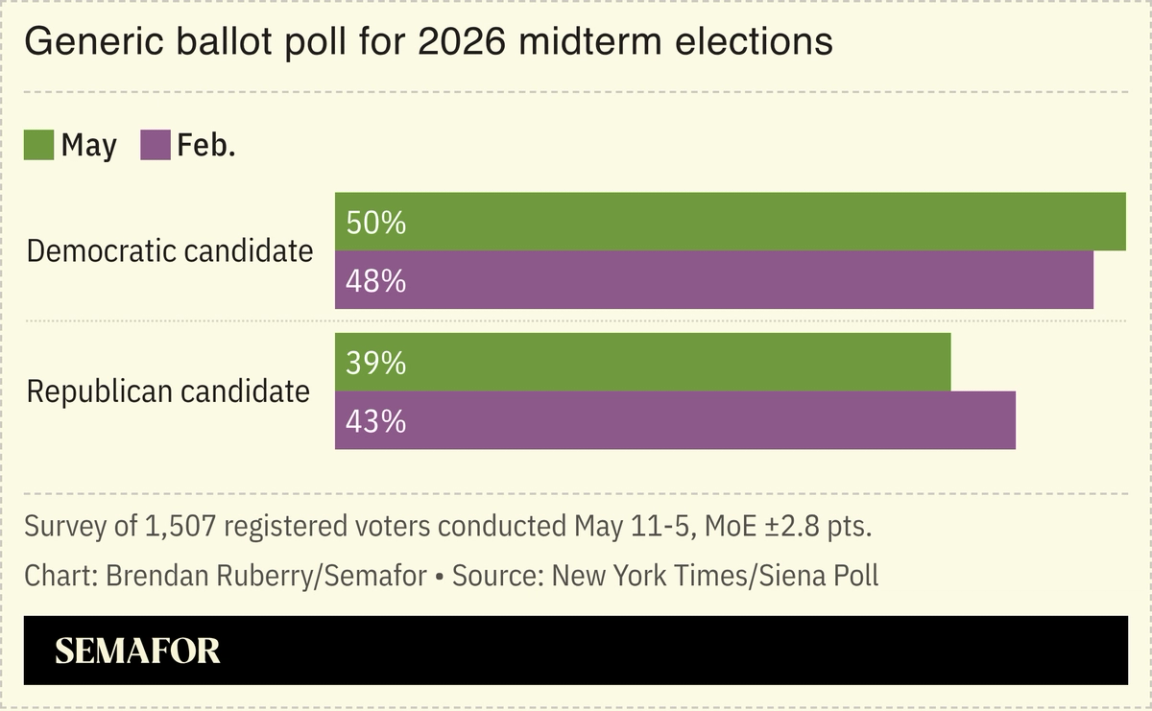 The dark national mood, colored by the Iran war and persistently high cost of living, is helping Democrats before they’ve really fixed their fundamental problems. Republicans have lost ground since the start of the year, but the changes in voter opinion are more striking when compared with the final NYT/Siena poll of 2024, when the choice for control of Congress was a tie. Among voters under 30, support for GOP candidates has fallen from 43% to 26%. Among Hispanics, it’s fallen from 41% to 24%. Here’s the bad news for Democrats: Their support has barely moved in 18 months. The non-white and young voters turning on Republicans have, mostly, become undecided and less likely to vote. The Democratic base, and the anti-Trump vote, is resilient, but the party has not persuaded many voters to switch. It has had more luck doing that in individual races. The newly-drawn Trump-won Hispanic seats in Florida and Texas, which Republicans expected to flip easily, look less solid for them. |
|
Texas Democrat sprints to the finish, literally |
 Christian D. Menefee/X Christian D. Menefee/XThe Cornyn-Paxton finale isn’t the only runoff Texans voted in this week. Around Houston, where Republicans combined two majority-Black districts into one, Democratic Rep. Al Green is facing Rep. Christian Menefee, who’s 40 years younger and finding ways to point that out. In “Still Running,” the latest work for Menefee from the Adwell firm, the 38-year-old candidate runs in place while his family starts its day, then runs to work. He then goes home and runs in bed, to dramatize how many elections he’s had to win since the seat opened up. “Christian is in Congress for the long run,” says his wife Kaitlyn, a not-that-subtle suggestion that he can serve Houston for years, and Green might not. (Menefee won his House seat after its last two occupants, both younger than Green, died in office.) The ad also pushes back on one of Green’s attack lines: that Menefee hasn’t fully committed himself to his job because he missed some votes after being sworn in. |
|
 On Thursday, June 11, Semafor will convene The Future of Philanthropy to examine how, for generations, philanthropy has backed ideas ahead of their time — from early childhood education to breakthrough research that later became public goods. As the United States approaches its 250th anniversary, the sector faces a pivotal moment: under increasing political scrutiny, yet more vital than ever to expanding opportunity and driving innovation. Join Semafor for on-the-record conversations on how philanthropy can scale solutions for workforce mobility and community resilience. Featuring: Emma Bloomberg, Founder & CEO, Murmuration; Asha Curran, CEO, Giving Tuesday; Rep. Blake Moore (R-UT), Bipartisan Philanthropy Caucus; Steve Preston, President & CEO, Goodwill Industries International; and Tim Shriver, Chairman, Special Olympics, CEO & Co-Founder, UNITE. June 11 | Washington, DC | Request Invite |
|
|


