| | In this edition, a guide on how to handle AI at commencement addresses, and worker backlash at Bosto͏ ͏ ͏ ͏ ͏ ͏ |
| |  | Technology |  |
| |
|
 - Meta lays off thousands
- Singularity at Google I/O
- Boston Dynamics backlash
- Are robots really autonomous?
- Colossal’s synthetic eggs
 A guide to fending off boos at graduation addresses, and how a bait-and-switch sparked a debate about AI in art. |
|
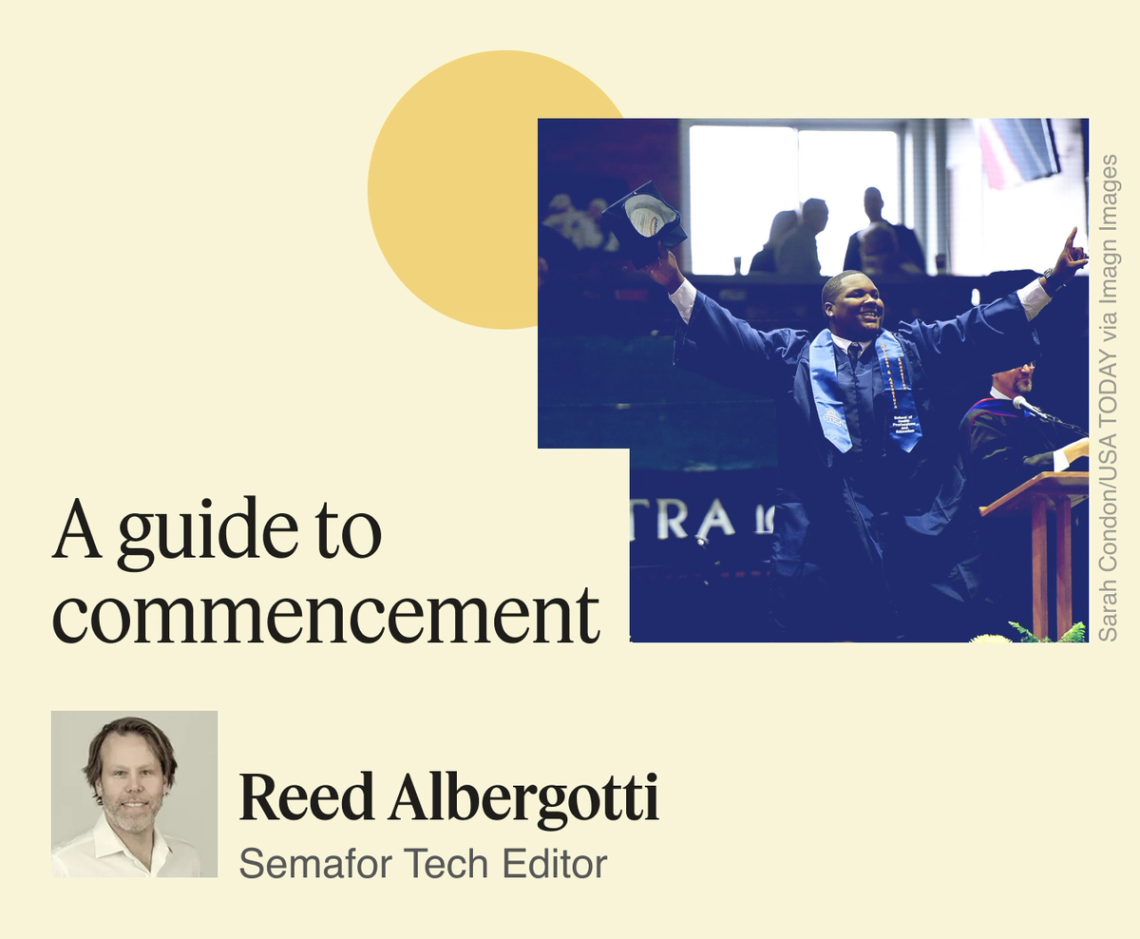 Former Google CEO Eric Schmidt joins the growing ranks of commencement speakers bombing on stage as frustration with AI builds for the Class of 2026 (read our deep dive into why). So I thought I’d offer up a speaker’s guide to not getting booed at graduation this year. Dear commencement speakers: First of all, congratulate yourselves. You’re important enough to be asked to speak at graduation and your job now is to impart your secret sauce to the next generation. I’m sure you want to be different. Think outside the box. Share your wisdom. But if your sage advice involves the use of artificial intelligence, please keep it to yourself. Also avoid the following triggering terms: Software, robots, data centers, chips, gas turbines, self-driving cars, and agents. Current graduates have been through a lot: a global pandemic, climate change, wars in Ukraine and Iran. And now, they’re facing major advances in software automation that are zapping entry-level jobs just as they’re trying to snag them. If you must address AI — and you probably shouldn’t — get in touch with your inner Sarah Connor, the college student-turned-AI safety advocate who fought off a killer robot sent from the future (and the protagonist in The Terminator sci-fi series). Commencement speakers love advising graduates to “wear sunscreen.” So did Connor, who said in Terminator 2: Judgement Day: “Anybody not wearing 2-million sunblock is gonna have a real bad day. Get it?” Your best bet, though, is to avoid the AI topic altogether. In fact, don’t even talk about technology or software. Most graduates were forced to learn computer code from a young age and prepared for a lifetime of free snacks and stock options. That future seems less likely today. Which reminds me, don’t mention snacks. Our future leaders don’t want to be reminded that they are going to be buying their own snacks (which have quadrupled in price in the last six months). Ditto for phrases like “a token” of appreciation and a “bit” of advice. Whatever you do, stay away from the word “prompt.” So what can you talk about? My AI agents recommend topics like love, friendship, and the importance of a good nap. Sunsets are good — though be careful, because someone in the back will mutter something about solar panels. Dogs are safe. Nobody has ever been booed for mentioning dogs. But be specific. A real dog. With fur. That does not run on batteries. Food is also good, just don’t say “recipe” because someone will bring up how they got theirs from ChatGPT and then we’re right back in it. See? There are plenty of topics that don’t invoke feelings of existential dread. That is, unless you go the Sarah Connor route. In that case, existential dread is your main point. College students have been feeling a sense of existential dread since … forever. And maybe they can learn something from Connor, who saw the world clearly and took it head on, with the stubborn, slightly unhinged belief that the future is not written. |
|
Meta layoffs add to AI angst |
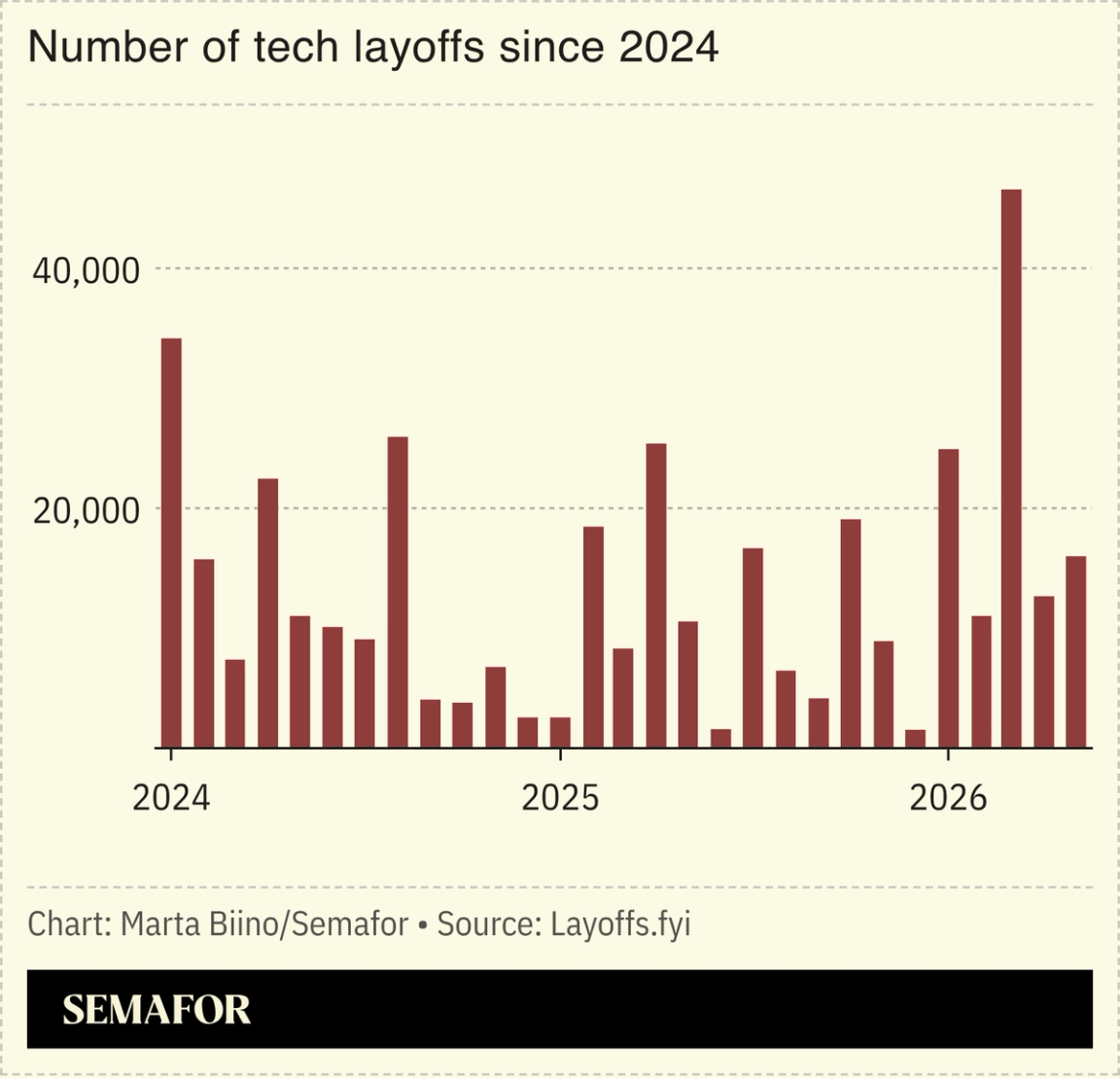 Meta began laying off thousands of workers on Wednesday with an eye toward axing 10% of its staff to offset AI costs. The company also said it would move another 7,000 workers into AI-focused roles. Meta’s technology chief Andrew Bosworth described “the vision we are building towards is one where our agents primarily do the work,” in a post cited by The Wall Street Journal. The market may respond positively when tech companies cite AI for layoffs — Meta’s shares have gone up virtually every time it’s announced job cuts — but the AI pile-on is one of the many reasons that Schmidt and others are getting booed at commencement speeches when mentioning AI. And it’s already becoming a political issue as midterms approach. After our story last week on how the age of AI has impacted the Class of 2026, students around the country reached out to share their own struggles. One 27-year-old master’s student told me it validated her decision to pause her data analytics program and work at her dad’s accounting firm — a stable job with health insurance. The Class of 2026 article was “depressing af,” she said. “But it was also weirdly comforting” in confirming she made the right decision. — Rachyl Jones |
|
Google I/O’s real reveal: singularity |
 Manuel Orbegozo/Reuters Manuel Orbegozo/ReutersAfter more than two hours of announcements at Google I/O that included flashy new models, AI agents, a smarter search box, tools for work and video creation, and smart glasses, Google DeepMind CEO Demis Hassabis delivered a poetic, if slightly abrupt kicker: “We’re at the foothills of the singularity,” he said on stage. The decision to end the show that way was a deliberate one. “We debated it back and forth,” Hassabis told me in an interview after the event. “I was closing, and I wanted to be authentic about what I’m thinking with AGI,” he said. “The singularity, at least my interpretation of that word and that term, means the era that we’re in,” he said. Google has reoriented the company so that DeepMind’s research can, as quickly and responsibly as possible, filter into the rest of the company’s products. It’s racing to compete with Anthropic and OpenAI, which the WSJ reported could file for an IPO as soon as Friday. From the outside, that can look like a two-hour laundry list of product improvements without a single focal point. But as Hassabis sees it, the focal point isn’t any individual product, but a gradual shift. “When we look back in five or 10 years’ time, it’s not going to be a single moment, pre-singularity/post-singularity,” he said, noting the gradual move. Still, it wasn’t until this year that he “really felt … that it’s the beginning.” — Reed Albergotti |
|
Worker backlash at Boston Dynamics |
 Ludovic Marin/Pool/via Reuters Ludovic Marin/Pool/via ReutersBoston Dynamics, the humanoid-maker owned by Hyundai, reversed course on selling its four-legged robot Spot to a firm that supplies equipment to police departments after employees pushed back on how the robots could be used, Semafor’s Rachyl Jones reported. Employees protested the idea of fastening “flash bang” grenades — a device that produces a flash of light and loud bang — to Boston Dynamics’ Spot robots, which they feared would be used as a form of protest control, according to people familiar with the worker backlash. A spokesperson for Boston Dynamics confirmed that the sale didn’t go through, but said the company scuttled the deal because it risked “undermining our anti-weaponization pledge.” She said that using Spot in protest control was barred by Boston Dynamics’ terms of sale. This example of employee activism at Boston Dynamics is one of the few cases in which tech workers have been able to change the direction of management when they disagree with a decision on moral grounds. Employees at Google and other big tech companies have long campaigned against actions taken by their employer, often without producing meaningful results. |
|
 What happens when every interaction on the internet becomes monetized? Joe Weisenthal, co-host of Bloomberg’s Odd Lots podcast, thinks we’re already finding out. After more than two decades reporting on business, he has witnessed the transformation of financial media firsthand, from the early “golden” era of Twitter, when amateurs would engage in what he calls “unmonetized transactions,” to now, when everyone with expertise is selling something. In this week’s episode of Compound Interest, presented by Amazon Business, Liz and Semafor Editor-in-Chief Ben Smith ask Weisenthal about the future of financial journalism in the age of AI, the creator economy, and what gets lost when every interaction becomes monetized. |
|
Are Figure AI’s robots remotely operated? |
 Courtesy of Figure AI Courtesy of Figure AIPeople have been glued to a livestream of Figure AI’s Helix-02 robots, which are placing packages on a conveyor belt and providing a preview of what factory work looks like with humanoids that don’t require sleep, food, or a bathroom break. But suspicions have been growing over Figure’s claims that the robots are running “fully autonomously.” If that’s true, why do they keep reaching up to their “faces”? It’s a classic tell they may be controlled by a remote person fixing their headset, one tech worker told me. There’s no proof of this yet — Figure didn’t respond to Semafor’s questions on the matter — but I saw a half dozen cases of this in a two-hour stretch. This isn’t the first time tech companies promising autonomous robots have been caught with humans behind the scenes — Tesla’s Optimus humanoids were remotely operated during Elon Musk’s “We, Robot” showcase, for example. But it’s a reminder that for all the online buzz, humanoid tech has a long way to go before it can be useful in real-world scenarios. — Rachyl Jones |
|
Colossal makes a synthetic egg |
 Courtesy of Colossal Biosciences Courtesy of Colossal BiosciencesColossal Biosciences announced Tuesday it developed a device that acts as a synthetic egg, which successfully hatched two dozen chicks. The company took fertilized eggs from its avian farm and transferred them to a lab, where they matured in synthetic eggs kept in a controlled incubator. After the chicks hatched, they were moved back to the farm. The process has yet to be peer reviewed, but the company is pitching the technology as a step toward one of its goals of resurrecting extinct dodo and moa birds. Using ex-vitro reproduction, rather than individual surrogates, could help it scale up production of endangered and de-extinct species faster. The process could also serve as a model for human reproduction (which Colossal doesn’t currently do). “If pharma wants to use it, we’ll look at it, but it’s not on a direct monetization path,” CEO Ben Lamm told Semafor. Colossal has more than 100 artificial eggs, and said it would share the tech with interested conservationists and research labs. |
|
 On Wednesday, June 10, Semafor Tech will convene in San Francisco to explore the breakthroughs pushing technology into a new phase of economic and geopolitical consequence, from quantum computing and fusion energy to humanoid robotics. The challenge extends beyond tracking innovation to understanding its downstream effects across industries, institutions, and power structures. Semafor Tech Editor Reed Albergotti will host on-the-record conversations with Jeetu Patel, President & Chief Product Officer, Cisco; Aaron Levie, Co-Founder & CEO, Box; Charina Chou, Chief Operating Officer, Google Quantum AI; Max Hodak, Co-Founder & CEO, Science Corporation; and Pete Shadbolt, Co-Founder & Chief Scientific Officer, PsiQuantum, as they explore how breakthrough technologies are reshaping industries, redefining competitive advantage, and transforming the global economy. June 10 | San Francisco | Request Invite |
|
|


