| | In today’s edition: There is gathering momentum for new pipelines to bypass Hormuz, Hajj costs are r͏ ͏ ͏ ͏ ͏ ͏ |
| |  | Gulf |  |
| |
|
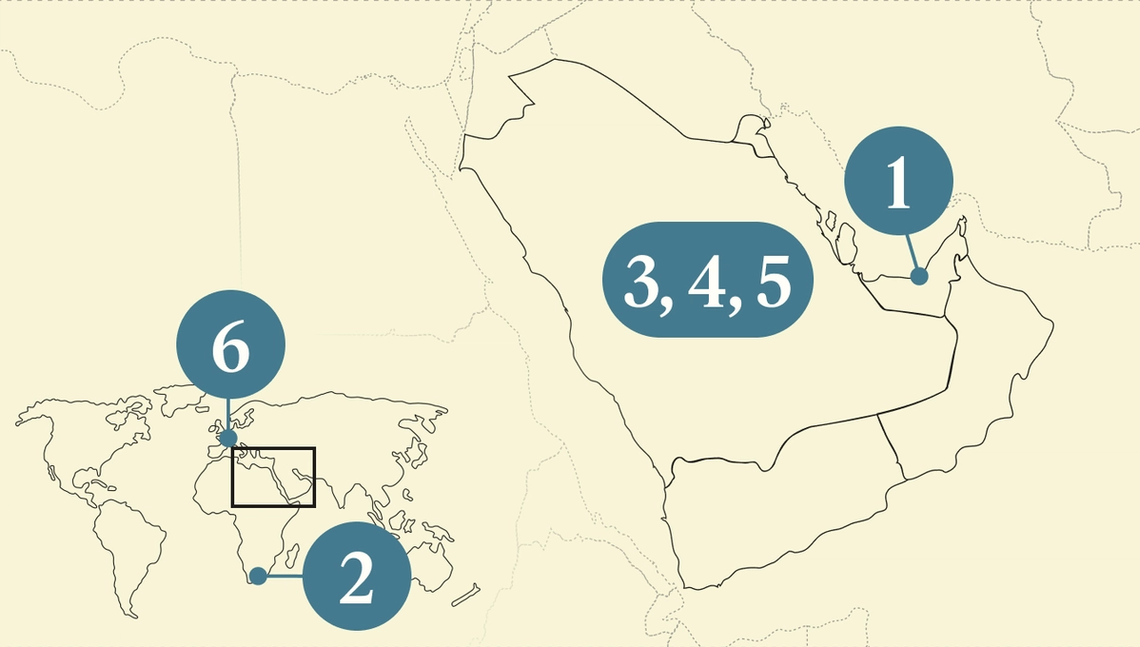 - War’s uneasy equilibrium
- Iran war’s global fallout
- Hajj in a time of war
- Aramco’s quantum computer
- Qiddiya taps Google AI
- Europe’s Gulf opportunity
 Abbasid bling unearthed on Hajj trail. |
|
Little progress in US-Iran talks |
 Reuters ReutersThe US and Iran remain far apart on the terms of a potential peace deal, raising doubts about finding an off-ramp to the conflict during a strained ceasefire. US President Donald Trump on Tuesday threatened “another big hit” if talks failed, leaving the region on edge and mediators seeing little progress. The unpredictability poses a growing risk to energy markets and is muddying forecasts, according to Semafor’s Energy Editor Tim McDonnell; one expert put the odds of renewed military escalation at 70%, while another predicted the Strait of Hormuz would reopen in June. Momentum is meanwhile gathering for infrastructure projects aimed at reducing reliance on the oil chokepoint. The Iran war is accelerating a push away from fossil fuels, but “the world still runs … on oil and gas,” McDonnell wrote. With that in mind, the UAE is racing to complete a pipeline that aims to double its oil export capacity outside Hormuz; Iraq is working with Türkiye to increase its crude exports; India is deepening energy ties with UAE, as is Japan with South Korea; and Russia and China are discussing a long-stalled pipeline this week. The moves come as Iran appears to seek permanent leverage over the waterway — not by closing it, but by regulating it, JPMorgan analysts wrote. |
|
Asia, Africa squeezed further |
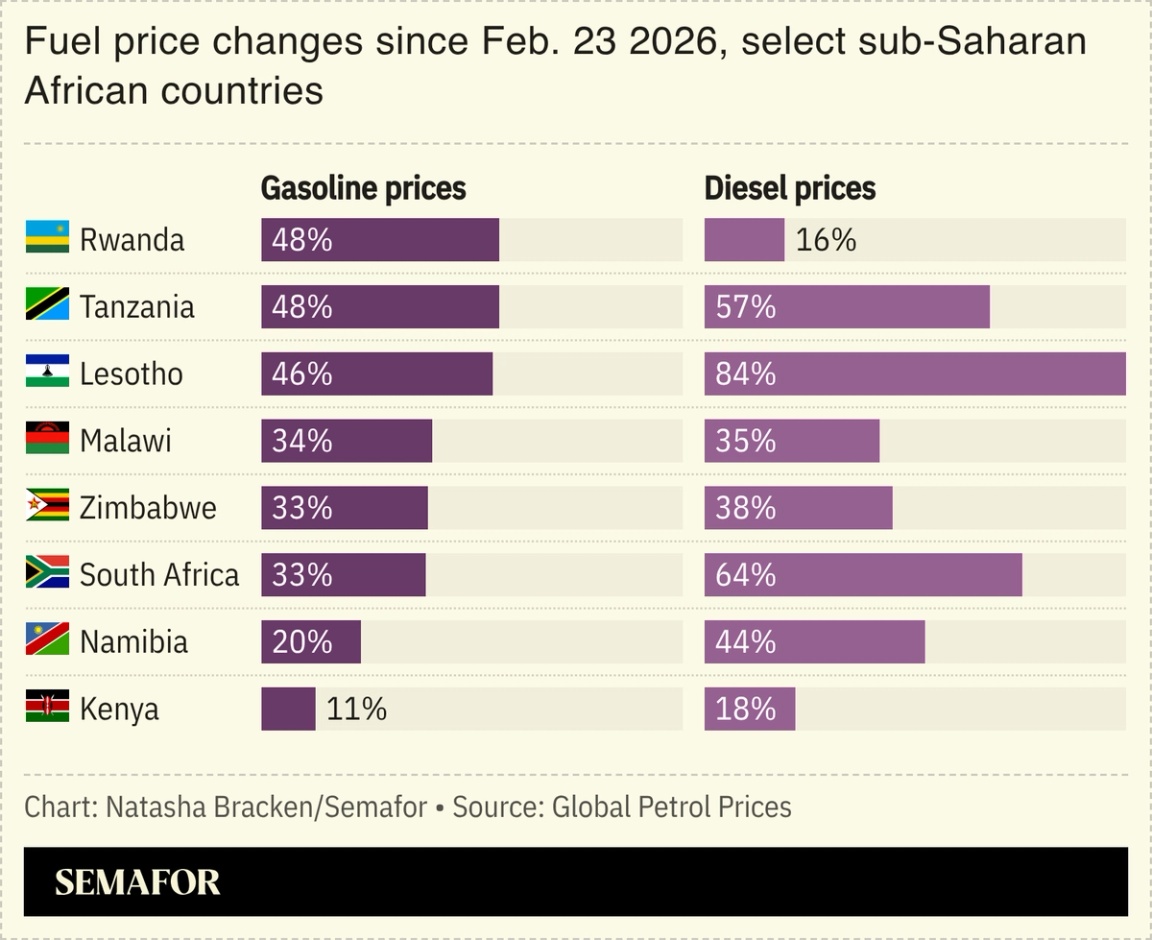 The fallout of the Iran war deepened globally as countries struggled to contain the impact of rising fuel and commodity prices. Higher petrol costs have sparked deadly protests and strikes across Africa, with demonstrators in Comoros, Kenya, and Mozambique clashing with authorities in recent days. The continent is particularly vulnerable given it imports the vast majority of its fuels. And Indonesia — which has taken a considerable fiscal blow from the war — imposed export restrictions on certain commodities as it looks to boost government coffers. The war is hitting rich countries too: The UK Treasury is reportedly urging supermarkets to impose price caps on some groceries as the government vies to tame higher inflation. |
|
 Ibraheem Abu Mustafa/Reuters Ibraheem Abu Mustafa/ReutersThe Iran war is making the world’s largest annual religious gathering more expensive. This year, fewer flights across the Gulf and disrupted supply routes are driving up prices ahead of Hajj, the pilgrimage which begins with its main rituals in Mecca next week. Travel package prices were hiked “three or four times before departure,” said Anas Hafiz, a Jeddah-based travel agent who has worked on Hajj trips for more than three decades. Around 1.6 million Muslims performed the pilgrimage last year, with Indonesia, Pakistan, and India sending the largest contingents. Governments help organize and subsidize the journey, and some are absorbing the higher costs: Indonesia covered $107 million in additional airline expenses to shield its 221,000 pilgrims from price hikes; Pakistan and Malaysia also stepped in with subsidies. India added a $100 surcharge, citing higher aviation fuel costs. Religious tourism is central to Saudi Arabia’s Vision 2030 strategy, with the kingdom investing heavily in airports, transport, and hospitality infrastructure tied to Hajj and Umrah, the lesser pilgrimage performed throughout the year. — Manal Albarakati |
|
Aramco gets its first quantum computer |
 An engineer working on a Pasqal quantum processing unit. AgenceOblique/CyrilMarcilhacy. An engineer working on a Pasqal quantum processing unit. AgenceOblique/CyrilMarcilhacy.Saudi Aramco and French startup Pasqal launched Saudi Arabia’s first quantum computer, part of a broader push by Gulf energy producers to use technology to squeeze more output and efficiency from their oil and gas operations. Housed at Aramco’s Dhahran data center, the system is designed to address complex challenges in the energy, industrial, and materials sectors. The launch follows Aramco’s announcement this month of a new supercomputer, expected online in 2027, that will boost the company’s compute capacity sevenfold for seismic imaging and reservoir simulations. Aramco first backed Pasqal through its Wa’ed Ventures arm in 2023. The companies have jointly developed systems that help optimize carbon dioxide storage, port logistics, rig scheduling, and well placement. — Mohammed Sergie |
|
Saudi theme park turns to Google for AI |
 Courtesy of Qiddiya Courtesy of QiddiyaRiyadh entertainment district Qiddiya will use Google Cloud’s data and AI products to monitor construction, visitor patterns, and real-time operations. Qiddiya, which is controlled by the Saudi wealth fund, includes a Six Flags theme park and a water park. Once complete, it will also feature a stadium for the men’s soccer World Cup in 2034 and a Formula 1 race track. Qiddiya will use Google’s Gemini agent to monitor visitor behavior, spending, and movement patterns, and its own Q-Brain platform to help management and staff with decision-making around the parks. Saudi Arabia is aiming to become a top global AI hub by partnering with the biggest US firms, building data centers, and using a network of state-linked companies as anchor customers. To help finance that rollout, HUMAIN — also controlled by the government’s Public Investment Fund — has hired Goldman Sachs to help it raise at least 20 billion riyals ($5.3 billion) to finance data center developments and chip purchases, Reuters reported. |
|
View: Europe’s chance in the Gulf |
 Joint European Union and the Gulf Cooperation Council summit in Brussels, in 2024. Johanna Geron/Reuters. Joint European Union and the Gulf Cooperation Council summit in Brussels, in 2024. Johanna Geron/Reuters.European countries were taken by surprise when the US and Israel attacked Iran but have, so far, rejected direct military participation. That shows a willingness to chart a more independent foreign policy, but translating that into longer-term regional influence will require substantive engagement, Polisphere Advisory’s Robert Mogielnicki and the German Marshall Fund’s Grace Wermenbol wrote in a column for Semafor. Deeper trade, investment, and defense partnerships with the Arab Gulf are obvious starting points. “Foreign investment partnerships are going to be even more critical for the Gulf going forward,” they argued. “Savvy European governments and businesses should be able to find ways to support the domestic economic interests of Gulf countries, while also demonstrating the attractiveness of investment opportunities on their own continent.” |
|
 Checking In- Riyadh Air, the Public Investment Fund-backed carrier, began selling tickets for its inaugural route from the Saudi capital to London, scheduled to begin operating on July 1. The airline has hundreds of planes on order and aims to connect Riyadh to more than 100 destinations by 2030.
- The Israeli Transportation Ministry sent a delegation to the UAE last week to discuss granting Dubai-based carrier Emirates so-called “seventh freedom rights,” which would allow the airline to operate direct flights from Tel Aviv to New York and Bangkok. — Jewish Insider
Energy- QatarEnergy acquired stakes in three exploration areas off the coast of Uruguay from a Shell subsidiary. It adds to the Gulf energy company’s South American portfolio, which includes assets in Argentina, Guyana, and Suriname. — Reuters
Finance- There was a 5% year-on-year rise in companies registering in Abu Dhabi’s financial center ADGM in March, despite the war. Office setup is one of the most closely watched metrics for Gulf cities competing to attract investors and foreign capital. — AGBI
- LIV Golf is drawing up a new business plan as it searches for new backers, but is also considering a US bankruptcy filing after Saudi Arabia’s Public Investment Fund pulled funding. Players are also preparing for the possibility the league collapses when the season ends in August. — Bloomberg
Real Estate- Thirty-five luxury mansions are being built on the grounds of Abu Dhabi’s Emirates Palace, the landmark hotel that has featured in Mission Impossible and Fast & Furious movies, in a partnership between Mandarin Oriental and Lead Development. — The National
- Dubai South, the master development being built around what will become the world’s largest airport, has signed a $17 billion deal with Majid Al Futtaim to build a mixed-use community including a major shopping mall across 22 million square feet.
|
|
Abbasid-era gold and silver artifacts discovered by Saudi Arabia’s Heritage Commission during archaeological excavations in the Al-Qassim region, located along the ancient Hajj route.  @MOCHeritage/X @MOCHeritage/X |
|
|


