| | In this edition: Nigeria eyes $20B in foreign direct investments, an Ebola outbreak grows, and Germa͏ ͏ ͏ ͏ ͏ ͏ |
| |  | Africa |  |
| |
|
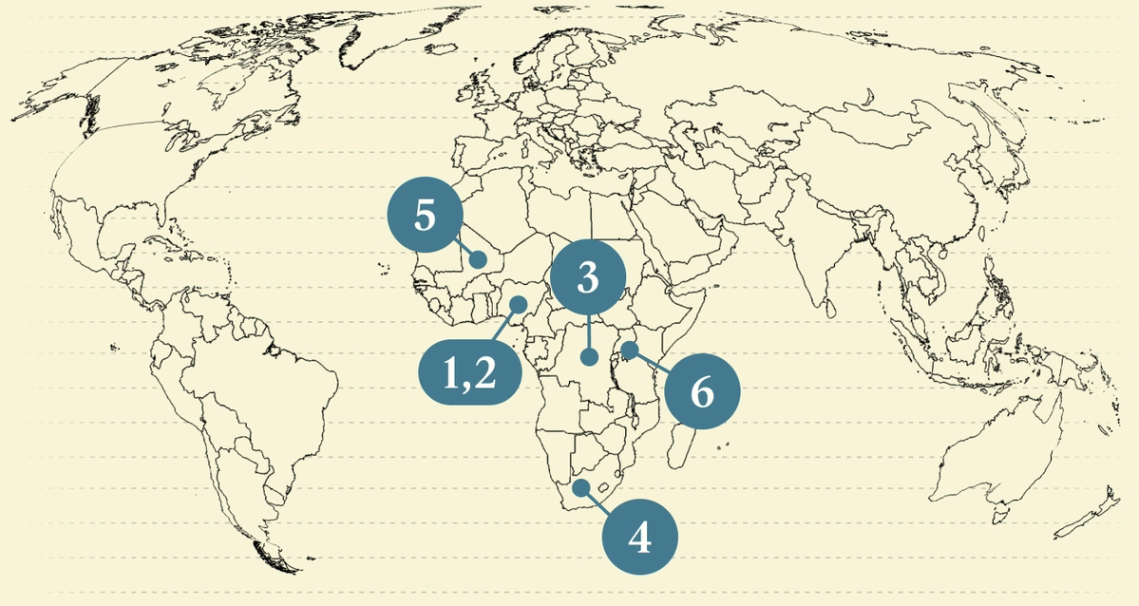 - Nigeria eyes $20B FDI
- New Nigeria-US strikes
- Ebola crisis grows
- US tariff impact on S. Africa
- Intra-Africa trade projection
- AI opportunity in healthcare
 Tyla and Rema among World Cup opening acts. |
|
 The debate about who controls Africa’s resources has expanded considerably in recent years, from critical minerals to domestic capital to the terms on which foreign investors operate. But one frontier remains underweighted in that conversation, despite being among the most consequential: digital public infrastructure. Control of digital infrastructure is not a question of ownership. It is a question of planning. You can let someone else build the road but you shouldn’t let them decide where it goes. State regulators will need to focus on the architecture of governance, meaning the decisions about how systems are designed, what data they collect, and how they interconnect. Within those guardrails, private partners can bring financing, expertise, and deployment speed. That is not a sovereignty concession. It is a division of labor that has successfully built everything from ports to power grids. The scale of what needs to be built is significant. Meeting the continent’s growing demand for data center capacity could require as much as $20 billion in cumulative investment — and that’s before AI began accelerating the timeline. Yet the funds can be sourced at home. The continent holds $4.4 trillion in domestic capital, with more than $2 trillion managed by institutional investors. Hardy Pemhiwa, CEO of Cassava Technologies, which operates one of Africa’s largest fiber and data center networks, says the biggest bottleneck is financing new digital asset classes — not technology or even demand. African countries are entering the AI era at roughly the same starting point as the rest of the world, argues Pemhiwa. Sovereignty at this moment is not about keeping foreign partners out. It is about being absolutely clear — in law, in design, in governance — about what can never be handed over. |
|
Tinubu says Nigeria to draw $20B in FDI |
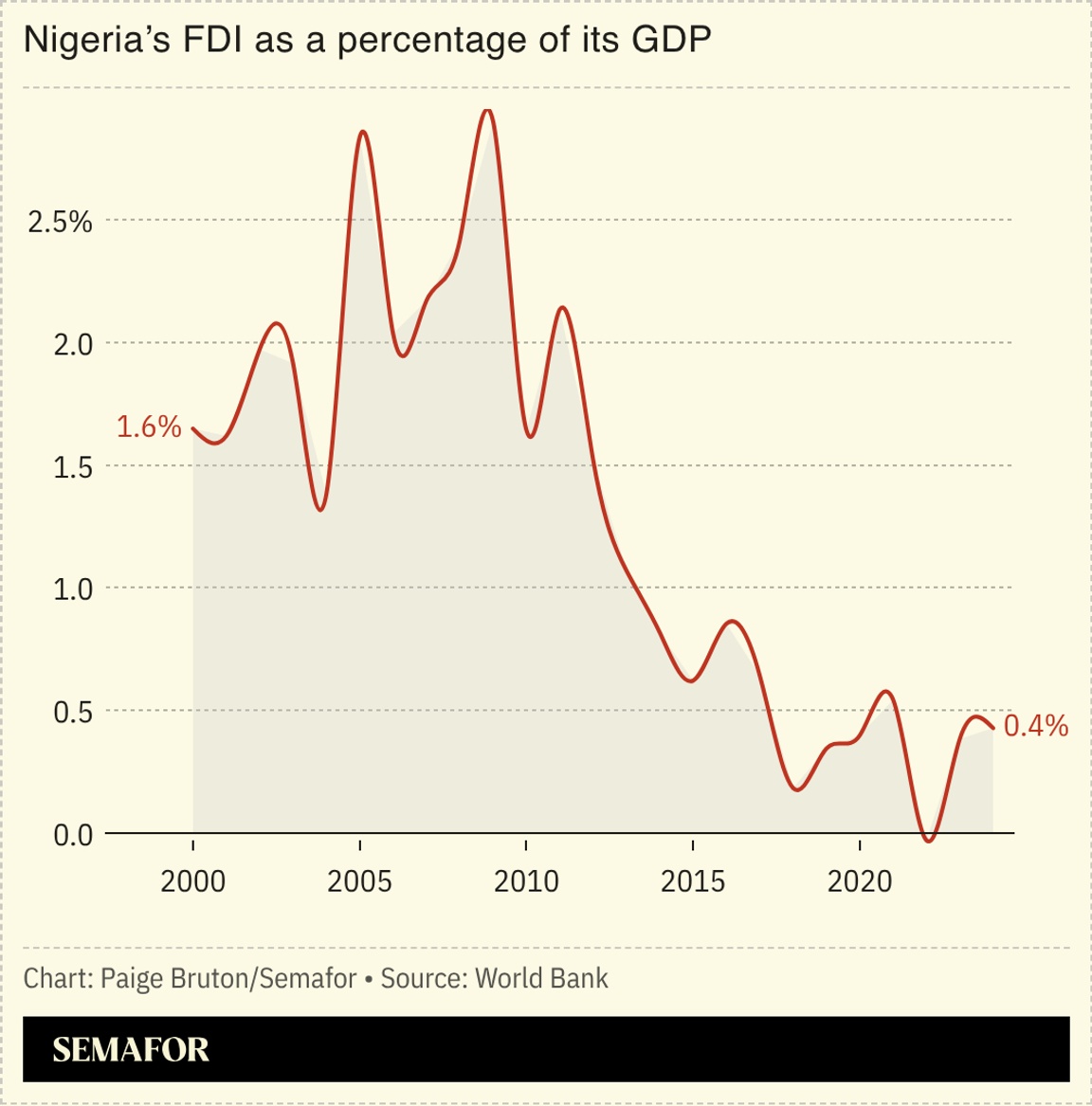 Nigeria is on course to secure up to $20 billion in foreign direct investment this year, President Bola Tinubu said, as his government pushes to reap the gains of a three-year economic revamp ahead of crunch elections in January. Tinubu’s estimate appears to be optimistic given that capital inflows into the country totaled $23.22 billion in 2025, of which FDI comprised about 4%. Nigeria’s president made the comments at last week’s Africa CEO Forum in Rwanda. Overall capital importation into Nigeria has grown every year throughout Tinubu’s tenure after falling every year in the four years before he took office in 2023. The government has reshaped the economy, scrapping petrol subsidies and fixed foreign exchange regimes, while raising oil production output and changing tax laws to lift revenues. S&P Global Ratings cited these reforms in raising Nigeria’s credit rating by one notch on Friday, estimating that sub-Saharan Africa’s second-largest economy will maintain a strong current account surplus through 2029 while its foreign exchange reserves continue to grow. — Alexander Onukwue |
|
Nigeria, US target Islamists |
 Sodiq Adelakun/Reuters Sodiq Adelakun/ReutersUS and Nigerian forces carried out strikes against Islamic State fighters a day after saying they had killed the group’s second-in-command. The US deployed troops to Africa’s most populous nation following President Donald Trump’s allegations that Nigeria was doing little to stop violence against Christians in the country, accusations rejected by Abuja. Islamist violence has spread across much of West Africa in recent years, aided in part, experts say, by countries in the region cutting defense ties with Western nations and replacing them with partnerships with Russia. The pivot has turned West Africa into the world’s terrorism hotspot; thousands of people have been killed there so far this year. |
|
Ebola outbreak grows in DRC, Uganda |
 A Ugandan doctor vaccinates someone against Ebola in 2025. Abubaker Lubowa/File Photo/Reuters. A Ugandan doctor vaccinates someone against Ebola in 2025. Abubaker Lubowa/File Photo/Reuters.The World Health Organization declared an Ebola outbreak in DR Congo and Uganda a “public health emergency of international concern.” At least 88 people have died and more than 300 suspected infections have been linked to the rare Bundibugyo strain, which has no approved vaccines or antibody treatments. The vast majority of cases have been identified in DR Congo, which borders nine countries. The outbreak does not meet the criteria of a pandemic emergency, the WHO stressed, but requires global coordination and surveillance to curb its spread. Jean Kaseya, director-general of the Africa Centres for Disease Control and Prevention, told Sky News the outbreak highlighted the urgency of manufacturing vaccines and medicines on the continent. Experts warn that massive cuts to foreign aid programs could weaken emergency response in vulnerable states. |
|
Germany overtakes US in S. Africa trade |
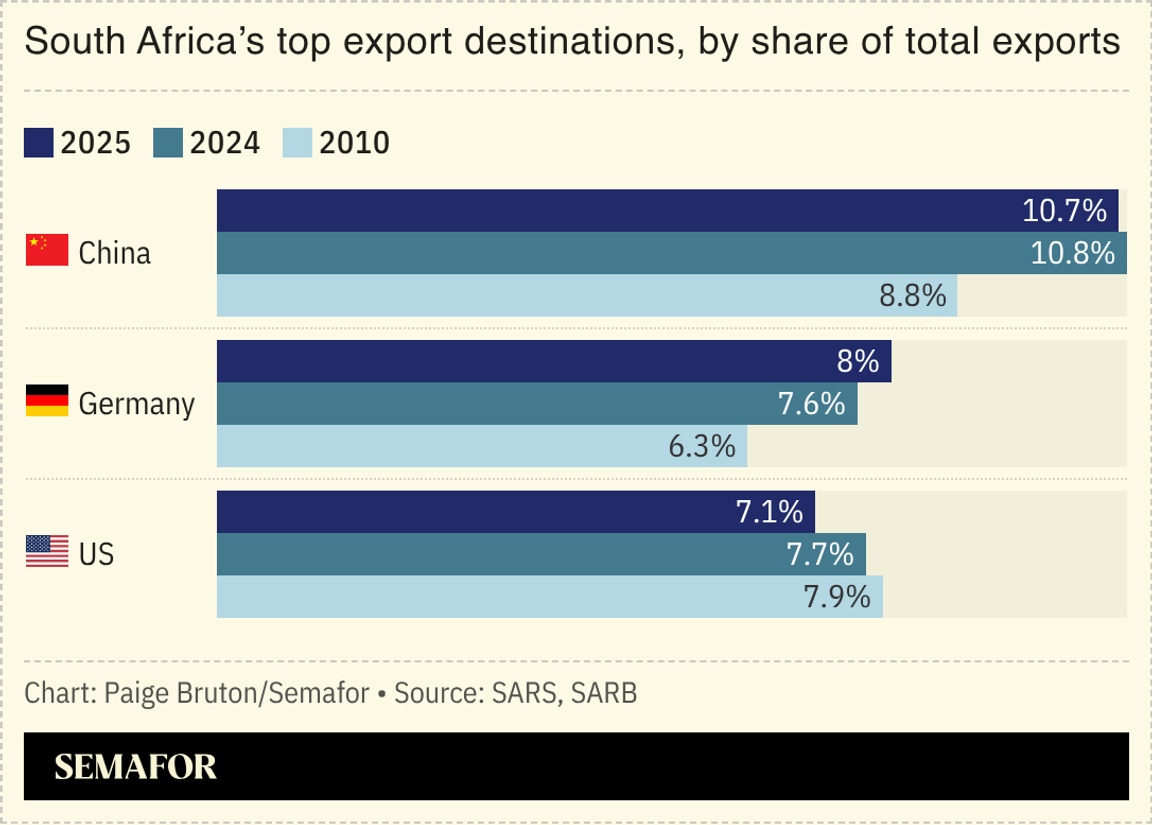 Germany overtook the US as the second-largest buyer of South African goods after US President Donald Trump’s Liberation Day tariffs took effect, new data showed. The South African Reserve Bank said the tariffs hit South Africa’s value-added goods the hardest, with the country’s vehicle and transport equipment sector absorbing the bulk of the damage. China remains the top destination for South African exports. While South Africa exports few manufactured and value-added goods, Beijing has enhanced its diplomatic soft power with a tariff-free access deal that came into effect this month. And while the US may regain its former standing after the country’s Supreme Court invalidated the levies, tensions between the two countries have been growing over matters including Pretoria’s domestic Black empowerment policies, alignment with the BRICS grouping, genocide case against Israel, as well as US accusations that it is “cozying up to Iran.” — Tiisetso Motsoeneng |
|
Intra-Africa trade boost projection |
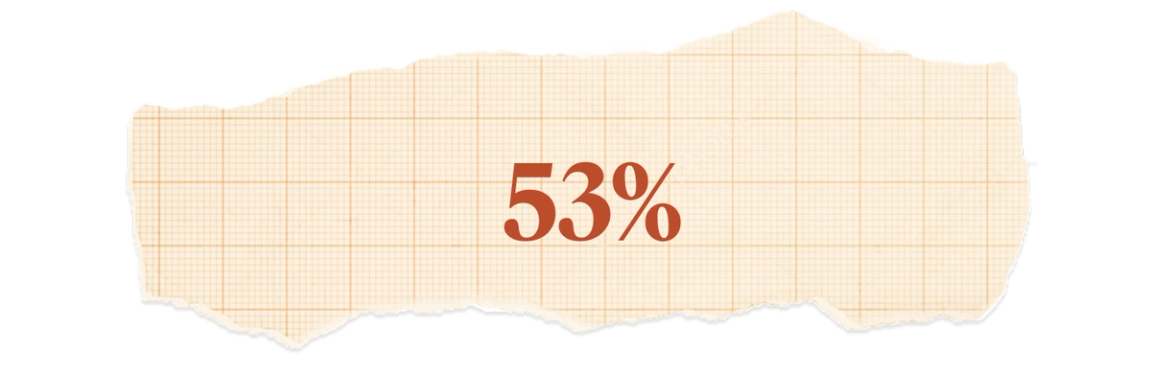 The share of intra-African commerce that could be achieved if the African Continental Free Trade Area was fully implemented, up from 18% currently. The AfCFTA, which aims to create the world’s largest single market by progressively eliminating tariffs on most goods, came into force in May 2019. But major mobility and connectivity hurdles remain, the Mo Ibrahim Foundation noted: Only four countries — Mali, Niger, Rwanda, and São Tomé and Príncipe — have ratified the 2018 African Union’s Free Movement of Persons Protocol, for example. The report said AfCFTA implementation could grow the continent’s manufacturing sector by $1 trillion, generate income worth $470 billion, and create 14 million jobs by 2035. — Preeti Jha |
|
View: Folding AI into African healthcare |
  Michele CattaniI/AFP via Getty Images Michele CattaniI/AFP via Getty ImagesAfrica’s health data could become one of the continent’s most strategic assets in the age of AI — but only if African countries build the capacity to govern, store, and benefit from it locally rather than exporting its value abroad, a global health professor argued in a new Semafor column. AI’s transformation of health data into the foundation of future diagnostics and public health systems raises urgent questions about sovereignty and who captures the economic value for Africa, wrote Francisca Mutapi of the University of Edinburgh. “In an AI-driven health economy, whoever stores and processes data is often best positioned to develop the models, set the standards, capture the commercial value, and shape future systems,” she said. Mutapi pointed out that without stronger local infrastructure, governance, and regulatory capacity, African countries risk becoming suppliers of raw health data while the benefits of AI-driven healthcare are realized elsewhere. |
|
 - May 18: AI entrepreneurs gather for AgentCon, a one-day conference in Nairobi on AI agents.
- May 19-21: The Africa Energy Technology Conference, which focuses on intra-African trade and development, takes place in Accra.
- May 19-21: Nairobi hosts AI Everything Kenya X GITEX Kenya, a summit about AI startups in East Africa.
- May 20: South Africa releases its inflation data for April, while Ghana, Mauritius, and Nigeria report their interest rate decisions.
- May 20-23: The Africa Soft Power Project, which spotlights creative capital, kicks off in Nairobi.
- May 22-24: South Africa hosts a three-day meeting of regional foreign ministers.
|
|
 Business & Macro |
|
|


