| | China agrees to establish a Board of Trade with the US, a Donald Trump critic loses his Republican p͏ ͏ ͏ ͏ ͏ ͏ |
| |  New Delhi New Delhi |  Kinshasa Kinshasa | Taipei |
 | Flagship |  |
| |
|
The World Today |  - Oil shock tests US voters
- Trump tightens grip on party
- China agrees to trade board
- Taiwan responds to summit
- Kyiv defends Moscow attack
- WHO warning on Ebola
- India’s semiconductor push
- Europe’s tech giant
- Growing e-bike scrutiny
- Monet pic sparks AI debate
 A book explores the history of a German city that was once an incubator for both democracy and Nazism. |
|
Oil shock in US is testing voters |
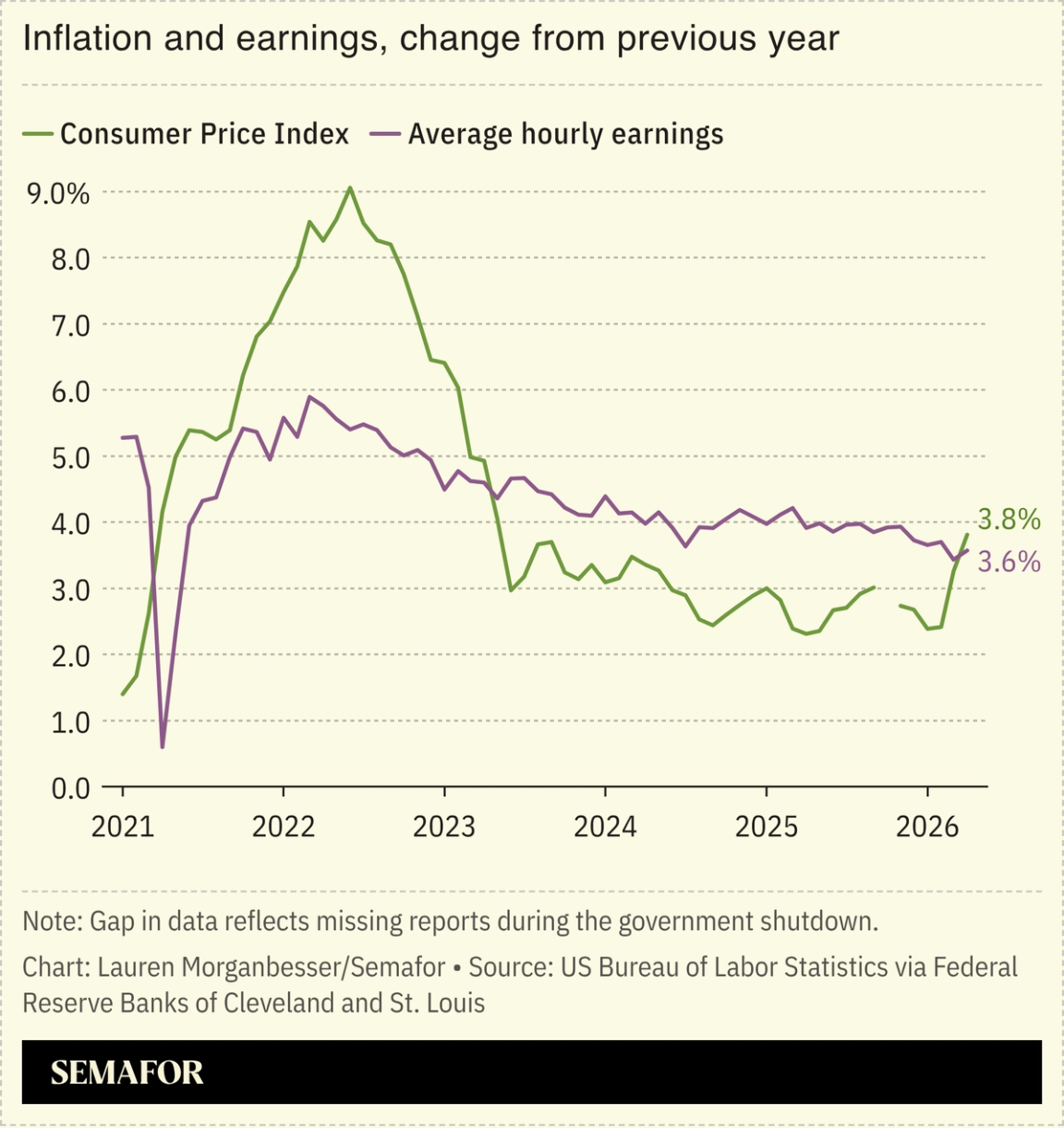 The historic oil disruption, fueled by the ongoing stalemate in the Strait of Hormuz, is deepening economic divides in the US and casting a shadow over President Donald Trump’s political fortunes. Surging gas prices are squeezing low- and middle-income households — Americans have spent $45 billion more on gasoline and diesel during the war than over the same period last year — while boosting the coffers of energy firms, The Wall Street Journal reported. Anxiety over rising prices and increasing debt has weakened Trump’s approval ratings ahead of the midterm elections, and many voters blame him for high gas prices. While the president appeared to dismiss Americans’ economic woes last week, some rural voters remain loyal to him, Reuters reported. |
|
Trump targets his Republican foes |
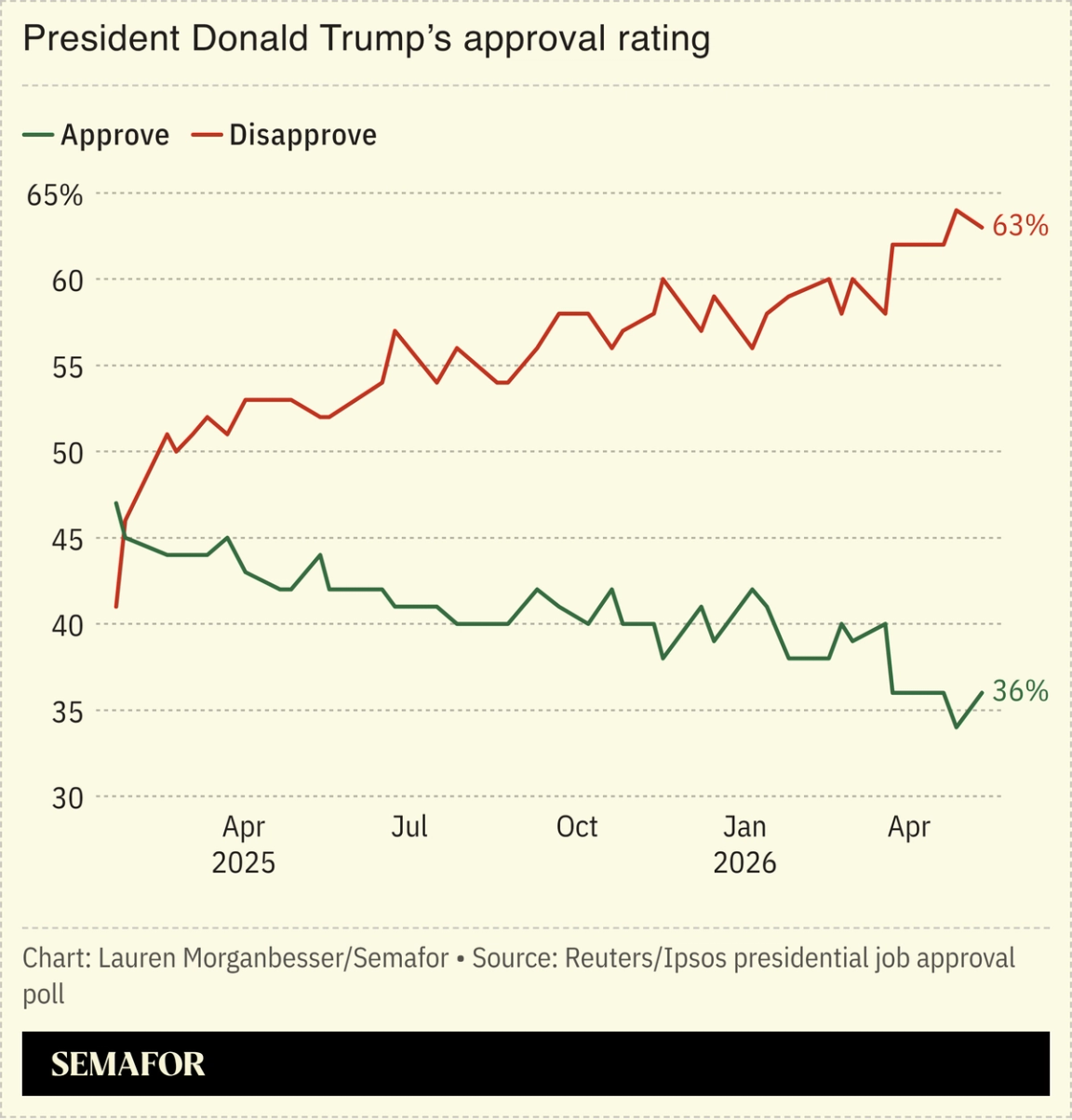 A Republican senator who voted to convict President Donald Trump in his 2021 impeachment trial lost his primary Saturday, reflecting Trump’s tightening grip on the party despite his waning popularity with voters. Louisiana Sen. Bill Cassidy’s defeat, which Trump celebrated as comeuppance for Cassidy’s “disloyalty,” underscores how the president’s “sagging standing with the general public is doing little to deter him from asserting his influence on a party in his thrall,” The New York Times wrote. It also serves as a warning sign for other Republicans who have provoked Trump’s wrath, Politico noted. Trump ousted several Indiana lawmakers who challenged him over redistricting, and is campaigning to unseat Rep. Thomas Massie, a vocal Trump critic, in Tuesday’s Kentucky primary. |
|
China agrees to trade board with US |
  Story photo: Kenny Holston/Pool via Reuters. Header photo: Andrew Caballero-Reynolds/AFP via Getty Images Story photo: Kenny Holston/Pool via Reuters. Header photo: Andrew Caballero-Reynolds/AFP via Getty ImagesChina said Saturday it would buy US aircraft and seek mutual tariff reductions, but specifics on agreements following a two-day summit between the countries’ leaders remain elusive. Beijing agreed to establish trade and investment bodies with Washington, without offering details on how they would operate. The US trade representative told CBS News on Sunday that a deal to sell China 200 Boeing planes was “locked in,” and that the trade board would facilitate a “double-digit increase in agricultural purchases” by Beijing, while suggesting an investment board would act like a “firefighter” to resolve issues between the superpowers. While the summit was short on concrete deliverables, both leaders could claim “a measure of victory,” an analyst argued, having sealed a “delicate détente.” |
|
Taiwan defends US arms purchases |
 Ann Wang/File Photo/Reuters Ann Wang/File Photo/ReutersTaiwan’s leader on Sunday emphasized the island’s sovereignty and the importance of US arms purchases in deterring regional conflict, amid doubts of Washington’s support for Taiwan. After his meeting with Chinese leader Xi Jinping, US President Donald Trump suggested using potential weapons sales to Taiwan as a “bargaining chip” with Beijing, which views the island as a renegade province. While US officials have sought to dispel concerns of Washington changing its Taiwan policy, Trump’s comments “will embolden Beijing to increase pressure on Taipei,” a Brookings scholar on China argued, elevating “the risk of confrontation.” Trump’s close advisers believe that China could invade Taiwan in the next five years, Axios reported, threatening the chip supply chain that powers the US’ AI boom. |
|
Ukraine drone attack targets Moscow |
 Stringer/Reuters Stringer/ReutersUkraine’s biggest drone attack on Moscow in more than a year killed at least three people in the city, damaged residential buildings, and targeted an oil refinery, as Kyiv intensifies its strikes deep inside Russia. Russian authorities said air defenses destroyed around 80 drones headed to Moscow and downed more than 1,000 over the country in the past 24 hours. Ukraine’s president called the attack “entirely justified,” suggesting it was retribution for Russia’s massive aerial attack last week. Ukraine is gaining the upper hand, analysts noted, pointing to Russia’s high death toll and territorial losses. For the first time since the war began, Russians worry more about strikes inside the country than on the front lines, according to a poll from a Kremlin-controlled organization. |
|
Ebola outbreak declared emergency |
 Victoire Mukenge/Reuters Victoire Mukenge/ReutersThe World Health Organization on Sunday declared a global health emergency over an Ebola outbreak in the Democratic Republic of Congo and Uganda. Around 80 deaths and more than 200 suspected infections have been reported, with cases in the capitals of Kinshasa and Kampala raising concerns over wider spread. The outbreak involves the rare Bundibugyo strain, which has no approved vaccines or antibody treatments. The WHO said the declaration is intended to trigger a coordinated international response to contain transmission. During previous outbreaks, the US helped train epidemiologists, support vaccine deployment, and expand emergency response capacity. Experts warn that massive cuts to foreign aid programs could weaken emergency response in vulnerable states. |
|
India to get its first semiconductor fab |
 Piroschka van de Wouw/Reuters Piroschka van de Wouw/ReutersIndia’s Tata signed a deal with Dutch giant ASML to build India’s first semiconductor fab, part of New Delhi’s efforts to boost domestic chipmaking. Dutch chip firms are looking to new markets as the US seeks to restrict ASML’s exports to China, and India has pledged billions in investments and incentives to ramp up semiconductor manufacturing. But India’s push to build out its domestic industry on the back of legacy chips — used in cars and consumer electronics — faces serious competition from China, which is rapidly scaling up production, Nikkei reported. Chinese companies — throttled by US curbs on making cutting-edge AI chips — have poured money into mature-node chips, with one analyst suggesting Beijing’s dominance could lead to a “China shock moment.” |
|
How ASML became a tech giant |
 Maxim Shemetov/Reuters Maxim Shemetov/ReutersEurope’s greatest tech success story comes from “transatlantic cooperation, not continental parochialism,” a technology writer argued. Dutch firm ASML makes all the world’s most advanced chipmaking machines and is a crucial chokepoint in the US-China tech war. It made early bets on novel laser techniques. But it was, until recently, relatively obscure and in its early years so cash-starved that it was forced to outsource components from a sprawling network of manufacturers, unlike rivals that built all their parts in-house. That had the unexpected advantage, Neil Hacker wrote in Works in Progress, that it didn’t have to solve cutting-edge physics problems alone, speeding progress. The EU wants more tech sovereignty, but its biggest winner came from giving up control. |
|
Countries target high-powered e-bikes |
 Mike Blake/Reuters Mike Blake/ReutersLegislatures worldwide are targeting high-powered e-bikes. Most e-bikes are treated like pedal bikes, and riders don’t need licenses. But the availability of ever more powerful models capable of motorbike-like speeds is changing that. Jailbreaking kits that remove bikes’ speed restrictions are common. California and Australia both moved to ban — and in Australia’s case destroy — overpowered bikes. The Netherlands and France have cracked down on jailbreaking. In Britain, e-bikes are theoretically meant to only give power boosts while being pedaled to a maximum of 15.5 mph — otherwise they’re just unlicensed motorbikes — but enforcement has lagged adoption, despite some progress. Powerful bikes are everywhere, and often used in the UK’s roughly 83,000 annual phone thefts. |
|
Monet troll sparks AI debate |
 SHL0MS via X SHL0MS via X |
|
|


