| | In this afternoon’s edition: Will anything come of Xi Jinping and Donald Trump’s optimistic talks?͏ ͏ ͏ ͏ ͏ ͏ |
| |  | Washington, DC |  |
| |
|
 - China ‘nothingburger’?
- Board of investment worries
- China’s rare earth card
- Iran emboldened in strait
- An anti-monopolist test candidate
 AI chipmaker Cerebras ▲ 68%, the first of several tech IPOs slated for this year. |
|
View: How real are Trump’s China deals? |
| |  | Morgan Chalfant |
| |
  Story photo: Kenny Holston/Pool via Reuters. Header photo: Andrew Caballero-Reynolds/AFP via Getty Images Story photo: Kenny Holston/Pool via Reuters. Header photo: Andrew Caballero-Reynolds/AFP via Getty ImagesPresident Donald Trump concluded his speech in Beijing today by toasting “the rich and enduring ties between the American and Chinese people” and inviting Chinese leader Xi Jinping to the White House. Xi told American CEOs that Beijing would “only open wider” to them. But optimistic talk about deepening the bilateral relationship doesn’t mean that the promises made and deals announced are all real. News that China had agreed to purchase 200 large Boeing planes saw the company’s stock slide — a sign that the deal fell short of expectations. Though Trump hates to admit it, his first-term pact with Beijing fizzled: China only made good on 58% of the overall US goods and services purchases it agreed to as part of the talks, according to one estimate. “Seems like a nothingburger,” one former US official said of the China trip thus far. |
|
Washington wary of US-China investment board |
  Story photo: Maxim Shemetov/Pool/Reuters. Header photo: Andrew Caballero-Reynolds/AFP via Getty Images Story photo: Maxim Shemetov/Pool/Reuters. Header photo: Andrew Caballero-Reynolds/AFP via Getty ImagesTrump’s plan to set up a new means of vetting Chinese investments in the US is already meeting with resistance from both parties on Capitol Hill. Treasury Secretary Scott Bessent told CNBC earlier today that officials in Beijing would discuss a US-China board of investment to determine “non-sensitive areas where it would be possible for the Chinese to invest.” Bessent said the board would “make sure that these investments don’t get referred to” the Committee on Foreign Investment in the US, which screens certain investments for national security purposes. Sen. Mark Warner, D-Va., said he’s “very reluctant to have this administration arbitrarily choosing who goes through CFIUS and who doesn’t.” Sen. Josh Hawley, R-Mo., said he’s “all for China investing in a way that … creates American jobs,” but would oppose agreements that dealt with AI or Chinese ownership of US land. — Eleanor Mueller |
|
Trump’s rare earth problem |
 Story photo: Evan Vucci/Reuters. Header photo: Andrew Caballero-Reynolds/AFP via Getty Images Story photo: Evan Vucci/Reuters. Header photo: Andrew Caballero-Reynolds/AFP via Getty ImagesTrump needs a deal on rare earth minerals more than Xi needs a deal on fossil fuels, concludes Semafor climate and energy editor Tim McDonnell. That’s left the US president in a weak position on arguably the highest-stakes question of this week’s summit. Trump wants China to extend a moratorium on rare earth export restrictions, which China had put in place in retaliation for Trump’s “Liberation Day” tariffs, and are now set to kick back in near the midterm elections in November. Compare that to Trump’s side of the negotiating ledger: There are advanced Nvidia chips that China wants and only the US can proffer, but oil and gas, which are usually Trump’s trade cudgel of choice, won’t have much heft with Xi; China is well-supplied with reserves of both and has other options, including US adversaries like Russia, for getting more. |
|
Iran asserts itself as owner of Hormuz |
 Adnan Abidi/Reuters Adnan Abidi/ReutersIran reasserted its control over the Strait of Hormuz today as Trump and Xi discussed passage through the waterway. “The Strait of Hormuz is open for all commercial vessels but they need to cooperate with our navy forces,” Foreign Minister Abbas Araghchi told state broadcaster Press TV on Thursday, according to The Wall Street Journal. The rhetoric suggests Iran is seeking a long-term role in managing traffic through the waterway. Iran’s vice president put it bluntly: “The Strait of Hormuz is ours.” The New York Times reported this afternoon that Iran has allowed Chinese vessels through the strait in recent days, after diplomatic outreach from Beijing. Treasury Secretary Scott Bessent said today on CNBC that Iran is out of storage space for oil and will soon shut down production — proof that the US blockade is choking off the regime’s economic lifeline. |
|
Anti-monopolist independent jumps into Nebraska House race |
 Campaign of Austin Ahlman Campaign of Austin AhlmanAnother populist independent is running for Congress in Nebraska: Austin Ahlman, a 28-year-old progressive journalist and former anti-monopolist think-tanker, is challenging Rep. Mike Flood, R-Neb., and Democrat Chris Backemeyer, a former Biden administration official, Semafor’s David Weigel reports. Unlike Dan Osborn, the independent candidate for Senate, Ahlman doesn’t want or expect the Democratic nominee to drop out of his race. When Sen. Bernie Sanders, I-Vt., called for “working class” populists to run against Republicans this year, the model was Osborn, who convinced Democrats to avoid his race, reducing the risk of a split in the anti-incumbent vote. Ahlman, whose campaign isn’t part of the Sanders project, argues that his politics have a bigger constituency than cautious Democrats. “We are going to break up the corporations that are taking away people’s power and making it so they can’t afford to live,” Ahlman said. |
|
 Tom Wilson runs an insurance company in a low-trust America. That makes trust a core business issue for Allstate. “We sell trust,” he says. On this week’s episode of The CEO Signal, presented by PwC, Penny Pritzker and Andrew Edgecliffe-Johnson ask Wilson how that premise shapes the way he leads one of America’s biggest insurers. Wilson, who has led Allstate for nearly two decades, said he’s disappointed that more CEOs are not speaking up on societal issues — but he is not calling for corporate commentary on everything. He explains the framework Allstate uses to decide when it has standing to engage, how the company connects corporate purpose to employees’ personal purpose, and why AI should force leaders to ask a harder question than how much cost they can cut: what kinds of good jobs can they create? Watch the latest episode of The CEO Signal now. |
|
 Justice Department- While on an official visit to Hawaii last year, FBI Director Kash Patel went on a “VIP” snorkeling dive around the USS Arizona, which sank during the attack on Pearl Harbor in 1941, and is normally off limits to swimmers. — AP
- The Justice Department plans to drop charges against India’s richest man, a decision made soon after he hired one of President Trump’s personal lawyers. — NYT
White House- US Border Patrol Chief Mike Banks announced today he is stepping down, the latest in a string of recent high-profile departures from the Department of Homeland Security.
- The Environmental Protection Agency plans to propose delaying enforcement of a Biden-era pollution rule.
- Military leaders fear they could start running out of money this summer unless Congress passes a funding bill for the Iran war, but the Pentagon has not submitted a request. — WSJ
Congress- Republicans on the Senate Banking Committee approved a long-awaited overhaul of cryptocurrency regulation with the support of two Democrats, Sens. Ruben Gallego of Arizona and Angela Alsobrooks of Maryland, Semafor’s Eleanor Mueller reports.
- Senators voted to withhold their own pay in any future government shutdowns.
- The House campaign of 33-year-old Jack Schlossberg, son of Caroline Kennedy, is “so erratic and plagued by turnover that it raises questions about how he might handle himself as a member of Congress,” reported The New York Times, citing interviews with other Democrats and people with direct ties.
Courts- The Supreme Court ruled 9-0 that auto crash victims can sue companies that negligently hire dangerous truck drivers.
Foreign Policy- Protests broke out in Havana last night after government officials said the US blockade had depleted its remaining reserves of diesel and fuel oil, which the island uses for power generation. — FT
- The Defense Department abruptly canceled the deployment of 4,000 US troops to Poland, catching military officials off guard. — NYT
Census- US population growth slowed last year to the lowest rate since 2021, reflecting a decline in immigration and a record-low fertility rate, according to new Census data.
Technology- Anthropic’s new AI model Mythos found a way to crack Apple’s MacOS, one of the world’s toughest targets for hackers. — WSJ
Media- Israeli Prime Minister Benjamin Netanyahu plans to file a defamation lawsuit against The New York Times over a column by Nicholas Kristof that alleges Israeli prison guards and soldiers routinely sexually abuse Palestinian prisoners.
- Paramount is considering a podcast distribution deal with Katie Miller, wife of Stephen Miller, President Trump’s deputy chief of staff. — Axios
|
|
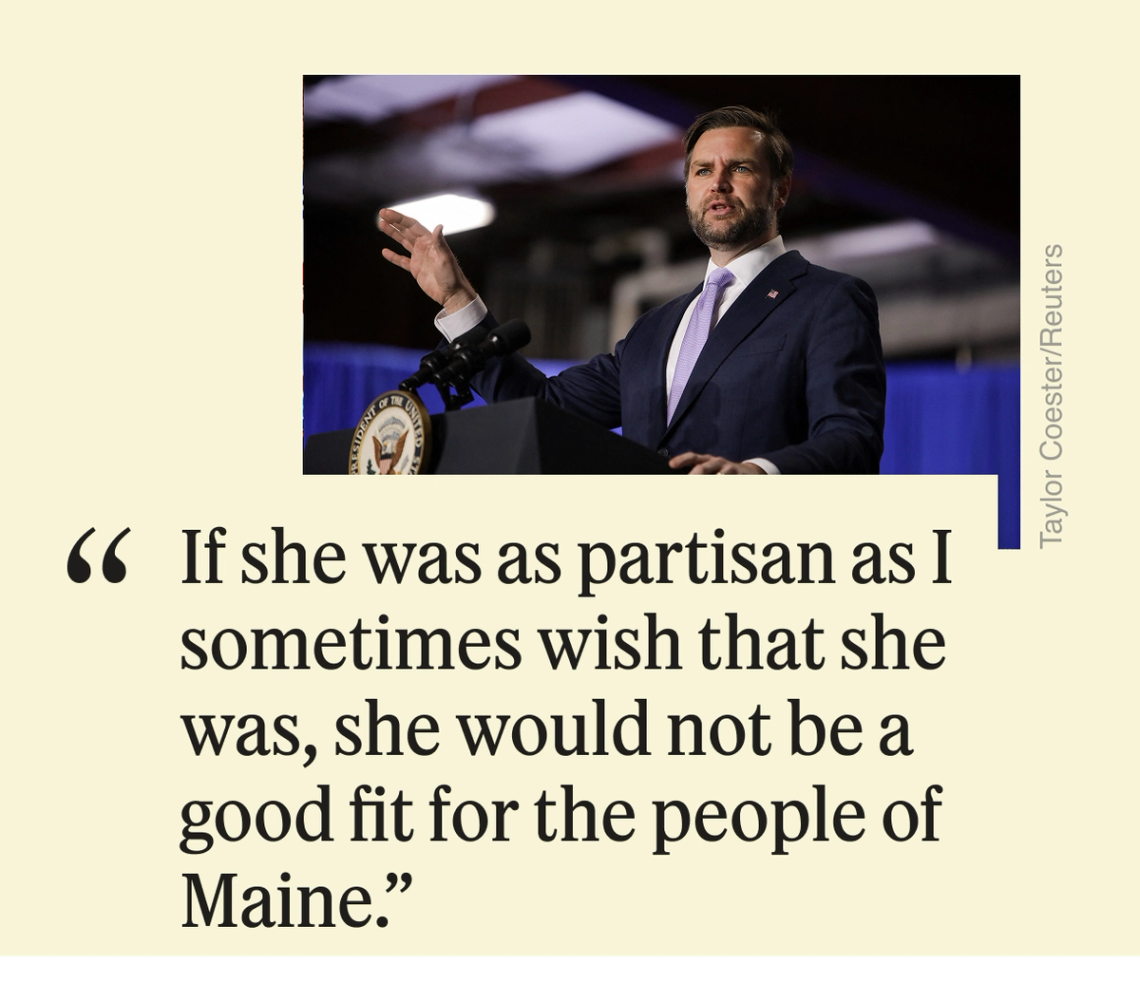 — Vice President JD Vance on Republican Sen. Susan Collins during a speech in Bangor today. |
|
|


