| | In this edition, CEOs are losing relevance as big business becomes more politically salient, and doo͏ ͏ ͏ ͏ ͏ ͏ |
| |  | Business |  |
| |
|
 - ‘Board of investment’
- M&Amdani
- AI job doom
- Ford’s AI pivot
 The audience at Musk v. Altman is sitting on fancy pillows |
|
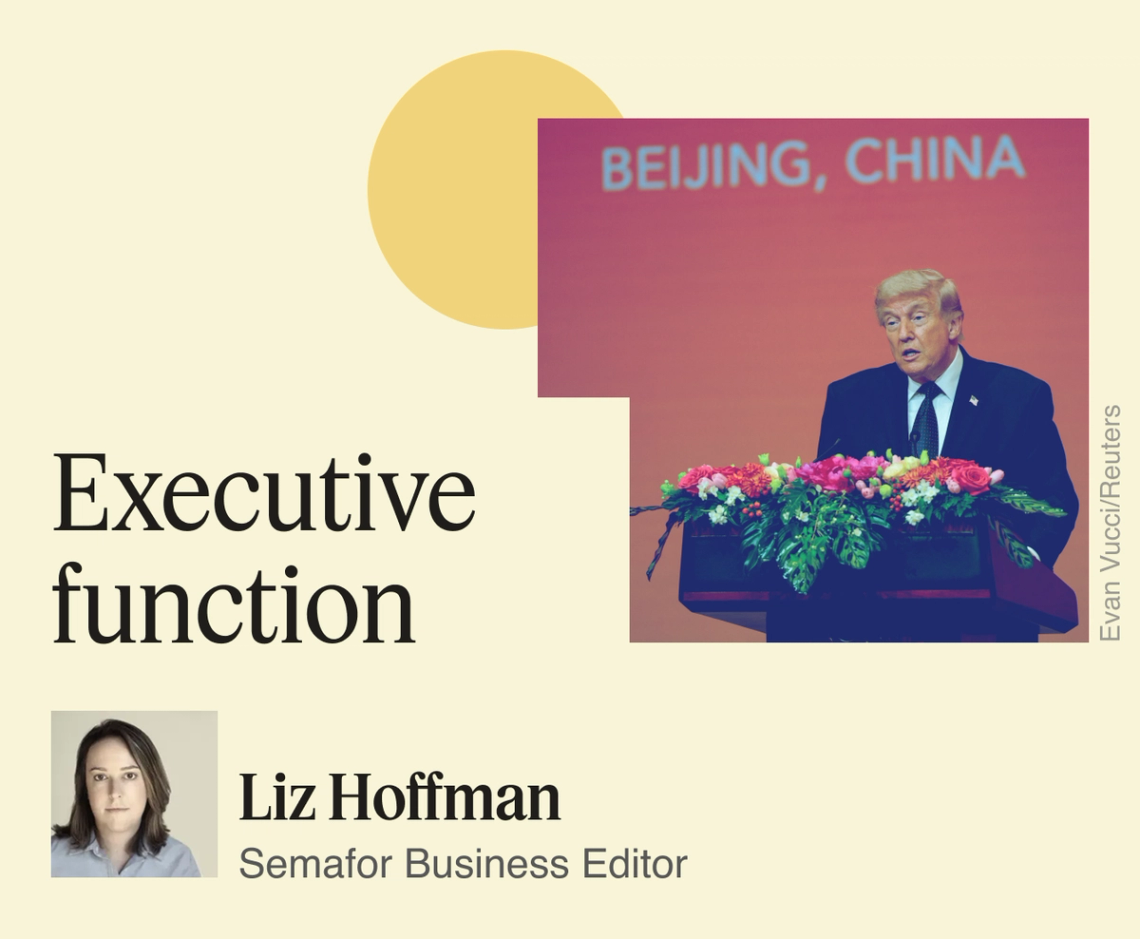 President Donald Trump is meddling in corporate mergers. So is New York City Mayor Zohran Mamdani. Welcome to the age of executive power. The only thing missing are the CEOs. Big business has never been more politically salient, but the CEOs who sit atop it have rarely mattered less. This week, a dozen of them are trailing Trump to China on a trip that has very little to do with them and from which they can expect very little in return. Jets and soybeans are about all that’s formally on the table, leaving only Boeing’s Kelly Ortberg and Cargill’s Brian Sikes with much reason to be there. The rest of them got seats at the state dinner and mingled over cocktails at the exclusive Capital Club in Beijing. But they’re not the main attraction. They’re props. Jensen Huang was set to be invited, then left off the list, then reinvited, before scrambling to Alaska where he met Air Force One with a backpack, looking all too human. But even chips are absent from the formal agenda because the politics are too messy. That’s a long way to go to be a background actor. Meanwhile, back home the US economy is as central to culture and politics as it’s been since 2008. Americans are souring on capitalism, a development that, while unwelcome for CEOs, might at least bring them into focus. And yet they remain oddly blurry — non-player characters in pixelated suits, adding texture to scenes they aren’t actively shaping. The public’s ambivalence toward corporate chiefs cuts across gender, age, party, and even income. Nobody is seriously floating Bob Iger or Howard Schultz as a 2028 presidential prospect — the business-builder, centrist blank canvas onto which Americans might project their hopes and dreams. Even the celebrity CEOs building our AI future have been swallowed by forces bigger than themselves. Anthropic and OpenAI are dancing uneasily with the Pentagon, and neither has come off better for it. Tim Cook, whose name Trump got wrong by accident once and now on purpose, flashed a thumbs-up and a peace sign as he walked out of Beijing’s Great Hall of People — but is no closer to curtainling Apple’s overreliance on China. Elon Musk is more powerful than he was before Trump was elected, but less powerful than he was in the days after Trump was sworn in. CEOs have gotten little of what they paid for. During Trump’s first term, they were afraid of getting a presidential tweet; now they’re afraid of getting a president on their cap table. I wrote nine months ago that CEOs were in the strange position of being “the focal point of cultural ire but with little of the power that made it deserving of populist outrage in the past.” Nobody liked the robber barons, but at least they wielded power. |
|
Wall Street awaits word on ‘Board of Investment’ |
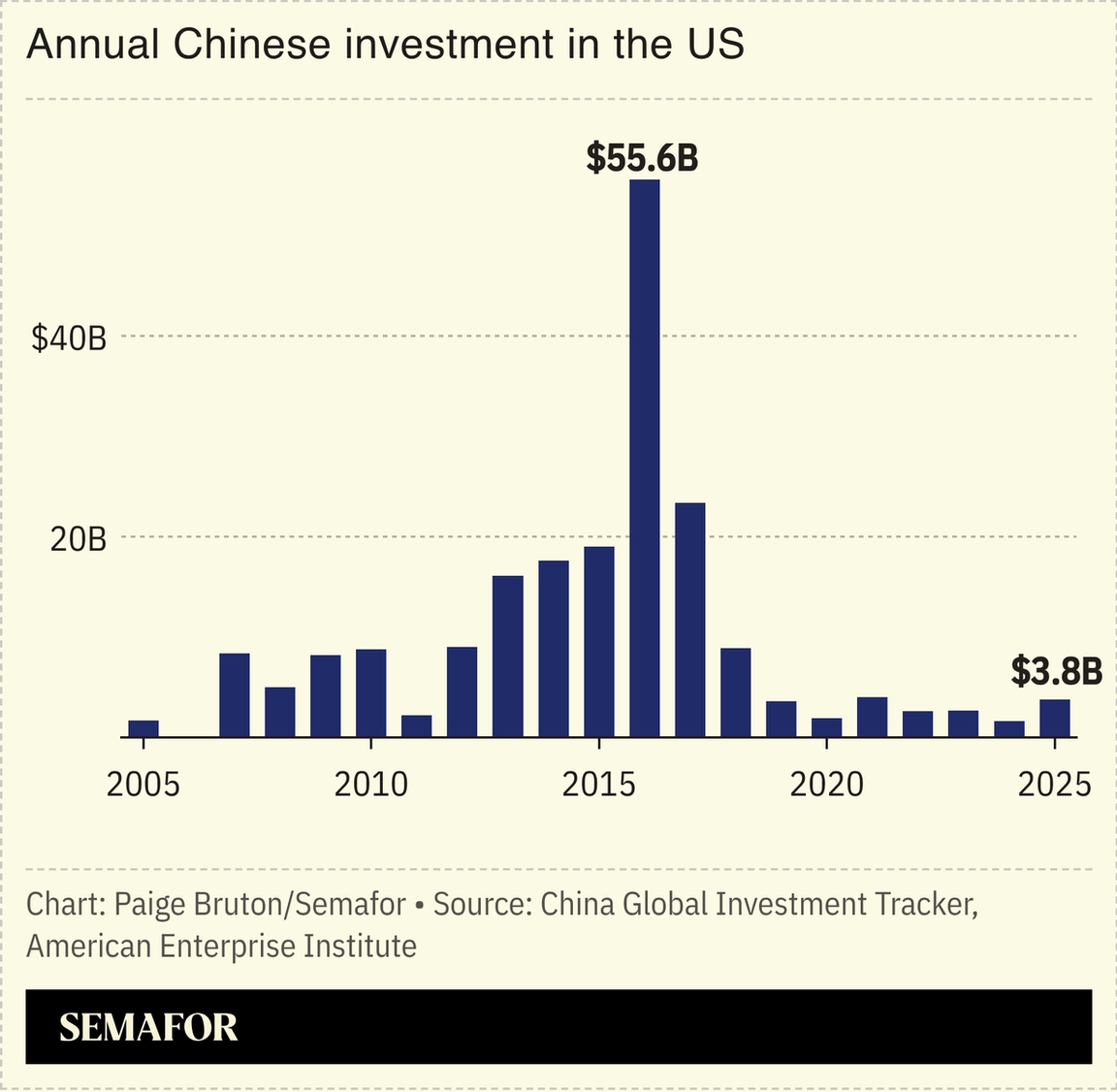 Chinese investments into “non-strategic, non-sensitive” US companies would get fast-tracked regulatory approval under an agreement being ironed out in Beijing this week. “What we want to do is make sure that these investments don’t get referred” to the Committee on Foreign Investment in the US, the government body that reviews and often rejects inbound deals on national-security grounds, Treasury Secretary Scott Bessent said on CNBC. “So this would pre-game those investments.” Bessent met with his Chinese counterpart in Seoul earlier this week and Republican senators who visited China the week prior said the board could serve as a way for non-sensitive deals “to take place in a more routine manner.” That contradicts what Amb. Jamieson Greer, the administration’s top trade official, told Semafor last month: The “board of investment” being discussed “isn’t about CFIUS,” he said. “It doesn’t affect that. It’s really a government-to-government forum to talk about investment issues as they come up.” Chinese investment into the US has fallen from $56 billion in 2016 to less than $4 billion in 2025, squeezed by tightening scrutiny on both sides. Both countries are keen to boost that number, though where the White House’s red line is drawn — particularly around cutting-edge tech and AI components — will be key. |
|
 Shannon Stapleton/Reuters Shannon Stapleton/ReutersAs the Trump administration takes a lighter touch to policing corporate mergers, local officials are filling the gap. The latest flavor of this all-politics-are-local enforcement approach: New York City Mayor Zohran Mamdani is urging state regulators to block Western Union’s takeover of Intermex, a remittance company used by immigrants sending money to Latin America, Semafor scooped. Elsewhere, state attorneys general are pursuing antitrust cases, dropped or ignored by the Justice Department, against tech companies HPE and Juniper and broadcasters Nexstar and Tegna. California’s attorney general is investigating the pending merger of Paramount and Warner Bros., and 34 state AGs are trying to break up ticketing giant Live Nation. |
|
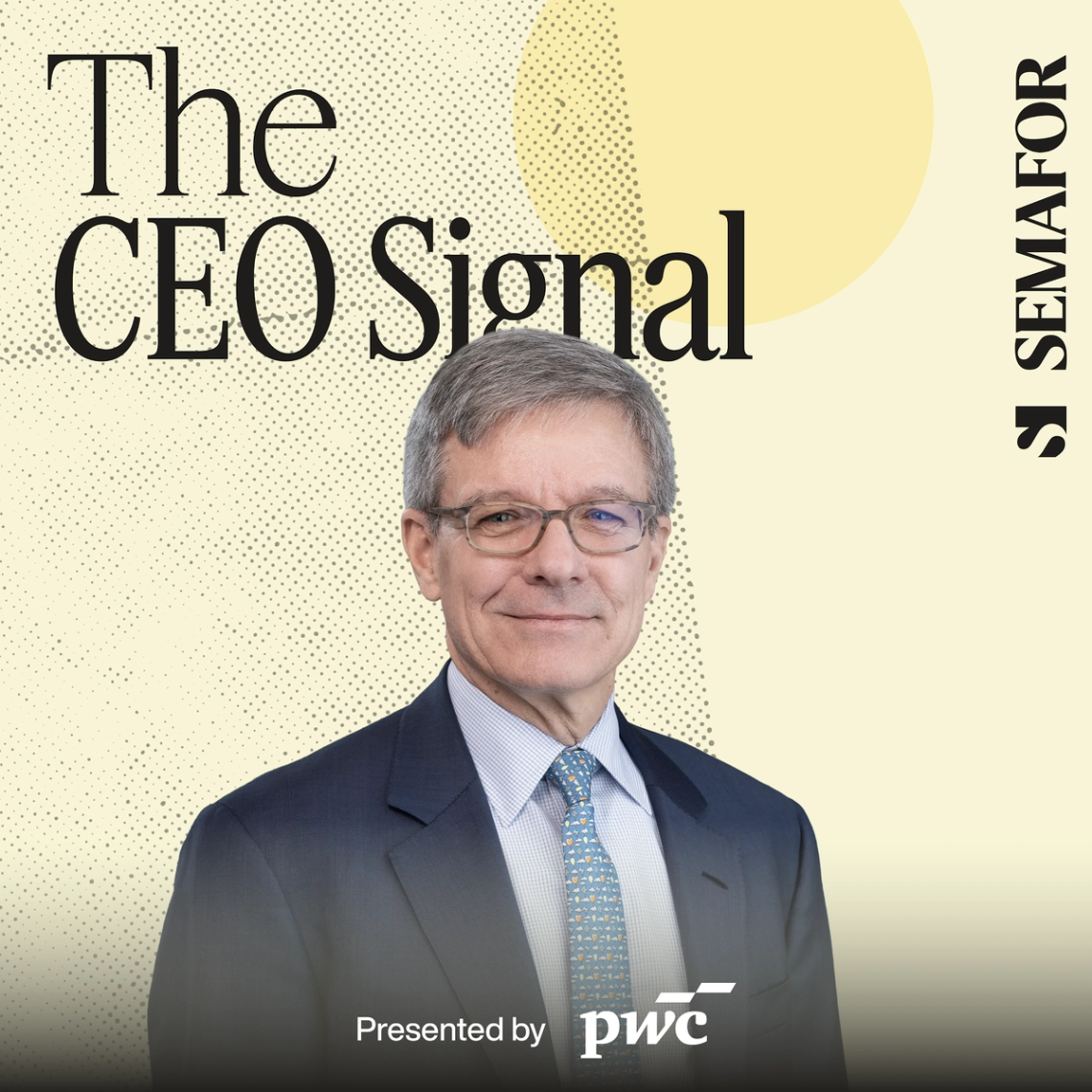 Tom Wilson runs an insurance company in a low-trust America. That makes trust a core business issue for Allstate. “We sell trust,” he says. On this week’s episode of The CEO Signal, presented by PwC, Penny Pritzker and Andrew Edgecliffe-Johnson ask Wilson how that premise shapes the way he leads one of America’s biggest insurers. Wilson, who has led Allstate for nearly two decades, is disappointed that more CEOs are not speaking up on societal issues — but he is not calling for corporate commentary on everything. He explains the framework Allstate uses to decide when it has standing to engage, how the company connects corporate purpose to employees’ personal purpose, and why AI should force leaders to ask a harder question than how much cost they can cut: what kinds of good jobs can they create? |
|
AI is coming for (some) jobs |
 Blair Effron (R) speaking at an event in 2024. Lananh Nguyen/Reuters. Blair Effron (R) speaking at an event in 2024. Lananh Nguyen/Reuters.The AI future is here, but unevenly distributed. Doomsday predictions about AI’s jobs wipeout are overly influenced by tech companies and don’t reflect the reality that most companies don’t know how to use it, said Blair Effron, CEO of boutique investment bank Centerview. “A year and a half ago, I was deathly scared that the issue of 2028 was only about jobs, that it was going to be an acute matter of unemployment going from 4% up to 10%,” Effron told Liz at an event in New York Thursday. “I have absolutely changed my perspective 180 degrees.” Nearly all the big companies that have explicitly tied layoffs to AI are tech companies, he pointed out. “Tech companies know how to do this, and they will,” he said. “Any company that isn’t native technology, it’s going to be quite a while before they figure out exactly what adoption looks like.” (Effron’s own business is being disrupted — or turbocharged, depending on your outlook — by companies like Rogo, an investment-banking AI tool spun up by three twentysomethings.) “You’re hearing from people who run tech companies who write code that AI is taking over the world,” Julie Samuels, CEO of industry group Tech:NYC, said at the event. “But that’s because it’s really, really good at writing code. It is not really, really good at a lot of other things.” |
|
Companies jostle for AI stock bump |
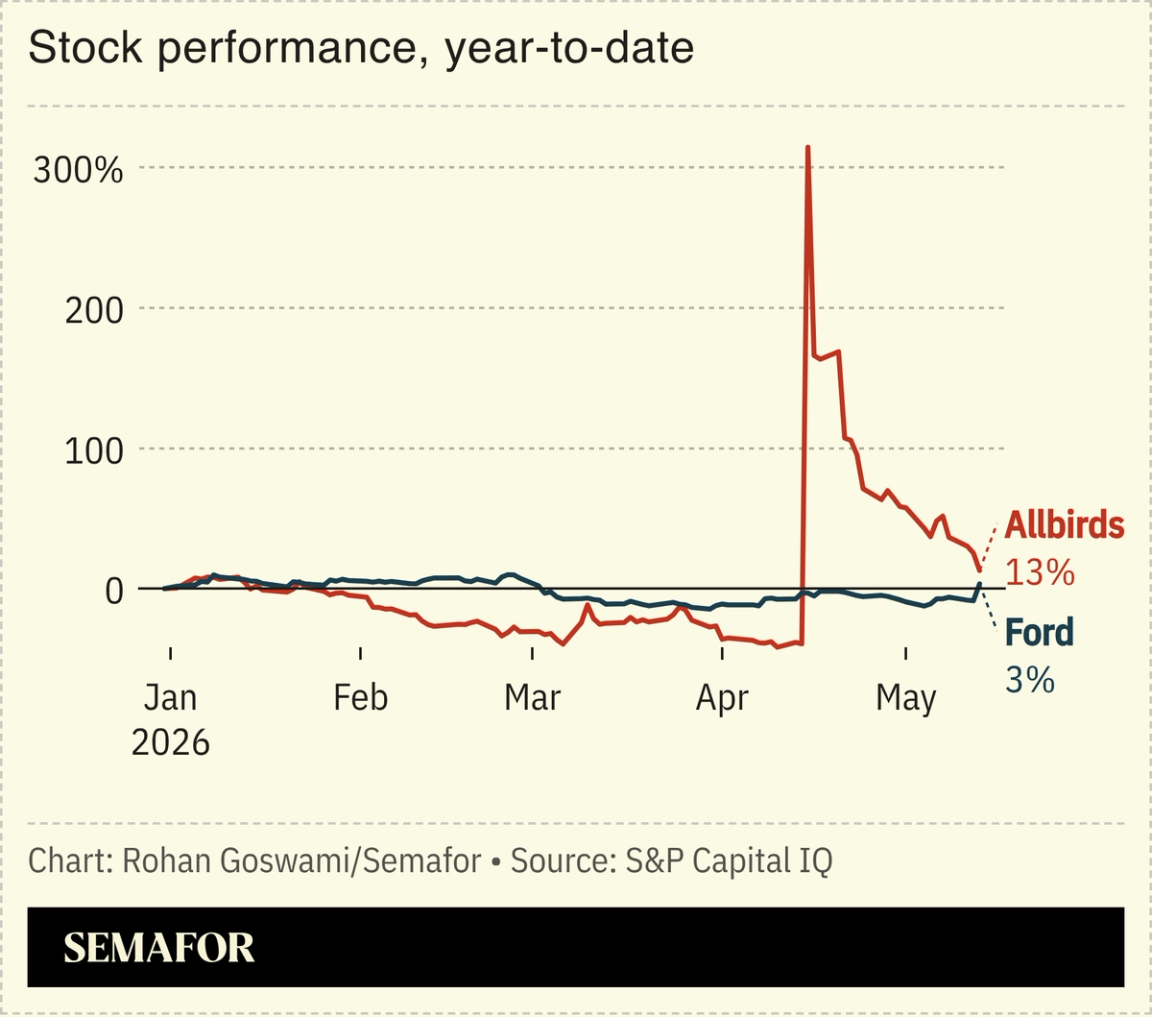 Call it the great Long Island Ice Tea Blockchain trade of 2026: Companies are jostling for an AI stock bump. If you’re a flailing sneaker company like Allbirds, you issue a press release announcing you’re now in the GPU-leasing business. If you’re a blue-chip company with equity coverage, like Ford, you whisper to your analysts and let them do the work for you. Shares in the Detroit automaker surged 14% Wednesday off the back of a Morgan Stanley note that pointed out Ford’s new energy-storage business, built on the back of the batteries that power its shrinking electric-car arm, could work for data centers, too. Investors have an insatiable appetite to fund the pick-and-shovel businesses underpinning data-center buildouts and Ford’s version of an AI pivot shows that even staid companies like the 122-year-old giant aren’t above the fray. Backchanneling to stock analysts is, on the refinement scale, somewhere between Allbirds’ naked and evidence-proof pivot and more defensible AI plays, like toilet maker Toto highlighting the uses of its advanced ceramics in AI components. — Rohan Goswami |
|
 Tired of the same business news? The Hustle covers the bold, bizarre, and brilliant from the far corners of business. Every day, more than 1.5 million readers discover daring moonshots and oddball ideas traditional outlets won’t touch. No ads, no fluff, just fresh perspectives in five minutes flat. Subscribe today. |
|
➚ BUY: Soft power. In a toast to Xi, Trump acknowledged a love for “basketball and blue jeans” in Beijing, while noting that Chinese restaurants in the US now outnumber some of the largest American fast food chains. ➘ SELL: Hard liquor. Diageo is hoping a World Cup partnership can stem the bleeding from a broader downturn in the spirits sector. Its US sales fell 15.4% from a year ago. |
|
 Companies & Deals- Edge case: Chipmaker Cerebras went public today in the largest IPO so far in 2026, raising $5.5 billion, paving the way for more highly anticipated public offerings that could top records this year, like OpenAI’s and SpaceX.
- Poorly timed: Wix shares fell 30% on weak earnings during a quarter in which it bought back $1.6 billion of its own stock. Companies are never good at buybacks, but this is the definition of buying high.
- Toxic relationship: Plans to build a $1 billion Trump Tower in Australia fell apart as the local developer called the family’s brand “toxic.” The Trump Organization said the developer was “unable to meet the most basic financial obligation.”
Markets- What’s old is new again: Global EV sales are surging as the Iran war sends gas prices soaring; OPEC and the IEA are forecasting that global fossil fuel demand could be permanently lower after the conflict ends.
- Who even knows anymore: US retail sales jumped for the third consecutive month in April, with rising gas and food prices muddying the snapshot on American spending.
|
|
|


