
Here’s What I Told the DNC Autopsy
The Harris campaign’s head of digital offers his candid breakdown of what worked in 2024, what failed, and what Democrats have yet to learn.
|

Editor’s note: Democrats have been taking whacks at DNC chair Ken Martin in recent weeks for not releasing the long-awaited “autopsy” report on the 2024 election. Now a prominent official on the Biden and Harris presidential campaigns—Rob Flaherty, the deputy campaign manager, who led digital operations—has written for The Bulwark his own summary of what went right and wrong.
Flaherty’s analysis is fascinating not only because of his unsparing criticism (including of his own decisions) but also because of his up-to-the-minute insights into how digital campaigning is changing. It’s a guided tour of how top operatives think about this rapidly evolving field. He ends with speculation about how AI could transform campaigns—not in some far-off future but maybe as soon as this year’s midterms. Buckle up.
We’re able to bring you longform analysis like this thanks to our Bulwark+ members. More than 120,000 people have joined forces to help build this home for independent journalism and commentary. If you’re already among them: THANK YOU.
And for everybody else, I hope you’ll find value in Flaherty’s article—and consider becoming a Bulwark+ member yourself. If you sign up today, you’ll get a two-week trial period for free—this free trial offer ends Sunday.
–Adam Keiper
Executive editor, The Bulwark
 |
YOU MAY HAVE HEARD about the Democratic National Committee “autopsy”—the post-election report commissioned by the DNC in 2025 to examine what went wrong in the 2024 campaign.
And you may have heard that it was never released to the public.
Because of that, there’s been a lot of rightful concern among Democrats about there not being an honest accounting of what went wrong and what we could learn from it. But there are a few people who have insight into what the autopsy report actually says and can share what they know of it. I’m one of them.
I was deputy campaign manager of Kamala Harris’s 2024 presidential campaign (and of Joe Biden’s campaign before that). My remit was things that touch the internet: social content, creators, rapid response, paid media, fundraising, digital organizing, and a few other odds and ends along the way. I was one of the few campaign staff the autopsy team actually spoke to, which is its own problem. (And, hey, if you appreciate the type of experience and strategic analysis that gets you an invite to speak to the autopsy, have I got a podcast for you.)
Now, to be clear, I have not seen the autopsy report. I understood that they would release the autopsy shortly after last November’s off-year elections. The team putting together the autopsy first reached out to former campaign staffers in late September 2025, and I spoke with them in mid-October. It seemed odd that they were doing this so late, but I played ball for two reasons: (1) It’s important to look backwards to learn what makes sense for the next election, and (2) the digital components of a campaign are usually misunderstood—assuming any effort is made to understand them at all.
But then . . . the autopsy never went out.
News coverage has focused on why the DNC shelved it. My understanding—based on Dem-world hearsay—is that the truth is stupider than the fiction: No autopsy was released because there is no actual autopsy. The members of the “autopsy team” were in over their heads and struggled to put the thing together. What they produced was a loose summary of a bunch of interviews that were largely done without talking to the campaign or big spenders.
The more interesting question is what would an actual autopsy of the 2024 campaign have said?
One overarching takeaway from my time on the Biden 2020 campaign (which we won) and the Biden→Harris 2024 campaign (which we lost) is that results don’t totally define what lessons you can draw from a campaign. There were things we messed up in ’20 and things we got right in ’24. Some folks might yell at me for this, but I think that in ’24 we ran a good—not great; certainly not perfect—campaign that was stuck in a hole we just couldn’t get out of. The average shift toward Trump was significantly lower in the states where we competed than in the ones where we didn’t. But you don’t get a medal for “the average shift being significantly lower.” We lost and should learn lessons from it.
No autopsy—not the DNC’s, not any outside group’s, and not mine—is going to show a smoking gun. There are too many confounding variables, too many what-ifs. But a smart, careful autopsy would still provide practical insights that could inform what to do in the future. So, in that spirit, I want to offer here the gist of what I told the team that worked on the DNC autopsy. Some of this I said to them directly; other parts of it I would have said if we had had more time; and the rest has taken shape in the months since I spoke with them last year.
I’ll break this down into three parts:
Part 1: What Happened
Part 2: How It Happened
Part 3: What Happens Next
A caveat before we dive in: This is just one guy’s opinion. It is not the official Harris campaign’s opinion, nor maybe even the opinion of the majority of those who worked on the campaign. There are very smart people on that team whose analysis and conclusions would be different from mine, and who will tell you that I am completely full of shit. When I shared a draft of this article with other campaign folks, some told me directly they disagree with parts of what follows. I’m sure you will, too. But I was there. I have a different lens than most. So here’s my take.
Part I: What Happened
You Have to Have a Brand. We Didn’t.
My biggest lesson from the 2024 election is that tactics don’t add up to a brand, and a brand is the most important thing in politics today. Without a brand that people genuinely feel is connected to your candidate’s deeply held beliefs, your tactics will add up to nothing. You’ll reach people but won’t close the deal.
People often think of a campaign’s brand as visual—the logo, for instance—but really it’s the story of why the candidate got into the race. That “why” is critical, and we couldn’t clearly articulate it.
Our research showed that we were reaching the voters we needed to reach, and that they even liked our specific outreach—our ads tested well and we started to win on underlying issues. But something bigger wasn’t gelling. It wasn’t just us: Incumbents around the world were getting absolutely croaked. Labour’s honeymoon in the U.K. lasted about twelve seconds.
We underestimated then—and are underestimating now—just how disillusioned people are. There was and is a pervasive sense that nothing works and the institutions holding us up have failed. Media, government, business—no one trusts anyone anymore. For reasons both of Democrats’ own making and from simply being incumbents, the Democratic brand sucked.
In the face of that massive cultural shift toward skepticism and distrust, and some holes Democrats dug for ourselves, we hit the limit of what campaign tactics can do. We cut the margin everywhere we played, but the national deficit was too much to overcome. We could not break the perception that we were the status quo.
We traditionally think of “swings” as right-left or left-right—the kind of person who, say, votes for Romney one cycle and Obama the next. In reality, today’s swing voter is choosing between “change” and “burn it all down.” People just didn’t trust our ability to make a difference in their lives.
Which brings us to the elephant in the room: President Biden never should have run for re-election in the first place. Biden’s a good man; I think he woke up every day trying to do what was best and I think he genuinely believed he was the only one who could defeat Donald Trump. When he decided to run again—irrespective of the wisdom of that decision—my view was that the best thing to do was to throw everything we had at getting him re-elected. It was the only option to stop Trump. You may have even seen an email in my name making the case for Biden being the only person who could win.
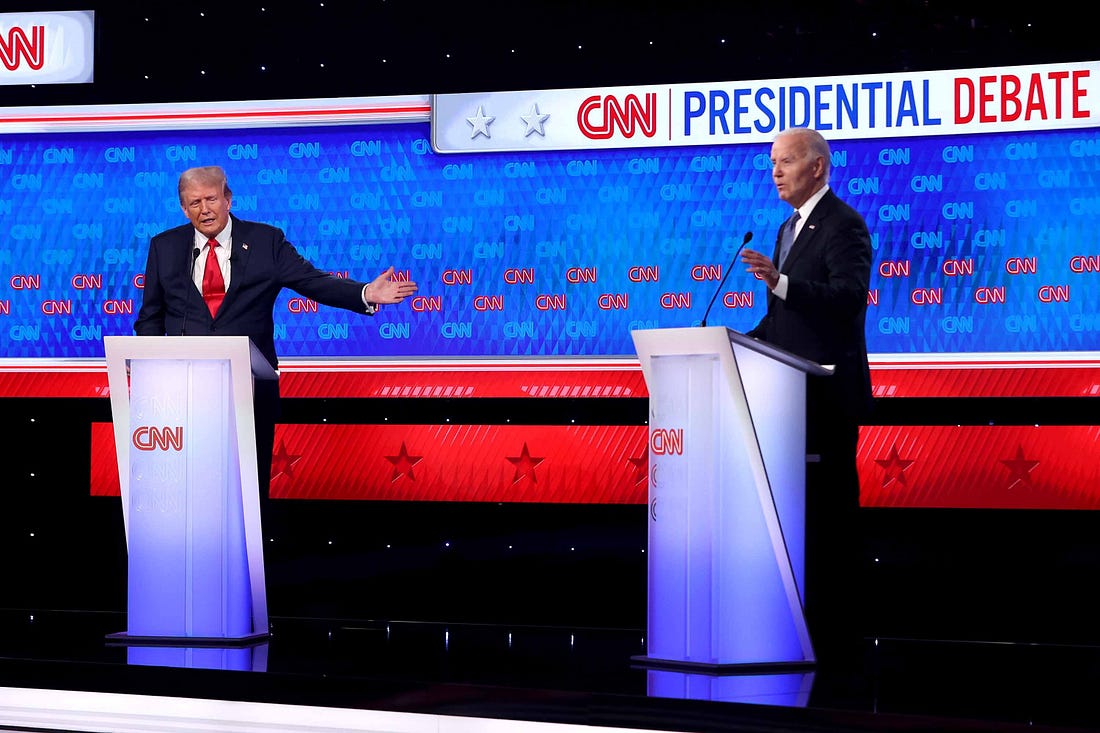
Look, I am a political professional: I believed—and still believe—that once you’re on the team, you’re on the damn team. Even after the pivotal June 27, 2024 Biden-Trump debate, the campaign owed it to downballot candidates and grassroots donors to keep up our energy. Grassroots donors were keeping the lights on, and if Biden was staying in (which I believed he was going to), they needed to see the campaign rally like they were. Our only option was to fight to the death. Turns out, well, that’s what we did.
 |
We all knew Biden’s age was his worst negative. At 81, he was the oldest sitting president. But his age was more than just a number, it mattered tactically. It was harder for him to communicate clearly, which eroded trust in his leadership. But the worst damage was to the perception that Biden could connect with people’s lives and could be trusted to deliver. Even at the beginning, focus groups showed clearly that the problem wasn’t that Biden was perceived to be senile—it was that he was perceived to be too old to understand what voters were going through. The perceptions around his age took away Biden’s reputational superpower: empathy, the thing that kept him in the Senate for thirty-six years, got him on the ticket in 2008, and made him president in 2020.
And unfortunately, the problem of Biden’s age also pre-loaded the “she’s not in it for you” perception that would dog Vice President Harris.
I saw the vice president rise to the occasion in all the obvious ways—and in ways people didn’t get to see. But in a country fervently pissed off at the status quo and with Biden’s numbers being what they were, anyone from the Biden administration would have lost.
Could Harris have rehabilitated the brand by distancing herself more from Biden? Perhaps there were ways she could have, but I doubt it would have changed the outcome. It was a quandary: If she had said ‘Joe Biden was wrong about [X] and I disagreed vehemently,’ the obvious journalistic followup would be: ‘Okay, so what did you do about it?’ Once we missed an early window on that distancing, anything late-breaking would have seemed political and phony.
It’s clear in retrospect that what Democrats needed for our damaged brand in 2024 was a primary in which a real, well-funded candidate running an economically populist campaign could have teed off against the Biden administration. Even that wouldn’t have been a sure bet. But “a primary” and “a one-week shotgun primary 107 days out from the election” are not the same. Once we were in it, we were always playing around the edges.
Paid and Organic Brands Need to Align
Throughout the campaign, there was a disconnect between what people were hearing from us and about us in earned and organic media, and what we were saying in paid media.
Online and at events, the campaign came to be “Freedom” and “brat girl summer.” Most of that happened organically—people latched on to those frames and they stuck. Personally, I liked “Freedom.” You can probably tell from this video. I thought it could effectively combine our economic and anti-authoritarian arguments—and it had its fans. Ad testing showed it was actually among our most persuasive pieces of content of the whole campaign.
But in the long run, I don’t know if I was right. Either way, my side lost the internal debate. After David Axelrod panned the spot as “base mobilization” on an episode of Hacks on Tap, we moved on from using it in paid media.
It’s hard not to look at the success of an affordability message in the time since the campaign and wonder what would have been if we had focused just on that.
Then again, would it have been convincing in 2024? Harris was the sitting vice president.
Contra conventional wisdom, when we messaged people—through paid media, mainly—on middle-class economics, it worked. Harris started to close the gap on whom voters most trusted to handle the economy. People even started to associate her with “middle-class economics.” Looking back, though, “middle-class economics” is a political buzzword that means nothing to anyone. Trump’s message was much clearer: The economy feels bad and Harris says it’s good. Those vibes were tough to argue with.
This is where having 107 days to put a plan together just