| | US inflation rises more than expected, the yuan strengthens, and AI tensions loom over US-China talk͏ ͏ ͏ ͏ ͏ ͏ |
| |  | Flagship |  |
| |
|
The World Today | 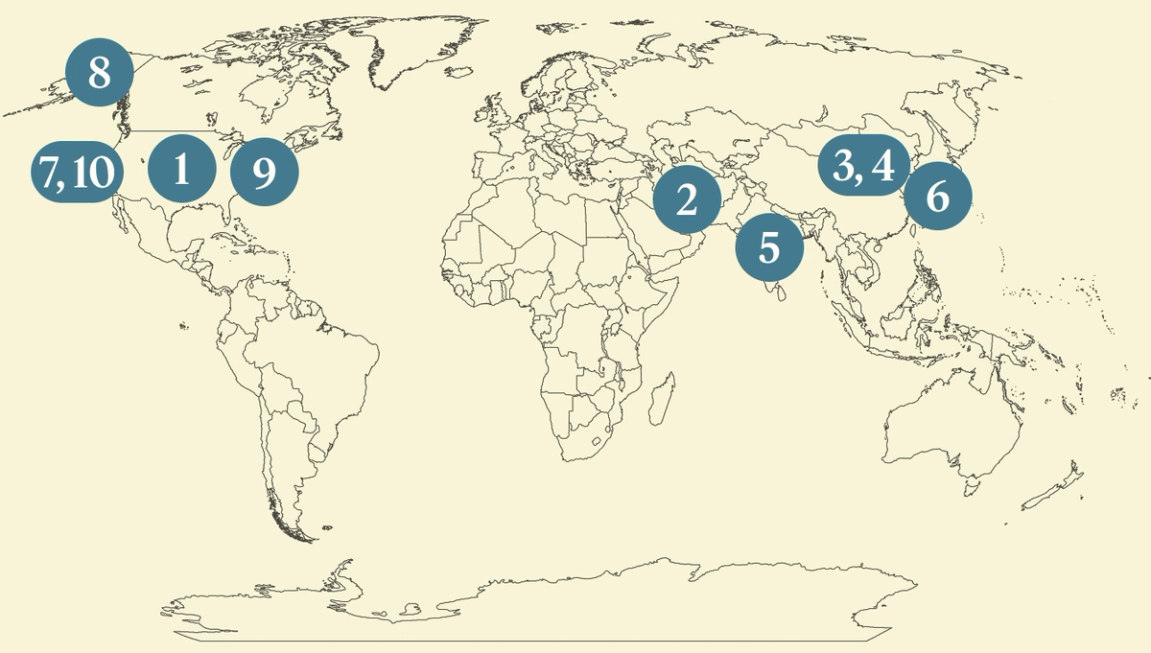 - US inflation jumps, stocks slip
- Gulf’s secret attacks on Iran
- A US-China currency war
- AI tensions at Beijing summit
- Foreign investors flee India
- SK’s AI dividend proposal
- Sam Altman under scrutiny
- Big Oil returns to Alaska
- The future of agentic media
- Google DeepMind games
 Rethinking our relationship to nature. |
|
US inflation jumps on gas price hikes |
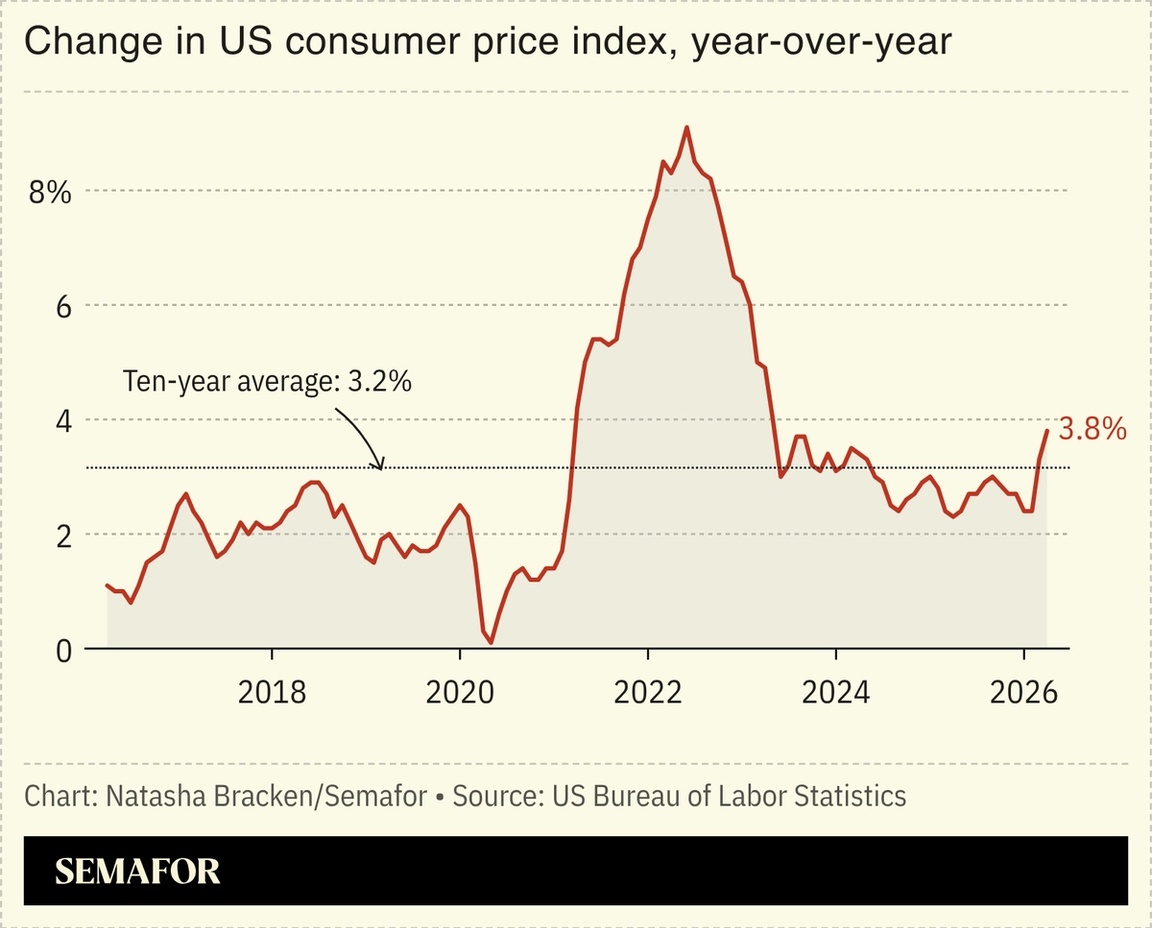 US inflation jumped in April to its highest level since 2023, largely driven by surging fuel prices sparked by the Iran war. The hotter-than-expected reading pushed stocks down and bond yields up just ahead of Kevin Warsh taking over as chair of the US Federal Reserve, where he will contend with both higher prices and President Donald Trump’s calls to cut interest rates. But the US economy is less sensitive to interest rates than it used to be, eroding one of the Fed’s most powerful economic levers, Semafor’s Liz Hoffman wrote. Warsh is “of the view that rates [are] a blunt instrument at best, and probably not nuanced enough to deal with a more complicated economic storyline today,” an investment executive said. |
|
Saudi also secretly struck Iran |
 Brian Snyder/File Photo/Reuters Brian Snyder/File Photo/ReutersUS President Donald Trump on Tuesday said Iran must strike a deal or “be decimated,” as Gulf nations’ involvement in the war came into clearer view. The warning, which Trump issued as he departed for Beijing, underscored the fragility of the ceasefire with Tehran and the stalemate in the Strait of Hormuz. Trump is facing swelling bipartisan frustration from lawmakers over the war, as the conflict’s cost ballooned to $29 billion. The hostilities have also drawn in the broader region: Following a report that the UAE secretly attacked Iran last month, Reuters reported Tuesday that Saudi Arabia launched unpublicized strikes against the Islamic Republic, while Kuwait accused Iranian forces of trying to infiltrate its territory on May 1. |
|
US-China currency war simmers |
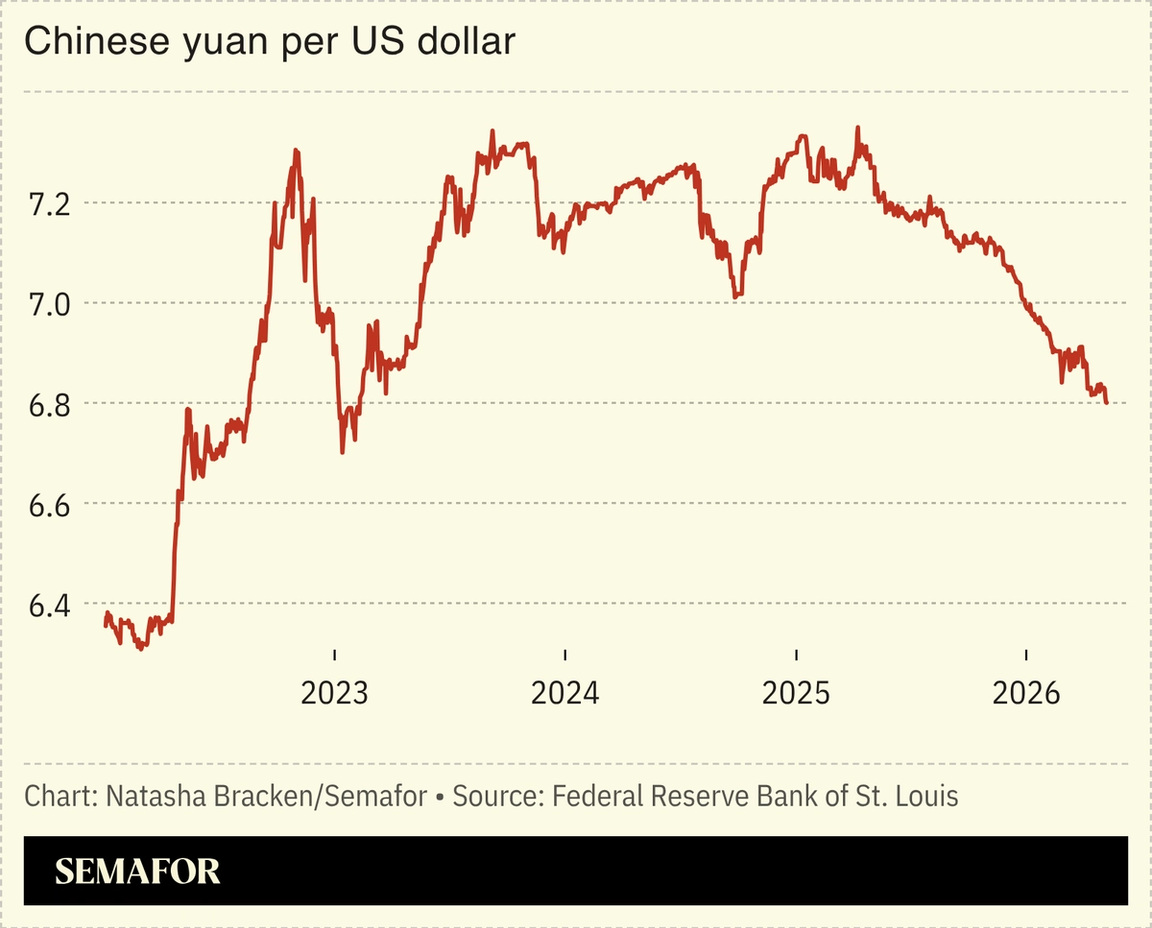 The yuan hovered near a three-year high against the dollar Tuesday, buoyed by expectations of stronger US-China ties ahead of this week’s meeting between the countries’ leaders. Goldman Sachs analysts said China’s currency remains more than 20% undervalued and will keep strengthening this year, and a summit that stabilizes trade ties could accelerate its climb. An “intensifying currency war” is simmering between the two superpowers, The New York Times wrote, as Beijing eyes a larger international role for the yuan, while the US looks to defend the dollar’s position as the world’s reserve currency. Washington has discussed currency swaps with Gulf and Asia partners in an effort to entrench dollar dominance, a strategy the US Treasury secretary said would strengthen “America’s economic shield.” |
|
AI tensions loom over Trump-Xi meeting |
  Evelyn Hockstein/File Photo/Reuters Evelyn Hockstein/File Photo/ReutersAI is on the agenda for the Donald Trump-Xi Jinping summit this week, but analysts say it’s unlikely Beijing will cave on agreeing to significant guardrails around the technology. The meeting comes as both countries race to create and adopt new AI models amid mounting cybersecurity fears. Anthropic last month refused to give Beijing access to its new too-risky-to-release model, The New York Times reported, a sign of how the superpowers’ deepening tech rivalry could imperil their leaders’ talks on AI safety. Investors are expecting trade tensions to be on the backburner at the summit, and are focused instead on possible chip export control discussions, Reuters wrote. “The only thing worth monitoring is development around AI,” a Beijing-based fund manager said. |
|
Foreigners pull out of India at record pace |
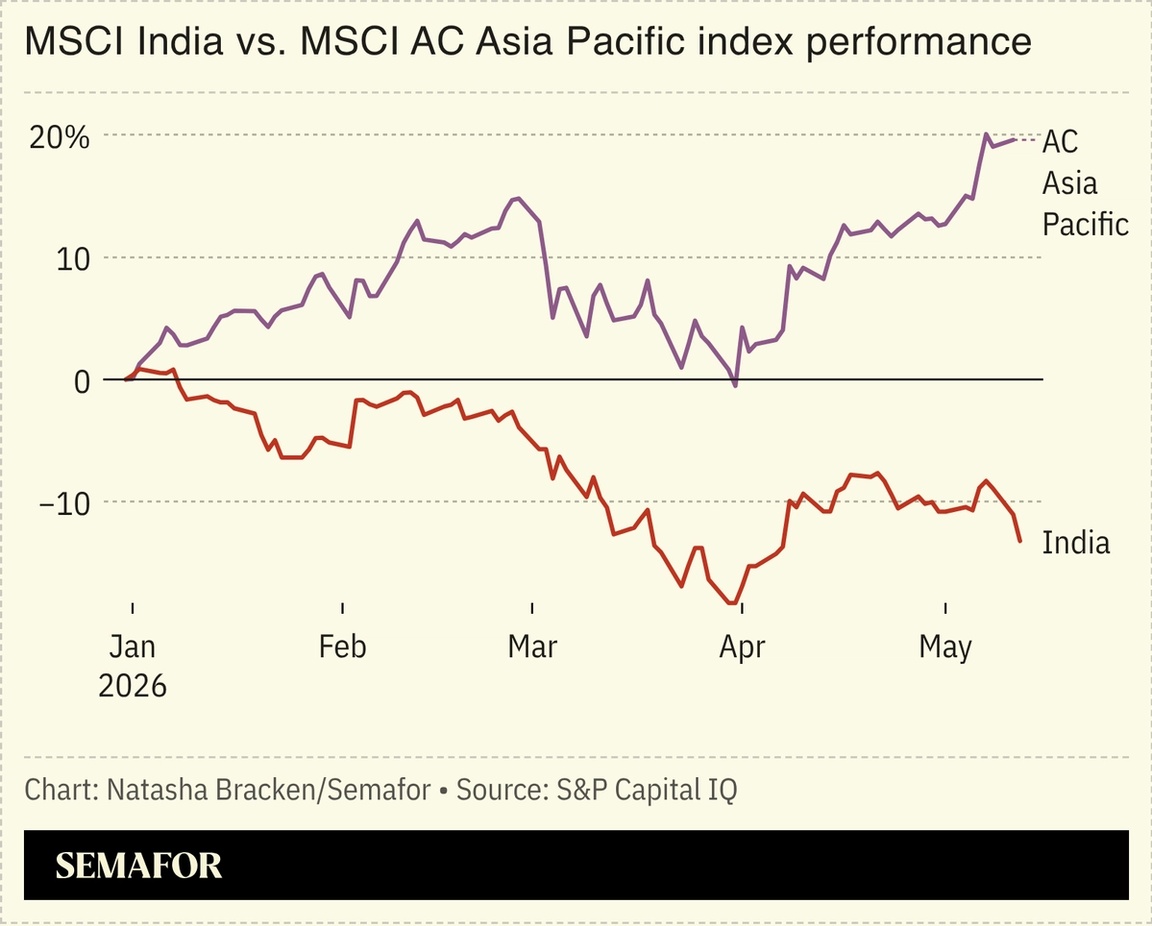 Foreign investors have pulled $21 billion out of Indian stocks in the last two months, putting 2026 on track to be the worst year for outflows since the markets opened to overseas investment in 1993. Investors are instead looking to South Korea and Taiwan, where stocks are booming on the back of AI chip demand. India has also been hit especially hard by the ripple effects of the Iran war, with New Delhi recently urging Indians to travel less and stop buying gold. The rupee has weakened considerably. Adding to the markets’ pain: The digital arm of Reliance Industries is now rethinking its IPO, which was set to let existing investors cash out, but will instead be a fresh share sale to avoid worsening outflows. |
|
SK official proposes AI dividend |
 Kim Soo-hyeon/Reuters Kim Soo-hyeon/ReutersA top South Korean official proposed that citizens should share in the profits of the country’s AI chip boom. Samsung and SK Hynix have seen huge profits and soaring share prices as demand for semiconductors surges. Kim Yong-beom’s suggestion that some of that windfall should be redistributed to support basic income programs for rural communities and startup funding for young people, spooked investors, but AI leaders themselves have suggested similar proposals. Anthropic’s Dario Amodei, Google DeepMind’s Demis Hassabis, OpenAI’s Sam Altman, and Elon Musk have suggested some sort of universal basic income (or “universal high income,” in some formulations) funded by taxes on AI companies. Bill Gates, back in 2017, floated a “robot tax” on companies automating workers’ jobs away. |
|
Altman under scrutiny amid trial, IPO plans |
 Manuel Orbegozo/Reuters Manuel Orbegozo/ReutersThe head of OpenAI is facing heightened scrutiny thanks to a lawsuit from Elon Musk and a massive, planned IPO. Sam Altman took the stand Tuesday in the trial against Musk; the Tesla CEO, who also co-founded OpenAI, has accused the AI startup of betraying its original nonprofit mission. Musk has looked to portray Altman as deeply untrustworthy. It’s “a little bit unfortunate for the AI industry at a time when the public perception of AI is quite negative,” a tech policy expert said. Republican lawmakers are also probing Altman’s personal investments ahead of the IPO, after the Wall Street Journal reported that he sought to have OpenAI back companies he also personally invested in. |
|
Alaska’s renewed appeal to oil majors |
 Mark Meyer/Reuters Mark Meyer/ReutersOil majors are exploring the Alaskan Arctic, spurred by the Iran war energy crisis and the White House’s support for fossil fuels. Shell abandoned Alaskan offshore drilling in 2015 after a $7 billion debacle. But onshore exploration in a region estimated to hold 8.8 billion recoverable barrels, and the Trump administration’s loosening environmental regulations, make it appealing again. Alaska’s Pacific location is especially useful: Asia is starved of oil by the Strait of Hormuz disruption, meaning US exports have a ready-made market. Environmental groups told the Financial Times that the projects could become “stranded assets” when future presidents reverse course, but majors are betting that such reversals would be politically costly. |
|
Agents the new online gatekeepers |
 Manuel Ausloos/Reuters Manuel Ausloos/ReutersAlgorithm-powered social media feeds will give way to online spaces dominated by personalized, agentic interfaces, a new report predicted. AI models will replace platforms like Twitter and Facebook as the primary gatekeepers of information, according to tech and media researchers at the nonprofit New_ Public, whose co-director coined the now-universal term “filter bubbles.” As AI makes “synthetic engagement” cheap, trust and reputation will become the new currency, while human-to-human connection becomes more valuable. One likely outcome, per the report, is a rise in “high-trust micro communities,” like a local running group, and online spaces that are overseen by both humans and AI agents. |
|
|


