| | In this edition, Kevin Warsh’s confirmation as Fed chair comes at a time when the economy is less se͏ ͏ ͏ ͏ ͏ ͏ |
| |  | Business |  |
| |
|
 - Who’s not going to Beijing
- What CEOs want in China
- The future of Big Law
- eBay’s better alone
- Paramount reassures Hollywood
|
|
 Kevin Warsh is expected to be confirmed this week as Federal Reserve chairman after signalling a willingness to lower interest rates — either because the president wants him to, or because he thinks current conditions justify it. It’s not entirely up to him, and the market is losing faith in that outcome anyway, but the bigger question is whether it would matter. The US economy is less sensitive to interest rates than it used to be. The long shift from manufacturing — which responds to higher borrowing costs (factories are expensive) in a way that services don’t — has blunted one of the Fed’s most powerful economic levers. The ultrarich, whose spending has ballooned, don’t care what money costs. Neither do the tech companies fueling the AI boom, which they see as an existential moment they can’t risk missing out on. “Most of our economic models today … were designed for completely different economic times,” Anne Walsh, Guggenheim’s macro-investment guru, told me last week to explain the limits of the Fed’s playbook in the face of today’s inflation. “I think they’re stale.” Another kink in that policy-transmission hose is that the Fed only controls overnight interest rates, not the longer-term levels that determine what money costs in the real economy. Expectations of inflation (if you’re a pessimist) or growth (if you’re an optimist) have kept longer-term borrowing costs higher than you’d expect after six rate cuts. And as Bloomberg’s Joe Weisenthal offers in a related diagnosis this week, the economy is being tossed around by supply shocks, which central bankers can’t control, rather than the demand shocks they can. The Iran war is a shock to the supply of oil. AI is a shock to the supply of knowledge. The Trump administration is a shock to the supply of certainty. Put it together and central bankers are pushing on a string, and getting less bang for their buck on interest rates. Huge swaths of the economy care only that money is available, and it is. By the Fed’s own measure, financial conditions are looser than they were before it started raising interest rates 38 months ago, meaning it’s easier (if not cheaper) for people to borrow to start businesses or build factories or make leveraged bets on stocks. Which makes Warsh an interesting choice at this moment. “He’s more of a monetarist,” Guggenheim’s Walsh said, focused more on the availability of money than on what it costs. Warsh has said shrinking the Fed’s balance sheet and “run[ning] the printing press a little quieter” — a jab at stimulus-happy electeds of both parties — is as important as anything the central bank might do on interest rates. (That’s also the more politically tenable position, since quantitative tightening is less likely to generate the same angry call from the White House as failing to cut interest rates.) Warsh “views monetary policy differently than Jay Powell, and frankly, his predecessors,” Guggenheim’s Walsh said, and is “of the view that rates [are] a blunt instrument at best, and probably not nuanced enough to deal with a more complicated economic storyline today.” |
|
Who is, and isn’t, going to China |
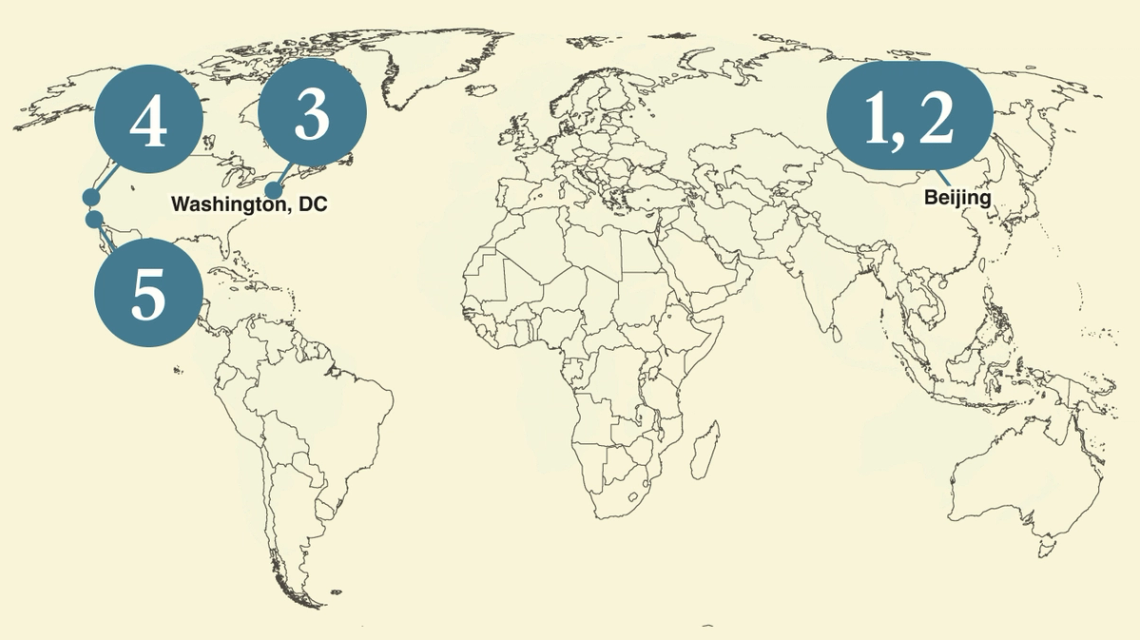
  Trump and Xi Jinping during a meeting in October 2025. Evelyn Hockstein/File Photo/Reuters. Banner credit: Andrew Caballero-Reynolds/AFP via Getty. Trump and Xi Jinping during a meeting in October 2025. Evelyn Hockstein/File Photo/Reuters. Banner credit: Andrew Caballero-Reynolds/AFP via Getty.More than a dozen CEOs will accompany President Donald Trump to Beijing this week. More noteworthy than who’s making the trip is who isn’t. Nvidia CEO Jensen Huang, who was on an early draft of the White House’s invite list that Semafor reported on last week, won’t be there. The Trump administration has signalled that Huang was left off the list because chips aren’t on the formal agenda alongside the Boeings and the beans, but it’s worth noting that the fine line Nvidia is walking between the US and China has become a political liability that could distract from a trip that the White House is positioning foremost around relationship-building. That’s why the folks coming along are generally viewed as neutral on China: Financial firms like Goldman Sachs and BlackRock, industrials like GE, telecom companies like Qualcomm (though, curiously, not Cisco, whose CEO begged off, citing the company’s earnings release), and Apple, which remains reliant on China despite years of shifting production across Asia. “Big American business is far from unanimous,” Semafor’s Ben Smith writes, and those with stickier agendas — notably, US automakers who desperately want to keep China out of the US — won’t be coming along. |
|
  A Reckitt livestream. Alexander Marrow/Reuters. Banner credit: Andrew Caballero-Reynolds/AFP via Getty. A Reckitt livestream. Alexander Marrow/Reuters. Banner credit: Andrew Caballero-Reynolds/AFP via Getty.One thing all of those CEOs flocking to China with the president are asking themselves — other than “how can I please Trump” — is “what are we getting out of this?” Our colleague Andrew Edgecliffe-Johnson’s interview with Reckitt CEO Kris Licht suggests that it isn’t the buying power of Chinese consumers, but their behavior, that’s valuable to western CEOs setting global strategy. The rise of TikTok-inspired “social commerce” in China is “the most profound channel shift I have seen in my career, in any market,” Licht said, and has driven sweeping changes in how Reckitt markets Lysol cleaners and Durex condoms. Six years ago, e-commerce accounted for 30% of Reckitt’s sales in China. Now, e-commerce and social commerce sales — driven through TikTok (locally, Douyin) Shop feature — account for 80% of Reckitt’s sales in China, up from 30% from e-commerce alone six years ago. The company’s new “China speed” playbook gives its executives there a longer leash to follow new consumer patterns, which could be “an early sign of where the rest of the world may go.” |
|
Wall Street’s newest obsession: funding lawsuits |
 Semafor SemaforLitigation has long been a cost of doing business. Now it’s becoming a Wall Street asset class. Chris Bogart spent years at white-shoe firm Cravath before founding Burford Capital, the world’s largest litigation finance firm, turning corporate legal disputes into an investable product with billions at stake. It’s the frontier of the financialization of everything, which brought us burrito bonds, coffee-pod bonds, and internet IP address bonds. “Companies don’t want to be buying legal services in the way that they’re being sold, but law firms don’t really have another option,” Bogart said on the latest episode of Compound Interest. That opens “a fertile ground for us to come in.” We also talked about what it would take to finally let private equity buy a piece of Big Law. “So many partners look back on their careers and say, ‘look at all the value I’ve created. If I’d started a technology company, hell, I’d be rolling in money,’” Bogart said. - Some news today from one of those partners: John Quinn, who built Quinn Emanuel into a litigation giant, is stepping back. No word on what’s happening to his equity in the firm, which Bogart, a longtime friend, said is the “poster child” for this problem and “easily a multibillion-dollar business.”
|
|
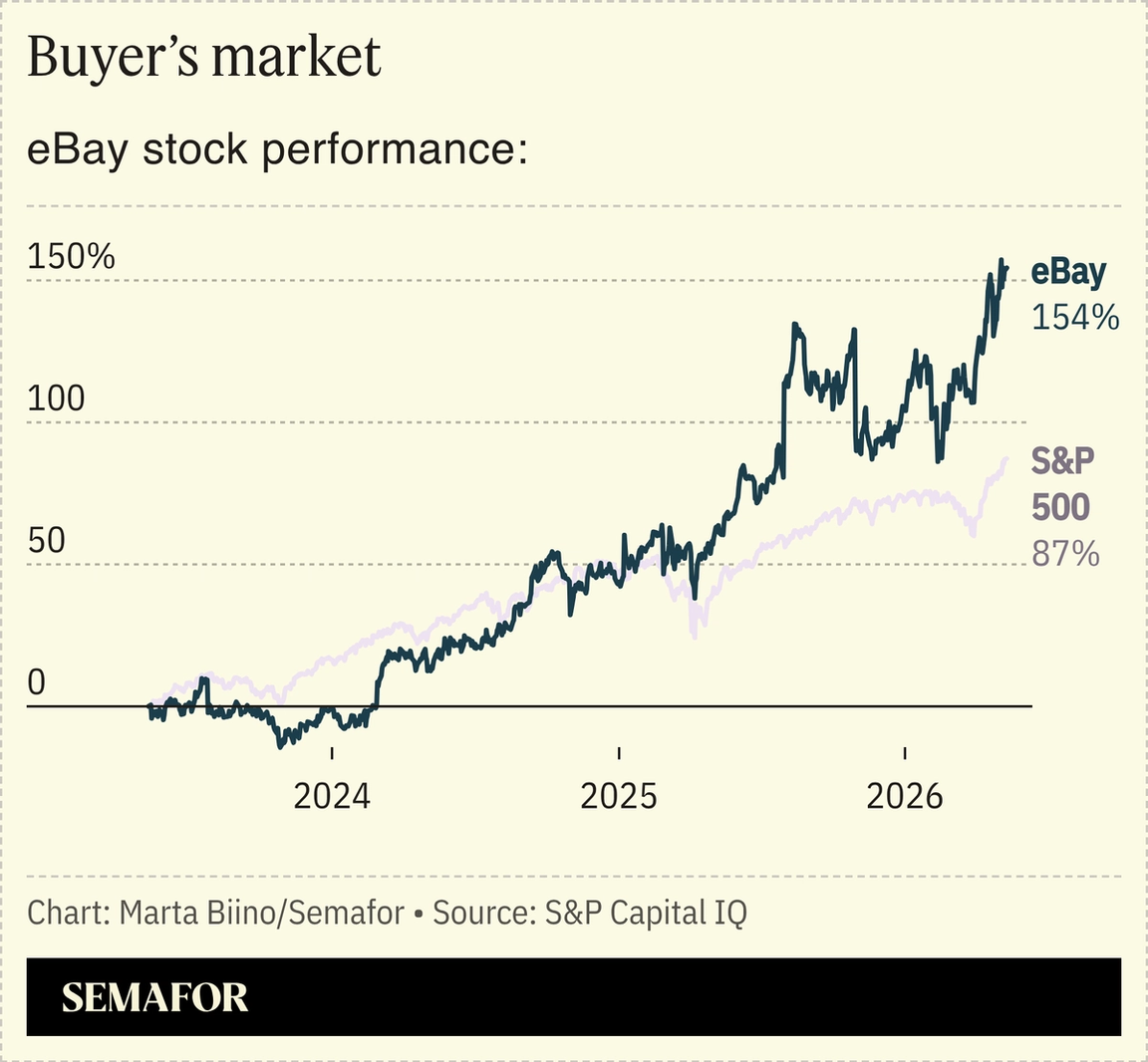 EBay has been ripe for a takeover, and rightly targeted by angry investors, many times. Now is not one of them. It’s one of many things that remains perplexing about GameStop CEO Ryan Cohen’s bid for the company, which eBay this morning rejected as “neither credible nor attractive.” EBay shares have nearly tripled since CEO Jamie Iannone took over in 2020. Its profit margins are more than twice those of Etsy and have held steady around 20% in recent years. Unlike the last time eBay tangled with an activist, there isn’t a PayPal-sized business to be spun off. Carl Icahn won the fight more than a decade ago — eBay eventually spun out the payments business — because he was right. EBay has managed its debt down from roughly $8 billion to $6 billion under Iannone; billions in fresh debt would be needed for GameStop to swallow a company five times its size. The company would be anywhere from five to seven times levered, depending on whether you believe Cohen’s plan to cut costs. When pressed on eBay’s capital return plans, M&A strategy, and whether they anticipate any cost cuts as a result of Cohen’s pressure, the people said they aren’t changing anything for now. Cohen’s limp showing on CNBC last week — where he told viewers to just check his website — gives eBay all the ammunition it needs for now to stiff-arm. — Rohan Goswami |
|
Paramount tries to calm creatives |
 Mike Blake/File Photo/Reuters Mike Blake/File Photo/ReutersParamount is racing to reassure Hollywood that its takeover of Warner Bros. Discovery, with its HBO streaming service, won’t kill movie theaters. “Theaters will continue to be an essential part of the moviemaking business and social fabric,” Paramount legal chief Makan Delrahim wrote to California attorney general Rob Bonta in a letter viewed by Semafor. “Paramount and WBD have every intention, and, importantly, incentive to keep filling California theaters (and theaters across the world) with a wide range of titles.” The letter was sent before Bonta’s press briefing on Monday, when he suggested the state might try to block the deal. “There are red flags everywhere,” Bonta said, naming “higher prices, lower wages, fewer jobs, less quality, less choice, less competition.” Paramount’s big challenge now — having won over skeptical shareholders, Warner’s skeptical board, and a skeptical White House — is convincing Hollywood talent that it means no harm. Creatives have good reason to be afraid: The combination of Disney and 21st Century Fox led to fewer movies hitting theaters, not more. — Rohan Goswami |
|
 Denis Balibouse/Reuters Denis Balibouse/ReutersDavos, the town, is cracking down on the madness of Davos, the spectacle. Semafor scooped that the Swiss municipality is tightening rules for temporary structures along the Promenade, where storefronts are converted each year into tricked-out headquarters for companies, governments, and other organizations. Permits will be limited to official partners of the World Economic Forum — primarily large global companies that pay up to seven figures for the privilege, bad news for many of the media companies and advocacy groups that have long slipped through those cracks. “No further temporary construction projects will be permitted for accredited media,” read new guidelines for the 2027 summit, and “social entrepreneurs” won’t qualify as NGOs. Still welcome: Food trucks. “Gastronomic offerings” won’t count toward the quota of temporary structures, the document outlines. |
|
➚ BUY: BBB. Defaults are falling in the junk-debt market, as are the hand-waving maneuvers that can obscure trouble, Apollo’s Torsten Slok notes today. Bad vibes are clouding out decent fundamentals. ➘ SELL: A. Harvard’s faculty |
|
|


