| | In today’s edition: Trump prepares to head to China for the first US presidential visit in almost te͏ ͏ ͏ ͏ ͏ ͏ |
| |  | Washington, DC |  |
| |
|
 - Trump’s China trip
- A shattered consensus
- US-Iran talks falter
- Immigration funding crunch
- Housing cut pushback
- Young Americans on jobs
- Mifepristone decision
PDB: Senate Dems fight ballroom funds  Trump hosts Indiana University football team … Bessent in Japan … Senate returns; House back tomorrow |
|
WH downplays hopes for China visit |
  Photo: Tingshu Wang/Reuters; Banner: Andrew Caballero-Reynolds/AFP via Getty Photo: Tingshu Wang/Reuters; Banner: Andrew Caballero-Reynolds/AFP via GettyThe Trump administration is tempering expectations ahead of the president’s trip to China this week, Semafor’s Shelby Talcott reports. US officials told reporters on Sunday that artificial intelligence, boards of trade and investment, and the Iran war are likely to be discussed — but it’s unclear how many major formal agreements will come from President Donald Trump’s sit-down with Chinese leader Xi Jinping. One senior US official acknowledged that “there’s not a proposal out there for some massive investment” from China to the US. Asked whether the so-called “Board of Trade” would be unveiled formally, the official noted that any such announcement “requires” both countries “to go home and do stuff.” And the official offered no commitments on AI, saying only that the visit will provide an opportunity “to open up a conversation” and see whether “a channel of communication” should be established. |
|
View: Trump and the CEOs go to China |
| |  | Ben Smith |
| |
  Photo: Tingshu Wang/Reuters; Banner: Andrew Caballero-Reynolds/AFP via Getty Photo: Tingshu Wang/Reuters; Banner: Andrew Caballero-Reynolds/AFP via GettyIn Washington, a carefully constructed decade of political consensus on China policy lies in ruins. Starting in the first Trump administration, both parties converged around a worldview: The US should reverse the mistakes of past decades, drag its supply chains out of China, and enact an embargo on sensitive technologies. That consensus exploded just as it seemed to have been working. Cynics always thought that the anti-China turn in US politics was driven by big American business looking to kneecap competitors or score a bailout. But the tendency to let commercial interests drive American foreign policy is as old as the first US adventure abroad. What’s new, if anything, is that some in Trump’s personalist Washington, encouraged by opportunistic business leaders, have lost the courage of their commercial convictions — and now gaze admiringly on autocratic regimes that believe their leaders can out-plan the market. |
|
No peace deal as Iran war drags on |
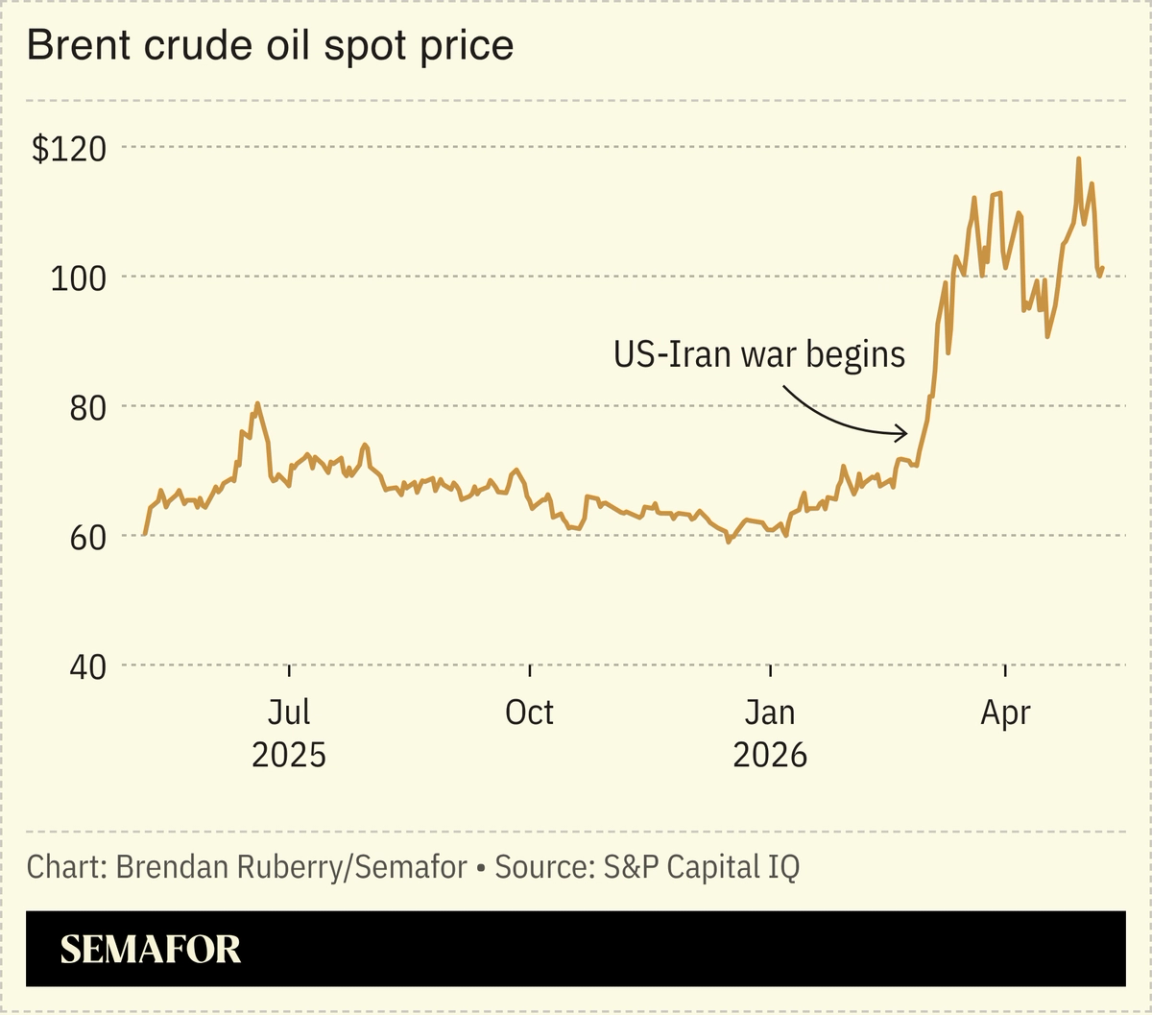 Any hope for a breakthrough in winding down the Iran war was extinguished Sunday night, after Trump rejected Tehran’s response to his latest peace proposal as “totally unacceptable.” Iran’s last offer did not resolve the US’ demands on its nuclear program and proposed transferring part of its enriched uranium stockpile to a third country, according to The Wall Street Journal. The White House will be watching the markets today closely for a reaction to the latest turn in the talks. Energy Secretary Chris Wright said Sunday on NBC that he “can’t predict the price of energy” as the war drags on, and he left open the door to suspending the federal gas tax. And Israeli Prime Minister Benjamin Netanyahu said Sunday that the war is “not over” because Iran still has nuclear material, comments that diverge from the Trump administration’s own assertions. |
|
Iran, ballroom hang over GOP agenda |
 Annabelle Gordon/Reuters Annabelle Gordon/ReutersRepublicans return today to a two-week sprint to finalize their $70 billion immigration enforcement bill — though debates over Trump’s ballroom and the Iran war remain front and center. Senate Republicans must quickly decide whether to advance $1 billion in security funding for the White House’s East Wing renovation as parliamentary arguments begin this week on whether the package can survive budget reconciliation’s strict rules, according to people familiar with the conversations. And though negotiations continue on crypto and housing bills, Republicans see the reconciliation bill as the only certain vehicle for their agenda. “That’ll probably be the last thing we’ll get passed for the midterms. I know it’s all talk about reconciliation 3.0 and all that. This is May, man,” said Sen. John Kennedy, R-La. Another wild card: Some Republicans want to finalize a congressional authorization if the fragile Iran ceasefire crumbles. — Burgess Everett |
|
Groups criticize Trump housing cut |
 Kevin Lamarque/Reuters Kevin Lamarque/ReutersAs the White House seeks to lower costs ahead of the midterms, housing lenders and state agencies are raising concerns that administration officials could soon wind down a program that has so far helped finance more than 56,000 affordable rentals at no cost to taxpayers. The FFB Risk-Sharing Program, which agencies across 34 states use to lower borrowing costs at “a net revenue gain for the Treasury,” is “precisely the kind of program a fiscally serious administration should want to preserve,” the National Association of Affordable Housing Lenders wrote to the administration in a letter signed by more than a dozen other groups and shared first with Semafor. Instead, the White House’s fiscal 2027 budget “projects no new commitments” for the program, the groups write, warning that already, state housing agencies “are being turned away.” — Eleanor Mueller |
|
Young Americans pessimistic about jobs |
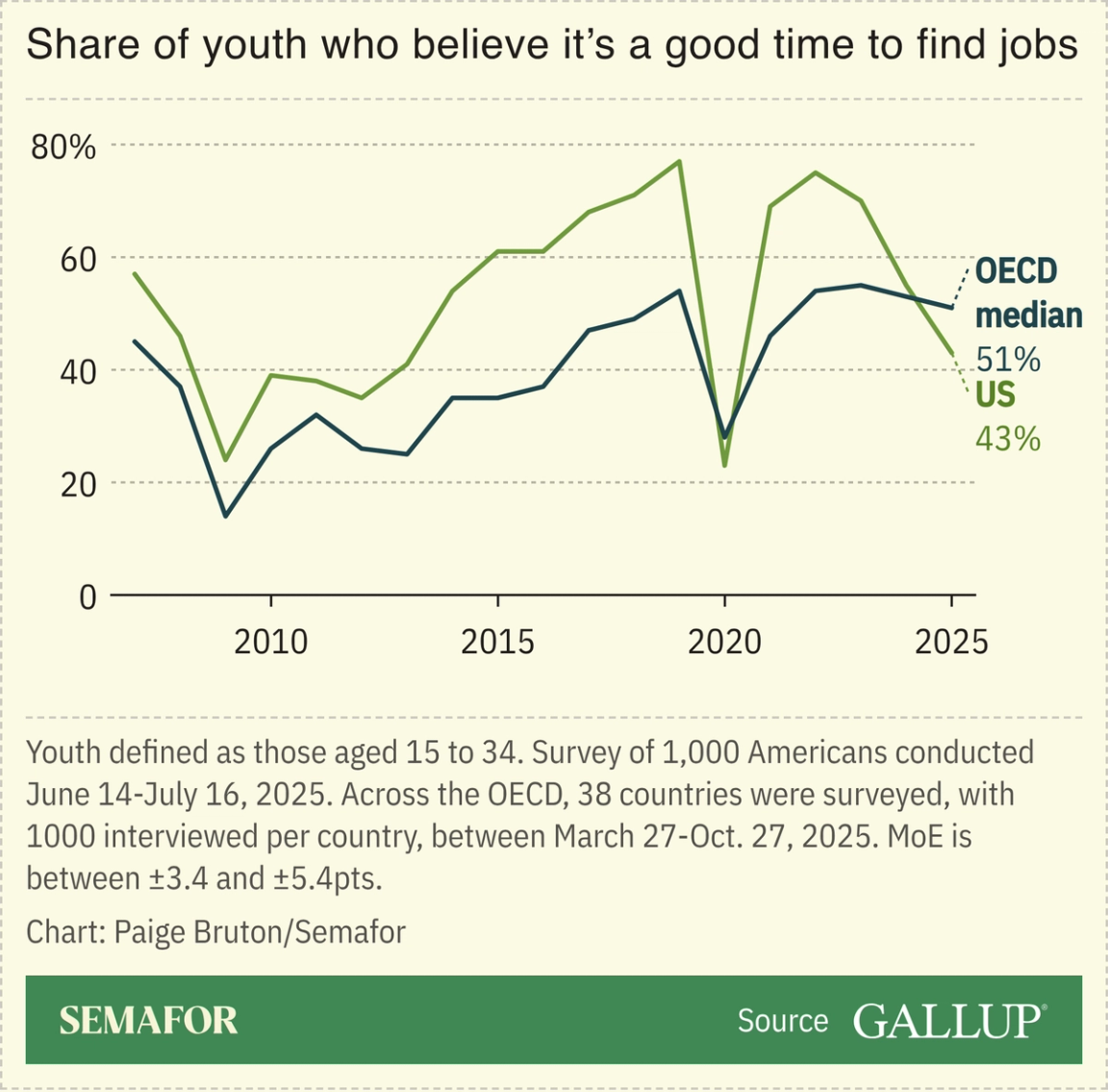 Young Americans are more pessimistic about the US job market than their older counterparts, an unusual trend relative to other wealthy countries. Last year, 43% of Americans between the ages of 15 and 34 said it was a good time to find a job where they live, according to Gallup, a 12-point decline from the prior year and 21 points lower than the share of adults 55 and up who said the same. In contrast, young people living in other OECD countries are more positive on the job market than their older counterparts. Only in China, Serbia, the UAE, Hong Kong, and Norway is the share of young adults feeling optimistic at least 10 points below older adults. Because the poll was taken last year, it’s unclear whether recent signs of job growth have brightened young Americans’ perspectives. |
|
SCOTUS faces mifepristone decision |
 Evelyn Hockstein/Reuters Evelyn Hockstein/ReutersA court order restricting access to the abortion drug mifepristone through telemedicine could take effect as soon as today. Supreme Court Justice Samuel Alito paused the ruling last week, but the stay expires at 5 pm tonight; he’ll either extend the pause or allow it to lapse while the high court considers the case. Whatever the court decides will add to the uncertainty surrounding access to the drug, which Louisiana wants to restrict. In a filing last week, the state accused the Biden administration of seeking to “undermine” the high court’s decision overturning Roe v. Wade by expanding access to the medication by mail. Hovering over the ruling is the fate of FDA Commissioner Marty Makary, who irked the anti-abortion movement by delaying action on mifepristone. Despite reports that Trump is preparing to fire Makary, the president told reporters yesterday he knew “nothing about it.” |
|
 Compound Interest is now Podchaser’s top-ranked emerging business podcast. At a moment when business is being reshaped in both subtle and seismic ways, from AI to shifting capital and new ideas about risk, the show brings clarity to the forces redefining the global economy. Every Tuesday, Semafor Business Editor Liz Hoffman and reporter Rohan Goswami cut through the noise with candid, in-depth conversations with the founders, CEOs, and power players behind some of the world’s most influential companies. Their interviews go beyond the headlines to reveal how, and why, the strategies, mechanisms, and systems driving today’s business landscape actually work. Recent episodes include interviews with Wonder Group CEO Marc Lore, Oura CEO Tom Hale, Uber CEO Dara Khosrowshahi, and Mark Cuban. |
|
Blindspot: Mamdani and leaks |
 Stories that are being largely ignored by either left-leaning or right-leaning outlets, curated with help from our partners at Ground News. What the Left isn’t reading: A business group warned that New York City Mayor Zohran Mamdani’s policies could jeopardize billions in growth fueled by the city’s private sector, The New York Post wrote. What the Right isn’t reading: An email in which White House chief of staff Susie Wiles sought to crack down on leaks to the press was reported by Politico. |
|
 Beltway NewslettersPunchbowl News: Sen. Elizabeth Warren, D-Mass., is giving more than $400,000 to six state Democratic parties facing competitive Senate races in November, taking her total contributions to state parties this election cycle to more than $800,000. Playbook: Chinese leader Xi Jinping may seek to get President Trump to move the US from a position of ambiguity on Taiwan to full-throated opposition to Taiwanese independence, with one Asian diplomat saying: “Let’s pray nothing disastrous happens.” |
|
|


