
|
Roundup #81: Back to our regular programming
National debt; AI cyberattacks; Phone bans; AI and coding jobs; Millennials vs. Boomers; Public order; California YIMBYism
|

| |||||||||||||||


 |
Hi, folks! My father unfortunately passed away two weeks ago from chemotherapy complications, and as you can imagine, I’ve been busy dealing with that, so posting has been a bit light. My apologies. (I will probably write something about my father on this blog at some point in the near future.)
Anyway, there’s tons of stuff happening out there in the world — far too much to fit in a single roundup post — but here are some items I hope you’ll find interesting.
1. The U.S. national debt bomb
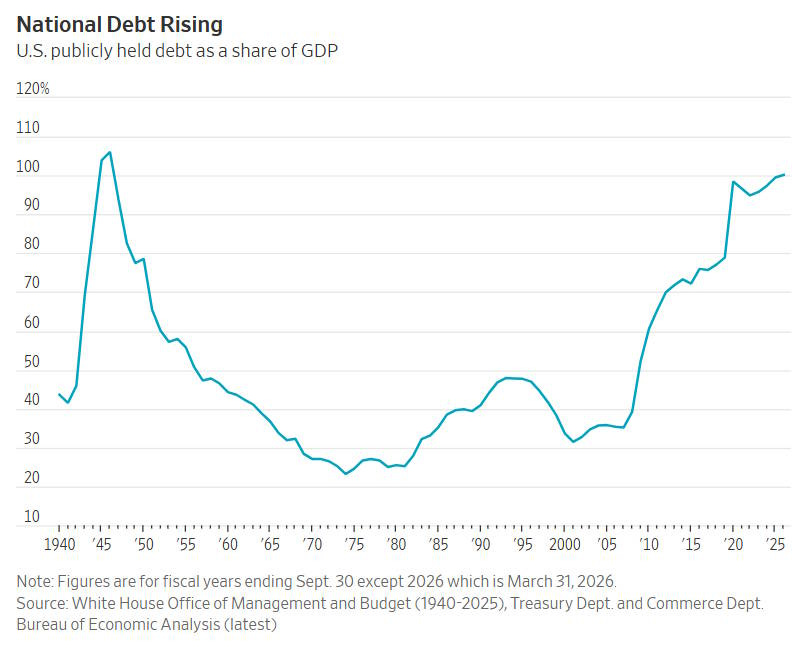
The U.S. passed a major milestone recently. The ratio of national debt to GDP passed 100% for the first time since World War 2:
 |
Note that there are two measures of national debt, and they have names that sound very similar. “Total public debt” is the amount owed by the Treasury, while “Federal debt held by the public” is the amount owed by the Treasury to lenders outside the U.S. federal government itself. If another government agency holds Treasury bonds, that debt counts in “Total public debt”, but not in “Federal debt held by the public”. The one exception is the Fed — if the Fed holds Treasuries, it counts in both debt measures.
It’s very confusing, I know. They should probably change those names to make them less similar. Anyway, it’s “Federal debt held by the public” that just passed 100% of GDP for the first time since World War 2.
Now, there’s nothing particularly special about the “100% of GDP” marker — it’s just a big round number. The amount of money that the federal government has available to pay back the national debt is tax revenue, not GDP. Debt is currently at a little over 8 times annual revenue, meaning that the U.S. federal government owes about 8 years of its “income”.
But what’s really scary isn’t the debt number itself — it’s two other things. First, there’s interest payments. As a percentage of GDP, the U.S. government is paying just about as much in interest as it ever has — and a lot more than after World War 2.
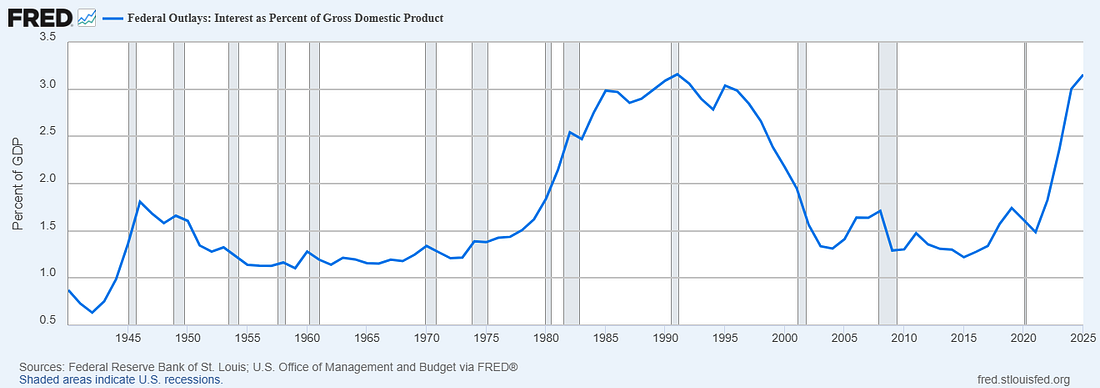 |
That number is going to soon hit record highs, as an increasing percent of the federal debt gets rolled over at current high interest rates.
The other scary thing is that no one in the United States government seems especially interested in curbing the debt. DOGE was a complete joke, and totally failed to lower spending. Trump is going on a giant deficit spending binge. The Democrats are now promising tax cuts. The government’s official deficit projections rely on totally fantastic assumptions about interest rates.
As Paul Krugman says, we are no longer a serious country. (But the Democrats are more complicit in that unseriousness than Paul would probably like to admit.)
If we keep going in this direction, we will eventually see negative consequences. It could be inflation, or a collapse in the dollar, or a sovereign default. Any of those outcomes would be very bad for the American economy and the American people. But everyone seems more interested in winning the next election cycle and kicking the can down the road.
2. Is the danger of AI cyberattacks overrated?
The recent release of Anthropic’s Claude Mythos model sparked global alarm about the possibility of a wave of AI-powered cyberattacks. The new model was able to find a bunch of security flaws in existing software systems, prompting fears that if it got into the wrong hands, it could collapse all kinds of critical digital infrastructure. Ostensibly in order to allay these fears, Anthropic limited the initial release of Mythos to only a few people, while it worked with the government and with corporations to use Mythos to find and close as many security loopholes as possible.
Then along came OpenAI, and released GPT-5.5. While there’s no single test of hacking capabilities, the UK government’s AI Security Institute rates GPT-5.5’s capabilities as equivalent to — if not slightly better than — Mythos’.
 |