| | In this edition: Ruben Gallego speaks, the Supreme Court limits the Voting Rights Act, and new Michi͏ ͏ ͏ ͏ ͏ ͏ |
| |  BATON ROUGE, LA BATON ROUGE, LA | LANSING, MI | WASHINGTON, DC |
 | Americana |  |
| |
|
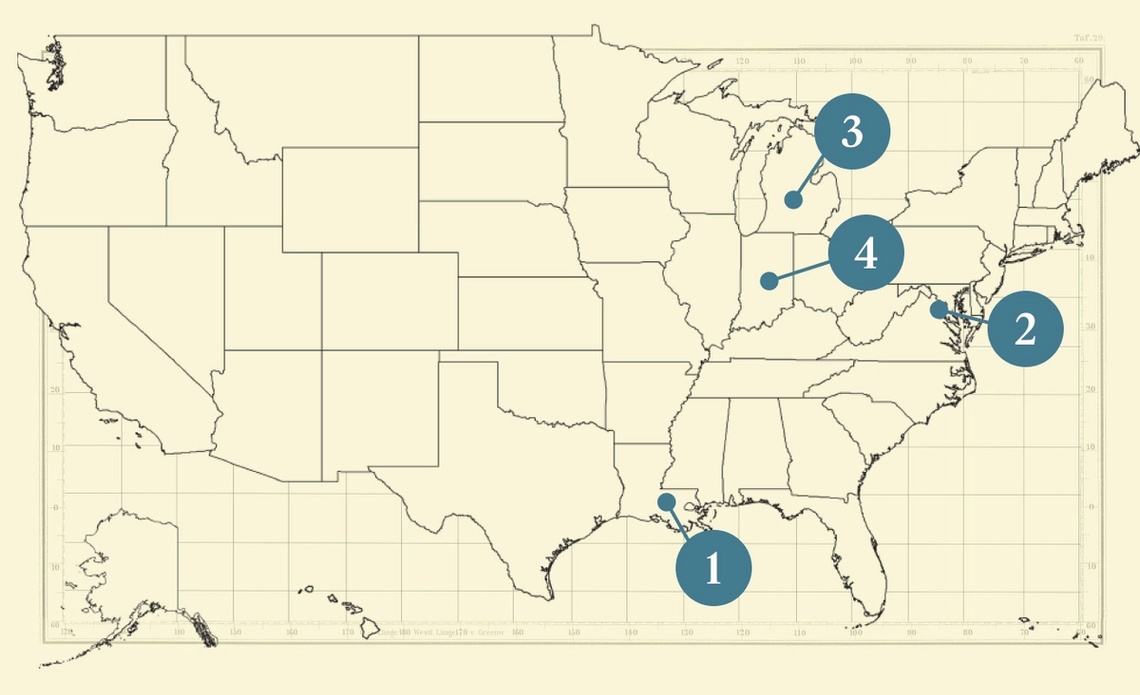 - Callais fallout
- Progressive status check
- Michigan’s Dems, polled
- Ad Watch
|
|
 Ruben Gallego’s friends told him to, “lay low,” as he put it, “and this will pass over.” He didn’t agree. The Arizona Democratic senator was right about one thing: This month’s sexual assault allegations against Eric Swalwell, Gallego’s onetime “best friend,” didn’t just destroy the Californian’s political career. They also subjected Gallego to the first stress test of the party’s invisible 2028 presidential primary, which is already underway. Which makes Gallego’s handling of the Swalwell disaster all the more remarkable. He held a 35-minute clear-the-air presser and spoke at length with me recently about the ad hoc war room he developed as the Swalwell crisis grew. He was confident that a rummage through his life, the kind presidential campaigns inevitably prompt, would not turn up stories of misconduct. “I could see early on that this was no longer about Eric Swalwell,” Gallego told me. “It was about targeting me. When you have Chris LaCivita tweeting it, and then Karoline Leavitt talking about me from the White House podium, that’s when I came to that realization.” He told me that, with “100%” certainty, he’d never gotten so intoxicated that he did something he couldn’t remember. He acknowledged a “reputation” for late nights and drinking, “before having kids,” that he now felt was being used against him — particularly in a NOTUS story about him inviting embassy staff to join him “partying” past midnight on an official trip to Colombia. “I will not expose myself to anything of this nature whatsoever with any embassy staff anymore,” he said. “It’s unfortunate. I’m just not going to risk it.” Perhaps the only question Gallego pushed off, at his April 14 press conference, and in our interview, was a big one: whether his credulous friendship with Swalwell made him less likely to run for president. The Swalwell crisis moved from questions about how the senator could be so trusting of his friend to follow-ups about whether he, too, was hiding something. |
|
SCOTUS gives Republicans redistricting boost |
 Nathan Howard/Reuters Nathan Howard/ReutersThe Supreme Court’s conservative supermajority prevailed today in a 6-3 decision that limits Section 2 of the Voting Rights Act, siding with Louisiana and shrinking the requirement for states to draw majority-minority congressional districts. “The Constitution almost never permits a State to discriminate on the basis of race,” Justice Samuel Alito wrote for the majority. In her dissent, Justice Elena Kagan mourned the “now-completed demolition of the Voting Rights Act.” Republicans have anticipated this win since last year. Louisiana Republicans pushed back the dates of their 2026 primaries in anticipation of the court letting them re-draw the 6th Congressional District, which in 2024 was reformulated as a majority-Black seat. In Mississippi, Gov. Tate Reeves had already called for a special session to redraw state supreme court lines, expecting the Louisiana v. Callais decision to free his hands. When the decision came down, Florida’s GOP legislative supermajority was already advancing redrawn congressional maps, designed to eliminate four Democratic seats around Tampa, Orlando, and the Miami suburbs. And Florida legislators had guidance from Gov. Ron DeSantis’s office that the Fair Districts Amendment, passed by voters in 2010 to ban gerrymandering, would probably not hold up to scrutiny. Part of the amendment dealt with racial gerrymandering, which the state and federal supreme courts would no longer protect. “I can’t do it, it’s just unconstitutional,” Florida state Sen. Jennifer Bradley said after casting one of the few GOP votes against the map — one day before the Callais decision. |
|
Inside the America Votes summit |
 Mike Segar/Reuters Mike Segar/ReutersProgressive groups don’t think they need the Democratic Party to cause a midterm “blue wave.” That was the mood at the annual summit of America Votes, founded 22 years ago to coordinate the electoral work of left-leaning unions and climate groups. Semafor got an in-depth look at the group’s entire confab, where hundreds of progressive campaigners talked about what worked to motivate anti-Trump voters — and what could win over the people who’d since turned on the president. Eighteen months after losing everything, these activists have a comeback in their sights, with a theory of victory behind it: The 75 million Americans who’d supported Kamala Harris had turned out more reliably since 2024 than the 77 million who’d supported Donald Trump, and member groups could build on that. “We’re doing a better job of getting those 75 million back, and they’re doing a sh*ttier job of getting 2 million more than that back,” America Votes President Greg Speed said in an interview. “That will be the single biggest factor in how this election goes.” |
|
Michigan Democrats don’t appear too dialed in yet |
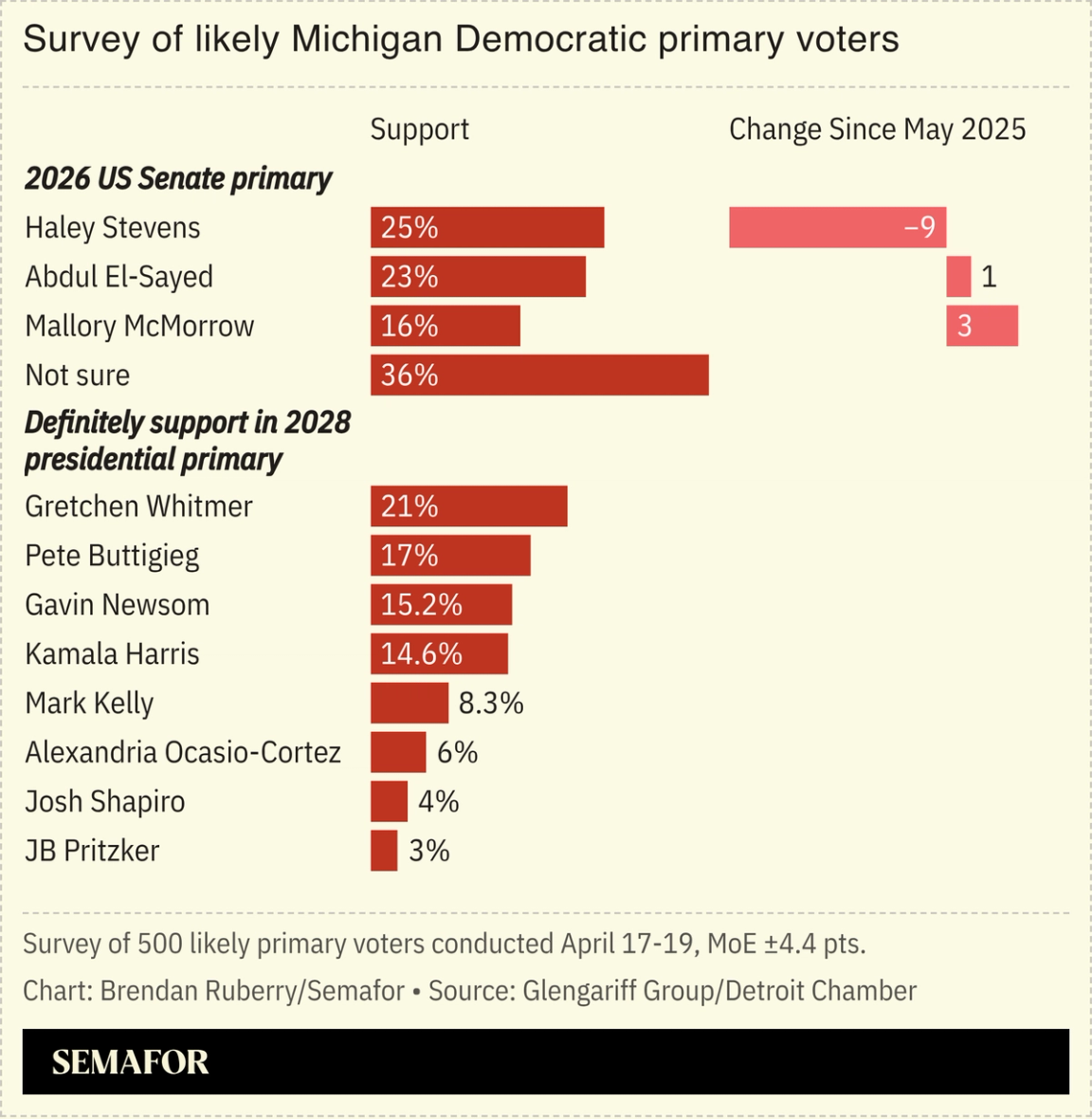 This is a politics briefing that acknowledges the ground truth: Most people aren’t paying attention to elections right now. A year of ink-spilling about the Democrats’ Michigan Senate primary (some of it spilled by me) has not clarified the choices. Slightly more Democrats are undecided in that race than were undecided last May. All that’s changed is that they have more awareness of who Stevens, El-Sayed, and McMorrow are. They’re just as undecided on what they’ll do in two years, when Michigan likely gets one of the first presidential primaries. Ninety-three percent of Michigan Democrats view their Gov. Gretchen Whitmer favorably, but most of them are scouting for another presidential candidate. Compare this level of voter awareness with what’s happening in Texas, where hundreds of millions of dollars have been spent to introduce and beat up candidates for Senate — and very few people are undecided. |
|
 Hoosier Leadership for America Hoosier Leadership for AmericaNext week, the president and his allies are asking Indiana Republicans to purge eight state senators who refused to eliminate Democratic House seats in a mid-decade redistricting. Hoosiers have seen the legislators and their opponents on TV ever since. Hoosier Leadership for America, a group led by Indiana GOP Sen. Jim Banks, is running ads against the top targets. Its two consistent messages: The Republican state senators “voted with liberal Democrats” against the new maps, and they opposed a popular ban on foreign ownership of Indiana farmland. Each senator gets a unique hit on his or her other vulnerabilities, like the fact that Kokomo’s James Buck is 80 years old. The challengers’ own ads highlight their conservative wins, on the other hand, and tend to ignore redistricting. In one of her spots, state Rep. Michelle Davis hands the microphone to a gun store owner thankful for her vote on a gender recognition bill: “She is going to make sure that my daughters have restrooms that are safe.” |
|
 Most CEOs have not woken up to the fact that technology is as important as their balance sheet, IBM Chairman and CEO Arvind Krishna says in the latest episode of The CEO Signal. The first technologist to lead the company in its 115-year history unpacks how he approaches high-stakes decision-making in moments of rapid technological change — including the initially controversial acquisition of Red Hat that he thinks landed him his current role. Krishna makes the case for why CEOs need to place bold bets, even when the payoff won’t be quick. And he cautions his fellow CEOs not to wait to start working out what quantum computing will mean for their companies. “You’d better start thinking about it now,” he says. |
|
 Liesa Johannssen/Reuters Liesa Johannssen/ReutersWhen a White House strategist asked why there was so much hype around Rep. Alexandria Ocasio-Cortez traveling to the Munich Security Conference in February, I dashed off a post about her “careful and spontaneous” media strategy. The four-term congresswoman skipped the post-2024 Democratic debate about whether their candidates should talk more to new, unusual, less-political audiences. Instead of long interviews, she communicated through her own social media, and through short questions and answers with progressive outlets that wait for her on the House steps after votes. I never turned this into a story, but Alex Thompson and Holly Otterbein did, for Axios, counting the total number of sit-down interviews she’s done this year: Three. (That’s also how many times she’s been the lead story of the Thompson/Otterbein newsletter this year, which shows that Ocasio-Cortez’s strategy doesn’t diminish her coverage.) |
|
 “The Method,” Isaac Butler’s history of the acting system developed by Konstantin Stanislavski and adapted by Lee Strasberg, got its flowers when it arrived four years ago. But I only got around to it last week, so I’m recommending it now. Butler can de-mystify entire careers or studio gimmicks in a paragraph and explain obscure theater exercises just as deftly. He even gets into how modern acting techniques invaded TV-era presidential campaigns, which makes it all relevant enough for me to flog in a politics newsletter. |
|
 - six days until primaries in Indiana and Ohio
- 13 days until primaries in Nebraska an
|
|
|


![David Weigel post: [TW: both sides take] Both camps have a defining historical moment that the other side thinks wasn’t a very big deal, and half think was a hoax. For Dems it’s Jan. 6, for Rs it’s Butler.](https://img.semafor.com/83519e2e9d70f92e4308777546838ce5b1f230aa-1196x748.png?w=1140&h=713&q=95&auto=format)