| | In today’s edition: The UAE quits OPEC, leaders prepare for more fighting, and Saudi Arabia suffers ͏ ͏ ͏ ͏ ͏ ͏ |
| |  | Gulf |  |
| |
|
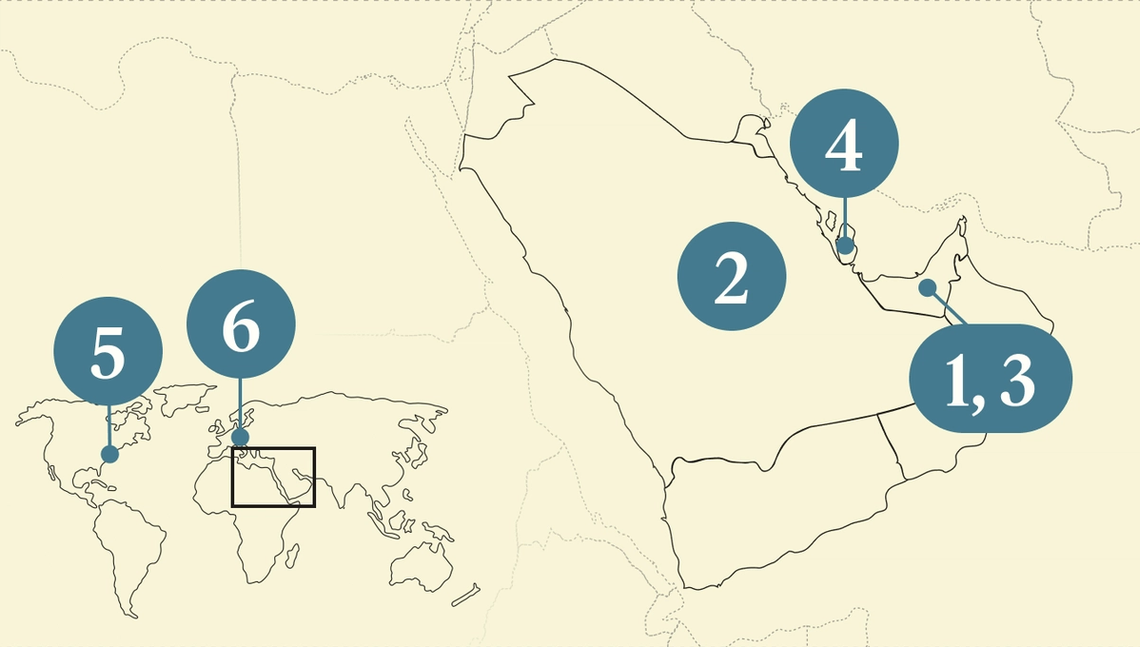 - UAE exits OPEC
- Rearming amid ceasefire
- Abu Dhabi real estate record
- Qatar’s stimulus efforts
- Saudi $150M movie flop
- Leaving OPEC not a shock
 Saudis curate ancient maps and incense burners for the Venice Biennale. |
|
UAE leaves OPEC, deepening Saudi rift |
 Saudi Energy Minister Prince Abdulaziz bin Salman and UAE Energy Minister Suhail Al Mazrouei in 2020. Ahmed Yosri/Reuters. Saudi Energy Minister Prince Abdulaziz bin Salman and UAE Energy Minister Suhail Al Mazrouei in 2020. Ahmed Yosri/Reuters.The UAE will quit OPEC and the wider OPEC+ grouping from Friday, threatening the cartel’s ability to manage crude prices and widening a rift between Abu Dhabi and Riyadh. The decision is the latest sign of the UAE’s willingness to take positions independent of its Gulf neighbors across a raft of policy issues, from energy to security and foreign relations. Already in the midst of a deep schism with Riyadh, Abu Dhabi is becoming more vocal about how disappointed it has been at the response of other Arab countries to the Iran war, and has hinted that quitting OPEC is the first move of a wider review of its involvement with multilateral organizations that no longer serve its interests. Abu Dhabi has long complained that its OPEC quota unfairly constrains its oil production. Its relatively diversified economy and modern infrastructure means it is better prepared for a post-oil future than other Gulf countries, but it still wants to make the most of its hydrocarbon resources. The closure of the Strait of Hormuz, and the stranding of most Gulf oil, has meant its departure from OPEC had only a limited market impact, but in the longer term the move could help lower oil prices if the UAE maximizes its output. — Matthew Martin |
|
Ceasefire provides cover for rearming |
 Saudi Crown Prince Mohammed bin Salman (right) and the Emir of Qatar, Sheikh Tamim bin Hamad Al Thani. Bandar Algaloud/Courtesy of Saudi Royal Court/Reuters. Saudi Crown Prince Mohammed bin Salman (right) and the Emir of Qatar, Sheikh Tamim bin Hamad Al Thani. Bandar Algaloud/Courtesy of Saudi Royal Court/Reuters.With diplomacy at an impasse, Iran and the US remain braced for a longer struggle and a potential resumption of fighting. Tehran said it has used the calm offered by the ceasefire to upgrade equipment and update its target list, while US President Donald Trump posted an AI image on social media on Wednesday morning showing him brandishing a gun against a backdrop of war, while adding “They don’t know how to sign a nonnuclear deal. They better get smart soon!” However, Trump has also told aides to prepare for an extended economic blockade of Iran, The Wall Street Journal reported, on the basis that a resumption of bombing or a retreat are riskier. Some further insights into US thinking may come from Defense Secretary Pete Hegseth’s testimony before Congress today and tomorrow. Iran’s neighbors remain wary onlookers. At a conference in Jeddah yesterday, Gulf leaders pledged to intensify military integration and accelerate the development of a joint early warning system to protect against missiles. They also vowed to improve cross-border connections for electricity, water, oil, and gas to improve their economic resilience. |
|
Abu Dhabi’s prewar property boom |
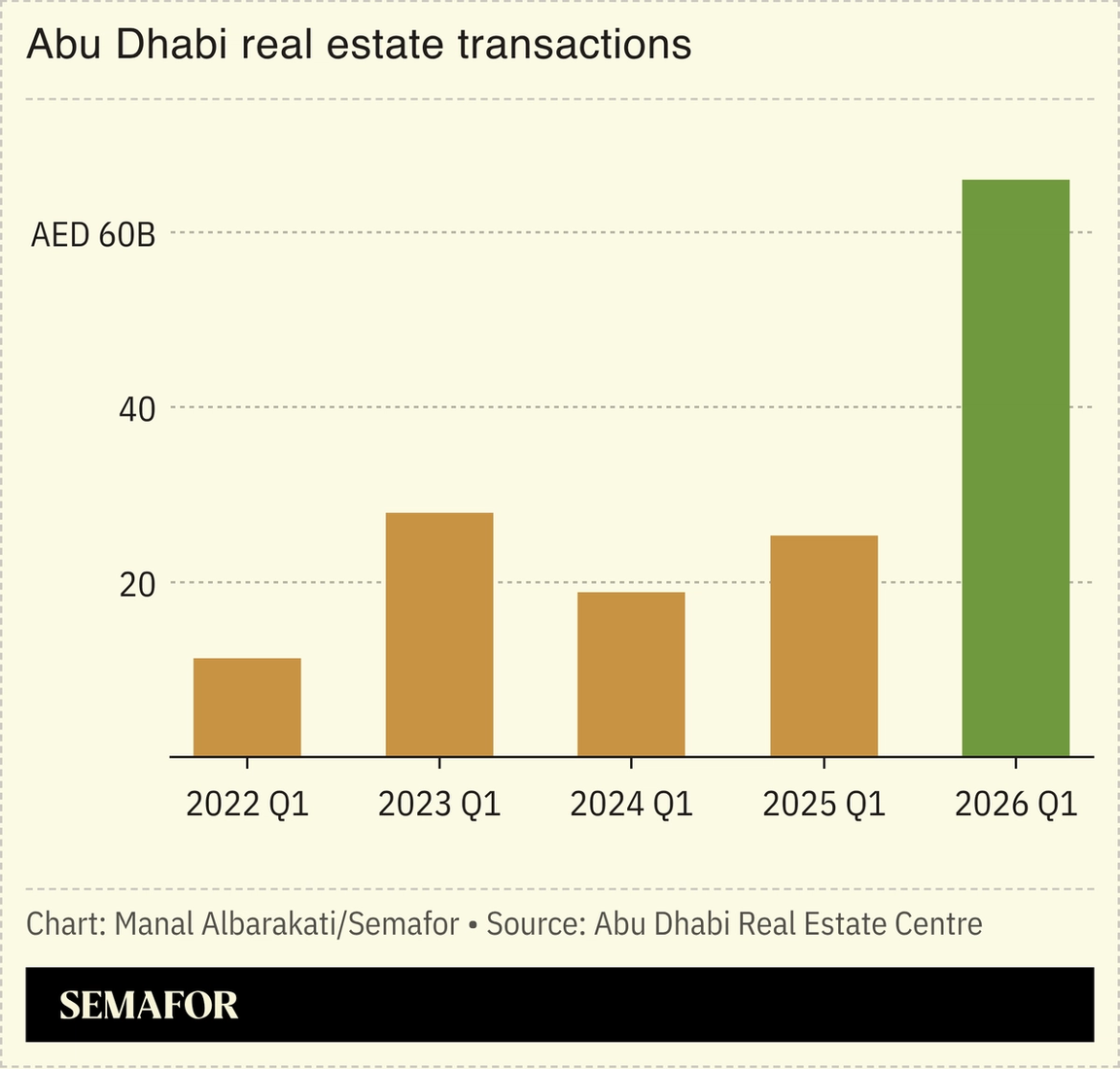 Abu Dhabi’s property market reported its best-ever start to the year, despite a slowdown after Iran launched thousands of missile and drone attacks. Sales in the first three months of 2026 were almost half of last year’s total figure, according to the sector’s regulator ADREC. Off-plan sales dominated the period, making up 81% of all transactions, with apartments accounting for almost three-quarters of the deals. Manchester City Yas Residences, a development on Yas Island linked to the English football club owned by Abu Dhabi, alone generated 6 billion dirhams ($1.63 billion) in sales within 72 hours of its launch in mid-February, according to real estate consultancy Savills. However, after the start of the Iran war on Feb. 28, the picture shifted, and transaction volumes fell 16% month-on-month in March as buyers adopted a more cautious stance, Savills noted. |
|
Qatar repackages incentives |
 Ibraheem Abu Mustafa/Reuters Ibraheem Abu Mustafa/ReutersThe Qatari government is reminding businesses it will reimburse up to 40% of setup costs as it tries to attract more non-energy activity, such as logistics, technology, and financial services, to its now war-battered economy. The dangling carrot predates the conflict, introduced last year as a stimulus. Now it’s being promoted by Invest Qatar, the government’s inward investment agency, alongside newer lifelines such as rent waivers and regulatory filing extensions which have been offered in response to the regional disruption caused by the Iran conflict. Expect to see more marketing pushes like this as the region charts a recovery. Qatar is among the hardest hit Gulf countries: The International Monetary Fund forecasts a sharp economic contraction of 8.6% this year, reversing a prewar 6.1% growth forecast. Goldman Sachs estimated that Qatar could see its GDP plunge by 14%, citing its lack of alternative export channels to the blockaded Strait of Hormuz. — Kelsey Warner |
|
Saudi-backed epic flops at the box office |
 The opening weekend haul brought in by Desert Warrior, the Saudi-backed movie that reportedly cost about $150 million to make. The film, starring Anthony Mackie and Ben Kingsley, took six years to produce, and its budget more than doubled in that time, according to Enterprise News. Audiences shunning the movie — which was released across more than 1,000 theaters in the US — is a reminder that art is tricky, even as the kingdom pours billions into building a film industry. Most reviews said the movie was visually impressive and highlighted Saudi Arabia’s appeal as a production hub, but the story was flat. The Hollywood Reporter didn’t mince words: “Desert Warrior takes place in arid settings, but they’re not nearly as arid as the turgid narrative.” |
|
View: The UAE’s OPEC exit is no surprise |
  Maxim Shemetov/Reuters Maxim Shemetov/ReutersAbu Dhabi’s decision to withdraw from OPEC has been nearly a decade in the making, after the UAE was forced to shoulder a heavy burden of production cuts even as it boosted capacity, independent energy commentator Wael Mahdi wrote in a column for Semafor. “Countries leave OPEC when the cost of compliance — in forgone production, revenue, and investment — exceeds whatever benefit membership provides,” Mahdi writes. “Countries with cheap extraction costs, massive reserves, and diversified economies,” like the UAE, “can increasingly afford to go it alone.” |
|
 Checking In- Booking Holdings, the online travel agency that owns Kayak and Booking.com, is predicting recovery for the travel industry in the second half of the year. Still, the firm drastically trimmed its earnings outlook, amid the disruptions to the Middle East transit hubs connecting Europe to Asia. — The Wall Street Journal
Energy- Saudi Aramco is reportedly suspending liquefied petroleum gas through May due to wartime damage to an export facility that has yet to be repaired. LPG, which is used for cooking, is running short in India, and Saudi supplies aren’t expected to quickly resume even if the Strait of Hormuz is reopened. — Bloomberg
- TotalEnergies said it restarted its Satorp refinery in Saudi Arabia in mid-April. Production at the 230,000-barrels-a-day facility, a joint venture with Aramco, was halted on April 8 due to an Iranian air strike. — AFP
Sanctions- Associates and relatives of Sudan’s Rapid Support Forces leader have acquired properties worth around $24 million in Dubai, according to US investigative organization The Sentry. The UAE government has repeatedly denied providing weapons or funding to the RSF. — The Guardian
Finance |
|
 Courtesy of the Saudi Ministry of Culture Courtesy of the Saudi Ministry of CultureThirteenth-century maps, first-century incense burners, and new commissions from Yoko Ono and Wael Shawky are coming together in Venice in an exhibition presented by the Saudi Ministry of Culture at the Abbazia di San Gregorio. Running alongside the city’s Biennale from May 6 through November, the show traces cartography from the medieval period to the present, including early European maps that labelled the Arabian Peninsula as Arabia deserta, placed alongside manuscripts and artifacts from the same era that tell a rather different story about the region’s place in the world. The premise is that every map is also an argument, a version of the world someone needed you to believe. — Manal Albarakati |
|
|


