| | In today’s edition: Dubai is building more beachfront property, a superyacht sails through Hormuz, a͏ ͏ ͏ ͏ ͏ ͏ |
| |  | Gulf |  |
| |
|
 - Dubai’s bigger Palm
- Saudi Vision 2030 scorecard
- Little relief in Hormuz
- Gulf-Pakistan shifting ties
- Bahrain citizen purge
 Money — and superyachts — always find a way. |
|
Dubai bets on more artificial coastline |
 The Palm Jebel Ali under construction in 2010. Ahmed Jadallah/Reuters. The Palm Jebel Ali under construction in 2010. Ahmed Jadallah/Reuters.Dubai is doubling down on its bet that Gulf beachfront property will be in demand from luxury buyers for decades to come. The emirate has just 72 kilometers (45 miles) of natural shoreline, but artificial islands and peninsulas have provided far more beachfront for its 4 million residents, and the millionaires and billionaires who collect such properties. Its biggest offshore development to date, Palm Jebel Ali, will add another 90 kilometers of coast. This week, state-owned developer Nakheel awarded contracts worth more than $950 million for 544 villas on the island, which should be ready by 2028. When the whole project is finished, it will be twice the size of the existing Palm Jumeirah down the coast, with 35,000 homes and 80 hotels. Palm Jebel Ali has had a tough history. Started in 2002, it was put on ice during the 2008 global financial crisis. The Iran war is now another unwanted complication. Dubai’s luxury market was on a record run before the war, with 500 sales worth more than $10 million in 2025, the most of any city globally. Palm Jebel Ali ranked second only to Palm Jumeirah in luxury transaction volumes last year. — Manal Albarakati |
|
Saudi’s Vision 2030 scorecard |
 The proportion of targets under Crown Prince Mohammed bin Salman’s economic diversification plan that the government said have been completed or are on track — some economic goals are proving elusive though. Vision 2030 targets related to unemployment, life expectancy, homeownership, the size of the private sector, and the tourism industry are being met, according to a government report, but efforts to attract more foreign investment, improve educational outcomes, and grow the assets of the kingdom’s sovereign wealth fund have underperformed. The report did not mention the recent pullback in some of the kingdom’s most ambitious spending plans, including parts of the $1 trillion futuristic new city NEOM, and a giant cube in the heart of Riyadh, which have been scaled back due to affordability and feasibility concerns. |
|
Hormuz reshapes energy markets |
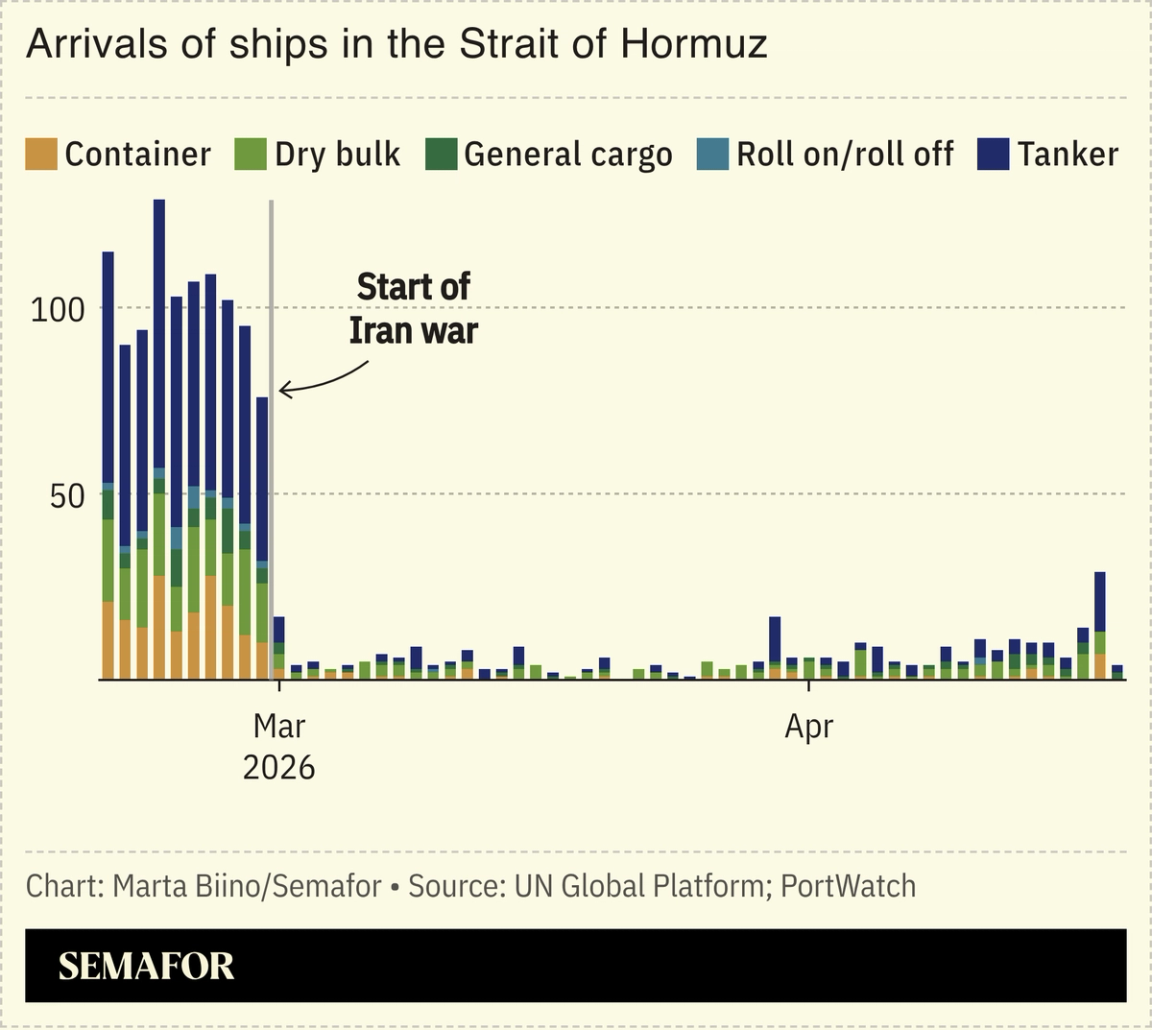 Nearly two months into the war — and after 20 days of a ceasefire that has left the Strait of Hormuz all but closed — the winners and losers from shifting global energy flows are emerging. Oil above $110 a barrel is squeezing poorer importing countries, while the US is expected to avert a recession unless prices climb toward $150. For Gulf producers, an extended conflict and the closure of Hormuz are changing assumptions. Rerouting supply chains is the medium-term goal; at the same time, state-owned companies are accelerating foreign investments. ADNOC’s international arm, XRG, is preparing to invest tens of billions of dollars to build a natural gas business in the US, the Financial Times reported. QatarEnergy and Saudi Aramco also have stakes in US gas and LNG facilities. Some ships are getting through Hormuz, with each vessel raising hopes in the Gulf and among buyers in Asia that oil and gas flows will soon resume. One LNG carrier linked to ADNOC appears to have passed recently, making it the first gas carrier to make it through the strait since early March. — Mohammed Sergie |
|
Pakistan’s Gulf-Iran tightrope |
 Iranian Foreign Minister Abbas Araqchi and Pakistan’s Army Chief attend a meeting in Islamabad. Seyed Abbas Araghchi via Telegram/Handout via Reuters. Iranian Foreign Minister Abbas Araqchi and Pakistan’s Army Chief attend a meeting in Islamabad. Seyed Abbas Araghchi via Telegram/Handout via Reuters.Pakistan has become one of the most consequential players in the Iran war, taking on a risky mediation role that draws on its ties with Tehran while keeping its financial lifeline with the Gulf intact. The nuclear-armed country — which shares a 900-kilometer (560-mile) border with Iran — is energy-poor, and its fragile economy leaves little room for geopolitical missteps. For now, Islamabad is maintaining a delicate balance: It has kept US-Iran talks alive and secured ongoing Gulf funding. But Iran’s latest proposal, delivered via Pakistan and focusing on reopening the Strait of Hormuz, was rejected by US President Donald Trump, amid frustration that Tehran has not made concessions on its nuclear program. Whether Iran is negotiating in good faith is reportedly at the center of Abu Dhabi withdrawing some support for Islamabad, according to the Financial Times. The UAE’s demand for a $3.5 billion loan repayment from Pakistan put its IMF program at risk. Saudi Arabia stepped in with $3 billion to plug the gap, building on closer ties that include a mutual defense pact. UAE officials deny a direct link to mediation, but the timing is notable. Pakistan is navigating a complex field: rivalry with India, a volatile Iran next door, and a less unified Gulf still shaped by the Saudi-UAE rift that predates the war. Gulf leaders are scheduled to meet in Jeddah on Tuesday to discuss the conflict, the Strait of Hormuz, and Pakistan’s mediation efforts. — Mohammed Sergie |
|
Bahrain strips citizenship from Iran ‘sympathizers’ |
 Smoke rises following a strike on Bahrain airport. Reuters/Stringer. Smoke rises following a strike on Bahrain airport. Reuters/Stringer.Bahrain revoked citizenship from 69 individuals accused of being sympathetic to Iran. The government said they were guilty of “glorifying or sympathizing” with Iranian attacks on Bahrain, or engaging with unnamed “external parties.” The group includes both individuals accused of being disloyal and their dependents. Countries across the Gulf have arrested scores of people during the war, on charges ranging from posting images of wartime damage, to planning terrorist attacks with Iran. However, this is the first known instance of citizenship being stripped from a large number of people. The London-based Bahrain Institute for Rights and Democracy said it heralded “a dangerous era of repression,” saying those affected had no right of appeal. More revocations are expected, with the government saying they will continue to review “those who merit the honor of Bahraini nationality and those who do not.” Earlier today, a Bahraini court also handed down life sentences to five defendants accused of collaborating with Iran’s Islamic Revolutionary Guard Corps, including three citizens and two Afghan nationals. |
|
 Can Mark Cuban solve soaring healthcare costs? On this week’s episode of Compound Interest, presented by Amazon Business, Mark joins Liz and Rohan to discuss his approach with Cost Plus Drugs, which aims to disrupt the little-known middlemen driving up prescription drug prices. He also discussed soaring valuations in sports, his regrets around the Dallas Mavericks sale, and offered a surprising assessment of TrumpRx. |
|
 Aviation- The CEO of Hungarian budget carrier Wizz Air accused Gulf airlines of putting politics before safety after they resumed flights before the Iran conflict had been resolved. — Financial Times
Deals- The Abu Dhabi Investment Authority participated in a capital raise by Singapore-headquartered TeraHop, which supplies high-speed optical transceivers for data centers. Reports in November said TeraHop was planning a $517 million round, with other potential investors including Singapore’s sovereign wealth fund Temasek.
Heritage- Omani frankincense has secured a geographical indication registration with the World Intellectual Property Organization, placing it alongside the likes of Swiss watches, Scotch whisky, and Darjeeling tea.
Markets- The Saudi Stock Exchange’s profits dropped by about half in the first quarter of the year to 56 million riyals ($15 million) due to a slump in trading volumes, even as the bourse opened up to more foreign investors on Feb. 1.
Sport- The Saudi Arabia Snooker Masters has been scrapped after just two editions, the latest sign of the government’s Public Investment Fund pulling back from sports spending, following reports it is also set to exit LIV Golf as the war squeezes state finances. — BBC
Transport- The final touches are being made to Dubai’s first commercial vertiports, with air taxi services expected to launch this year. The facility, designed to handle around 170,000 passengers annually, will support Joby Aviation’s electric vertical takeoff and landing aircraft, as well as traditional helicopters. — The National
|
|
 Donny Kwok/Reuters Donny Kwok/ReutersA superyacht linked to a sanctioned Russian oligarch has sailed through the blockaded Strait of Hormuz. Nord — a 465-foot yacht worth more than $500 million — left a Dubai marina on Friday afternoon and had arrived in Muscat by Sunday, Reuters reported. It isn’t clear how the vessel, which has ties to steel magnate Alexey Mordashov, managed to secure safe passage, but there are a few coincidences: Iran and Russia have cooperated in both the Ukraine war and Tehran’s latest conflict with the US, and Iran’s foreign minister held talks with President Vladimir Putin — a friend of Mordashov’s — in Saint Petersburg on Monday. The yacht, one of the largest in the world (with a submarine onboard, too), is not the only fun boat to make it through: The half-dozen cruise liners stranded in Gulf ports when the conflict broke out have all transited the strait safely in recent weeks. |
|
|


