| | Oil prices edged higher as uncertainty mounted over US President Donald Trump’s response to an Irani͏ ͏ ͏ ͏ ͏ ͏ |
| |  | Energy |  |
| |
|
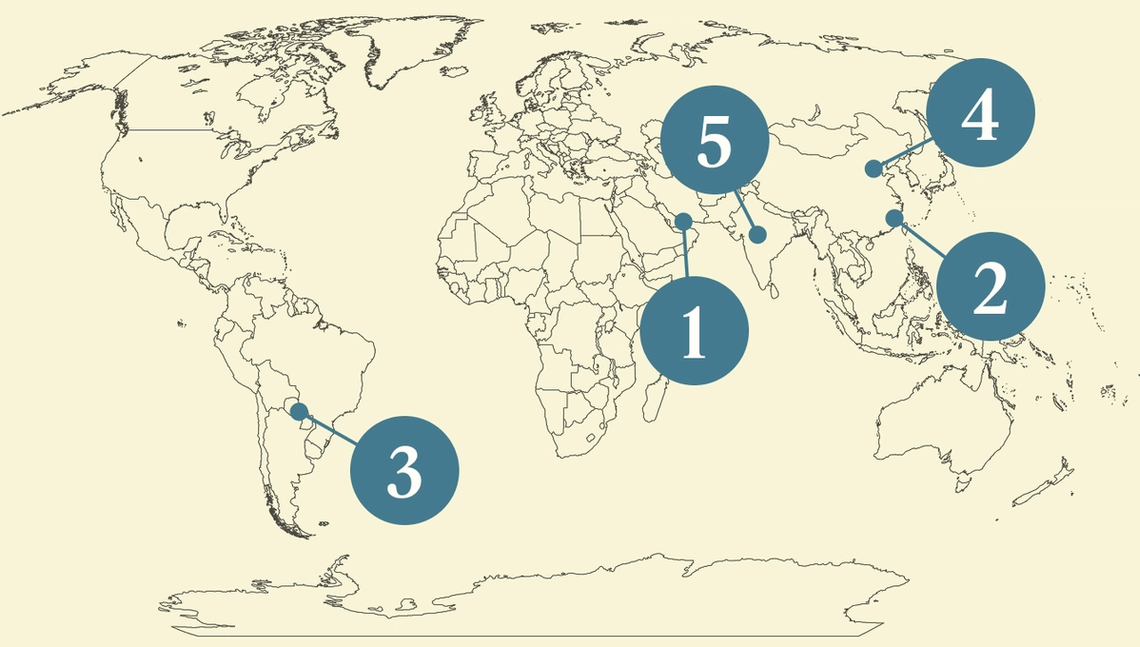 - Oil edges higher on Hormuz
- CATL responds, raising $5B
- A low-carbon fertilizer plan
- China’s new green goals
- Climate inflation picks up
 A European ‘electro-continent,’ and BP publishes its quarterly profit. |
|
Oil edges higher on Hormuz |
 Stringer/Reuters Stringer/ReutersOil prices edged higher as uncertainty mounted over US President Donald Trump’s response to an Iranian proposal to reopen the Strait of Hormuz. Tehran has insisted on keeping its nuclear program off the negotiating table, Axios reported, and while Washington has reiterated its opposition to that program, the administration said it was still reviewing the proposal. Brent crude rose above $110 a barrel on Tuesday; Goldman Sachs raised its price forecasts in light of the war’s disruption to production, now predicting that the international benchmark will average $90 in the final quarter of this year, up from its previous prediction of $80, if exports return to normal by the end of June. Should the disruption persist, oil could average nearly $120 in the fourth quarter. The US has so far remained relatively shielded from the disruptive consequences of its own war on Iran (and is even reaping windfalls from record exports of crude and petroleum products,) while much of the world is increasingly bearing the brunt: Asian refineries are cutting production and squeezing supplies of jet fuel and other products; Europe is canceling flights and struggling to replenish gas reserves cheaply, raising warnings of higher costs this winter; and across Africa, “food insecurity looms large,” the IMF said last week. |
|
CATL’s $5B stock listing boon |
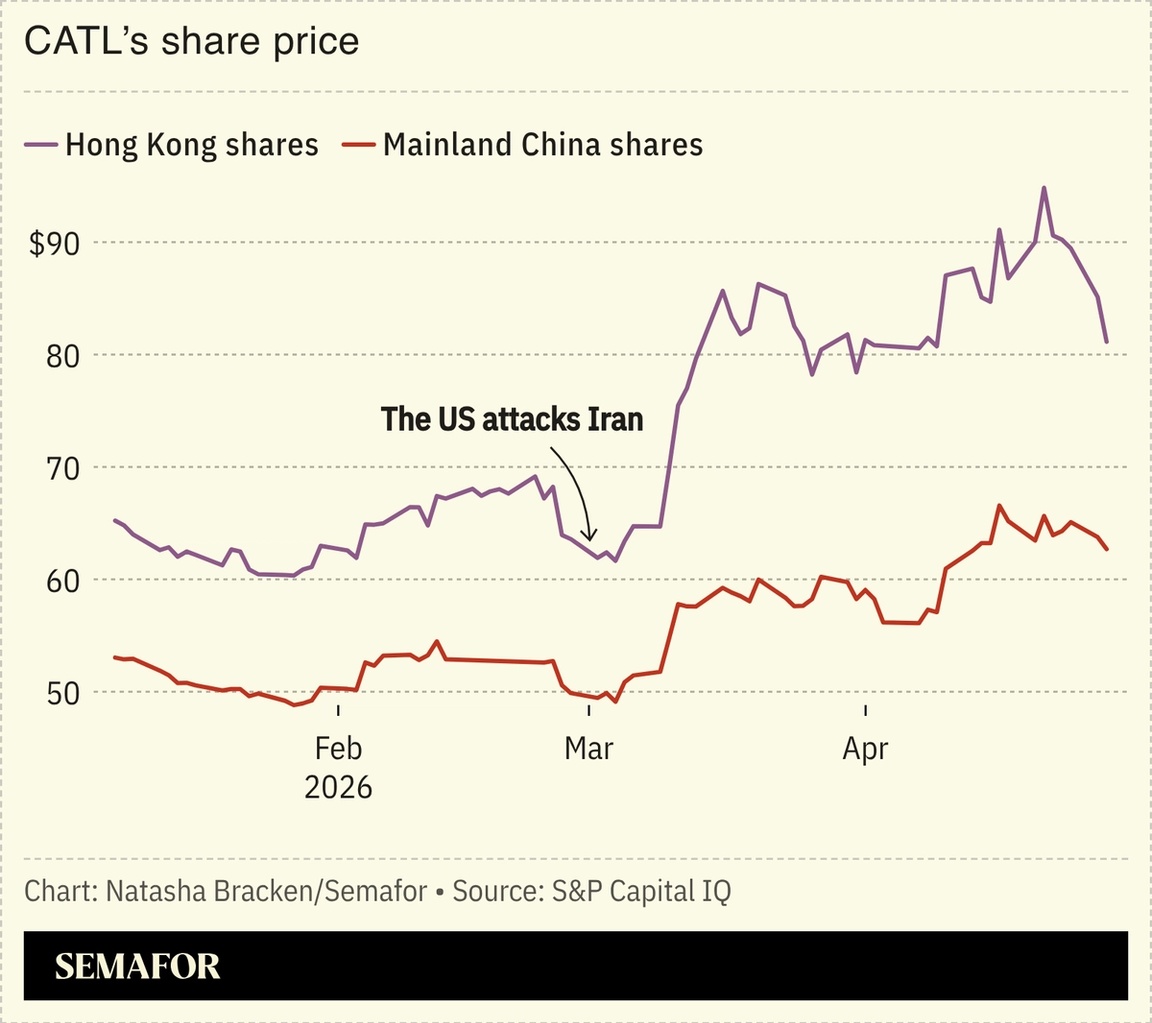 China’s CATL, the world’s biggest battery maker, raised $5 billion in a Hong Kong listing, welcome news for the firm as it looks to leverage booming demand amid soaring fossil fuel prices. The company — which last week unveiled a landmark car battery with a 1,500-kilometer (930-mile) range that takes just six minutes to charge — has been boosted by the conflict in the Middle East; its stock price has jumped almost 25% since late February. Ever-growing demand for data center energy storage has further boosted its prospects. The listing is also a boon for the Hong Kong stock market, which has seen raises totalling $31 billion so far this year, up 73% compared to 2025, Bloomberg reported. |
|
A low-carbon fertilizer plan |
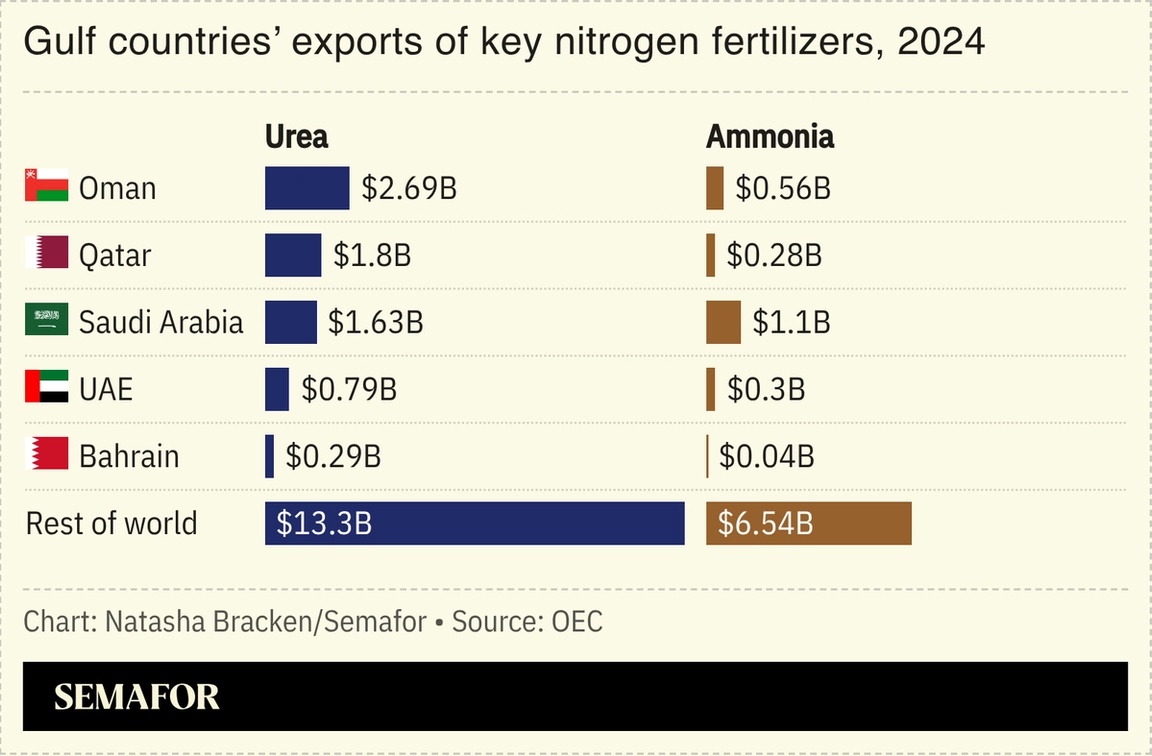 Throttled traffic in the Strait of Hormuz is highlighting the grip hydrocarbons’ hold on global food production as a result of reliance on fossil fuel-based fertilizers, but a new project in Latin America could pave the way for the production of low-carbon alternatives at an industrial scale. Green fertilizer developer Atome will go ahead with a 260,000-ton-per-year plant in Villeta, Paraguay, the first industrial-scale facility of its kind to hit that milestone, CEO Olivier Mussat told Semafor. The plant will feed on renewable power from Paraguay’s vast Itaipu dam to produce hydrogen by splitting water through electrolysis, which is then combined with nitrogen to create zero-carbon ammonia. The plant is expected to start supplying fertilizers to Latin American markets by early 2029, offering some respite to a region that is critical to global crop exports yet dependent on fertilizer imports. “What [the war] is showing you is that there is a systemic problem,” Mussat said. “A problem of security of supply.” |
|
 Tingshu Wang/Reuters Tingshu Wang/ReutersChina’s renewable energy sector is entering a new era defined by a greater focus on profits rather than simply chasing revenues and market share, according to a new report from S&P Global. Following years of overcapacity that dented margins and spurred a punishing price war, businesses are now putting more of a priority on efficiency and quality, the analysis found, even as oversupply continues to weigh on pricing. The shift comes as energy disruptions from the Iran war drive more global interest in Chinese renewables — the country’s solar exports doubled to record levels in March, while wind power firms are winning contracts to build huge installations across the Global South. |
|
 Can Mark Cuban solve soaring healthcare costs? On this week’s Compound Interest, presented by Amazon Business, Mark joins Liz and Rohan to discuss his approach with Cost Plus Drugs, which aims to disrupt the little-known middlemen driving up prescription drug prices. He also discussed soaring valuations in sports, his regrets around the Dallas Mavericks sale, and offers a surprising assessment of TrumpRX. Listen to the latest episode of Compound Interest now. |
|
Climate inflation picks up |
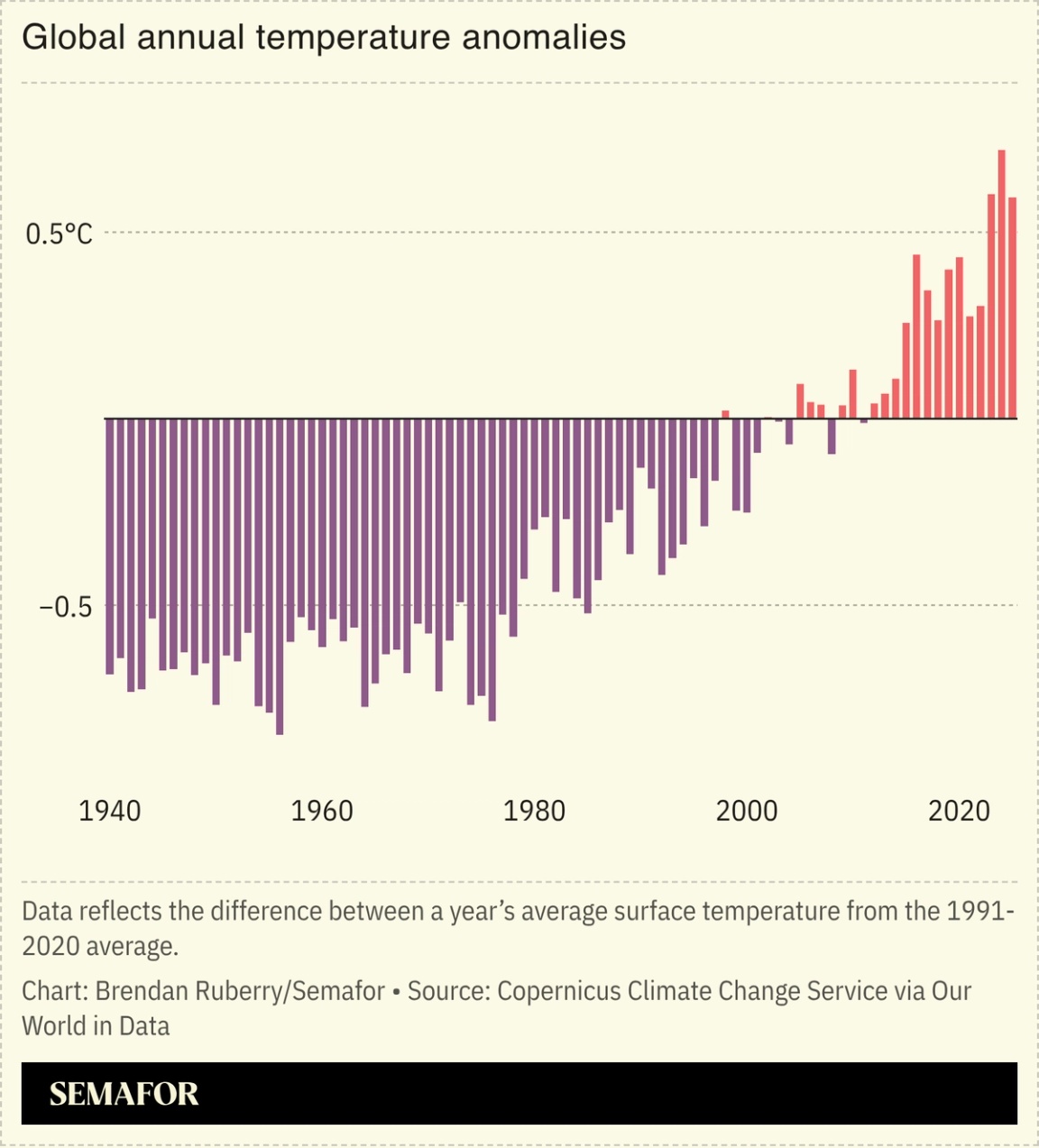 Climate change is starting to have a visible impact on prices, researchers said. Extreme weather such as droughts and floods have always affected costs, and since global warming is expected to increase their frequency, modeling suggests that it will lead to price rises. But teasing out its impacts is difficult: A rare exception was the 2022 European heat waves which economists estimated drove the continent’s food prices up 0.7%. But “climateflation” is increasingly detectable. As temperatures rise above certain thresholds, crop yields fall: Each 1°C (1.8°F) increase is associated with a roughly 1% increase in inflation, one researcher told Bloomberg. Extreme weather’s inflationary effects are felt for about two years. |
|
 New Energy- Major European businesses and investors have called on the EU to become the world’s first “electro-continent,” pushing for a target of 50% of the bloc’s energy to come from green electricity by 2040.
Fossil Fuels- European air travel faces growing challenges from fuel price hikes, falling demand, and regulatory pressure, investment analysts warned, with Britain, France, and Germany among the most vulnerable to rising jet fuel prices, according to Apollo Investment Group’s chief economist.
- Meanwhile, BP published its first-quarter net income of $3.2 billion, compared with forecasts of $2.67 billion in a company-provided poll of analysts, and $1.38 billion a year ago.
- In a continuation of the Trump administration’s desire to ditch renewable production in the US, the White House said it had reached a deal to end two more offshore wind leases in exchange for $885 million in investments in domestic fossil fuels.
- India hit a record high demand for power over the weekend as a heat wave hit swaths of the world’s most populous nation, forcing households to increase their air conditioning use. And despite New Delhi’s plan to increase coal use to power through the energy crisis, solar accounted for one-fifth of total generation during peak demand last weekend.
FinancePolitics & Policy- The first international meeting dedicated to phasing out fossil fuels will be held this week in Colombia, with more than 50 countries, including Brazil, Germany, Nigeria, and the UK, in attendance. The world’s top three emitters however — China, India, and the US — will be conspicuously absent.
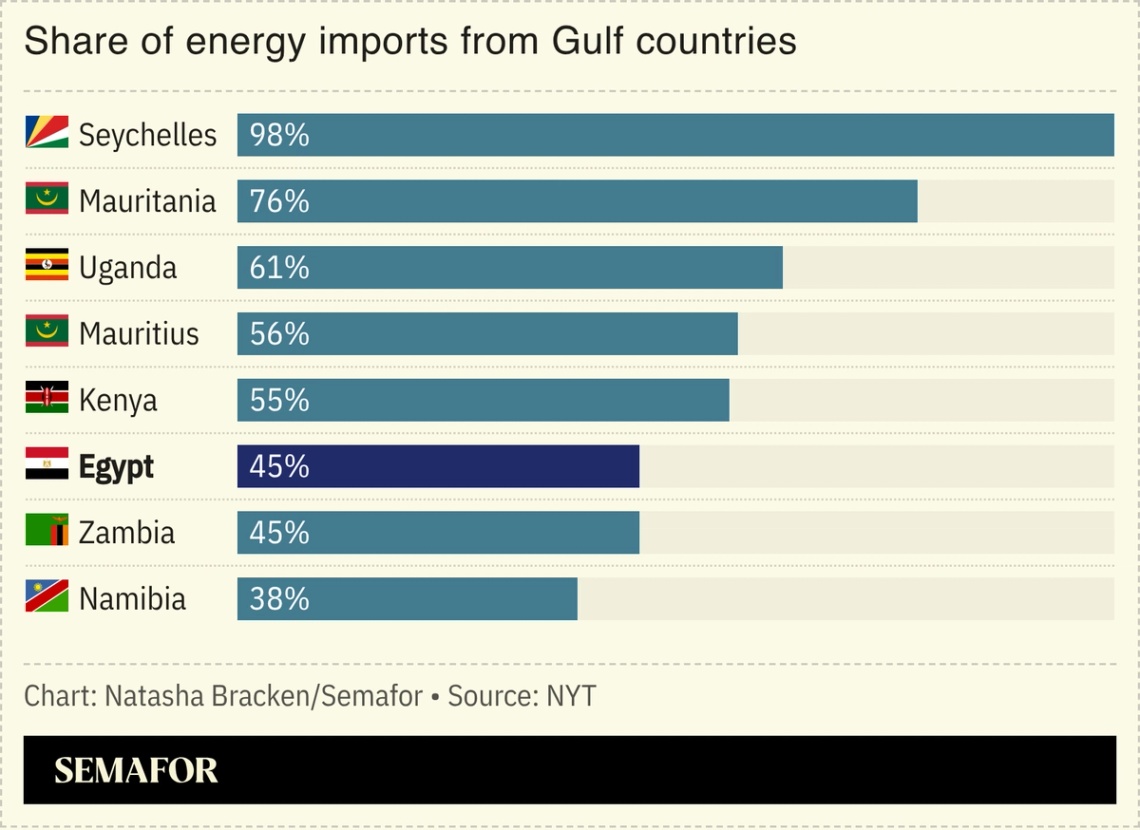
- Egypt lifted early-closure measures on Cairo, a month after energy strains from the war in Iran forced the famously late-night city to shut down by 11 pm.
 |
|
| |