| | In this afternoon’s edition: three new fronts in the country’s battles over partisan redistricting.͏ ͏ ͏ ͏ ͏ ͏ |
| |  | Washington, DC |  |
| |
|
 - WHCD aftermath latest
- FISA inches forward
- Ever-shifting House maps
- Hormuz vs. nuclear
- Spirit rivals raise hands
- War’s industrialization lesson
 United Airlines shares ▼ 1.4% after CEO says offer to buy American was rebuffed. |
|
WHCD suspect charged as ballroom fight builds |
 Kylie Cooper/Reuters Kylie Cooper/ReutersUS Attorney Jeanine Pirro dropped her investigation into the Federal Reserve last week, but she’s already got a new high-profile case: the alleged White House Correspondents’ Association dinner gunman. Prosecutors in her office filed charges against Cole Allen today, including “attempted assassination of the president.” Meanwhile, Pirro’s boss, acting Attorney General Todd Blanche, held up the foiled plot as proof that President Donald Trump’s planned White House ballroom is “essential” to his safety. Blanche urged a preservationist group suing to block construction of the ballroom to drop its “frivolous lawsuit.” Carol Quillen, head of the National Trust for Historic Preservation, said the group is moving forward in a statement to Semafor: “We are not planning to voluntarily dismiss our lawsuit, which endangers no one and which respectfully asks the administration to follow the law.” |
|
House wades back into surveillance |
 Brendan McDermid/Reuters Brendan McDermid/ReutersThe House is heading for a nail-biter floor vote this week on renewing warrantless government surveillance powers. The Rules Committee meets this afternoon to prepare the legislation. House GOP leaders are racing to get the votes they need to reauthorize Section 702 of the Foreign Intelligence Surveillance Act before an April 30 deadline amid lingering skepticism among conservatives who want changes to protect Americans’ rights. Republicans’ razor-thin House margin will require unanimity on what could become a party-line vote, on both the rule for debate and the underlying legislation. Democratic leaders have publicly warned that the GOP can’t count on much support from their side of the aisle. “These people have weaponized the criminal justice system, and they simply cannot be trusted to protect the privacy and the civil liberties of the American people,” House Minority Leader Hakeem Jeffries told reporters today. — Nicholas Wu |
|
Redistricting battles flare across the map |
 Evelyn Hockstein/File Photo/Reuters Evelyn Hockstein/File Photo/ReutersThe messy battle over mid-decade congressional redistricting that Trump kicked off is still flaring, as the two parties vie for an advantage six months before Election Day. The action played out in three states today: Florida GOP Gov. Ron DeSantis unveiled a new map that aims to create four additional Republican House seats, justices on the Virginia Supreme Court questioned whether the state assembly followed the law in creating a map voters recently approved that would give Democrats four new seats, and the Supreme Court allowed Texas to move ahead with a map designed to net four Republican-held seats. (The Texas gains, however, are expected to be effectively neutralized by a new California map the high court tentatively approved in February.) Given the uncertainty in Virginia and Florida, the final picture of which party might gain remains up in the air. |
|
Iran offers to reopen strait, but delay nuclear talks |
 Majid Asgaripour/WANA (West Asia News Agency) via Reuters Majid Asgaripour/WANA (West Asia News Agency) via ReutersThe question for the next phase of US-Iran talks may boil down to which matters more to the White House: an open strait now, or a nuclear Iran later? Iran made an offer to the US through mediators to reopen the Strait of Hormuz in exchange for the US ending its blockade, but it would put off nuclear discussions. Trump spoke with his national security team about the offer today, Karoline Leavitt, the White House press secretary, told reporters this afternoon. Earlier in the day, Secretary of State Marco Rubio said in an interview with Fox News that any deal must mean a fully open strait: “They cannot normalize, nor can we tolerate them trying to normalize, a system in which the Iranians decide who gets to use an international waterway and how much you have to pay them to use it.” |
|
Spirit rivals lobby for $2.5 billion |
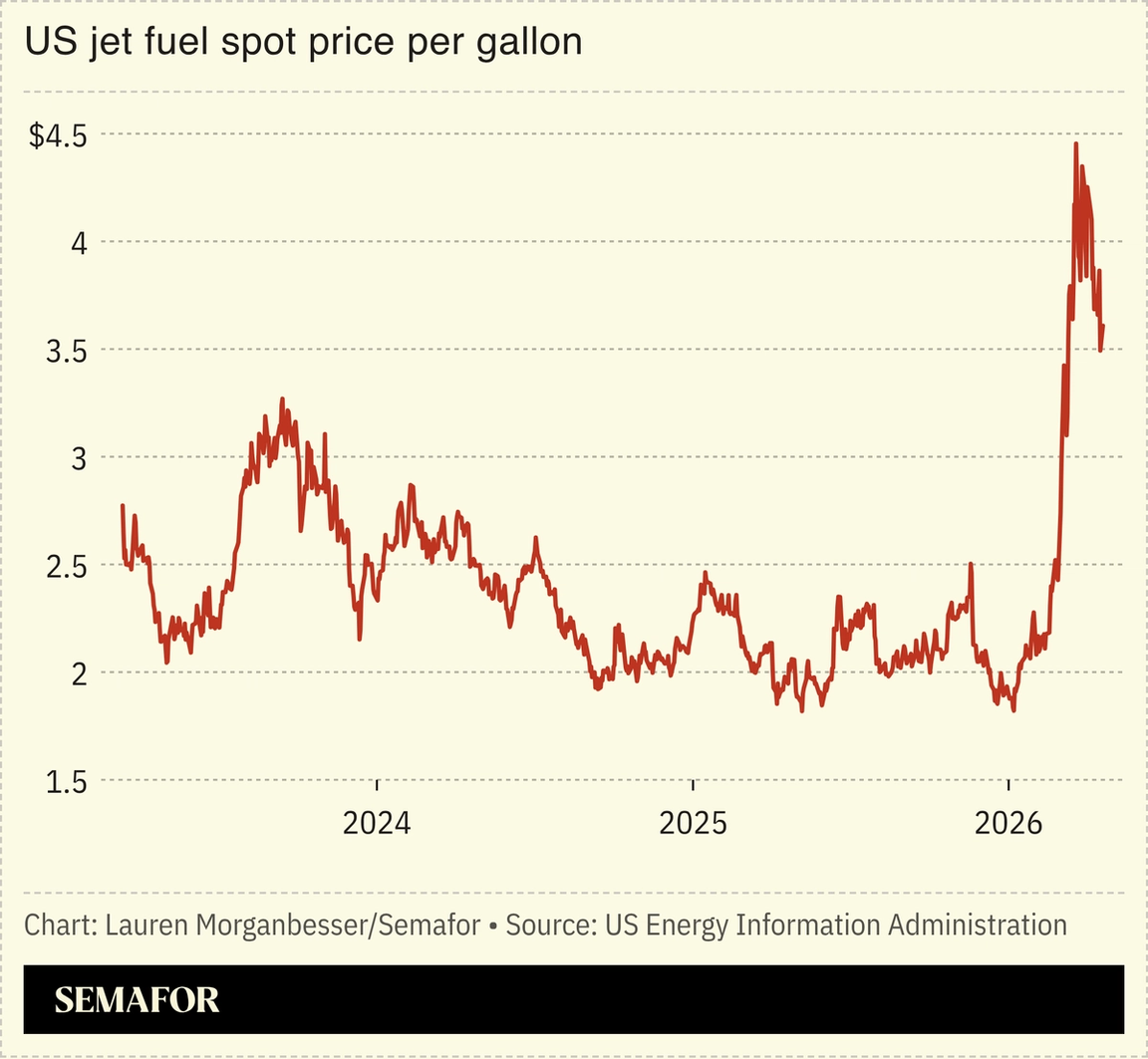 As the Trump administration weighs a $500 million lifeline for Spirit Airlines, rival budget airlines are asking Washington: What about us? A group of low-cost carriers is seeking $2.5 billion in federal aid, The Wall Street Journal reported, arguing that a surge in jet fuel prices is threatening their already thin margins. The war in Iran has pushed global jet fuel prices up more than 70%, pushing all major US carriers — American, Delta, United, Southwest, and JetBlue — to increase their checked-bag fees in recent weeks. But low-cost airlines say that strategy undercuts their core appeal. “Avelo competes against significantly larger airlines who have unprecedented market dominance,” low-cost carrier Avelo Airlines said in a comment. |
|
Scaling up industrialization |
| |  | Alexis Akwagyiram |
| |
 Sodiq Adelakun/File Photo/Reuters Sodiq Adelakun/File Photo/ReutersThe Iran war has shown the power of industrialization — just look at the impact of Aliko Dangote’s refinery in Nigeria. The conflict has highlighted Africa’s reliance on fuel imports and the knock-on effect of higher prices and currency pressure. Dangote’s plant has shown how local processing can reduce the impact of such global shocks, but the reality is that Africa’s richest man can’t singlehandedly drive industrialization across the continent. A new report by the Africa Finance Corporation argues that efforts to develop infrastructure across the continent hinge on deploying existing capital to develop local processing of fuel, fertilizer, and metals, rather than raising additional funds. But the biggest bottlenecks that threaten scaling industrialization revolve around energy and political will. Converting economic headroom into the factories and power lines will rely on governments committing to long-term projects with timelines that extend beyond election cycles. |
|
 Courts- During oral arguments, the Supreme Court appeared split on whether Bayer should be on the hook in cancer lawsuits linked to its weedkiller Roundup.
- Jury selection began in the court battle between OpenAI and Elon Musk.
- Former regulators say Polymarket could be liable in an insider trading case against a US Army sergeant. — Barron’s
Immigration- President Trump endorsed adding “National” to Immigration and Customs Enforcement, changing “ICE” to “NICE.”
- The Trump administration has hired dozens of new immigration judges with no background in immigration law. — WaPo
World- China is reversing the acquisition of an AI company by Meta, citing national security risks.
- Thailand, a close US ally, has turned to seeking help from Russia and China from the economic fallout of the war in Iran.
Media- Melania Trump called on ABC leadership to “take a stand” against Jimmy Kimmel for his “hateful and violent rhetoric,” after he described her as an “expectant widow” in a monologue Thursday.
Economy- The US’ biggest companies are doing better than inflation and war-related fears might indicate.
Health- The Trump administration’s decision to drop the recommendation that newborns receive a hepatitis B vaccine is expected to cause hundreds of childhood infections, increased liver cancer, and deaths, according to studies published today.
|
|
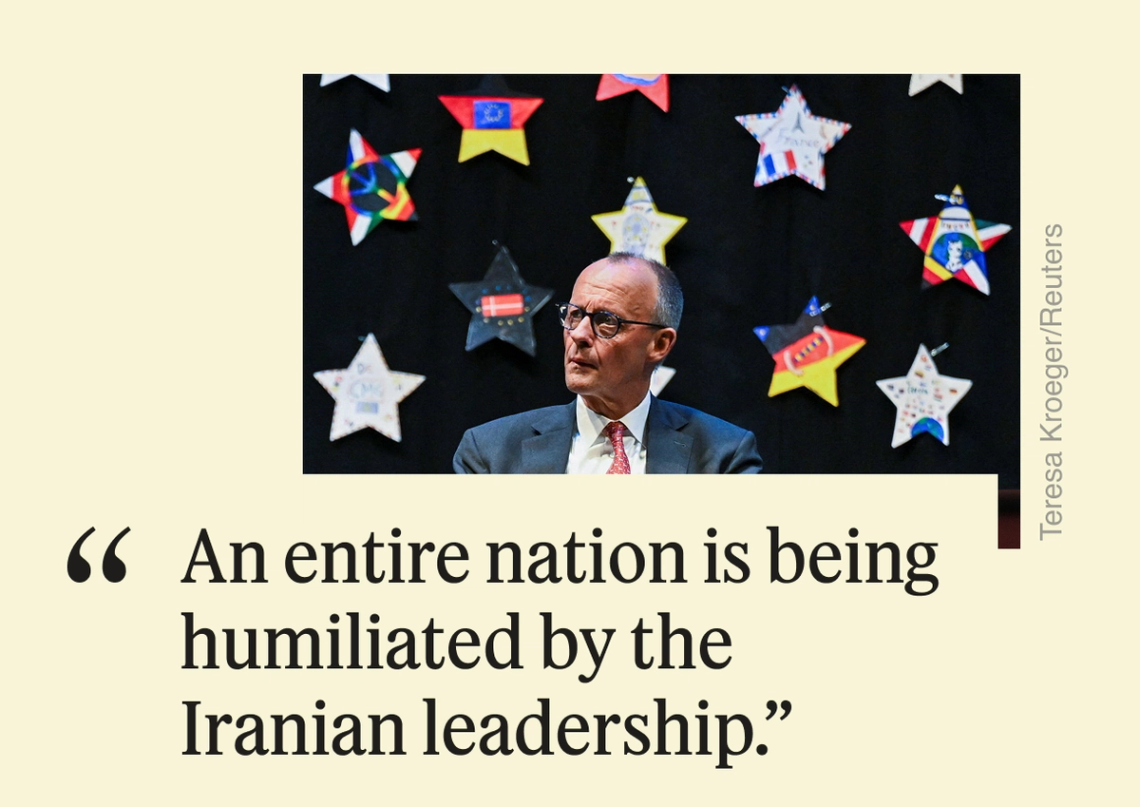 — German Chancellor Friedrich Merz, speaking to schoolchildren today, warning that the US does not have an exit strategy for the Iran war. |
|
|


