
| Forwarded this email? Subscribe for more |



 |
| By The Editors |
There was a time in American life when elected officials and journalists could gather in Washington and enjoy bad wine and banter without fear. But not last night at the White House Correspondents’ Association dinner, where what was supposed to be a routine celebration of the White House press corps and the First Amendment was cut short. And tragedy was narrowly averted.
The alleged shooter, Cole Tomas Allen, 31, from California, attempted to storm the ballroom of the Washington Hilton where more than 2,000 guests and senior members of the administration were gathered. He was, according to D.C. police chief Jeffery Carroll, armed with a shotgun, a handgun, and multiple knives. Allen had reportedly been staying at the hotel ahead of the event. CCTV released after the incident suggests he tried to sprint past a security barrier in the lobby, and allegedly fired at a Secret Service agent before he was subdued and taken into custody.
It was the first White House Correspondents’ Association dinner Donald Trump had attended as president, and it had been previewed as an adversarial moment. Many journalists saw Trump’s mere presence as an affront to press freedom, given the lawsuits he and his administration have deployed against critics. Meanwhile, Trump was set to joke about and even mock journalists in his remarks, later saying his speech would have been “rough.”
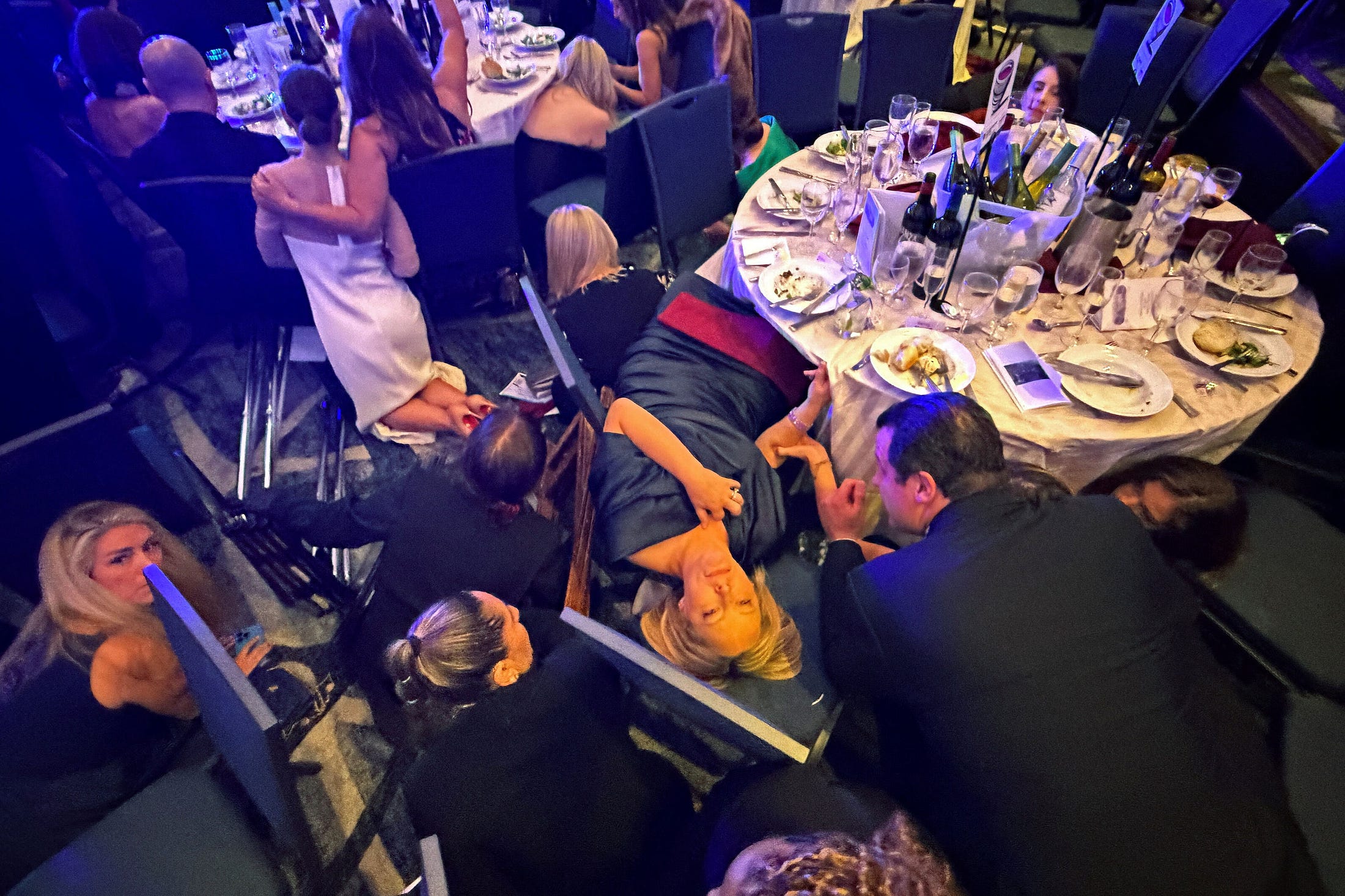
But barely an hour into the event, the president and the press found themselves on the same side. On the floor after gunshots rang out, Free Press staff witnessed the speedy response from the law enforcement officers who kept Trump and every guest safe. As the audience and dignitaries took cover, armed agents rushed toward the gunfire and suppressed the attacker, while others escorted out the president and cabinet officials.
According to acting attorney general Todd Blanche, the alleged shooter is believed to have targeted Trump administration officials. No evidence has emerged so far that suggests that Allen is mentally impaired, and he graduated from CalTech in 2017. A December 2024 Facebook post from the tutoring service where he appears to have worked described him as “teacher of the month.”
We’ll learn more details in the coming days, but it’s impossible to ignore the fiery pitch of the current political climate. Just outside the hotel, protesters held placards that read “Death to Tyrants” and “Death to All of Them.” They waved these signs in the faces of shaken attendees even after the thwarted attack. Hatred toward public officials and ideological opponents abounds in American politics today, and has too often turned violent.
It struck us, as they waved these placards in the event’s aftermath, that it was the perfect emblem of our present moment. One in which calls for violence against people “on the other side” can be stated flagrantly in public.
 |
If the shooter was indeed targeting the president, this would be the third assassination attempt in less than two years. One can find examples of ugly, violent rhetoric being used across the political spectrum in America today, but the animosity aimed at Trump is on a level of its own. That fixation is the symptom of a broken politics.
Trump was collected and resolved at his press conference at the White House shortly after the incident. “This was an event dedicated to freedom of speech that was supposed to bring together members of both parties with members of the press,” he said. “And, in a certain way, it did. Because of the fact that they just unified, I saw a room that was just totally unified. It was, in one way, very beautiful, a very beautiful thing to see.”
Trump’s reaction to the shooting was notably different from his justifiable impulse to “fight” after being struck during the Pennsylvania rally in 2024. On Saturday night, he sought to unify. “We have to, we have to resolve our differences,” Trump said. “I will say you had Republicans, Democrats, independents, conservatives, liberals, and progressives. There was a tremendous amount of love and coming together. I watched, I watched, and I was very, very impressed by that.” That impulse is sorely needed in the country today—and not just in the immediate aftermath of an emergency.
If the shooter was indeed targeting the president, this would be the third assassination attempt in less than two years.
Authorities on Saturday said the suspect will face at least two charges: armed assault on a federal officer and using a firearm while committing a crime. They expect to file more charges soon. Allen is set to be arraigned on Monday, and could face up to 30 years in prison if convicted on both of the currently announced charges.
The shooting is a reminder that the First Amendment alone cannot uphold free speech. Its legal protections for private individuals are essential, but the entire American system of expression, elections, and debate is also built on a shared culture—on the assumption that the elected representatives of the people will never lack the power to speak freely. Today, that can no longer be taken for granted. The assassin’s veto over the president is as great a threat to free expression as is the government’s power to suppress the public. If the shooter was aiming to silence President Trump, his bullet would also have nullified the views of the 77 million who voted for him, along with the entire electoral system.
While journalists celebrate free speech, it’s worth remembering that security guards and law enforcement play an essential role in allowing speech to circulate in the first place. And as in the Pennsylvania shooting, the officers who responded on Saturday acted swiftly and admirably, while the leaders in charge of preventing an attack have much reassessing to do.
The shooting is a reminder that the First Amendment alone cannot uphold free speech.
Among the guests on Saturday were members of a club that has grown too large: Steve Scalise, shot during a congressional baseball practice in 2017; Robert F. Kennedy Jr., whose father and uncle were assassinated; and Erika Kirk, whose husband, Charlie, was murdered last year. A video shows Kirk, in tears, being ushered out of the event. It struck us that we were gathered in the same hotel where, in 1981, John Hinckley Jr. attempted to assassinate then-president Ronald Reagan.
The venue and guests help put in context a harrowing notion: Political violence is once again a norm after several generations as a rarity. Trump has been a repeated target in the maelstrom, but it threatens to hit any American who dares to step forward in our divided and deranged era.
As the threats and attacks grow in frequency, they pass in and out of the public imagination with increasing speed. Democratic Rep. Maxwell Frost was reportedly punched in the face at an event in January, and Rep. Ilhan Omar was sprayed with a vinegar-like substance at a town hall the same month. Two Minnesota state legislators, Melissa Hortman and John Hoffman, were shot in their homes in June 2025, and Hortman and her husband, Mark, died in the attack. The residence of Pennsylvania governor Josh Shapiro was set ablaze last year while he and his family slept. And only weeks ago, a man threw a Molotov cocktail at the home of OpenAI CEO Sam Altman.
With each attack, the price of participation in American public life rises. The toll of this violence for our democracy is real and undeniable, if hard to quantify. It is measured in every speech that cannot go ahead for safety reasons, every candidate who decides not to run for office because of the risks that brings with it, every administration official forced to live on a military base because of the threats they face, and every journalist who suppresses a detail out of fear of reprisal.
In the tangle of causes of this dark trend, one thread stands out: the endorsement or justification of violence. We wish we could say that such language can only be found on the signs of protesters. Only a few days ago, The New York Times published a gleeful podcast conversation in which the participants excused the murder of UnitedHealthcare CEO Brian Thompson.
As was widely reported in the hours after the attack, Trump initially wanted to return to the ballroom and resume the evening’s program. Law enforcement protocol mandated otherwise. “We wanted to stay tonight,” he said. “I fought like hell to stay.”
Instead, the event will not be canceled, but postponed. “We’re going to reschedule,” he said. “We’re going to do it again. We’re not going to let anybody take over our society.”
That the event be rescheduled, and be held in as normal a manner as is safe, is a democratic necessity.
 |
