| | The US-Iran standoff over the Strait of Hormuz escalates, Meta slashes jobs amid aggressive AI spend͏ ͏ ͏ ͏ ͏ ͏ |
| |  BANDAR ABBAS BANDAR ABBAS |  NEW DELHI NEW DELHI |  SHENZHEN SHENZHEN |
 | Flagship |  |
| |
|
The World Today | 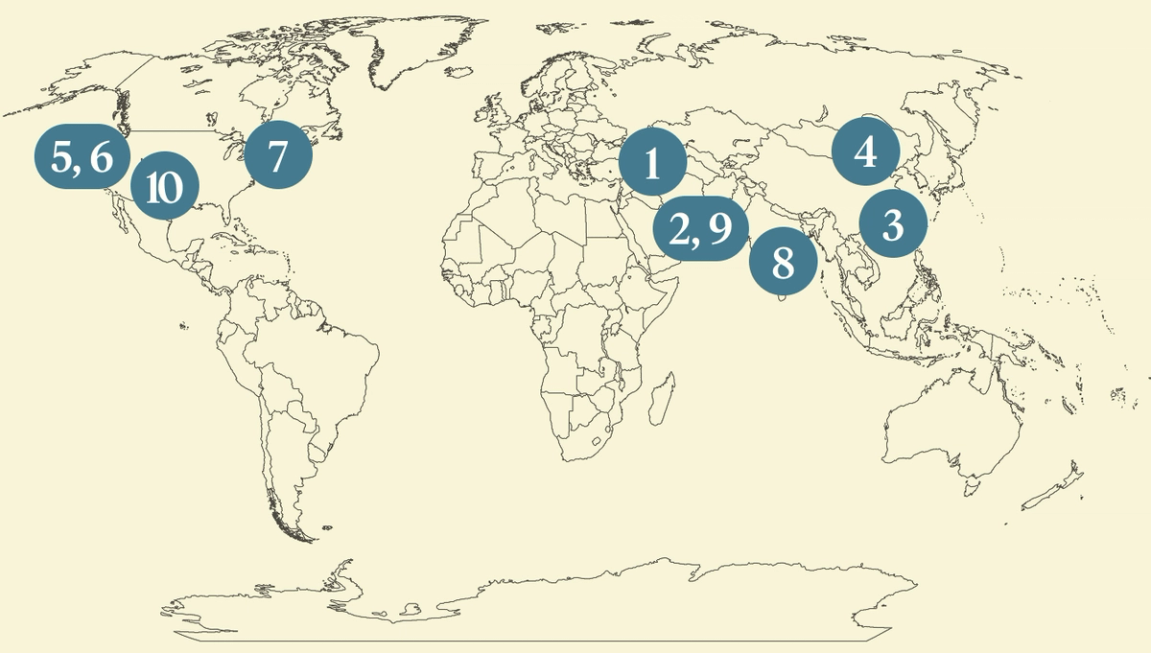 - Hormuz standoff deepens
- Dovish case on war disruption
- China’s big oil stockpile
- US-China AI theft charge
- Microsoft, Meta downsize
- Google embraces agents
- Trump reclassifies weed
- Row over ‘hellhole’ comment
- Crypto scam in Hormuz
- The origins of breathing
 The trippy world of psychedelics, and our latest Substack Rojak. |
|
US, Iran locked in Hormuz standoff |
 US Marine Corps/Handout via Reuters US Marine Corps/Handout via ReutersUS President Donald Trump ordered the Navy to “shoot and kill” Iranian boats placing mines in the Strait of Hormuz, escalating the bitter stalemate over the key waterway. The directive came after Iran seized two container ships; both sides are looking to control the strait through their own blockades, creating an “uneasy standoff” with no diplomatic off-ramp in sight, Bloomberg wrote. Trump suggested Thursday he feels no rush to end the war, despite his initial four- to six-week timeline. He later announced a three-week extension to the Israel-Lebanon ceasefire, which was due to expire Sunday; that conflict has complicated US-Iran peace negotiations, while some Pakistani officials — who are playing mediator — blamed the US’ blockade of Hormuz for stalled talks, Nikkei reported. |
|
The dovish case on Hormuz |
 Michael Schindler/Handout via Reuters Michael Schindler/Handout via ReutersSome experts argued the Strait of Hormuz closure may not lead to an all-out economic catastrophe, as the prevailing narrative suggests. The Brookings Institution’s Robin Brooks wrote that global manufacturing data from March shows that the Iran war “isn’t nearly [as] disruptive as some would like it to be,” and that “the apocalyptic talk is way off base,” given the resilience of the global economy. And new European economic readings show growth slowing but prices not yet spiraling out of control, according to HSBC analysts. Companies, however, appear to be bracing for the ripple effects of the disruptions; at least 21 firms have withdrawn or reduced financial guidance since the war began, and 32 have signaled price hikes, Reuters reported. |
|
Quantifying China’s vast oil reserves |
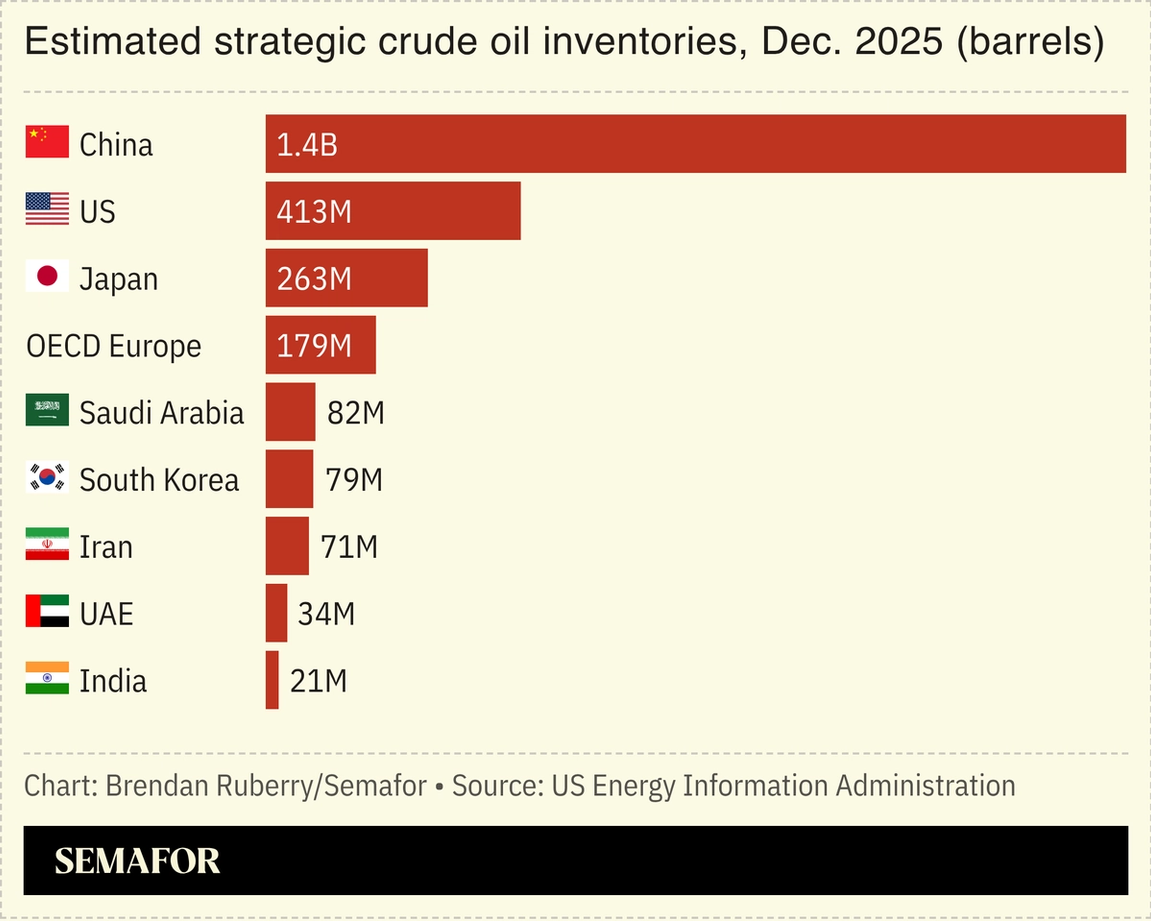 China stashed more than three times as much crude oil as the US in 2025, new data shows. The US government report underscores how intensely China worked to bolster its reserves ahead of the Iran war, giving it a crucial buffer in the face of energy supply disruptions during the conflict. The stockpiling surged last year in particular because of low oil prices, rising geopolitical risks, and a new law requiring more reserves, analysts said. “There’s a lot they can look back on and say, ‘We made the right call,’” a Columbia University scholar told CNN. But one economist argued that the US and Japanese stocks stretch further than Beijing’s because China consumes much more energy. |
|
US accuses China of AI theft |
 Larry Downing/Reuters Larry Downing/ReutersThe Donald Trump administration accused China of running “industrial-scale campaigns” to steal the capabilities of American AI models. While the charge itself isn’t new — Anthropic and OpenAI have said Chinese rivals tried to illicitly extract information about their chatbots — the White House memo marks a serious escalation on the issue, weeks before US President Donald Trump is slated to travel to Beijing. The administration said it would work with US AI firms to counter such campaigns; the companies themselves recently banded together to share information about so-called adversarial distillation attempts, in which a “teacher” AI model trains a “student” model. US companies are concerned Chinese AI labs are creating imitations of their chatbots, efforts that could hold national security implications. |
|
Meta, Microsoft shrink workforce |
 Carlos Barria/Reuters Carlos Barria/ReutersMeta and Microsoft are significantly downsizing their workforces as the US tech sector grapples with AI-fueled disruptions. Meta announced Thursday it was laying off 10% of its staff, about 8,000 employees, citing efforts to become more efficient and “offset other investments,” alluding to its heavy AI spending. And Microsoft, for the first time, is offering voluntary buyouts to 7% of its US staff. Other Big Tech firms, including Amazon and Oracle, have undergone layoffs amid the AI expenditure boom. But a growing chorus is skeptical that AI is driving such layoffs: The head of startup Scale AI said at Semafor World Economy that many of the cuts are just “right-sizing and [the companies] need an excuse.” |
|
Google hails ‘truly agentic workflows’ |
 Bhawika Chhabra/Reuters Bhawika Chhabra/ReutersGoogle CEO Sundar Pichai said 75% of the company’s new code is AI-generated. The trajectory is fast: In 2024 that figure was 25%, and last fall 50%. Meta targets similar levels by midyear. More startlingly perhaps, Pichai said the company was shifting to “truly agentic workflows” — rather than engineers giving prompts that the AI models complete, engineers now supervise autonomous digital teams. One complex code migration task, he said, was accomplished six times faster than would have been possible a year ago. It is leaving junior engineers an endangered species, HumanReadable-AI reported. Snap reached 65% AI-generated code this month and immediately cut planned headcount; a Stanford analysis found that employment rates among younger software developers have fallen 20% since its 2022 peak. |
|
US reclassifies marijuana |
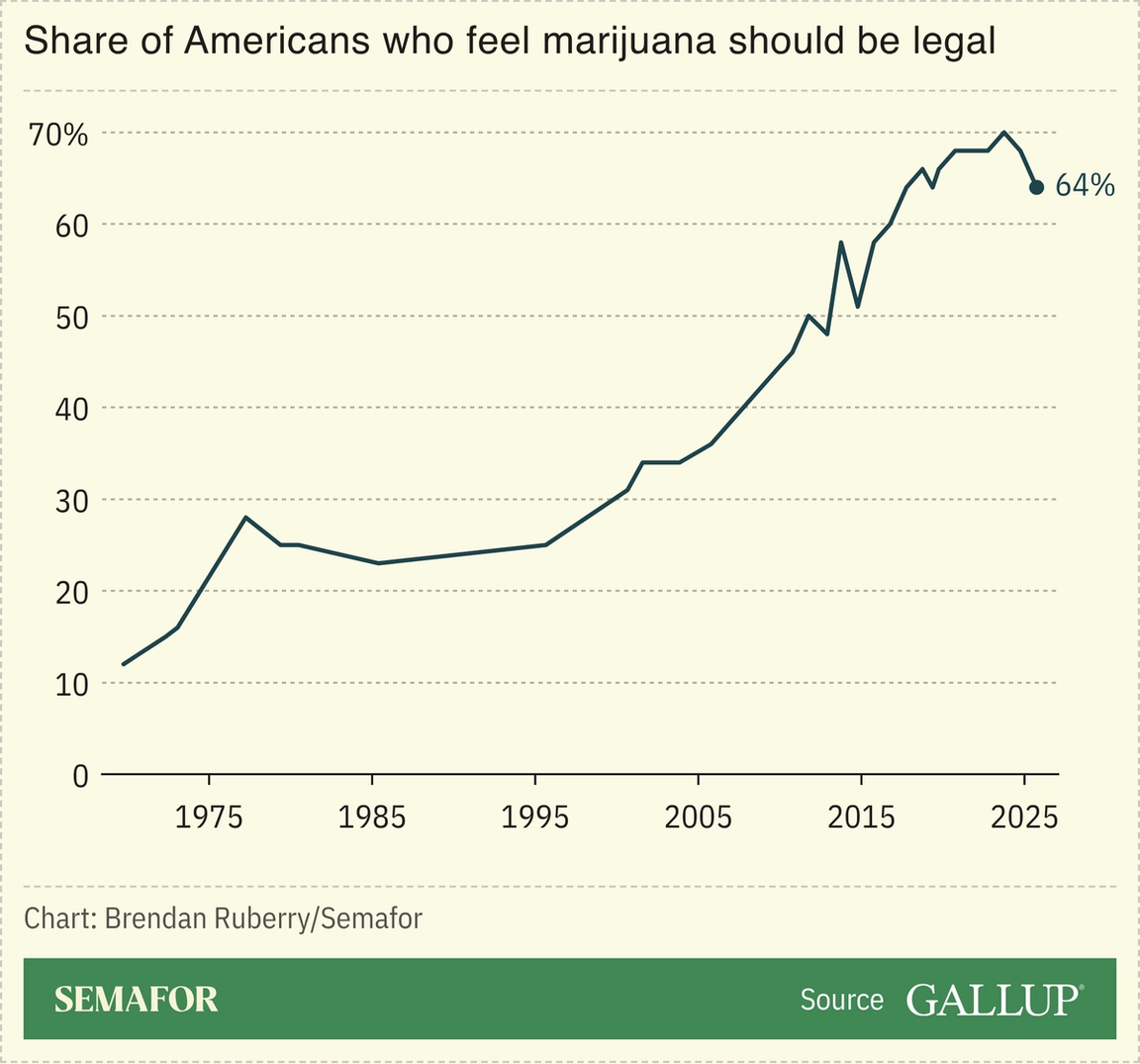 The Trump administration reclassified marijuana as a less harmful substance on Thursday, removing barriers to research and generating tax benefits for the legal industry. Cheered by advocates and criticized by some Republicans, the move doesn’t legalize marijuana use nationwide, but removes cannabis from the same federal category as heroin and LSD — drugs with high potential for abuse — providing regulatory wiggle room for an industry that has, somewhat incongruously, struggled to grow in recent years, Bloomberg noted. After a decade in which most US states liberalized drug laws, the once-unstoppable movement to “legalize it” has generated some public backlash over mounting concerns, including high THC concentrations and marijuana’s ubiquitous smell in public spaces. |
|
 From mercury elixirs to blood transfusions, the ultra-wealthy have always tried to cheat death. Tech journalist Kara Swisher joins the Business History podcast to trace humanity’s oldest obsession — and ask whether today’s longevity gurus are any different from history’s greatest quacks. Listen to Business History now or watch on YouTube. |
|
India rebukes ‘hellhole’ comment |
 Shir Torem/Reuters Shir Torem/ReutersThe Indian government strongly pushed back against a statement amplified by US President Donald Trump calling India a “hellhole,” sparking diplomatic friction amid trade negotiations between the two countries. Trump on Thursday shared a podcaster’s comments deriding India and China in an argument against birthright citizenship. India’s foreign ministry called the remarks “obviously uninformed, inappropriate and in poor taste,” while the US embassy in New Delhi moved to contain the fallout. US-India ties have taken several hits since Trump returned to the White House; the latest row comes just after an Indian delegation visited Washington with aims of finalizing a trade pact. The US trade representative called New Delhi “a tough nut to crack.” |
|
Scammers exploit Hormuz closure |
 European Union/Copernicus Sentinel-2/Handout via Reuters European Union/Copernicus Sentinel-2/Handout via ReutersAt least one ship that was fired on in the Strait of Hormuz may have been the victim of a crypto scam. Iran has demanded that ships pay a toll in cryptocurrency to safely traverse the waterway. A maritime risk management agency said that scammers posing as the Iranian government have sent messages to shipowners asking for the fee, and that one vessel appeared to have fallen for it, briefly attempting to cross the strait before turning back, Ars Technica reported. A second ship also reported being fired upon despite apparent permission, and authorities are investigating possible fraud. More than 2,000 ships and 20,000 mariners are stranded in the Gulf due to the strait’s closure. |
|
|


