| | In this edition, AI tokens may be starting to rival labor costs for companies, and Anthropic investi͏ ͏ ͏ ͏ ͏ ͏ |
| |  | Technology |  |
| |
|
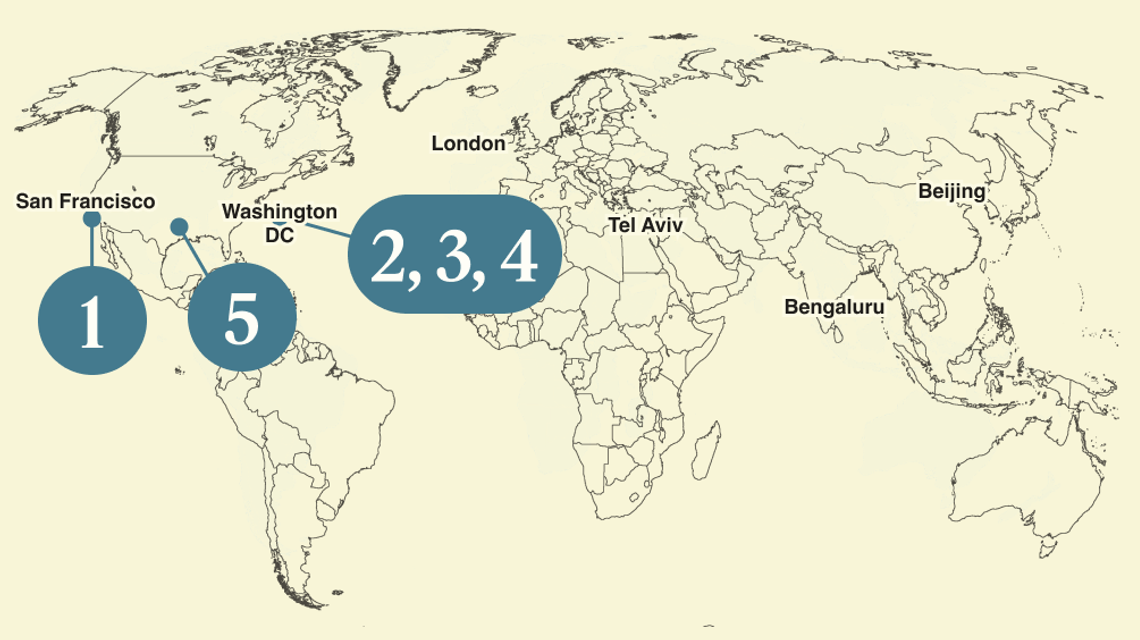 - Mythos security fears
- Skyrocketing token costs
- Gen Z’s AI era
- TBPN vs. X
- Profitable mammoths
 There’s still time for Google to step into the AI coding race, and Anthropic tried to make AIs supervise other AIs. |
|
 Google is facing a new wave of heat from critics who say it’s falling behind on AI coding and that even its own employees are choosing Claude Code over its homegrown products. This trope may sound familiar: Google caught flack when ChatGPT came out in 2022, prompting a spate of premature obituaries declaring that the tech giant missed the AI wave and wouldn’t be able to catch up with the growing startups. That narrative was wrong then, and it’s wrong now. Google, which has a giant frontier AI lab wrapped inside of an enormous, sprawling company, has a very clear beachhead when it comes to AI: consumers. While Anthropic and OpenAI are busy duking it out over enterprise and government customers, Google is stepping right in to gobble up everyday users that are already accustomed to turning to the tech company to run their email, meetings, and other large swaths of their lives. Google has had to react quickly before, and this time is no different. As the tech industry reorients around the AI token, it’s turning into a long-term industrial effort that will no doubt determine winners and losers. The “harnesses” built to leverage those tokens, connecting to computer systems and calling on tools, have rocked Silicon Valley but have yet to filter out into the wider world. OpenAI’s Codex is the closest thing to a consumer harness for AI, but it isn’t really being marketed that way, leaving a gap for someone to fill. Google hasn’t really spelled out its agentic coding vision to the world. (I asked Gemini to explain it to me. Even it had trouble). But we’re still very early in this product cycle. And there’s still a massive opening for Google to step in and wow consumers with something that gives them control over computers like they’ve never had before. |
|
Anthropic investigates Mythos uses |
 Anthropic co-founder Jack Clark at Semafor World Economy. Tasos Katopodis/Getty Images for Semafor. Anthropic co-founder Jack Clark at Semafor World Economy. Tasos Katopodis/Getty Images for Semafor.Anthropic is investigating reports that unauthorized users gained access to its powerful Mythos model, stoking greater fears among businesses and governments that AI is a bigger threat to cybersecurity than we previously thought. It appears the unauthorized users may have gleaned information from Mercor — a $10 billion startup that works with companies like Anthropic to collect training data for powerful AI models, which was hacked in March — to essentially guess the credentials needed to gain access to Mythos. The episode is a reminder that, as much as every industry has to worry about vulnerabilities being discovered by increasingly sophisticated AI models, fast-moving AI startups are the low-hanging fruit right now. Take the recent Lovable breach that exposed user data. We wrote about some of these issues back in May. Good security is expensive and it slows things down. It’s the age-old conundrum for startups and even large companies — do you invest in security and possibly give your competitors an advantage, or do you worry about security later and risk something catastrophic happening? |
|
Are AI tokens starting to rival labor costs? |
 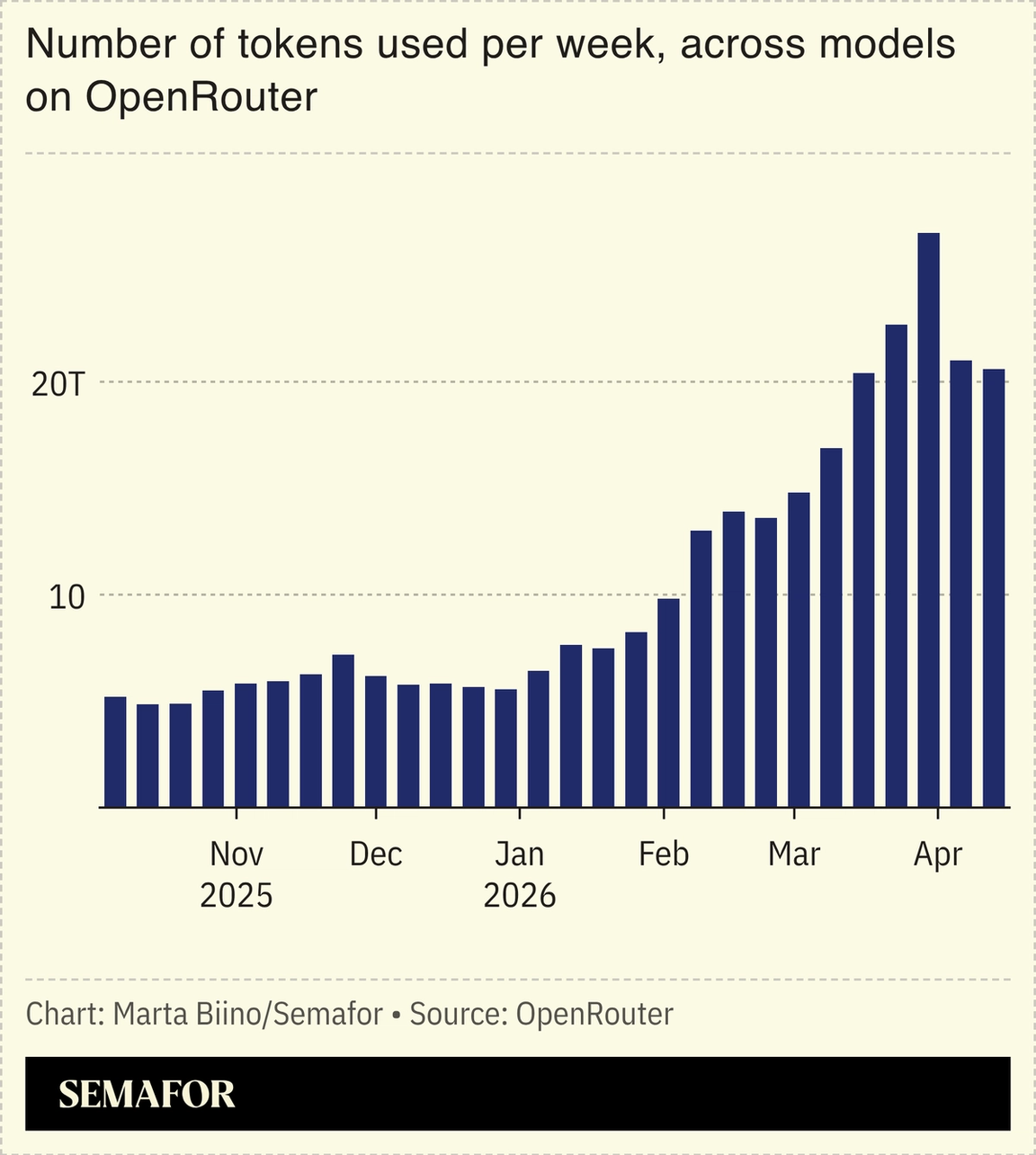 The cost of tokens is now competing with the cost of headcount. “You have to raise a lot more money on a per-headcount basis,” Henry Ward, who runs Silicon Valley financial-software provider Carta, said at Semafor World Economy in Washington, DC. “I don’t see any end to that in sight.” Tech executives like Nvidia’s Jensen Huang have suggested that the more companies spend on AI, the more money they will make. But the growing cost of tokens is a line item that CFOs are having trouble planning for. Several executives in Washington, DC, last week said they’re grappling with that uncertainty. “The unit costs are going down, but the aggregate costs are going up, and companies don’t like when something is unpredictable on cost,” said Charles Phillips, co-founder of private equity firm Recognize. Kunal Kapoor, CEO of Morningstar, added that subscription models “have endured for a long time because there’s value in certainty.” ICONIQ Capital founding partner Divesh Makan, whose investment firm recently led one of Anthropic’s funding rounds, called free AI models “the gateway drug” to paid versions, adding that his employees keep asking for more tokens. “The conversation we’re having is, ‘What is the amount we should be spending, and how do we measure ROI?’” he said. “Are you just buying holidays and checking the weather in Tokyo, or are you doing something productive with these tokens?” |
|
Employers need social humans |
 Pearson’s Omar Abbosh, Citadel Securities’ Alex DiLeonardo, and Shelly Banjo at Semafor World Economy. Annabelle Gordon/Semafor. Pearson’s Omar Abbosh, Citadel Securities’ Alex DiLeonardo, and Shelly Banjo at Semafor World Economy. Annabelle Gordon/Semafor.Executives are revamping what they’re looking for in job candidates, as they aim to train a new generation of employees that are savvy with AI but know how to schmooze. Several company leaders who spoke at Semafor World Economy last week said they are prioritizing interpersonal communication skills over technical ones. KPMG’s US chief Tim Walsh said the firm is assessing who to hire out of its summer intern class not by how well they perform an audit, but on their critical thinking skills. “I do need the employee because I need them to make client connections. I need them to make human connections,” he said. Citadel Securities’ Chief People Officer Alex DiLeonardo agreed. “You have to assess [candidates] on behavioral characteristics,” he said. “Those are things like creativity, leadership potential, raw problem-solving ability, commerciality.” The change stems from how AI is reducing the amount of technical tasks done by juniors — like making slide decks, coding, and performing financial analyses — and directing them towards client-facing work. But social skills are notably a weak spot for the generation of students whose childhood was filled with social media, high school interrupted by COVID, and college years automated with AI. — Rachyl Jones |
|
Is X downranking TBPN clips? |
 Chris Lehane speaking at Semafor World Economy. Tasos Katopodis/Getty Images for Semafor. Chris Lehane speaking at Semafor World Economy. Tasos Katopodis/Getty Images for Semafor.Fans are suspicious that since OpenAI bought TBPN, X is downranking the clips. Elon Musk, who owns the platform, has been openly sparring with the ChatGPT maker for months. When Semafor asked OpenAI’s Chris Lehane at Semafor World Economy in Washington, DC, last week, the chief global affairs officer told Reed Albergotti he “looked forward to Semafor’s reporting on this topic.” Lehane said the 70,000 viewers tuning into the three-to-four hour talk show are the “real center of Silicon Valley,” and that OpenAI bought the show — for an undisclosed sum — to help explain how and why AI matters, as well as how it works, at a moment when there’s a lot of worry about the societal and economic impacts of the technology. OpenAI CEO Sam Altman’s own home was attacked twice this month, and shots were fired at the home of an Indianapolis councilman after he supported the building of a data center. “No data centers,” read a note left at his door. Lehane said TBPN, which will maintain editorial independence in accordance with the purchase agreement, can facilitate a more thoughtful discussion of AI for a growing number of people. |
|
Will cloning woolly mammoths be profitable? |
 Semafor/YouTube Semafor/YouTubeWhen asked how much revenue there was in bringing back extinct animals, Ben Lamm doesn’t hesitate: $1.7 trillion. Add in the ability to protect sensitive ecologies and map the evolution of species and diseases, the CEO of biotech startup Colossal said on Semafor’s Compound Interest show, and the money-making potential is “immeasurable.” It’s less Jurassic Park than you’d think — Colossal has no plans to build a theme park for dire wolves, which it successfully revived last year to the frustration of some pedantic biologists. Instead, the money will come from where it always does: selling services to big companies and governments. Colossal is working with the Emirati government to protect native species, licensing its gene-editing technology to other biotech labs, and sees promise in mining its treasure trove of elephant DNA for clues about cancer prevention. He also hinted at some classified bioweapons work for the US government “that may not have made it into a press release.” Even in the buzziest and most futuristic corner of tech, B2B still reigns. |
|
 Most AI coverage feels like standing in a hurricane. Mindstream is the quiet room where the headlines make sense. Each issue is human-written and editorially curated to separate trends from trivia, highlight business impact, and give you practical next steps. Expect sober analysis, clear frameworks, and usable language you can lift into decks, briefs, and team chats. Subscribe today. |
|
 Lisi Niesner/Reuters Lisi Niesner/ReutersAnthropic tried to answer a looming worry: How will humans supervise AIs that are smarter than we are? One possibility is using less smart, but easily controlled, AIs to train cutting-edge ones. The firm had Claude try to do that, letting it stand in for human researchers using a relatively dumb open-source model to supervise a more powerful one. It was only a dry run for future efforts to control superhuman AIs, which will be far harder; also, the test was limited to one simple task. What’s more, some of the Claudes themselves sometimes gamed the system, displaying the exact reward-hacking they were supposed to prevent. But Anthropic argued that it suggested AIs could “meaningfully” improve AI safety research. |
|
|


