| | In this edition: Virginia Dems get their map, AIPAC hits Massie in Kentucky, and a Democrat’s unlike͏ ͏ ͏ ͏ ͏ ͏ |
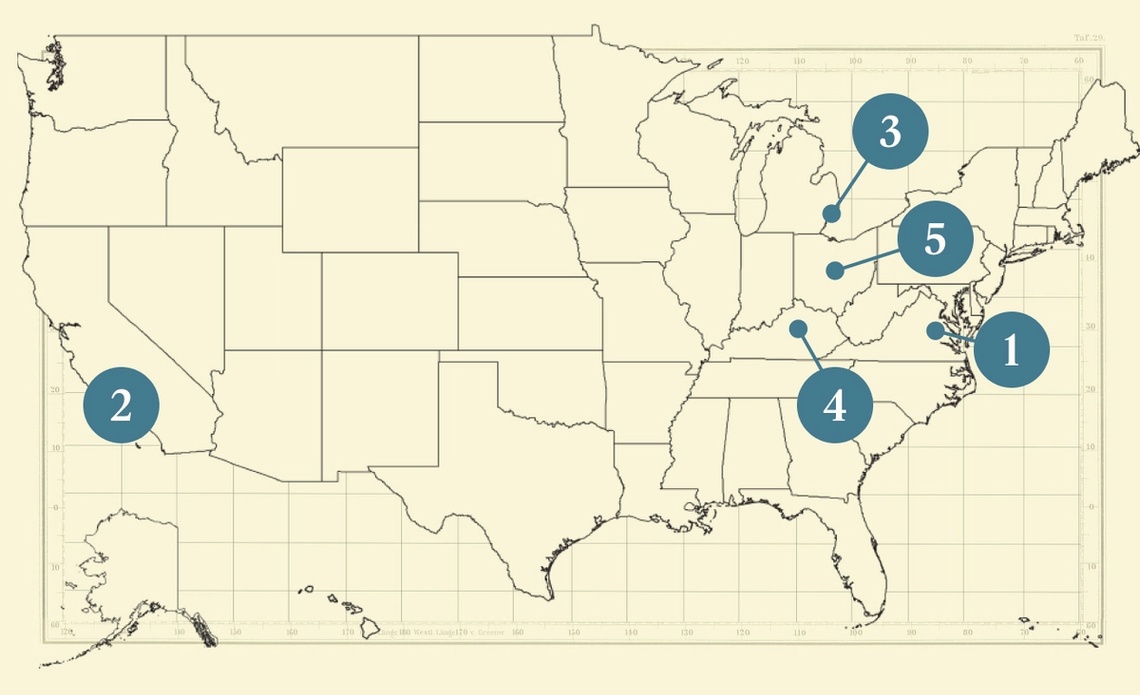
| |  LEXINGTON, KY LEXINGTON, KY | BATON ROUGE, LA |  RICHMOND, VA RICHMOND, VA |
 | Americana |  |
| |
|
 - Dems’ redistricting win
- Becerra’s unlikely rise
- Liberal fight in Michigan
- Latest anti-Massie push
- Ohio’s red tint, polled
|
|
 There were many losers in Virginia’s vote to approve a gerrymandered, Democratic map. President Donald Trump kept his super PAC wallet closed, quietly angering Republicans. Four members of House Speaker Mike Johnson’s GOP majority now face near-certain defeat in November. And Virginia Republicans, who wanted to prove that they could win again, proved that they can’t. Democrats feel more conflicted about another loser: The editorial board of The Washington Post. The publication was an early critic of their power play, publishing take after disappointed take about the “brazenly dishonest” campaign for “fair” elections. “Even The Washington Post has said the ‘yes’ campaign is, in their words, brazenly dishonest,” Former Virginia Attorney General Jason Miyares said at an April 11 rally in Rockingham County, which backed the “no” campaign by 50 points. “Think about that. The Washington Post covers DC politics, and it even shocks them!” The argument didn’t move votes in the DC suburbs, where the Post is the hometown newspaper, and where “yes” won by a landslide. The consensus among Democrats is that a Post editorial against one of their priorities and amplified by Republicans would have mattered five or 10 years ago. Maybe they’d have scrambled staff to figure out a response, and gamed out days of bad news cycles. Not in 2026. |
|
Virginia Dems win their gerrymander vote |
 Ken Cedeno/Reuters Ken Cedeno/ReutersDemocrats now have a wider path to a House majority this fall, after Virginians narrowly voted yesterday to let the party replace the state’s court-drawn congressional map with one that will demolish four Republican districts. High turnout against the amendment in red, rural areas was overwhelmed by Democratic votes from the DC suburbs, which will be drawn into four new Democratic-leaning seats. The goal, set out by the party’s state senate president Louise Lucas, was a “10-1” map that would last through Trump’s presidency. Unlike California Republicans, who couldn’t convince donors to help them fight last year’s gerrymander vote, Virginia Republicans rallied and spent $40 million on their “Fair Maps” campaign. Former Gov. Glenn Youngkin campaigned against his successor, Gov. Abigail Spanberger, claiming that she’d lied about her politics to win and urging the state Supreme Court to throw out the new map. The court was holding off on a decision about the map until after Tuesday’s vote, and similar lawsuits — including one from Republicans against the new California map, and another from Democrats against the new Texas map — have failed to overturn California gubernatorial dynamics shift, yet again the mid-decade gerrymanders. |
|
California gubernatorial dynamics shift, again |
 Manuel Orbegozo/Reuters Manuel Orbegozo/ReutersThe race for governor of California was shaken up, one more time, by Eric Swalwell’s resignation and another Democrat’s decision to quit the race. That helped narrow the stage for tonight’s first televised debate between the two leading GOP candidates and the four highest-polling Democrats. Former Biden Health and Human Services Secretary Xavier Becerra, who’d gotten little traction while Swalwell was running, got the biggest polling lift when he quit. He jumped to 10% in an Emerson poll and made a bigger leap in a poll conducted by the California Democratic Party — which has conducted its own surveys to nudge some candidates out and end the risk of Republicans winning both runoff slots for November. The shift surprised bettors, if not Democratic voters; trading platforms had seen a surge in bets for Tom Steyer, whose wealth has allowed him to dominate on TV, and San Jose Mayor Matt Mahan, whose donors re-fueled a super PAC for him after Swalwell imploded. Yet despite serving as state attorney general during Trump’s first presidency and rising in House leadership before that, Becerra was viewed as weak by fellow Democrats. At town halls, he’d called himself the readiest candidate for the job because he alone had “declared an emergency” (at HHS) and managed a bigger budget than California (also at HHS). Republicans Steve Hilton and Chad Bianco will join Steyer, Becerra, and Mahan at tonight’s KTLA debate, along with former Rep. Katie Porter. Two non-white Democrats, former Los Angeles Mayor Antonio Villaraigosa and state Education Superintendent Tony Thurmond, polled too low to enter it. Becerra led fellow non-white candidates in challenging the rules of a prior debate at USC, which was canceled. |
|
Democrats fret about El-Sayed for Senate |
 Jim West/UCG/Universal Images Group via Getty Images Jim West/UCG/Universal Images Group via Getty ImagesDemocrats in DC and Michigan are waking up to the real possibility that a Bernie Sanders-endorsed candidate can win their Senate nomination, setting up a general-election race that some moderates and strategists think he’d lose, as I reported with Burgess Everett and Nicholas Wu today. The angst started with Emerson polling that shows El-Sayed gaining ground this year, running ahead of Rep. Haley Stevens and even with state Sen. Mallory McMorrow. It intensified after the party’s weekend convention in Detroit, where Stevens was booed and a university regent candidate who’d praised Hezbollah defeated a regent who’d favored prosecuting some Gaza protesters.El-Sayed has been a rising star on the left since his 2018 gubernatorial bid, which he lost to Gretchen Whitmer. (“I went big and I went home,” he joked at the convention.) He jumped into the Senate race when DC Democrats expected Stevens to be the nominee, and when other Democrats saw McMorrow as the likeliest upset winner. But El-Sayed has grabbed more attention, with attacks on his decision to campaign with far-left streamer Hasan Piker getting massive earned media, alongside some condemnation. Rep. Hillary Scholten, D-Mich., who is backing Stevens, said all three candidates are qualified and talented but dinged El-Sayed “and his choice to campaign with someone who said, ‘America deserved 9/11.’ Mr. Piker has apologized for those statements, but you don’t say something like that and embrace an individual who has taken on views like that.” |
|
AIPAC adds lines of attack against Massie |
 United Democracy Project/YouTube United Democracy Project/YouTubeOver the next few weeks, both Rep. Tom Massie, R-Ky., and Sen. Bill Cassidy, R-La., will face Trump-endorsed primary challengers trying to capitalize on verified MAGA loyalty. Cassidy voted to impeach Trump, but Massie has more enemies — on and off the air. AIPAC’s United Democracy Project is up with “Massie Flip,” its first spot for challenger Ed Gallrein, latest in a years-long AIPAC project to remove Massie. Its previous ads focused on the congressman’s votes against US aid to the Jewish state (consistent with his broader opposition to foreign aid). In this latest ad, that’s one of four attack lines, and it’s framed not just as a pro-Israel stance but a bad choice of allies: Massie “votes with AOC and Ilhan Omar.” The rest of the ad jibes with the messaging from MAGA Kentucky, funded by the president’s super PAC. “Over 400,000” warns that by opposing Trump spending bills for his own deficit-hawkish reasons, Massie “voted with the Democrats.” |
|
Democrats’ Ohio struggles continue despite favorable dynamics |
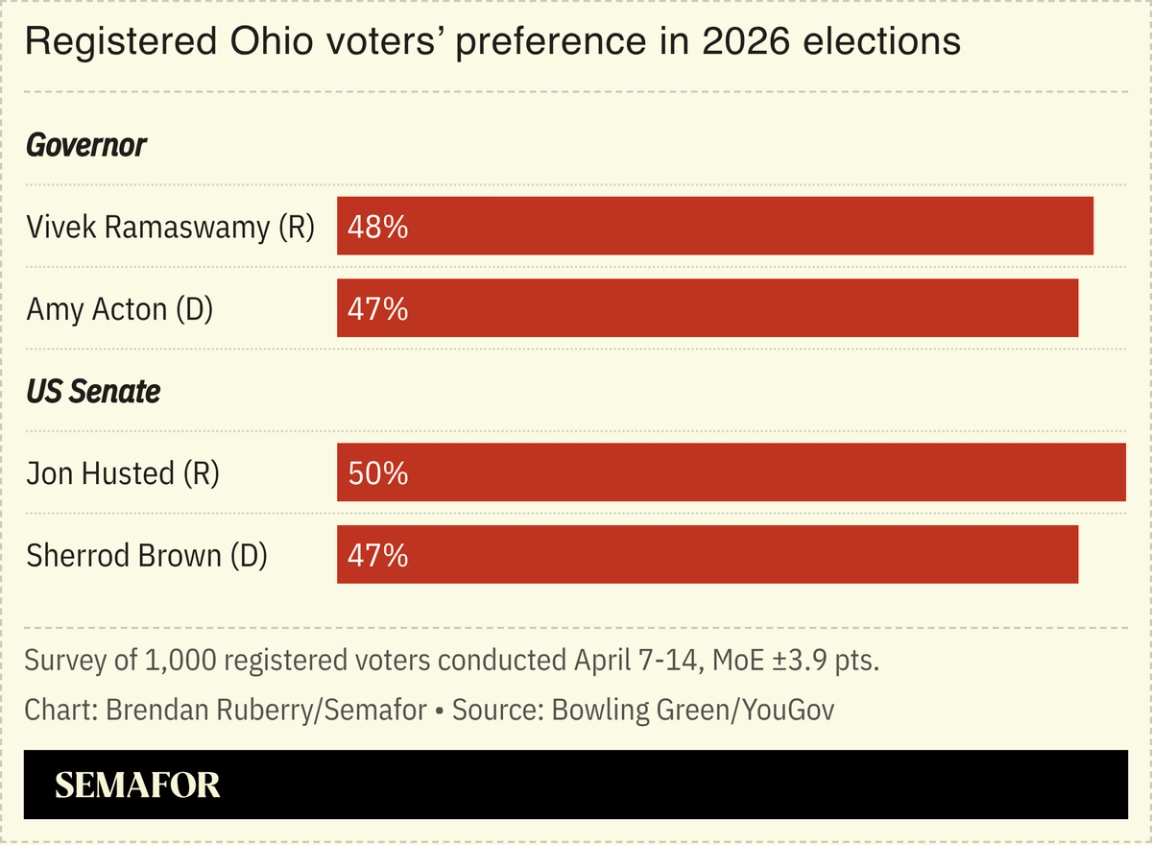 Ten years have passed since Ohio slid off of the swing-state map. Democrats have won just one statewide partisan election since then: Sherrod Brown’s 2018 race, where the decline of his party in northeast Ohio was evident even against a weak opponent. Republicans are still dominant in this fairly decent poll for Democrats. Most voters disapprove of Trump, around one in 10 regret their 2024 presidential vote, and most think the country and state are headed in the wrong direction. And yet, by a 5-point margin, most plan to support a Republican candidate for Congress; by 10 points, most voters consider themselves “part of the MAGA movement.” Republicans are weakened by the national environment, and Ramaswamy has fairly weak favorable ratings, but this state is not raring to elect Democrats again. |
|
 Kylie Cooper/Reuters Kylie Cooper/ReutersI haven’t been in Louisiana to cover Bill Cassidy’s primary challenge, but I know Alice Miranda Ollstein and Liz Crampton already found a fresh angle on it. The new, immediately high-profile MAHA network decided to fund its first electoral campaign against Cassidy, who voted to confirm Robert F. Kennedy, Jr. to lead the Department of Health and Human Services but has criticized his decisions ever since. That’s what MAHA activists want to talk about, but voters don’t care: “Messaging from all three campaigns has also focused primarily on standard Republican issues like crime, immigration and — above all — the cost of living.” |
|
 The long read I enjoyed the most last week was “Rhodesia: A Complete History” by Peter Baxter. Over liberals’ futile objections, the Trump administration has re-opened the fight over history — over what was inevitable, what was wrong, and who was a villain versus a hero. The administration has also closed most refugee resettlement to everyone but white South Africans. Baxter’s history of colonialism and minority resistance to Black majority rule was always gripping, and now it’s more relevant. The shorter recommendation: Anat Rubin and Jessica Pishko, in CalMatters, on a sheriff running for California governor with the ability to seize ballots. |
|
|