
|
 |
For Solo Chiefs—creatives, solopreneurs, and lone leaders orchestrating AI, humans, and chaos with no one to save their ass.
Your Vibe Business Team Is Here
Much like vibe coding was intended for software experiments, a vibe business is intended for business experiments.
|

| |||||||||||||||


 |
You’re not drowning in complexity because you’re lazy. You’re drowning because you’re responsible for everything. There’s a new kind of tool that might help—and a very old trap that comes with it.
This article is brought to you by Atoms, the first paying sponsor of The Solo Chief.
I once believed software was my bottleneck. If I could write more code, I could rule the world!
I had a beautiful product. Good idea. Clever features. It worked. Nobody wanted it. Well, a few people wanted it. But not enough people to keep the lights on and my pride intact. (I was even awarded Entrepreneur of the Year once because I was good at conveying my vision. My colorful diagrams of expected revenues looked fabulous on paper.)
So when I look at a tool like Atoms—a platform that helps a solo founder move from idea to market research, product spec, build, and deployment, ending with a live, testable product—I see two things at once.
First, I see where solopreneurs are headed in the near future.
Second, many people are about to get drunk on the wrong thing.
 |
Where We’re Headed
The future part is easy to recognize. A year ago, researchers at a major Chinese university showed that role-based AI agents could act like a fake software company—CEO, CTO, programmer, tester, reviewer—and spit out working apps in minutes for pocket change. Others proved these systems could read docs, write code, run tools, fix some of their own messes, and push things live.
The age of “code assistants” is already old news. We’re now in the age of small digital staff with no sleep cycle and no opinion about your branding.
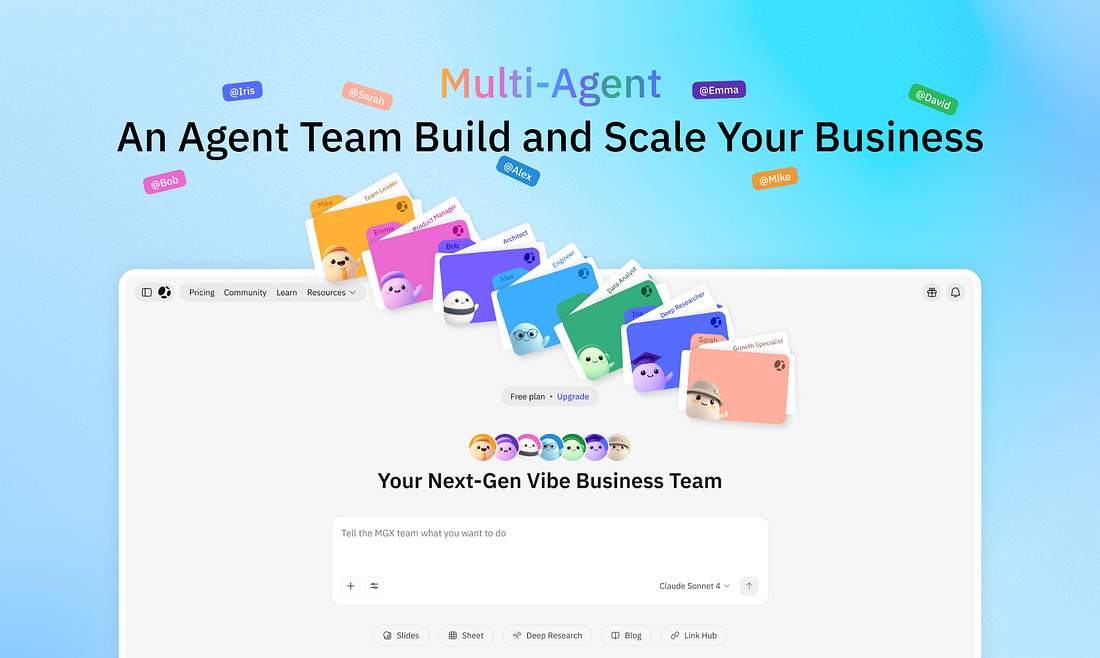
Atoms calls itself a “vibe business team,” and for once the marketing label earns its keep. Instead of handing you a code editor and wishing you luck, it gives you something closer to a small team you can talk to: a researcher who checks whether anyone actually wants your idea, a product manager who writes the spec, an architect, an engineer, and a coordinator who asks for your approval before making big moves. You describe what you want. The team builds it. You deploy.
For one person carrying the whole circus alone, that matters. The usual alternative is a sad little parade of freelancers, half-finished design files, one developer who disappears for ten days, and a payment setup that somehow becomes a spiritual crisis.
Solo operators don’t break because they’re lazy. They break because one calendar has to hold product decisions, customer calls, support emails, sales, invoices, bug reports, and whatever fire started while they were asleep. Eliyahu Goldratt’s Theory of Constraints applies here with embarrassing clarity: your business moves at the speed of its tightest choke point. For many solo chiefs, that choke point has been cross-functional execution.
A platform like Atoms that aims a cannon straight at that choke point is worth watching.
 |
The Wrong Part of the Demo
Here’s where my eyebrow starts twitching. The phrase “fully functional business” gets thrown around on Substack like confetti at a wedding where nobody checked if the couple actually likes each other.
A live app isn’t a business. Those are different species. One can collect money. The other can create repeatable value for an actual customer who returns, refers, or at least doesn’t vanish after the free trial.
I know someone who built an entire business in public using an AI: it picked the niche, named the company, wrote the copy, and launched the whole thing with a human acting as its hands. The internet loved it. Revenue, however, remained stubbornly unimpressed. Activity everywhere, traction nowhere.
And then there’s the devious cloning problem. When building software becomes cheap, distribution becomes the knife fight. Some guy builds a successful AI product, and—poof!—a swarm of copycats throw up lookalikes almost overnight. Plenty of founders still talk as if the hard part is getting the app built. Cute.
The reliability gap is real but shrinking. Today’s AI agents still fumble on complex edge cases—authentication flows,