| | In today’s edition: The Treasury secretary says the Fed should wait before lowering interest rates, ͏ ͏ ͏ ͏ ͏ ͏ |
| |  | Washington, DC |  |
| |
|
 - Bessent’s words to Fed
- Wright talks Venezuela oil
- New US-Iran talks?
- GOP eyes spring votes
- Swalwell, Gonzales resign
- Egypt banks on China
PDB: Gallup, Microsoft plan new global AI polling  Trump meets with Johnson, Hudson … Trump hosts Teamsters president … Hassett to speak at Semafor World Economy |
|
Bessent: Fed should wait to lower rates |
  Kris Tripplaar/Getty Images for Semafor Kris Tripplaar/Getty Images for SemaforThe Fed should “wait and see” before deciding whether to lower interest rates amid the war in Iran, Treasury Secretary Scott Bessent said Monday at Semafor World Economy in Washington, DC. “Do I think rates should be lowered? Eventually. I think now that we have to wait and see … what happens to the economy,” Bessent told Semafor Editor-in-Chief Ben Smith. “But I think, as we went into January [and] came out of January and February — the economy was very strong.” President Donald Trump has spent much of his second administration lobbying for lower interest rates. For now, the Fed is “doing the right thing by sitting and watching” how the Iran conflict plays out, Bessent said. He also said an executive order that would require banks to collect citizenship information on their customers is “in process,” adding: “I don’t think it’s unreasonable.” |
|
Wright speaks on Venezuelan oil sales |
 Tasos Katopodis/Getty Images for Semafor Tasos Katopodis/Getty Images for SemaforAt least 150 million barrels of Venezuelan oil have been sold since the US ousted Nicolás Maduro from power, Energy Secretary Chris Wright said Monday at Semafor World Economy. “In round numbers, probably 150 million barrels of Venezuelan oil have been sold — probably a little more than that, but something like that — since Jan. 3,” Wright said. Venezuela is currently producing more than 1.2 million barrels of oil a day, Wright said, up from “a little less than” 1 million barrels of oil a day prior to Jan. 3. As for the Iran war, Wright said that he no longer anticipates oil prices will go down by this summer — an acknowledgement of the conflict’s enduring impact on global energy prices. “It’s a very real possibility” that oil prices will rise higher than they have, he said. |
|
US, Iran weigh fresh round of talks |
 Jacquelyn Martin/Pool via Reuters Jacquelyn Martin/Pool via ReutersUS and Iranian negotiators are reportedly considering meeting for fresh talks in Pakistan this week, even as a US blockade threatened confrontation in the Strait of Hormuz. Tehran on Monday warned it would strike ports across the Gulf in retaliation for the US embargo on maritime traffic to and from Iranian ports, while experts warn the blockade could risk a military confrontation. However, stocks rose and oil prices fell on prospects for a more durable agreement, with reports that both countries are trading proposals on suspending Iran’s nuclear activities. Meanwhile, the clock is ticking on a shaky ceasefire that is due to expire in a week; Trump said Tehran wants a deal “very badly,” but experts believe Iran is playing for time. Iran’s hand is getting stronger “the longer the Strait of Hormuz is closed,” the Financial Times’ chief foreign affairs columnist argued. |
|
Republicans’ spring legislative sprint |
 Tasos Katopodis/Getty Images for Semafor Tasos Katopodis/Getty Images for SemaforThe House and Senate are speeding toward quick — and finite — action on the Trump administration’s immigration enforcement funding and on expiring surveillance powers. Sen. Rick Scott, R-Fla., said at Semafor World Economy on Monday that he’d back the plan to send roughly $50 billion in frontloaded ICE and border security funding for Customs and Border Protection, a crucial conservative boost for the plan. Senate Majority Leader John Thune said Republicans are aggressively moving to “limit” the measure to help shield it from complicated amendment votes on the floor. The House will take up a measure extending warrantless surveillance powers this week for 18 months as Joint Chiefs of Staff Chairman Gen. Dan Caine lobbies lawmakers to pass it — though, due to opposition from hardline conservatives, the legislation needs some Democratic votes to pass. The Senate also has a FISA extension ready for floor action… just in case. — Burgess Everett and Nicholas Wu |
|
Two embattled lawmakers quit House |
 Annabelle Gordon and Jonathan Ernst/Reuters Annabelle Gordon and Jonathan Ernst/ReutersEmbattled Reps. Tony Gonzales, R-Texas, and Eric Swalwell, D-Calif., are resigning from the House ahead of expulsion votes that would have likely succeeded. The two lawmakers faced mounting pressure to resign or step down from office after Gonzales acknowledged an affair with a member of his staff who later died by suicide, and Swalwell faced accusations of sexual assault and misconduct by multiple women. The House Ethics Committee announced an investigation into Swalwell Monday, but his departure from the House will short-circuit the probe; the bipartisan panel does not investigate former lawmakers. Still, the two members left the timeline of their departures ambiguous, and the lawmakers who were pushing to oust them might still take action today. — Nicholas Wu |
|
China helps Egypt survive energy crisis |
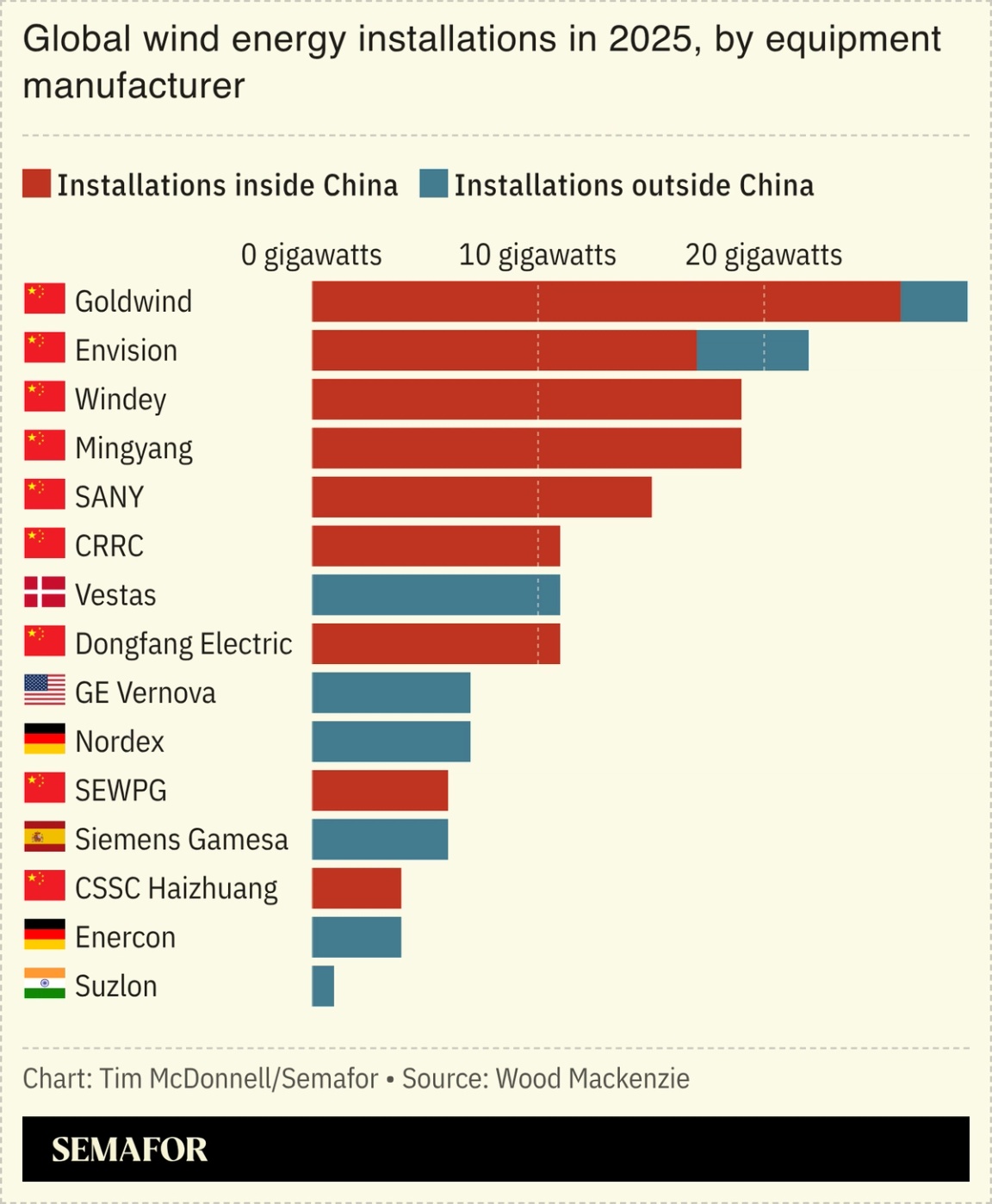 In a vast stony tract of desert three hours south of Cairo, a group of Chinese engineers is quietly rewiring Egypt’s energy strategy, Semafor’s Tim McDonnell reports. So far there’s nothing at the site other than a few mobile office units, a concrete mixer, and the occasional horned viper. But by next summer, it will be Egypt’s newest wind farm, a 200-megawatt project with a 25-year contract to sell power to the grid. As the energy shocks from the Iran war reverberate worldwide, countries like Egypt are left dealing with the consequences. Gas supplies 75% of the country’s electricity. When the US and Israel began bombing Iran, the offshore Israeli gas field that is one of Egypt’s most important suppliers shut down and halted exports. Now, Egypt is joining a number of countries banking on Chinese clean technology. |
|
Blindspot: Voting and ICE |
 Stories that are being largely ignored by either left-leaning or right-leaning outlets, curated with help from our partners at Ground News. What the Left isn’t reading: Rep. Claudia Tenney, R-N.Y., is raising concerns about the New York State Board of Elections lacking sufficient controls to prevent voter fraud, The New York Post reported. What the Right isn’t reading: Minnesota officials are investigating an ICE arrest as a possible kidnapping. |
|
 What happens when one of America’s sharpest energy traders takes on higher education — and the rise of sports betting? On this week’s Compound Interest, presented by Amazon Business, Liz and Rohan talk with John Arnold, the billionaire investor-turned-philanthropist who’s applying a data-driven, ROI mindset to reforming higher education, rethinking America’s sports betting boom, and making sense of the Trump-era turbulence shaking the energy markets. Listen to the latest episode of Compound Interest now. |
|
 Beltway Newsletters Punchbowl News: GOP senators including Senate Majority Leader John Thune are keen for the Trump administration to find an off-ramp to end the Iran war. The military operations “have been very effective and successful, but … they need a plan for how to wind this down, how to get an outcome,” Thune said. Playbook: White House Director of Cabinet Affairs Lea Bardon is leaving to take up a role as executive VP at The Sovereign Advisors, a DC-based public affairs firm founded by former Trump aide Taylor Budowich. Axios: OpenAI is set to unveil “Spud,” an enhanced version of its coding agent Codex, later this month; the firm is also developing a separate model to tackle cybersecurity threats. White HouseCongress Tasos Katopodis/Getty Images for Semafor Tasos Katopodis/Getty Images for SemaforOutside the BeltwayBusiness |
|
|


