| | The US blockade of the Strait of Hormuz begins, energy executives warn of the long-term impacts of t͏ ͏ ͏ ͏ ͏ ͏ |
| |  Washington Washington | Moscow |  Mexico City Mexico City |
 | Flagship |  |
| |
|
The World Today | 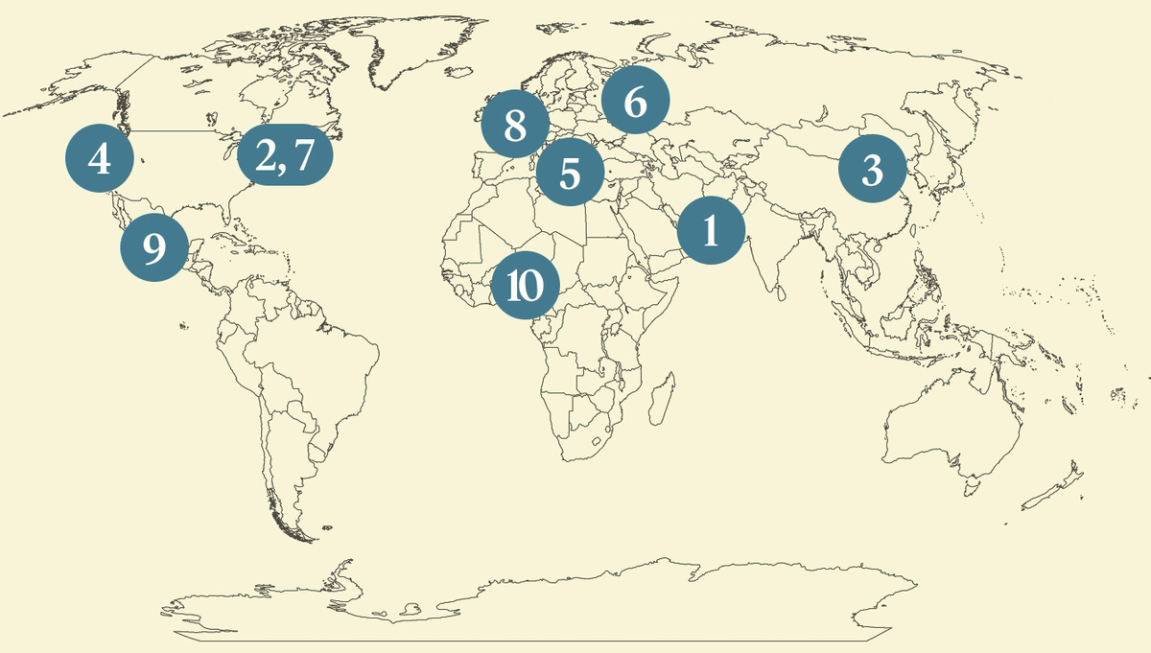 - US’ Hormuz blockade begins
- Long-term energy upheaval
- Spain’s leader visits China
- Anthropic’s AI warnings
- Trump vs. Pope Leo XIV
- Russian internet crackdown
- Internet Archive curbs
- World’s basic building blocks
- Mexico’s popular top cop
- Nigerian romance lit boom
 How fifth-century Athens, under the helm of Pericles, became an empire. |
|
US begins Hormuz blockade |
 US Navy/Handout via Reuters US Navy/Handout via ReutersThe US began its blockade of the Strait of Hormuz on Monday, as Washington and Tehran threatened further escalation amid a shaky ceasefire. US President Donald Trump vowed to obstruct all maritime traffic to and from Iranian ports, meaning Tehran could do “absolutely no business.” He added that Iranian ships approaching the blockade would be “eliminated,” while Tehran pledged a “decisive” response to military vessels in the waterway. The move sets up the “next great test” in the Iran war, The New York Times wrote: “Which side can endure more economic pain?” Despite the possibility of military confrontation, investors appeared upbeat about the prospect of a peace deal: The S&P closed at its highest point since the war began. |
|
Energy execs warn of war’s lasting impacts |
  Tasos Katopodis/Getty for Semafor Tasos Katopodis/Getty for SemaforTop executives on Monday warned of long-term damage the Iran war could inflict on global commodities markets. Speaking at Semafor World Economy, the TotalEnergies CEO warned disruptions could become “a question of years” if the conflict escalates. The head of energy tech company Baker Hughes said repairs to a damaged Qatari LNG facility could take three to five years, while Lazard’s CEO said the macro impacts are “not fully manifested yet,” with jet fuel, aluminum, and helium markets set to face “much more pressure.” US Energy Secretary Chris Wright, though, said at the event that higher gas prices are a “short-term” shock that will subside in the next few weeks, but “the longer the conflict goes, the longer the rebound is.” |
|
 Over the next several days, more than 500 CEOs and government leaders — including US Cabinet secretaries, central bank governors, finance ministers, and Fortune 500 executives — will take the stage for on-the-record conversations about the forces shaping the global economy. Our first sessions began today, with discussions on Building Intelligent Enterprises, The Economics of Infrastructure, and Rethinking Global Business. Across the week, we’ll host 21 sessions on the global economy, infrastructure, technology, AI, finance, energy, and much more — you can view the full agenda here. All sessions throughout the week will be livestreamed on Semafor’s homepage — watch here. |
|
Spain urges China peacemaking role |
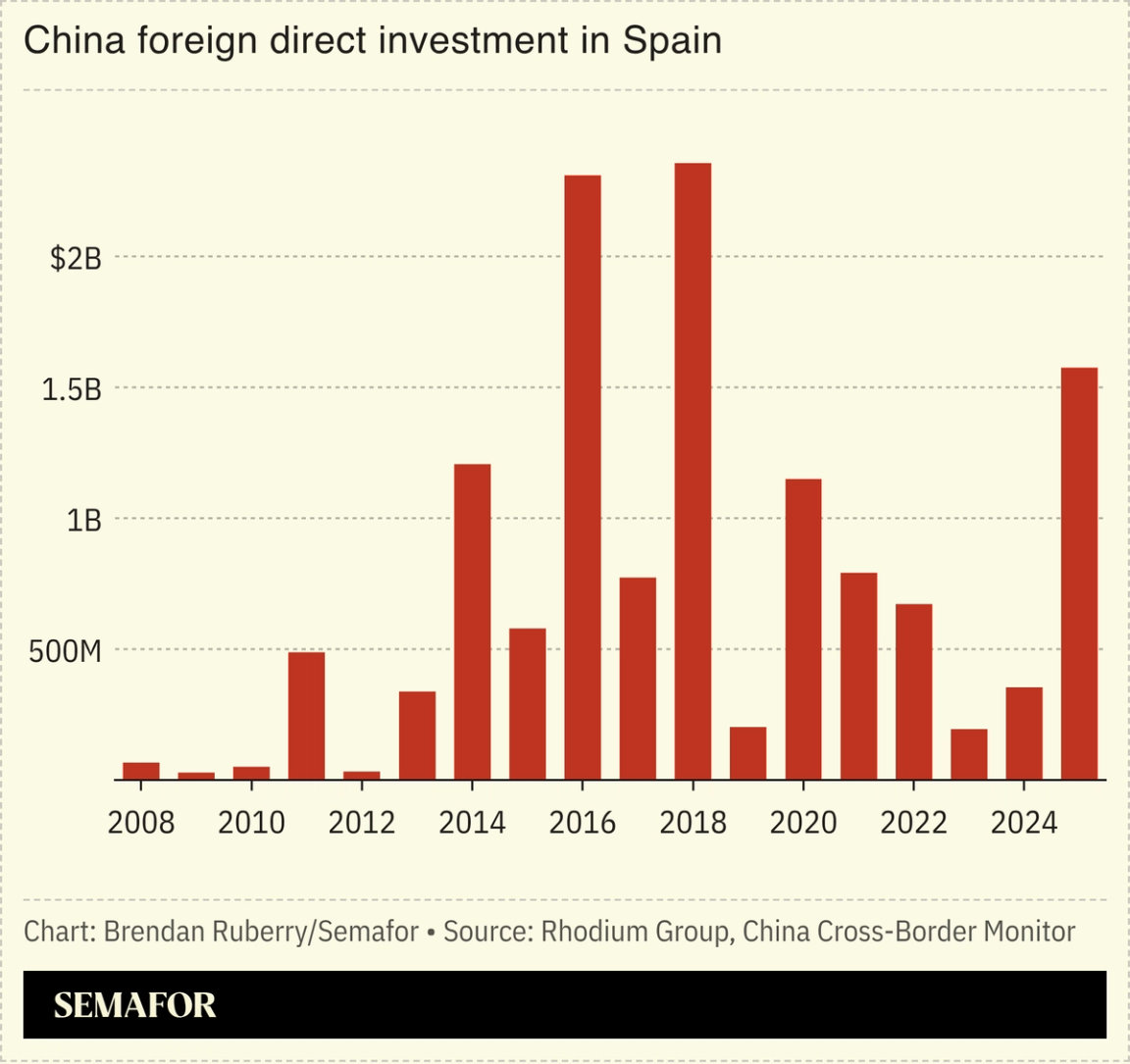 Spain’s Prime Minister Pedro Sánchez urged Chinese leader Xi Jinping to help end the Iran and Ukraine wars. The comments come as more European leaders cozy up to Beijing amid US threats, with Sanchez — a critic of Washington’s Iran war — kicking off a visit to China Monday. Though Beijing has condemned the campaign against Tehran, Xi has not commented, as he prepares to host US President Donald Trump next month. Trump, meanwhile, has railed against Europe for sitting out the conflict, further splintering transatlantic ties. Some observers are wary of Europe getting too close to China, fearing it could harm the continent’s industry: “It’s fine to reach out to China… but there has to be a plan B,” a German official said. |
|
Anthropic warns over AI cyber risks |
 Tasos Katopodis/Getty Images for Semafor Tasos Katopodis/Getty Images for SemaforAnthropic isn’t sure if it will sell its powerful new Mythos model to the public, the AI startup’s co-founder said at Semafor World Economy, days after top US officials summoned Wall Street banks to raise security concerns about the tech. Mythos sparked alarm at the company when it discovered previously unknown security flaws in every major web browser and operating system, unnerving global financial authorities. Mythos is “not a special model,” Jack Clark said Monday; within a year and a half, “there will be open-source models from China that have these capabilities.” Anthropic is working with the US government to address potential cyber risks from Mythos despite an ongoing legal battle with the Pentagon, which Clark dismissed as a “narrow contracting dispute.” |
|
| More from Semafor World Economy |
|
Trump attacks Pope over war criticism |
 @realDonaldTrump/Truth Social/Handout via Reuters @realDonaldTrump/Truth Social/Handout via ReutersUS President Donald Trump refused to back down from his row with Pope Leo XIV, who has spoken out against the war in Iran. Trump posted — and later removed — an AI image of himself as a Jesus-like figure. He also said Leo is “WEAK on Crime, and terrible for Foreign Policy,” telling reporters on Monday that he would not apologize, and claimed the image depicted him as a “doctor.” The posts drew condemnation from Trump-friendly Catholic bishops and some Christian MAGA commentators; one described it as “gross blasphemy.” Leo has recently sharpened his criticism of what he described as “absurd and inhuman violence” unfolding in the Middle East, telling reporters Monday that he had “no fear of the Trump administration.” |
|
Russian elite criticize internet controls |
 Igor Ivanko/Pool via Reuters Igor Ivanko/Pool via ReutersRussia’s domestic spy agency is pushing to tighten control of the country’s internet, sparking rare pushback from the country’s elite. Moscow has blocked Telegram, looked to crack down on VPN use, and is pushing a state-linked messaging app. Business leaders are losing money over the new rules because they are being forced to cut off VPN-using customers, and some are taking the unusual step of speaking out in the press, according to Vlast, an independent media outlet covering Russia. Some pro-Kremlin politicians are also criticizing the Telegram ban to boost their popularity. President Vladimir Putin, meanwhile, has dodged the issue; Russia’s spy agency is “adept at manipulating the internet-illiterate Putin, who tends to trust their recommendations — particularly in wartime.” |
|
News outlets block Internet Archive |
 Internet Archive Internet ArchiveMajor news outlets are increasingly blocking the Internet Archive, potentially hindering web historians, legal cases, and, ironically, journalism. The Archive preserves web pages, over a trillion so far. The New York Times, The Guardian, USA Today, and other outlets have all limited the site’s access, arguing that AI could use the archived content for training, WIRED reported. Journalists regularly use the Archive — USA Today itself did so this month in a report on US immigration enforcement policies — and more than 100 journalists signed a letter supporting it this week. Reddit has also blocked the Archive crawler: Its vast catalogue is an appealing data source for companies, and publishers are engaged in several lawsuits over use of copyrighted material. |
|
Physicists uphold the Standard Model |
 Denis Balibouse/Reuters Denis Balibouse/ReutersCERN’s ultra-precise measurements of a fundamental particle’s mass supported particle physics’ Standard Model, or how the basic building blocks of matter interact. The W boson mediates the weak nuclear force, one of the universe’s four fundamental forces alongside the strong force, gravity, and electromagnetism. It decays too rapidly to catch, but researchers measured the momentum of the products of that decay. A 2022 US measurement had found an anomalously high result, but CERN scientists found it in line with predictions. Quantum mechanics predicts reality incredibly well, but physicists are always looking for ways it breaks down, because it cannot mesh with general relativity, so apparent anomalies are a source of optimism: Researchers are likely to be secretly disappointed to be right again. |
|
|


