
|


 |
Patrick Collison’s YIMBY credentials are unimpeachable. He is a major backer of California YIMBY, the organization that has passed a stunning array of pro-housing bills in one of the most anti-development states in the nation. So it was interesting to see him claim that the movement has made a big mistake — or even been downright dishonest — by ignoring the aesthetics of apartment buildings:
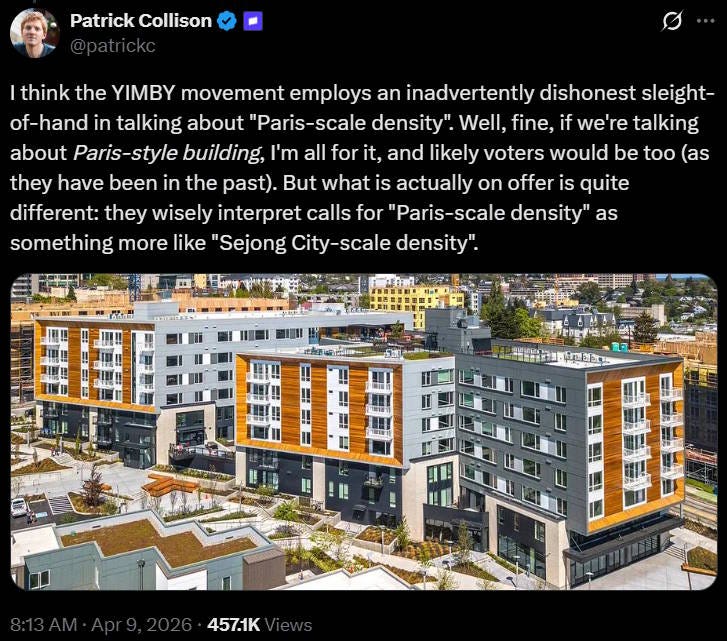 |
For reference, here’s Sejong City in Korea, whose residential districts do indeed look rather bland and oppressive:
 |
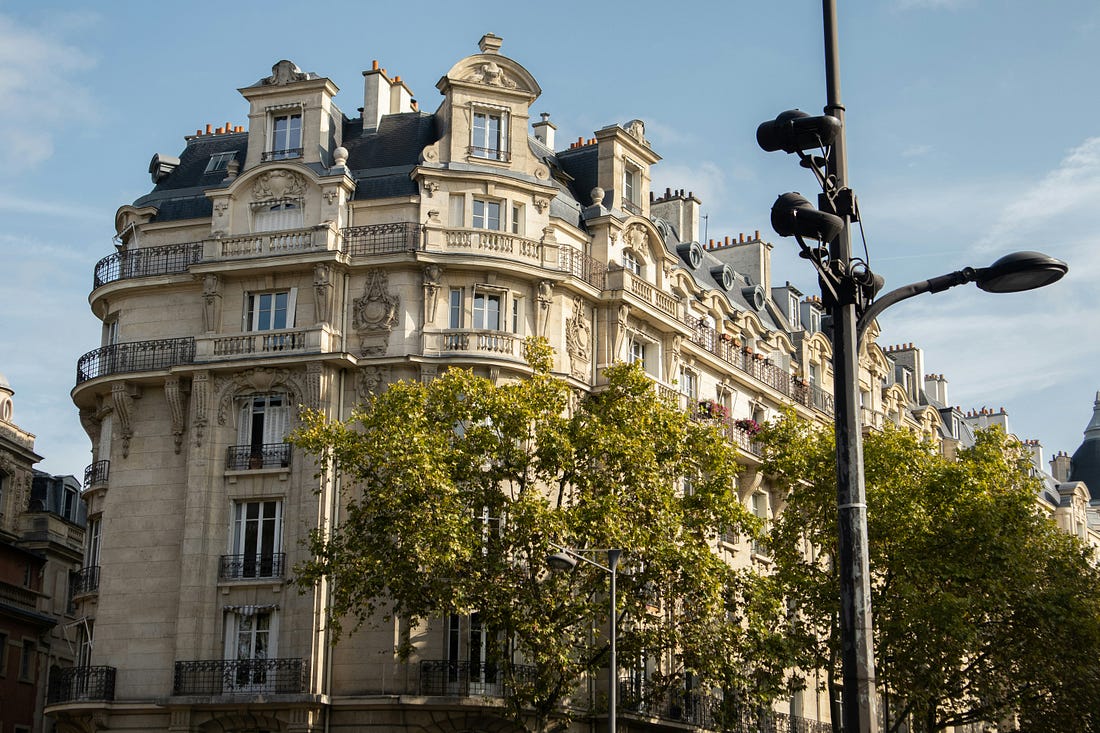
Some urbanists agreed, calling for regulatory reform that would allow American apartment buildings to look like the famous Haussmann buildings in Paris (depicted at the top of this post). So did some conservatives, which is unsurprising; intellectual conservatism has always called for a return to classical architecture and a rejection of modern styles. In fact, the idea that ugly building styles are a key reason that Americans disapprove of housing construction has been around quite a while, and it even has a name — “QIMBY”, meaning “quality in my back yard”.
Chris Elmendorf protested Patrick’s framing, arguing that YIMBYs have been active in pushing for reforms that would allow more beautiful buildings to be built in America:
YIMBYs have been pushing for single-stair reforms that would allow more "Paris-like" buildings…The municipal design standards & reviews that YIMBY laws allow developers to bypass did not improve designs. Per [Arthur] Stamps's studies (the only relevant empirical evidence of which I'm aware), they made things worse…[T]he problem of housing aesthetics deserves more attention -- and is receiving more attention -- but it's not like YIMBYs broke something that was working.
Elmendorf also pointed out that California YIMBY itself recently came out with a plan to encourage the building of more beautiful multifamily housing. The plan reads like exactly the kind of thing that Patrick might like:
[T]here’s a missing piece that housing policy still treats like an afterthought: how buildings look, function, and feel…Our current objective design standard paradigm…assumes you can “design away” ugliness by chopping a façade into smaller pieces…so the building feels “less big.” But contextual-design research shows why this keeps disappointing…When the underlying form and materials feel cheap or incoherent, extra façade break-ups read as fussiness, not beauty…
Many local Objective Design Standard codes demand heavy articulation and multiple cladding changes. The evidence suggests those moves have limited payoff compared to coherent style, material quality cues, greenery, and visible detail. (Stamps 2014; Nasar & Stamps 2008)…[We should u]pdate the California Department of Housing and Community Development’s model Objective Design Standards to [allow] projects [to] use a simpler envelope and meet a measurable threshold of real ornament (projections/recesses, columns/bands/cornices/fins, tile or relief work, murals), with minimum depth and material standards…
If California wants more European-feeling mid-rise development with courtyards, better daylight, shade, and balconies, it has to keep modernizing the [building] code…Too many building, electrical, and fire rules (in California and across the U.S.) [forbid] the buildings people actually like: bright cross-ventilated homes, true courtyard buildings, and mixed-use ground floors. All these requirements – egress, stairs, corridor, and elevator – often make projects bulkier and require much bigger lots, limiting where we can build new housing…[T]he web of building code regulations denies light, proportion, street connections, courtyards, greenspace – everything that makes buildings feel humane…Passing single-stair reforms and elevator reforms makes smaller mid-rise buildings possible, which fit on smaller lots, can be nestled into existing buildings, add variety to the streetscape, and reduce the pressure for larger, monotonous developments.
So at least one prominent YIMBY organization — the one that Patrick supports — is already answering the call to focus on building aesthetics. Others are likely to follow.
I think that’s a good thing. Eliminating onerous building codes and regulations will kill two birds with one stone, making it easier to build housing even as it also makes it possible to build more of the European-style ornamentation that commentators always call for. And allowing American developers to experiment with ornamentation and alternative styles will help break up the sameness of an urban landscape dominated by endless forests of boxy 5-over-1 buildings.
But that said, I highly doubt that this — or any stylistic change — would move the needle on public acceptance of new apartment buildings.
First of all, I’m skeptical that regular Americans actually like the kinds of building styles that intellectuals often yearn for. If you plunk down old-looking European-style buildings in the middle of Houston or Seattle, people tend to ridicule them as cheesy and inauthentic. The typical insult is “pastiche”, a derogatory term for a style that jumbles and mixes old European styles (even though, as Samuel Hughes points out, mixing and matching older ideas is exactly how classic European building styles were