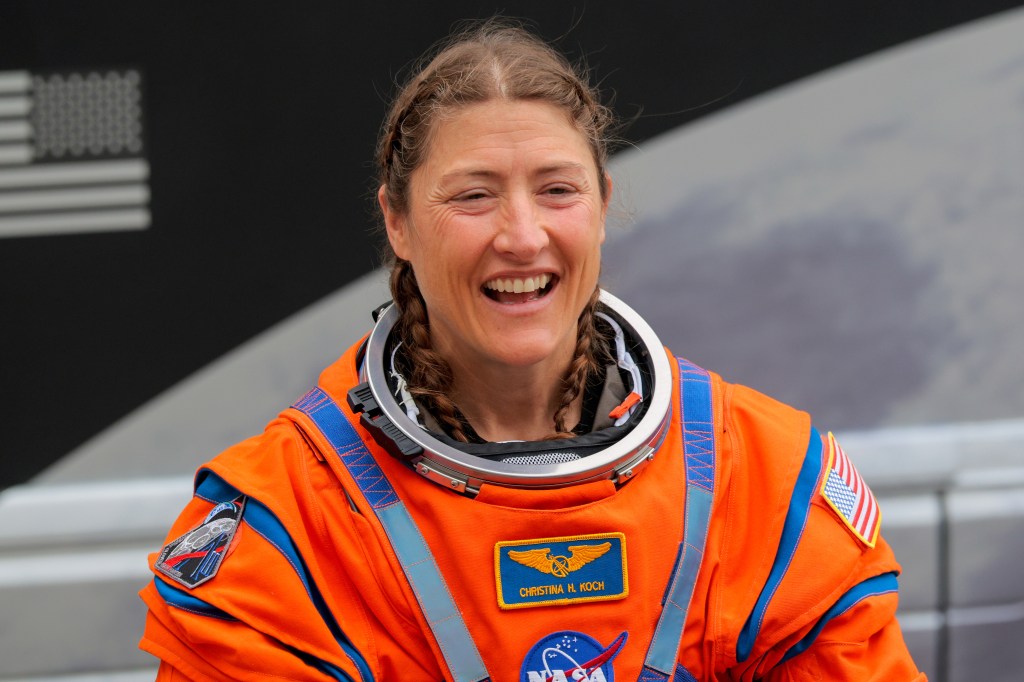
Last night, Christina Koch traveled past the far side of the moon. The astronaut on the mission Artemis II was one of four people
to travel farther from Earth than any other human beings ever have.
“It is so great to hear from Earth again,” Koch
said as the spaceship reconnected with humanity after 40 minutes cut off from all communications during the historic lunar flyby. She had just become the first woman to travel around the moon.
Koch, 47, has already
blazed a trail for women in space. In 2019, she set the record for the longest single spaceflight by a woman, with a total of 328 days in space. That same year, she was part of the first all-female spacewalk. (Since then she’s done two more.)
It’s worth reading her full bio and resume
via NASA—it embodies a spirit of scientific discovery, exploration, and adventure. Scientific highlights from her missions include “doing robotics for upgrades to the Alpha Magnetic Spectrometer, growing protein crystals for pharmaceutical research, and testing 3D biological printers in microgravity.” Before exploring space, she explored the world. Born in Grand Rapids, Michigan and raised in Jacksonville, North Carolina, she earned degrees in electrical engineering and physics and studied abroad at the University of Ghana. Before officially becoming an astronaut in 2013, she was an electrical engineer for NASA and a research associate for the United States Antarctic Program—she stayed for a year at Antarctica’s Admunsen-Scott South Pole Station. Besides Antarctica, she has worked across the globe from Alaska to Samoa.
Her achievements remind me that the last time everyone was talking about women in space was almost exactly a year ago—during that Blue Origin “all-female spaceflight” that went just to the edge of space for 10 minutes. I was
on the ground for that Blue Origin flight from Texas, and I’ve only seen Koch’s journey to space via videos—and I can confirm that the latter is still infinitely more satisfying to celebrate.
Alongside Koch is mission commander Reid Wiseman. His wife, Carroll Wiseman, died of cancer in 2020, at 46. He’s now a single father to two daughters. As the astronauts were on their lunar flyby, they called down to Earth to request that a crater on the moon
be named Carroll Crater, in Carroll Wiseman’s honor. It’s on the boundary between the near and far sides of the moon and sometimes can be seen from Earth. “It’s a bright spot on the moon,” mission specialist Jeremy Hansen told mission control, “and we would like to call it Carroll.”
The Artemis II mission is now on its four-day return to Earth. The astronauts are expected back on Earth on April 10. Koch said from space that people would return to the moon and build an enduring presence there. Her perspective stands out from the loud voices of billionaires we’re used to hearing talk about the future of humans in space. “Ultimately, we will always choose Earth,” Koch said. “We will always choose each other.”
Emma Hinchliffeemma.hinchliffe@fortune.comThe Most Powerful Women Daily newsletter is Fortune’
s daily briefing for and about the women leading the business world. Subscribe here.