| | Oil prices climbed above $110 per barrel on Tuesday, as Donald Trump’s deadline for Iran to agree a ͏ ͏ ͏ ͏ ͏ ͏ |
| |  | Energy |  |
| |
|
 - Oil climbs on strike threats
- The case for green H2
- China to the rescue
- Paris climate goal off the table
- Big new African climate fund
 The legal problems with air strikes on power plants. |
|
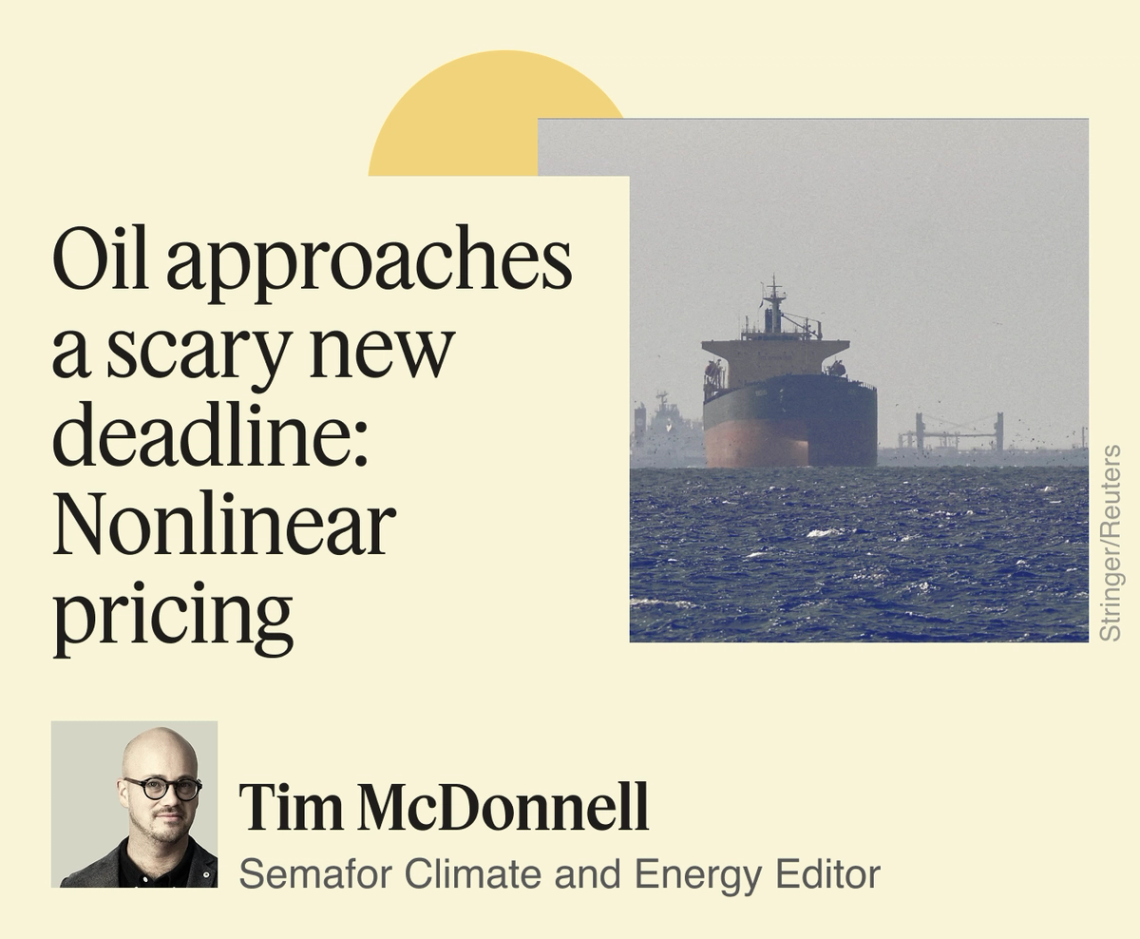 As US President Donald Trump’s latest deadline for Iran to strike a deal approaches, the oil market is focused on other deadlines that will ripple around the globe in coming weeks — including the prospect of a sudden jolt to oil prices far worse than what we’ve seen so far. Since the war started, the worst oil and gas market disruptions have been in Asia: Countries like Bangladesh and Indonesia are highly dependent on imports from the Gulf, are among the first stops for outbound tankers after passing the Strait of Hormuz, and had relatively little fuel in storage. Now that more of the tankers that loaded prior to the war are reaching their destinations, a similar impact will spread to Africa in the week ahead, Natasha Kaneva, head of global commodities strategy at JPMorgan wrote in a series of recent market notes. The impact there could be even more severe. The impact on Europe will follow. There are two alternate scenarios to consider moving forward. The longer the strait remains more or less closed — not counting the handful of shadow fleet vessels and select others still braving the run — strategic storage reserves will become increasingly important. When Russia invaded Ukraine in Feb. 2022, one reason for the timing was that Europe’s oil and gas reserves were at historic lows; the Kremlin knew that by cutting off its fossil fuel exports in that context, energy prices wouldn’t just increase, they would spike in a nonlinear fashion. In this current crisis, we still haven’t hit that point yet. By Kaneva’s reckoning, nonlinear prices will hit the global oil market by late May if nothing changes before then. And most analysts agree that ameliorating measures short of opening the strait — like the US waivers on sanctioned Russian crude that expire this weekend — amount to tinkering at the edges, with limited tangible impact. In the other scenario — which could happen soon, if Trump gets his way today — the strait opens up and things start to normalize. But there are a lot of steps to that. Ports, refineries, and other facilities have to repair and restart a lot of machinery. The owners, insurers, captains, and crews of tankers have to agree amongst themselves that they’re comfortable with the security situation, no matter what Trump tells them. Then there will be a lengthy process of clearing the long queue of empty tankers, which typically take up to 48 hours each to take on a cargo of oil. All told, Kaneva estimates that “normal” won’t be in the cards until at least four months after a ceasefire is reached. Summer vacation season is already cooked, in other words — but there’s still a narrow window for things to even out before the midterm elections. |
|
Oil climbs again on strike threats |
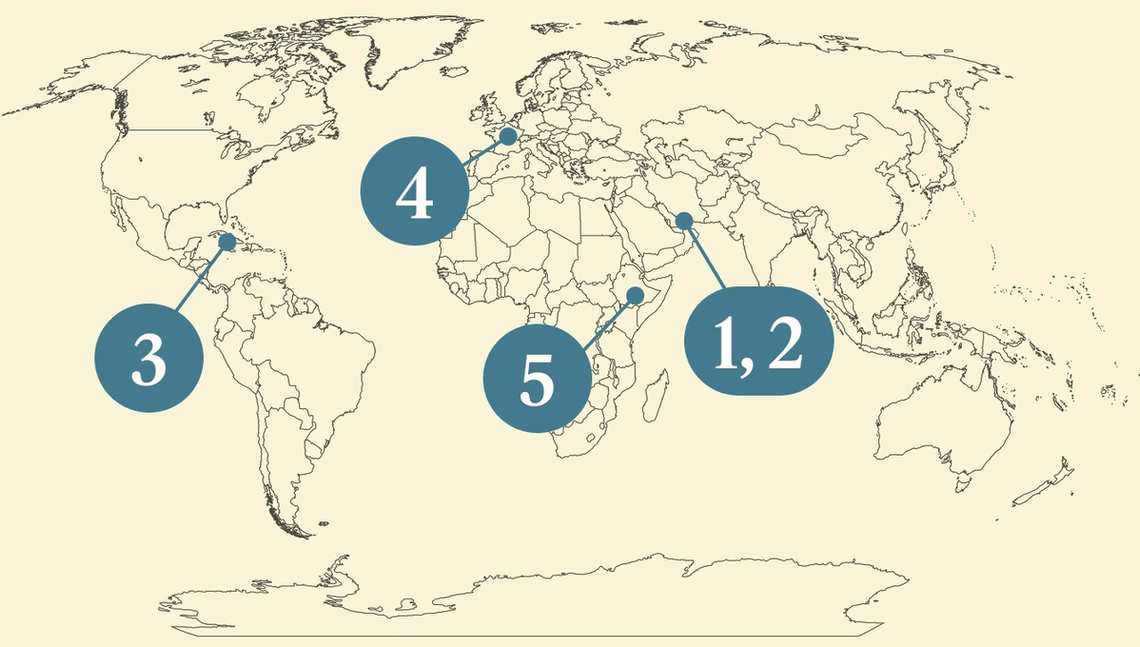
 Kuwait Petroleum Corporation/Handout via Reuters Kuwait Petroleum Corporation/Handout via ReutersOil prices climbed above $110 per barrel on Tuesday, as Donald Trump’s deadline for Iran to agree a deal with Washington — set for 8 pm Eastern time — fast approaches, but tensions show no sign of abating. Both Tehran and Washington rejected a 10-point peace plan put forward by Pakistan and other meditators. Should his deadline be ignored, Trump warned that the US had a plan “where every bridge in Iran will be decimated” and “every power plant in Iran will be out of business, burning, exploding, and never to be used again.” Targeting civilian infrastructure is banned under the Geneva Conventions, but Trump said he was “not at all” concerned about committing war crimes. Tehran’s top military command described the president’s threats as “delusional” and vowed “crushing” retaliatory attacks if the US and Israel continue to target civilian infrastructure. The impact of the effective closure of the strait and the resulting hike in oil prices varies among Middle Eastern oil producers: Iran still controls the strait, while Oman, Saudi Arabia, and the UAE have alternative routes through pipelines and ports. Countries like Iraq, Kuwait, and Qatar, on the other hand, don’t benefit from that luxury, and are increasingly bearing the brunt. Finding viable substitutes to the strait will be front of mind for future investors, the UAE’s special envoy for business and philanthropy argued in the Financial Times. “The pipelines will be expanded. The port capacity will be built. The power grids, water systems and trade corridors connecting the region’s economies will be formalised,” he wrote. — Natasha Bracken |
|
Remaking the case for green H2 |
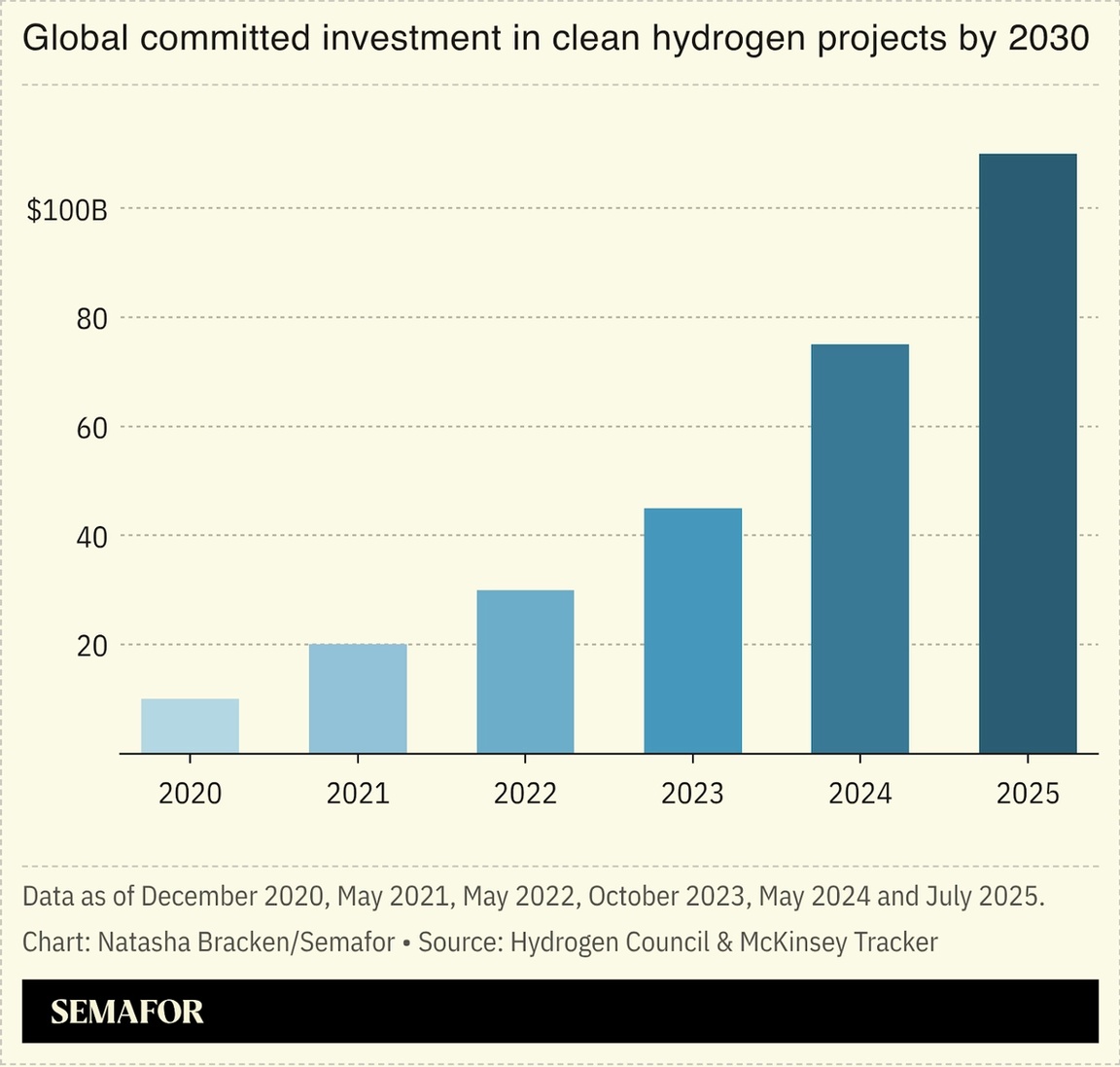 Fossil fuel shocks have historically strengthened the case for alternative energy sources, and green hydrogen could again benefit from higher fossil fuel prices — at least temporarily. Before traffic was effectively throttled in the Strait of Hormuz, the case for green hydrogen was harder to make. Investors remained wary of uncompetitive pricing, and government incentives in the US had all but dried up under US President Donald Trump. In Europe, however, the Iran war could nudge investors and governments toward a more favorable view of the high-cost, low-carbon alternative, as Russia’s invasion of Ukraine did. When prices for energy and ammonia surged in 2022, the EU responded with the REPowerEU Strategy, which set a target of producing 10 million metric tons of green hydrogen domestically by 2030. Hitting that quota seems improbable now, but rising natural gas prices have at least temporarily put blue and grey hydrogen on the back foot, creating, as Pierre-Étienne Franc, CEO of the world’s largest hydrogen infrastructure fund Hy24, put it, a stronger advocacy platform for green hydrogen and greater incentive for governments to move the needle on policy. Several EU member states are now urging looser production rules to avoid slowing investment, while Italy just secured approval for a €6 billion state aid scheme to support renewable hydrogen. China is already the world’s top hydrogen producer, but its increasingly bullish embrace of green hydrogen in its five-year plan — made more urgent as the country’s reliance on the Middle East for fossil fuels becomes more problematic — could also get things moving. Just last month, Beijing announced a low-carbon transition fund to provide direct financial support for domestic green hydrogen development. — Natasha |
|
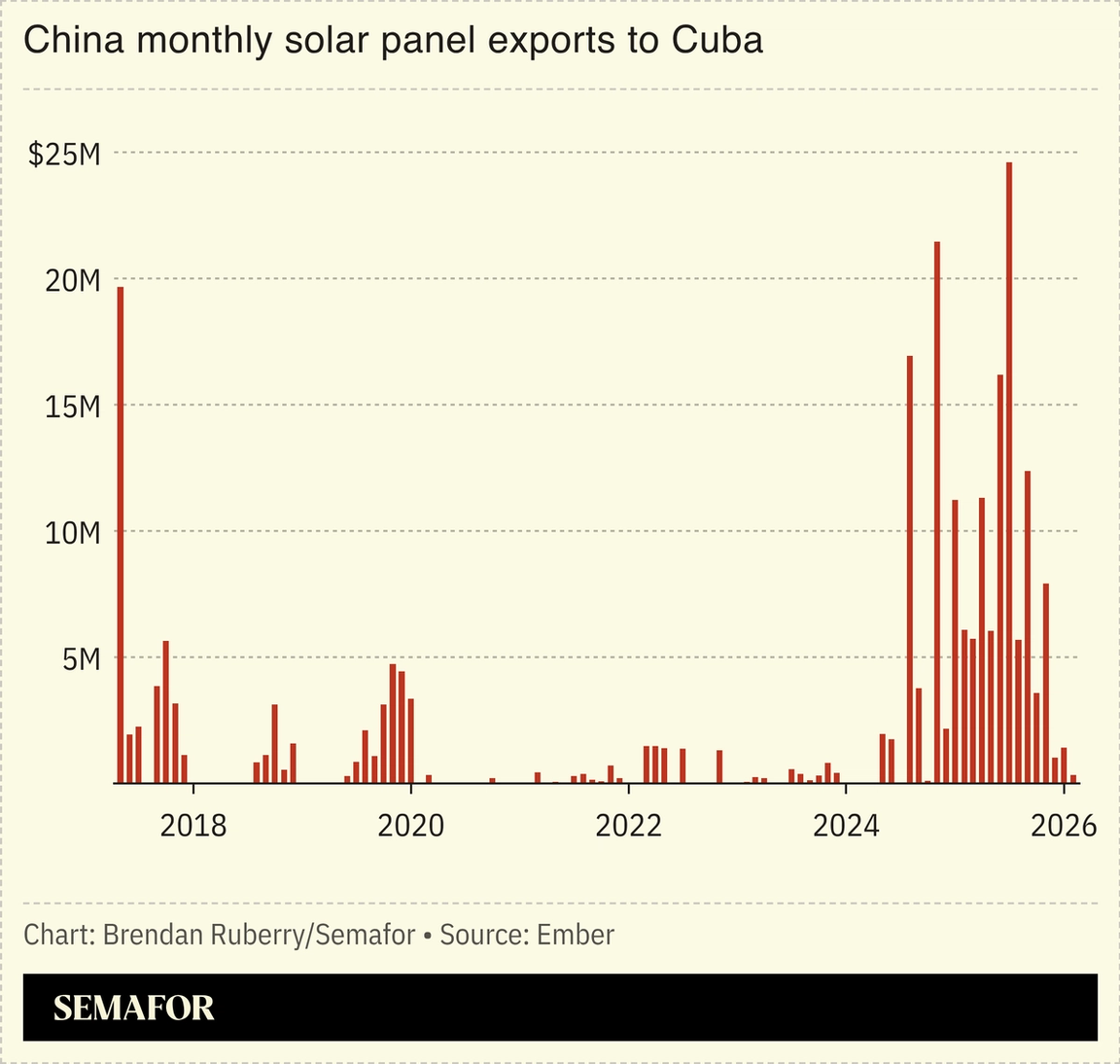 Cuba’s energy crisis is making the island more reliant on Chinese solar power. US President Donald Trump’s oil blockade on Cuba has led to widespread and frequent blackouts in the communist nation; the gigawatt of photovoltaic panels China provided last year has become a lifeline, the Financial Times reported. The Iran war has accelerated broader interest in renewable energy, given the rising cost of oil. The Philippines aims to build 100 gigawatts of solar power in the next two years, while Germany is planning to put billions toward expanding wind power and promoting EV sales. That shift is already benefitting China, The Washington Post noted, given its world-beating green-tech sector, which has suffered from overcapacity in recent years. Meanwhile, trends already pointed to a substantial expansion of Chinese renewables and EV sales abroad: African nations imported 48% more solar panels from China in 2025 than the prior year; exports of batteries and EVs were up 27% year-on-year in 2025, while sales of wind turbines rocketed up nearly 50%. The war has intensified that push: Battery giant CATL’s shares have gained as much as 20% since the war began, while EV giant BYD’s sales last month were 65% higher than a year ago. |
|
Paris climate goal off the table |
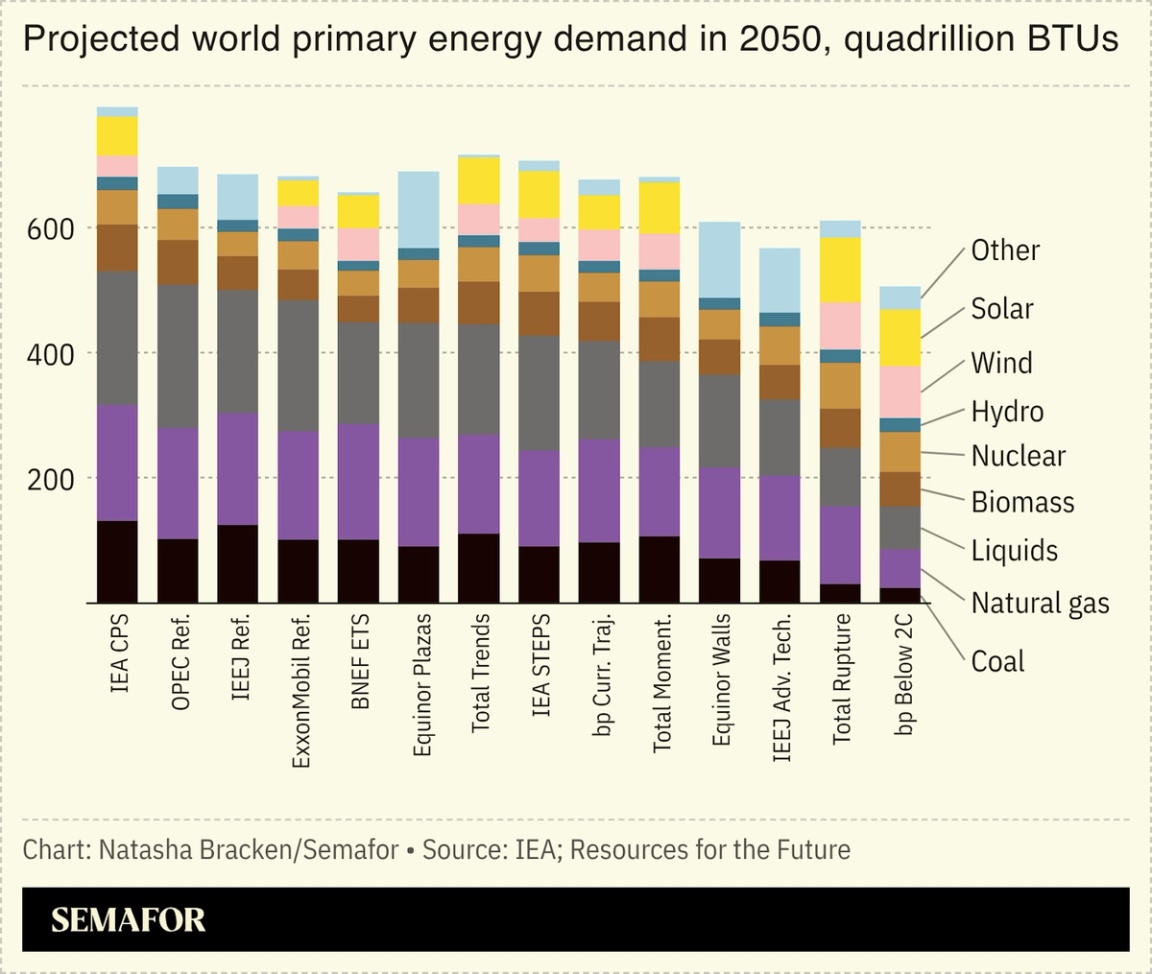 The Paris Agreement’s “stretch goal” of limiting warming to 1.5 C above preindustrial levels is no longer feasible, according to an analysis of 15 market outlooks compiled by think tank Resources for the Future. Energy-related CO₂ surpassed 38,000 million metric tons in 2024, and most forecasts don’t expect a peak until sometime between 2030 and 2035, with reductions by 2050 varying significantly. The most aggressive projection — the International Energy Agency’s Net Zero scenario — demands emissions fall by 13.4% every year through 2050 (the steepest drop this century was 5%, during COVID-19 shutdowns). Renewables will keep reshaping the energy mix, rising from roughly 15% of primary energy in 2024 to more than 20% by 2050. But that won’t be enough to meaningfully cut emissions while fossil fuels enjoy strong markets across the Middle East, Asia, and Africa. Rising electricity demand is also compounding the issue. Global power generation roughly doubled between 2000 and 2024, and could climb another 59% — or more than double again under some scenarios — by 2050, driven by the AI boom, the electrification of transport, and the rapid spread of air conditioning. Renewables are expected to supply a chunk of that new demand, but those additional terawatts represent “an energy addition, not an energy transition,” the report’s authors wrote. — Natasha |
|
 Oura, the smart ring favored by executives, finance bros, and Silicon Valley longevity-maxxers, is a big, lucrative business. On this week’s episode of Compound Interest, presented by Amazon Business, Liz and Rohan dive into the economics of that business with CEO Tom Hale, uncovering a surprising key demographic driving Oura’s growth, the financialization of better sleep, and the company’s public market aspirations. Listen to the latest episode of Compound Interest now. |
|
Big new African climate tech fund |
 Tony Karumba/AFP via Getty Images Tony Karumba/AFP via Getty ImagesStartup investor Novastar Ventures launched one of Africa’s largest ever funds backing climate-focused tech businesses. The Kenya-based firm, which raised $147 million, has already made six investments from the fund, including in Mexican biodigester producer Sistema.bio that serves farmers in Kenya African venture capital funds dedicated to climate solutions are rare. Existing African climate-tech funds include Equator’s $55 million fund raised last year and the Persistent Africa Climate Venture Fund that has raised about three-quarters of its $70 million target. Development financiers feature significantly in the investor base for African climate funds, since they tend to back projects that typically fail to attract funding from more risk averse venture capitalists. The drive for climate investments in Africa stem from the disproportionate burden the continent bears from a changing climate. The continent contributes less than 4% of carbon emissions, but annual adaptation costs will be at least $30 billion over the next decade, according to the World Meteorological Organization. — Alexander Onukwue |
|
 New Energy- Ryanair’s CEO warned that the UK was the “most vulnerable” market in Europe to jet fuel disruptions because of the country’s reliance on oil from Kuwait, adding that some flights may have to be canceled this summer during peak demand season.
Fossil Fuels Joyce Zhou/File Photo/Reuters Joyce Zhou/File Photo/Reuters- Surging energy prices are forcing less-wealthy countries in Asia to adopt rationing measures, including work-from-home days and promoting cycling and carpooling.
- The US plastics industry has emerged as one of the few winners of the Iran war: Oil is the key raw material for plastics, and production has been scaled back in Asia, Europe, and the Middle East, sending prices soaring.
Finance- Market volatility as a result of the war in Iran is creating new opportunities for energy traders to make more money, while exposing them to the risk of sharp losses and insider trading allegations, The Guardian wrote.
Tech- 25GW of US data center capacity was added to the funnel in the last quarter of 2025, 50% less than the third quarter, as the market struggles to keep up with new commitments. Instead, developers are beginning to focus on the existing pipeline to avoid load queue constraints for new projects.
- Google plans to partner with a natural gas power plant to provide energy for one of its data centers in Texas, suggesting a major
|
|
|


