| | In today’s edition: Iran steps up its attacks, Bahrain cracks down, and Dubai’s property market dive͏ ͏ ͏ ͏ ͏ ͏ |
| |  | Gulf |  |
| |
|
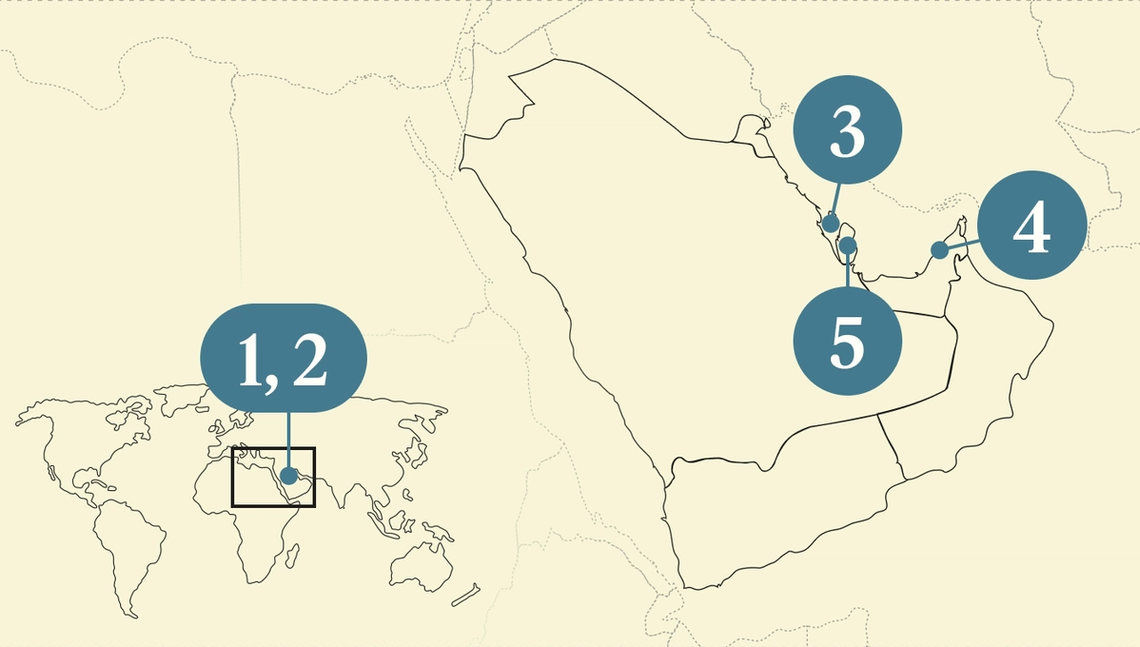 - Everything in the crosshairs
- Iran attacks tick up
- Bahrain cracks down
- Dubai property bubble bursts
- Gulf airlines’ slow recovery
 Dubai startup’s emergency kit is a wartime hit. |
|
Gulf braces for Trump ultimatum |
 Evan Vucci/Reuters Evan Vucci/ReutersIn 12 hours, US President Donald Trump’s latest deadline for Iran’s capitulation expires, and the region is bracing for what comes next. Trump on Monday threatened strikes that would cripple Iran’s infrastructure, including power plants and bridges, leaving damage that would “take them 100 years to rebuild.” A diplomatic channel remains open through Pakistani mediators, but both sides are sticking to maximalist positions. Tehran insists on imposing a $2 million toll on ships passing through the Strait of Hormuz, while Trump mused that Washington should control the waterway and collect the levy itself. The threats suggest the next phase of the war will focus on energy and civilian infrastructure. In reality, both have already been repeatedly targeted over the past six weeks. Iran has struck energy facilities, hotels, airports, and ports across the Gulf. Overnight, there were reports of fires at a Saudi petrochemicals complex, while Bahrain briefly closed the causeway to Saudi Arabia because of security threats. The US and Israel have between them hit Iranian gas fields, a nuclear plant, and the country’s tallest bridge. With Israel warning Iranians not to take trains today, and Iranian officials urging its people to surround power plants as human shields, the next few hours may hold terrible tragedies. Trump’s deadline expires at 4 am Abu Dhabi time Wednesday. — Mohammed Sergie |
|
Iran increases attacks on Gulf |
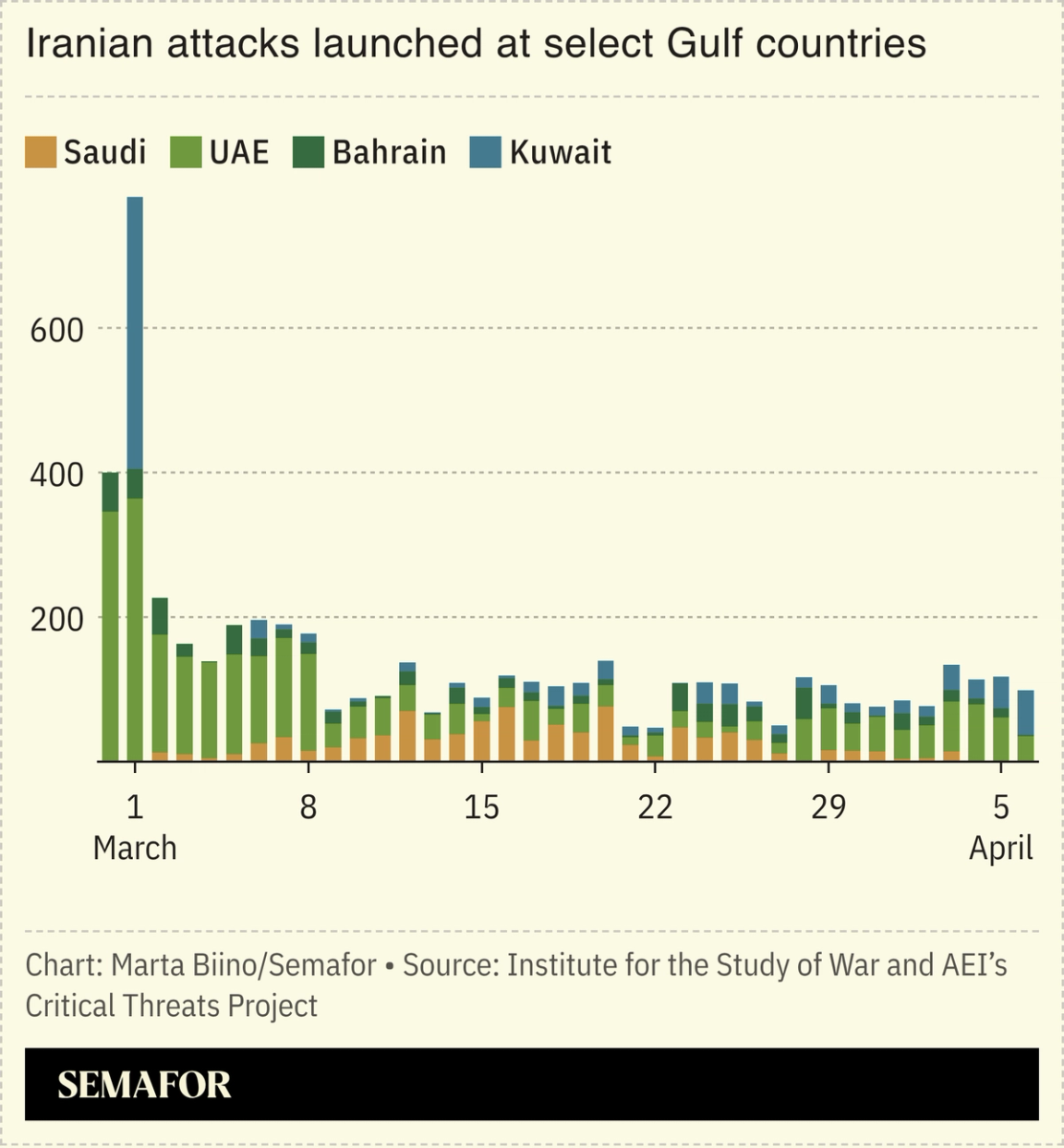 After weeks of sustained missile and drone attacks on Gulf states, Iran appears to be escalating its campaign, amid heightened rhetoric from the US. On Friday, the UAE — which has absorbed more projectiles from Iran than any other Gulf state — recorded the highest number of attacks since the early days of the conflict. In recent days, Iran’s shorter-range missiles and drones have damaged energy infrastructure, petrochemical plants, ports, telecoms, and desalination facilities around the Gulf. In addition to being more frequent, the strikes “are increasingly precise and lethal, and able to avoid interception,” according to the research non-profit The Soufan Center. It is unclear what remains of Iran’s missile stockpiles, according to the Institute for the Study of War, after sustained efforts by Israel and the US to degrade Tehran’s firepower. Since the start of the conflict, Tehran has fired more than 5,000 missiles and drones at Gulf states, killing 27 people and injuring at least 274 others as of April 6. — Kelsey Warner |
|
Bahrain cracks down again |
 Hamad I Mohammed/Reuters Hamad I Mohammed/ReutersBahrain is cracking down on dissent as it struggles with the political and economic impacts of the war. On Monday, several people were arrested on charges of spying for Iran, adding to more than 200 detained since the conflict began, according to the UK-based Bahrain Institute for Rights and Democracy. At least one man, Mohamed Almosawi, has died in custody. Rights groups said his corpse showed signs consistent with torture; the government dismissed the allegations as “misleading.” The government is wary of protests, haunted by memories of the 2011 Arab Spring pro-democracy movement and historic enmity with Iran tracing back to the kingdom’s founding and Tehran sponsoring a failed coup in Manama in 1981. Bahrain has intercepted more than 650 Iranian missiles and drones since the start of the war on Feb. 28. Unlike its Gulf peers, the kingdom can’t afford the economic consequences: This week, Capital Intelligence Ratings lowered the country’s credit rating one notch, and expects the budget deficit to spike this year because of the cost of repairing damaged infrastructure. — Dominic Dudley |
|
Dubai’s property market starts to crack |
 Amr Alfiky/Reuters Amr Alfiky/ReutersIranian strikes are putting pressure on residential and commercial property prices in Dubai — and on the people whose jobs depend on them. Sales volumes dropped almost 30% in Dubai in March, compared to the previous month, according to business news site AGBI. Prices are holding, possibly because of agreements struck before the war. With few tourists, remote work, and uncertainty affecting consumer spending, commercial real estate is also struggling, with hospitality taking the biggest hit. Hotel occupancy in Dubai for the week ending March 14 sank to 16%, down from the usual 90%. “In the near term, we expect to see hotels pivoting their focus to domestic travellers and staycations, mirroring the strategies adopted during the pandemic,” Faisal Durrani, head of research at property consultants Knight Frank MENA, told Semafor. — Manal Albarakati |
|
Gulf airlines on the rebound |
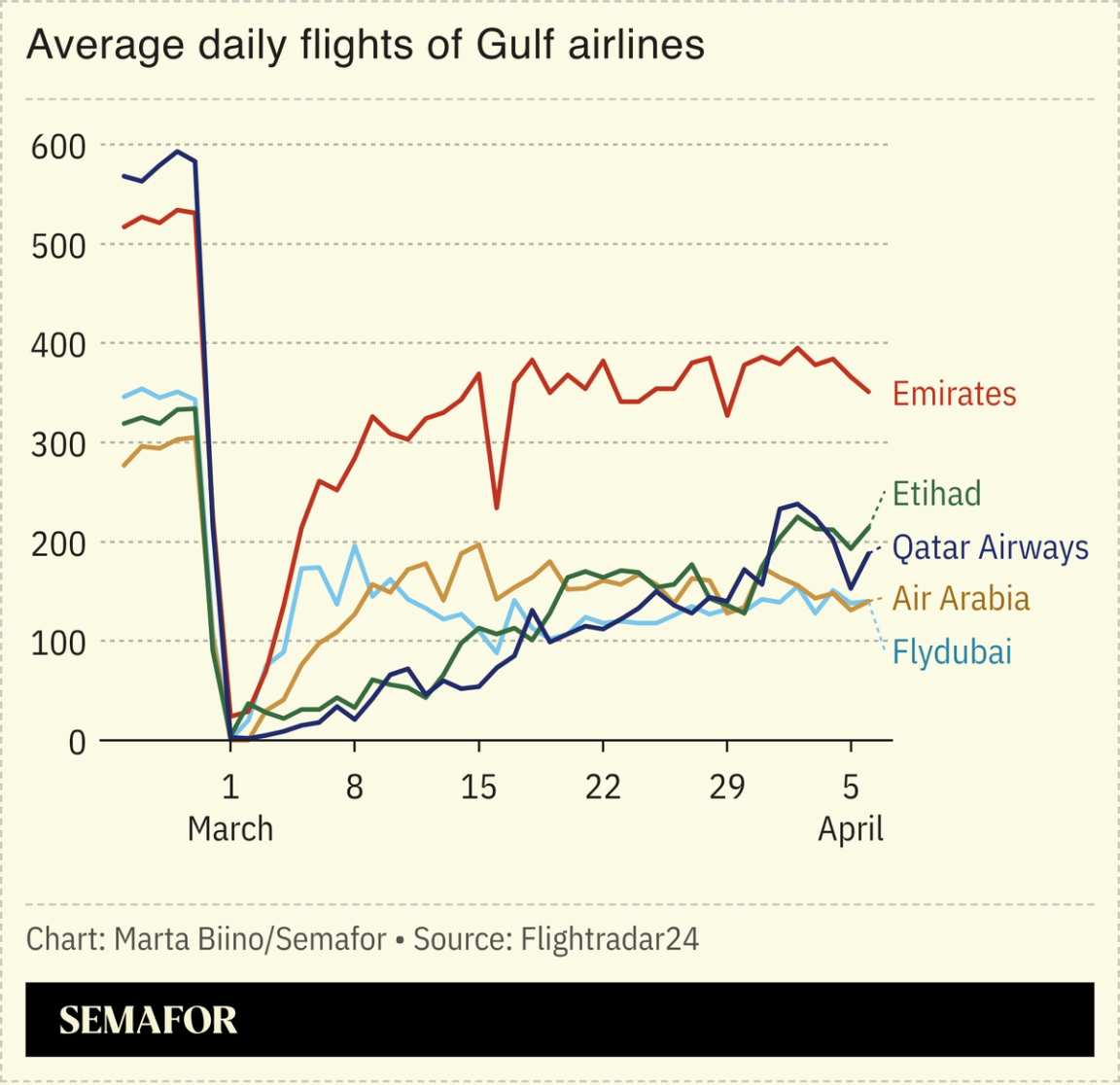 Gulf carriers are down but not out: Flight activity is slowly recovering, running at about half of prewar levels, according to industry tracker Flightradar24. Iranian strikes on airports in Abu Dhabi, Dubai, and Kuwait, and the thousands of drones and missiles lobbed at other targets, forced airspace closures across much of the region. For the major airlines in Qatar and the UAE — among the busiest and most profitable globally — the disruption has been a major setback. The carriers also have huge order backlogs for Airbus and Boeing jets. Recovery has been uneven, so far. Bahrain and Kuwait remain closed to regular commercial flights and airlines from those countries have set up temporary bases in Saudi airports, Qatar is constrained, and Emirates has recovered almost three-quarters of its prewar capacity. — Manal Albarakati |
|
 Oura, the smart ring favored by executives, finance bros, and Silicon Valley longevity-maxxers, is a big, lucrative business. On this week’s episode of Compound Interest, presented by Amazon Business, Liz and Rohan dive into the economics of that business with CEO Tom Hale, uncovering a surprising key demographic driving Oura’s growth, the financialization of better sleep, and the company’s public market aspirations. |
|
 - Arab Gulf States Institute: The region could be facing an ascendant Israel and an embittered but still dangerous Iran after the war ends. The complexity of the situation means it is unlikely the Gulf states will consolidate into a unified position.
- Financial Times: The high deficits and debt levels of many western countries mean their governments and central banks have few policy options to contain the economic fallout of the war.
- Foreign Affairs: The disruption to global energy supplies is prompting some governments to seek energy self-sufficiency, but that goal is fraught with risks and would raise costs for most countries that seek it.
- The National: US strikes have caused great damage to Iran, but the massive lethality has not been directed at the most decisive point. “They can blow up every bridge and medical laboratory in the country but if they cannot re-open Hormuz, they have lost,” writes energy industry executive Robin Mills.
- Reuters: The closure of the Strait of Hormuz has handed a windfall to Gulf countries that can still export their crude oil, notably Iran, Oman and, to a lesser extent, Saudi Arabia; others are seeing their revenues plummet, with Iraq and Kuwait among the worst affected.
- The Wall Street Journal: Saudi Crown Prince Mohammed bin Salman’s economic vision had been plagued by budget shortfalls and impractical designs before the war began; the conflict has plunged his strategy into greater jeopardy.
|
|
 thetrooperbox/Instagram thetrooperbox/InstagramSales of one Dubai startup’s emergency survival kits are up eightfold since the war began. Trooper, which sells a 75-item box equipped with water pouches, meal bars, and a hand-crank radio, designed to sustain a family of four for 72 hours, built its kits after the 2024 floods but has found an altogether different audience since the missile and drone volleys started, AGBI reported. Emergency kits are a growing business, adjacent to the doom-prepping and bunker mentality popularized by some of the US tech elite. In the Gulf, demand was expected to be driven by life in a hostile climate — few imagined that citizens and residents here would keep a go-bag by the door. |
|
| |  | | | You’re receiving this email because you signed up for briefings from Semafor. |
|


