|
 |



 |
DONALD TRUMP LAST WEEK gave an unexpectedly candid riff on his governing priorities—and, in the process, revealed that he’s losing one of his most important political skills.
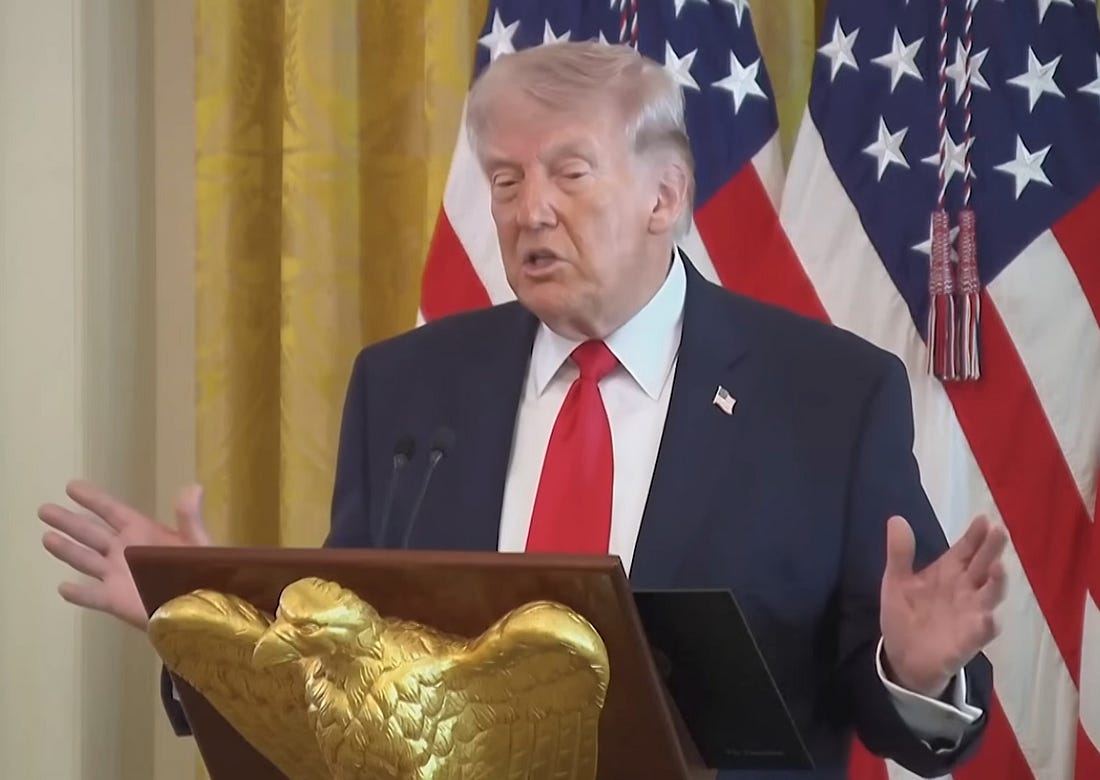
It happened on Wednesday, during a private Easter luncheon at the White House. Here’s what Trump said:
We’re fighting wars, we can’t take care of daycare. You’ve got to let a state take care of daycare, and they should pay for it, too. They should pay—they’ll have to raise their taxes, but they should pay for it. And we could lower our taxes a little bit to them, to make up for—but we—it’s not possible for us to take care of daycare, Medicaid, Medicare, all these individual things. They can do it on a state basis. You can’t do it on a federal [basis]. We have to take care of one thing: military protection. We have to guard the country.¹
Typically, Republican leaders try very hard to deny they are starving social programs to fund the military, leaving Democrats to make the case on their own. Yet here was Trump coming right out and saying it. And while the president frequently blurts out statements that have no bearing on reality, in this case his description of how he’d like to rearrange federal spending priorities was pretty much on the nose.
In fact, just two days after he made those remarks, his administration released its budget for fiscal year 2027. It envisions a $1.5 trillion increase for defense, then proposes to offset that cost with a 10 percent reduction in domestic spending. Among the casualties would be a program that helps low-income Americans pay for heating and cooling—yes, right at a time when electricity prices are on the rise.
Not that it takes a new budget to see Trump’s priorities in action. It’s been less than a year since he worked with Republicans to pass historic cuts to Medicaid and food assistance, while refusing to extend Affordable Care Act subsidies holding down insurance premiums for more than 20 million people.
None of this has been popular. Most Americans are opposed to the Iran war, according to polling, just as most Americans opposed the Medicaid cuts and wanted to see those “Obamacare” subsidies stay in place. That’s going to hurt in the midterms, as my Bulwark colleague Catherine Rampell observed last week.
But Wednesday’s riff and the governing record it matches threaten to undermine Trump’s appeal in another, more fundamental way—one that requires thinking back to 2015 when he was first seeking the Republican presidential nomination.
IT’S BEEN A WHILE—more than ten years!—so it’s easy to forget the extent to which Trump presented himself as a different kind of Republican, one who was willing to buck his own party’s establishment.
A lot of this was about trade, war, and immigration—how, as Trump told it, Republican elites had bankrupted the country with foreign interventions and sold out working Americans by shipping jobs over to China, all while allowing the country to be overrun with dangerous immigrants stealing everyday jobs. But Trump went out of his way to say he disagreed with the GOP establishment on matters of the welfare state as well.
“I’m not going to cut Social Security like every other Republican and I’m not going to cut Medicare or Medicaid,” he told the Daily Signal in 2015, making a promise he’d repeat many times over the course of the campaign.
And while Trump from day one was pledging to repeal the Affordable Care Act, he repeatedly told audiences, interviewers, and anybody else who would listen that he would replace it with something better, so nobody had to go without health care.
“Everybody’s got to be covered,” Trump told 60 Minutes in 2015, adding, “This is an un-Republican thing for me.”
Trump, in making this pitch, sounded a lot like a political archetype familiar in Europe, where some right-leaning parties have long opposed immigration while supporting government programs that provide generous health care, childcare, and other benefits. There’s even a term in the political science literature for this type of appeal: “welfare chauvinism.”