|
 |
Liberation Day Brought Us Here
Trump’s tariff catastrophe taught the world about TACO. We may have over-learned the lesson.
|


| ||||||||||||


Could peace in Iran be getting closer? Yesterday, Iranian President Masoud Pezeshkian suggested that Iran would be willing to end the war in exchange for U.S. security guarantees, which led to an immediate jump in stock prices—even though Pezeshkian’s remarks were heavily caveated.
Then, this morning, Trump posted that Pezeshkian had just asked America for a “CEASEFIRE,” adding that “we will consider when Hormuz Strait is open, free, and clear.” Whether Trump was breaking new news or just responding to yesterday’s reports isn’t clear.One reason to think this might just be Trump winging it is that he described Pezeshkian, who has been in office since 2024, as “much less Radicalized and far more intelligent than his predecessors”—apparently taking him to be one of the leaders who recently took over for a top official killed by Israeli or American strikes.Trump is planning to give a primetime address on Iran to the nation tonight. Should be illuminating! Happy Wednesday.
 |
TACO Is The Opiate of the Masses
by Andrew Egger
Liberation Day! One year ago tomorrow, Donald Trump took the lunatic policy swing that would bring a swift end—though he didn’t yet know it—to the first act of his second term.
He’d been reelected with a mandate to rule, he believed, and he’d wasted no time getting started. He’d empaneled DOGE to run riot through the executive branch, and Elon Musk’s posse of tweaky manlets had already ripped much of the wiring out of the walls of the government. He’d gotten started immediately with his personal-vengeance campaigns of political retribution and economic extortion, and he’d begun to spin up an immigration-enforcement machine to deliver on his promises of mass deportation. And now it was time to turn to the biggest economic swing of all: reorienting the entire global economy through an unbelievably strict regime of massive tariffs.
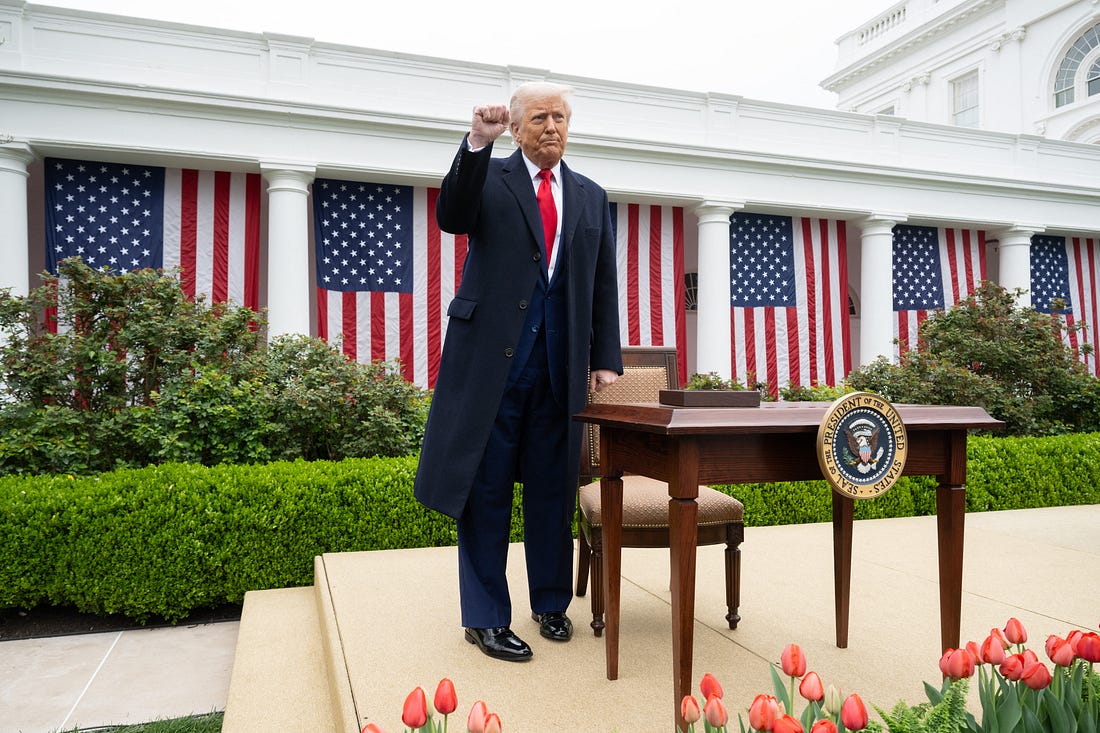
“April 2, 2025 will forever be remembered as the day American industry was reborn, the day America’s destiny was reclaimed, and the day that we began to make America wealthy again,” Trump exulted in his Rose Garden¹ speech announcing the change. “Our country and its taxpayers have been ripped off for more than fifty years, but it is not going to happen anymore.”
Markets had been bracing for some major tariff action, but what the president actually rolled out—massive, economy-stifling tariffs on nearly every country in the world, with rates calculated according to an almost unfathomably clownish baby’s-first-stats-class formula—went beyond anyone’s wildest imaginings. “The market reaction after hours, I’ve never seen anything like it,” a shell-shocked Jon Fortt said on CNBC immediately after Trump wrapped up. “This—I think, fair to say—is worse than the worst-case scenario of the tariffs that many in the market expected the president to impose.”
You probably remember what happened next. Trump held firm for about a week, as markets crashed around his ears and investors fled the U.S. bond market. Then, abruptly, he gave in to gravity: He postponed implementation of most of the global tariffs, then spent much of the next year hashing out individual deals with various countries. His partial retreat let the economy return from its cardiac event: from then on, tariff damage would accrue to it gradually, rather than all at once.
This was the moment that the world learned the lesson that Trump would, in the final and bitterest moment, respond to normal economic stimuli. Until the fallout from Liberation Day, Trump’s momentum had seemed unstoppable: You can just do things was the MAGA credo on which the country was suddenly running, and nowhere was his determination greater than in the realm of tariffs. And yet, faced with the prospect of inevitable economic calamity, he had blinked. The lesson seemed clear: If markets get spooked enough, Trump will see reason. And this in turn meant that if any individual trader held their holdings while others were panic selling amid a nightmare Trump policy swerve, they’d stand to benefit when Trump abruptly chickened out. Overnight, the TACO trade was born.
We’ve been living in the time of TACO ever since. But there’s a contradiction at the heart of this model that rendered it fundamentally unstable over time, and I wonder whether we’re now reaching the end of this second era of Trump II.
The only thing that seems to get through to Trump is catastrophic market movements—but those market movements are not only reacting to Trump, but trying to predict him, too. The more the TACO trade philosophy permeates through the markets, the less the markets respond to Trump’s rash impulses and grandiloquent proclamations—because they expect him to reverse course once the damage becomes obvious. But that very confidence means Trump’s moves aren’t causing markets to swoon like they once did, which in turn means Trump isn’t getting the better-act-now stimuli that might cause him to reverse course.
What does this vicious cycle look like in practice? It looks like the world we’re living in now, where Trump has risked a global depression by precipitating Iran’s blockade of the Strait of Hormuz—and has now apparently deluded himself into thinking America can actually get on just fine without solving that problem. And why not? Sure, oil prices have risen and the stock market has taken a bit of a hit. But neither market has gone truly berserk yet—in part because they’re expecting Trump to change course. But he has convinced himself he has little incentive to change course, since they haven’t yet gone berserk!
So far, it appears Trump sees his strait problem as primarily a political one, which can be solved by simply finding the right people to blame. He does not see the economic calamity bearing down on us, because the markets—in their quest to find the optimal way of dealing with Trump—have inadvertently taken away the one signal that can get through to him. Liberation Day wasn’t just the economic catastrophe that set the tone for the 2025 economy. By introducing us to the TACO model, it sowed the seeds of our present catastrophe, too.