|
 |


For this week’s essay, I’m republishing something Dominic Packer and Jay Van Bavel wrote for their popular Substack, The Power of Us.
 |
I've known Dominic and Jay for over 20 years. We first met when they were both graduate students at the University of Toronto and I was a visiting speaker. I left that visit energized and, frankly, jealous. The intellectual culture in the psychology department was exactly what I'd been looking for—lively, rigorous, genuinely curious. I applied for a job at UofT a few weeks later and have been here ever since.
But as I reflect on my remarkable visit and the wonderful time I had, I realize that Jay and Dominic played an outsized role. A major reason I found the culture so stimulating is that I found Jay and Dominic so stimulating—they loved discussing ideas, were open to different perspectives, and liked lively debate. I was later amazed by how varacious a reader Dominic was and is and how charismatic and curious Jay was and is. I am now convinced the reason I was so impressed with UofT at the time was that Jay and Dominic are so impressive. I continue to love UofT but now realize that my initial feelings were a misattribution.
Dominic and Jay are widely known now, and deservedly so. Some Canadians are meant to be shared. Their Substack is a good window into how they think. This particular essay, on the Kitty Genovese case and the bystander effect, is a perfect place to start.
Enjoy!
The night of March 13, 1964, marked one of the darkest moments in the history of New York and the beginning of a myth that shaped how people saw the city—as well as human psychology—for decades.
For more than half an hour, 38 respectable citizens in Queens watched a killer stalk and stab a young woman named Kitty Genovese in three separate attacks in Kew Gardens. Twice the sound of their voices and the sudden glow of their bedroom lights interrupted him and frightened him off. Each time he returned, sought her out and stabbed her again. Not one person telephoned the police during the assault; one witness called after the woman was dead.
Exactly where the total of thirty-eight witnesses came from is not clear. But the notion that so many citizens could callously observe the stabbing and murder of a fellow human being without intervening triggered widespread outrage. People decried the decay of civilization and the degradation of life in New York City.
The story also struck a nerve with social psychologists John Darley (a professor at NYU) and Bibb Latané (a professor across the city at Columbia) who were working in New York City at the time. Based on the tragic story of Kitty Genovese, they developed and tested a hypothesis that they called “the bystander effect.” Their hypothesis was that the more bystanders there are in an emergency situation, the less likely any given person is to help. In their view, this might explain why people did nothing to help Kitty.
They theorized that there were at least two reasons why the presence of other people in an emergency can cause an individual not to act. First, it is not always clear what is and is not an emergency, and people often look to others to try to diagnose the situation. When you see that others are not reacting, you might assume that it is because they know it is not an emergency. This is a big problem if they reach the same conclusion by gauging your own lack of reaction. This is known as pluralistic ignorance—when no one knows what is going on but assumes that everyone else does.
Second, if people somehow overcome this mutual state of ignorance to recognize an emergency situation for what it is, they may still fail to act due to a diffusion of responsibility in which everyone assumes that someone else should or perhaps already has taken care of it.
Darley and Latané designed several clever laboratory experiments to test their idea. In one experiment, someone faked a seizure. In another, smoke began billowing under a door. They observed how participants responded to these crises when they were alone versus in the presence of other people who did nothing. Sure enough, people were less likely to help when there were others around than when they were alone. We highly recommend watching the video below to see the origin of the Bystander effect and vidid details about the studies.
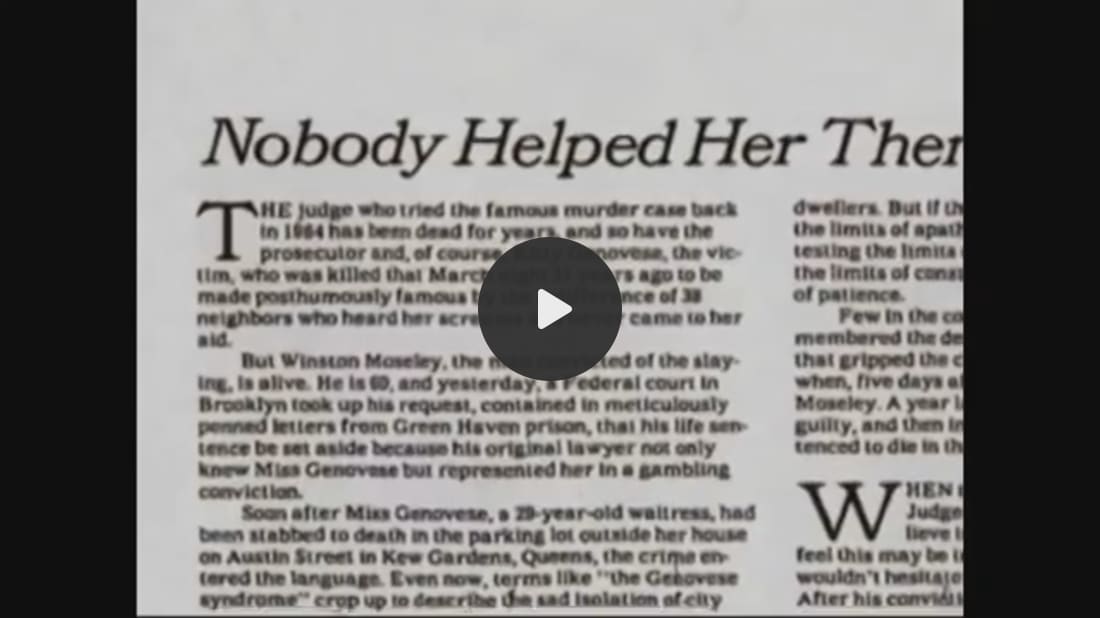
Every time an event like this occurs (and they occur shockingly often), people—very rightly—ask why. How could people possibly just sit there, doing nothing to help while a fellow human being is in dire need of assistance? Although we note in our book that people do often, eventually, intervene, there are factors that seem to make this more or less likely.
But we now also know that neither the tale of Kitty Genovese nor the