|
|
|
|
Good morning. U.S. President Donald Trump has threatened to strike Kharg Island, a tiny offshore outpost that carries most of Iran’s oil to global markets. In focus today, we look at how it became one of the world’s most sensitive energy choke points – plus, how a commodities boom masked an even deeper productivity problem. |
|
|
|
|
|
|
|
|
|
|
|
|
|
|
|
|
|
|
|
|
|
|
Travel: Air Canada’s chief executive is leaving the company after setting off a political and public-relations storm with an English-only video about the fatal collision at New York’s LaGuardia Airport. |
|
|
|
|
Family feuds: McCain’s ownership flaws were identified decades ago – now a second generation is fighting all over again. |
|
|
|
|
|
|
|
|
|
|
|
|
|
|
|
A satellite image shows an oil terminal at Kharg Island this February. 2026 Planet Labs PBC/Reuters
|
|
|
|
|
|
|
|
|
|
|
The many fights over the ’Forbidden Island’ |
|
|
|
|
In the 1960s, Iranian writer Jalal Al-e-Ahmad – a prominent critic of Western influence – described Kharg Island as the “orphan pearl of the Persian Gulf,” a tiny patch of coral land that sat for centuries on the margins of the Gulf’s trade and politics. |
|
|
|
|
Not that it didn’t have its uses: Traders stopped along routes linking Basra, a coastal city in southern Iraq, to ports in India. Pearling took place in the surrounding waters into the early 20th century, part of a wider Gulf trade that supplied markets across the region and beyond. European powers passed through in the colonial era – first the Portuguese, then the Dutch, who built a fortified trading post in the mid-18th century before being driven out in 1766. In the 20th century, it served as a remote place of exile under Reza Shah, and was later targeted during the Iran–Iraq War. |
|
|
|
|
|
|
|
|
Today, Kharg is known among Iranians as the “Forbidden Island,” its tight security and restricted access guarding the country’s main oil export terminal – the point where crude leaves Iran for global markets, one of the most sensitive choke points in the world’s energy system and now a potential target of U.S. President Donald Trump. |
|
|
|
|
This is a tightly integrated system that began to take shape after the Second World War, when Iran’s system of moving oil through rivers and smaller tankers out of ports such as Abadan, near the Iran–Iraq border, could no longer support a surge in global demand or the shift to larger vessels, which required deeper water than much of the country’s mainland coast could provide. |
|
|
|
|
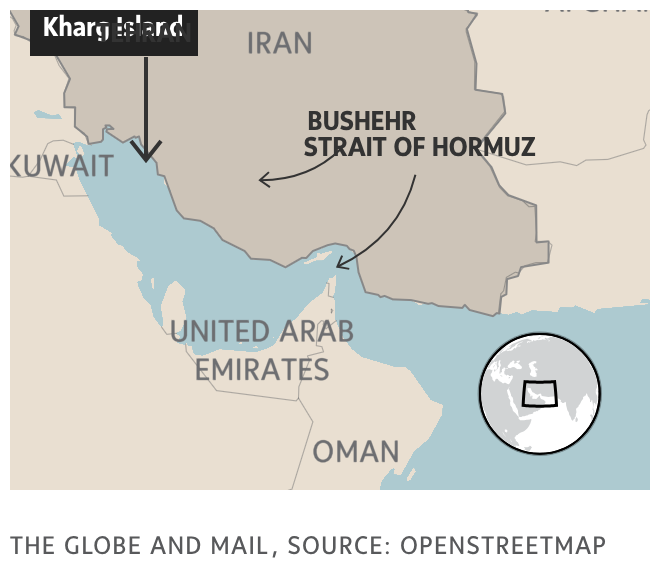
Officials looked northwest off the port of Bushehr, in the northern Persian Gulf, and found an answer in the ocean pearl. The island covers roughly 22 square kilometres – about the size of Lower Manhattan – traced by deep waters allowing bigger tankers to load up, and close enough to be connected to the mainland by pipeline. |
|
|
|
|
|
|
|
|
|
|
|
|
In the mid-1950s, Iran began turning Kharg into an oil terminal, extending pipelines from inland fields and building the storage tanks and loading facilities needed to move crude offshore. Within a decade, the island became the country’s main export point, a position that strengthened with the rise of supertankers in the years that followed. |
|
|
|
|
Today, oil arrives on Kharg from across Iran, and moves through a network of pipelines, storage tanks and loading terminals before being pumped onto several tankers at a time, bound for global markets. Those vessels must pass through the Strait of Hormuz to reach open water. |
|
|
|
|
In recent weeks, that exit has come into wider view as a point of global leverage for Tehran – what Doug Saunders refers to as “a sort of macroeconomic hydrogen bomb.” |
|
|
|
|
But if Hormuz is the locked door, Kharg is where Iran’s oil could pile up behind it – a single site responsible for 4 per cent of the world’s supply and virtually all of Iran’s crude exports, which play a vital role in the country’s economy. |
|
|
|
|
On Monday, even as Trump said in a social-media post
that the U.S. was in “serious discussions with A NEW, AND MORE REASONABLE, REGIME to end our Military Operations in Iran,” oil prices rose, perhaps in part to that same post. If a deal isn’t reached, he continued, “we will conclude our lovely ’stay’ in Iran by blowing up and completely obliterating all of their Electric Generating Plants, Oil Wells and Kharg Island (and possibly all desalinization plants!), which we have purposefully not yet ’touched.’” |
|
|
|
|
If Trump’s threats around Kharg were enough to move oil markets, following through on them could push prices much higher – over the potential loss of millions of barrels, but also over the likelihood of retaliation and the risk of escalation across the Gulf. |
|
|
|
|
After centuries on the periphery of trade and empire, the small island Al-e-Ahmad described as isolated has moved abruptly into the spotlight – a global oil shock turning its lonely geography into both a source of value and a point of vulnerability. |
|
|
|
|
|
|
|
|
|
|
|
|
|
|
|
|
|
|
|
|
|
|
|
|
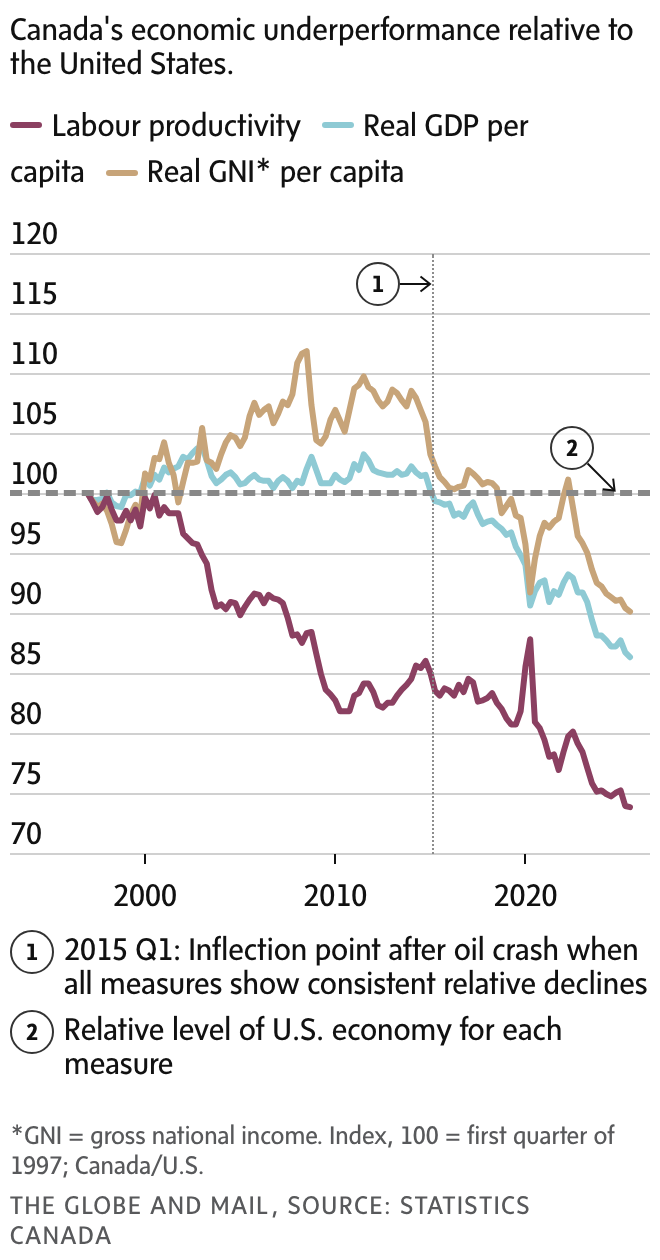
The years-long boom in oil and other commodity prices that ended in spectacular fashion in the last decade masked how badly Canada’s weak labour productivity has weighed down the country’s economy since the late 1990s, a new report by Statistics Canada found. |
|
|
|
|
|
|
|
|
|
|
|
|
|
|
|
|
|
|