|
🎙️ This week on How I AI: How Stripe built “minions”—AI coding agents that ship 1,300 PRs per week + How to turn Claude Code into your personal life operating system
Your weekly listens from How I AI, part of the Lenny’s Podcast Network
|

| |||||||||||||||


 |
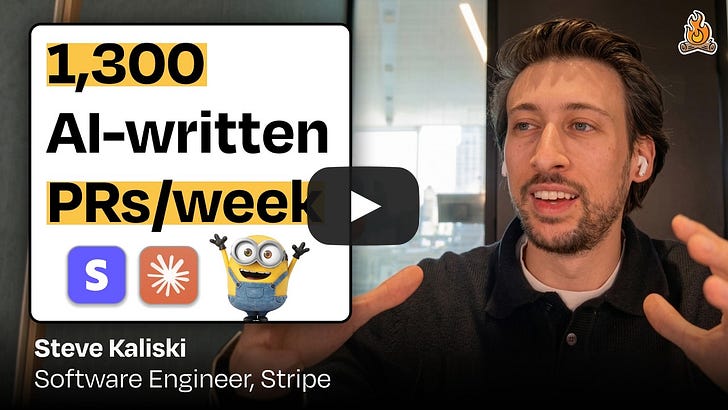
How Stripe built “minions”—AI coding agents that ship 1,300 PRs weekly from Slack reactions | Steve Kaliski (Stripe engineer)
Listen now on YouTube • Spotify • Apple Podcasts
 |
Brought to you by:
Optimizely—Your AI agent orchestration platform for marketing and digital teams
Rippling—Stop wasting time on admin tasks, build your startup faster
Steve Kaliski has spent over six years building developer infrastructure at Stripe. In this conversation with Claire, he breaks down Stripe’s “minions”: AI coding agents that ship about 1,300 pull requests per week, often kicked off with nothing more than a Slack emoji. He explains why the real bottleneck in engineering isn’t coding, how cloud development environments unlock parallel AI workflows, and what it takes to safely review thousands of AI-generated PRs. He also demos AI agents that can spend money, coordinate services, and complete tasks end-to-end without human involvement.
Biggest takeaways:
What’s good for human developers is good for AI agents (and vice versa). Stripe’s years of investment in developer experience—comprehensive documentation, blessed paths for common tasks, robust CI/CD, excellent tooling—directly translates to higher AI agent success rates. When you have clear docs on “how to add a new API field,” the agent can follow those same instructions. This creates a virtuous cycle: investments in DX improve agent performance, and investments in agent infrastructure (like cloud environments) benefit human developers too.
Activation energy is the real bottleneck, not coding speed. Steve hasn’t started work in a text editor in months. Instead, work begins in Slack threads, Google Docs, or support tickets—the natural places where ideas emerge. By allowing engineers to kick off development with a single emoji reaction, Stripe lowered the friction between “good idea” and “code in production.” This is especially powerful in large organizations, where coordination costs typically kill momentum before coding even begins.
Cloud development environments are non-negotiable for multi-threaded AI work. Running multiple AI agents in parallel requires cloud-based dev environments that can spin up in seconds, run isolated workloads, and never fall asleep. This infrastructure investment—which Stripe’s developer productivity team built long before AI agents—now enables engineers to run dozens of agents simultaneously without melting their MacBook Pros.
1,300 AI-written PRs per week requires shifting review capacity, not eliminating it. Stripe still reviews every AI-generated PR, but the review process relies heavily on automated confidence signals: comprehensive test coverage, synthetic end-to-end tests, and blue-green deployments that enable quick rollbacks. The bottleneck shifts from writing code to reviewing it—and eventually to generating enough good ideas in the first place.
Machine-to-machine payments unlock ephemeral, API-first businesses. In Steve’s birthday party demo, Claude Code autonomously paid Browser Base, Parallel AI, and Postal Form for single-use services—no human signup, no subscription, no dashboard. Businesses can now optimize for agent consumers rather than human users, focusing on “hyper-useful single APIs” instead of landing pages and admin panels. The economics become transparent: tokens and dollars sit side by side, making the true cost of AI work visible.
Treat AI agents like new employees, with progressive trust. Start with limited access, expand permissions as the agent proves reliable, and maintain clear boundaries. Each minion runs in an isolated environment with specific data access—the finance agent can read bank statements but can’t send messages; the scheduling agent can text but has no financial data. This physical partitioning prevents accidental data leakage and creates accountability.
The future of software is disposable and hyper-personalized. Steve builds custom iOS apps for his toddler—music players limited to six specific songs—despite having no iOS development experience. He describes this as “the disposability of software”: when AI can build apps in hours, you can create single-purpose tools for incredibly specific use cases and throw them away when they’re no longer needed.
Detailed workflow walkthroughs from this episode:
How Stripe’s AI ‘Minions’ Ship 1,300 PRs Weekly from a Slack Emoji: https://www.chatprd.ai/how-i-ai/stripes-ai-minions-ship-1300-prs-weekly-from-a-slack-emoji
How to Build an Autonomous AI Agent That Pays for Services to Complete Tasks: https://www.chatprd.ai/how-i-ai/workflows/how-to-build-an-autonomous-ai-agent-that-pays-for-services-to-complete-tasks
How to Automate Code Generation from a Slack Message into a Pull Request: https://www.chatprd.ai/how-i-ai/workflows/how-to-automate-code-generation-from-a-slack-message-into-a-pull-request