| | In today’s edition: Diplomats seek an end to the war, US financiers say they are still committed to ͏ ͏ ͏ ͏ ͏ ͏ |
| |  | Gulf |  |
| |
|
 - Escalation and negotiations
- Rights of Indian workers
- Double down on the Gulf
- One all-in director
- Gulf airlines take a hit
- War lessons, month one
 Dubai developer abandons Texas project after ‘Sharia city’ outcry. |
|
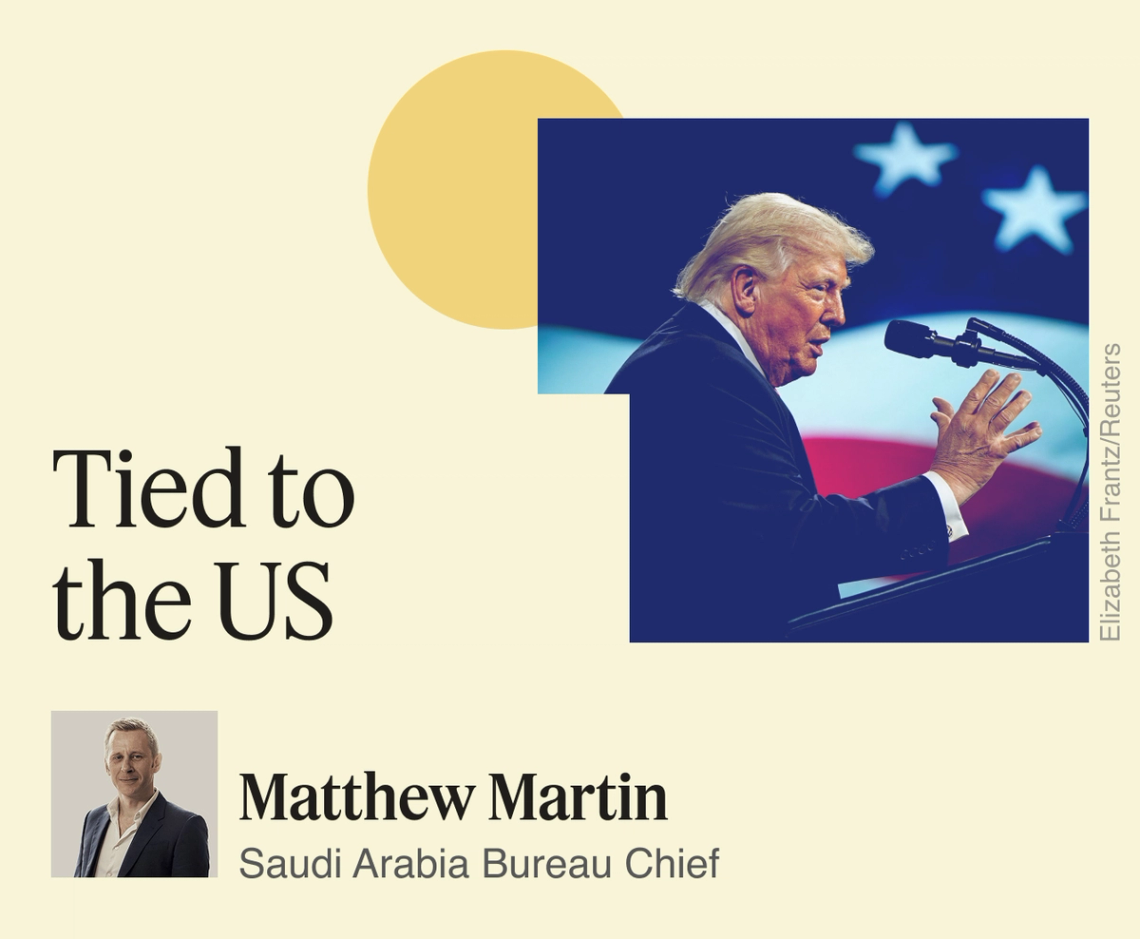 Anyone hoping that US President Donald Trump’s appearance at a Saudi-backed event in Miami would illuminate the path forward for the US and Israel’s war with Iran left disappointed. Saudi officials had little to say about how the kingdom was coping with the impact of the conflict. The takeaway of the event was instead to demonstrate how intertwined both countries remain. Trump’s speech was at times entertaining, rambling, repetitive, and combative. It did not contain much new information on the Iran war, and offered a little something for everyone from the hawks (“America is ending the threat posed by this radical regime”) to the TACO traders (“we’re negotiating now and be great if we could do something”). Saudi officials equally didn’t offer up much new information on how the biggest conflict in the region in decades, and the consequent closure of vital oil and shipping routes, was impacting the kingdom’s economy. The governor of the country’s nearly $1 trillion sovereign fund and the chairman of its oil company both barely acknowledged the war, beyond a brief mention that the kingdom’s economy was “strong, stable, and resilient” and the fund’s portfolio was diversified. That’s despite the Public Investment Fund also boasting that it had invested over $170 billion into the US in the past nine years. Outside Saudi Arabia, the US is by far the biggest bet the PIF has made. Many of the plans to diversify the Saudi economy need some combination of US partnership, technology, and goods: The kingdom’s nascent new airline and its autos cluster rely heavily on American firms; ambitions to become an AI hub need US expertise, semiconductors, and customers. Saudi Arabia is also proving its usefulness as a US ally. The kingdom’s investment more than 40 years ago in a pipeline to move its oil away from the Strait of Hormuz is only now paying off, both economically and strategically. Without it, oil prices would be much higher, and pressure on the US to reopen the strait either diplomatically or by force would be even greater. No one left Miami any wiser about how the Iran war will unfold, or what its consequences would be, but there was little doubt that Saudi Arabia still sees the US as its most important global partner. |
|
War widens as Trump eyes oil |
 Smoke rises following a strike in Sitra Island. Stringer/Reuters. Smoke rises following a strike in Sitra Island. Stringer/Reuters.Negotiations to end the war are underway, with the human and economic costs rising every day. Iran struck power and desalination facilities in Kuwait, as well as aluminum plants in Bahrain and the UAE over the weekend. More than 15,000 US troops are heading to the region as US President Donald Trump weighs his options, including a reported plan to extract enriched uranium from deep inside Iran. Brent crude climbed above $116 a barrel and global stocks extended their sell-off after Yemen’s Houthi militants joined the war with missile attacks on Israel. Trump told the Financial Times his preference was to “take the oil” from Iran, potentially by seizing the Kharg Island export hub. Foreign ministers from Egypt, Saudi Arabia, and Türkiye met in Islamabad to discuss plans to end the war, but recent Trump comments may make Tehran wary of agreeing any deal: “You never know with Iran because we negotiate with them and then we always have to blow them up,” he said. The accuracy of Iran’s attacks, meanwhile, seem to be improving: a $300 million US E-3 Sentry early warning aircraft at Prince Sultan Air Base in Saudi Arabia was destroyed on the ground. The strike gives new urgency to bolstering air defenses in the region: Ukrainian President Volodymyr Zelenskyy visited Qatar, Saudi Arabia, and the UAE over the weekend, signing deals to provide Ukrainian anti-drone systems it has deployed against Russia. — Mohammed Sergie |
|
Indian workers sit out the war |
 Faisal Al Nasser/Reuters Faisal Al Nasser/ReutersWith nearly all of the 10 million Indians who live in the Gulf sticking it out during the conflict with Iran, efforts by New Delhi to overhaul the rights of its workers abroad are falling short of what is needed, according to the Indian news outlet Scroll. Overseas work is crucial to the Indian economy — a source of tens of billions of dollars in remittances annually and a release valve for a struggling domestic jobs market. The majority of Indians in the Gulf are low-income, blue-collar workers, and many suffer from abuses, including wage theft, extortionate recruitment fees, and dangerous workplace conditions. Rules governing Indians’ work abroad have not been updated in decades, but a draft bill was introduced to the Indian parliament last year to address exploitation overseas. Under the proposed law, a new body called the Overseas Mobility and Welfare Council will look after emigrants’ welfare, but Scroll argued that it lacks teeth to provide oversight on the recruitment offices that source workers and send them abroad. |
|
General Atlantic sticks with Gulf |
 General Atlantic CEO Bill Ford. Courtesy of Future Investment Initiative Institute. General Atlantic CEO Bill Ford. Courtesy of Future Investment Initiative Institute.US private equity firm General Atlantic remains committed to investing in the Gulf even as the war with Iran upends the regional economy, Chief Executive Bill Ford told Semafor in an interview. “The biggest mistake we could make is to pull back and not be prepared when the markets become more investable,” said Ford. The company, which manages over $120 billion, is still looking at deals in the Gulf despite the conflict. “We have to have discussions about investment risk on specific deals, but we’re continuing to look at some opportunities,” he said. Ford is the latest US finance executive to signal commitment to the Gulf. Executives from Carlyle and Brookfield have said they are still optimistic about the outlook for the region, while Blackstone has announced deals since the war broke out. The Gulf’s giant sovereign wealth funds are a key source of capital for western asset managers, and in recent years the region’s governments have been using those relationships to get Wall Street firms to boost their presence in the region. — Matthew Martin |
|
A believer from the worlds of cargo, casinos |
 The number of Boeing 747 flights it will take to deliver all of the AI servers that Microsoft has ordered for the Gulf. That is according to Betsy Atkins, who sits on the board of US freight company Atlas Air, owner of the world’s biggest fleet of wide-body aircraft freighters. Speaking at FII Priority in Miami, Atkins — also a director at Wynn Resorts — added that $5.8 billion has been poured into Ras Al Khaimah by the Nevada casino company, where work has resumed on its 70-story resort casino after a brief stop at the start of the conflict; it is slated to open in spring 2027. — Kelsey Warner |
|
War upends aviation strategies |
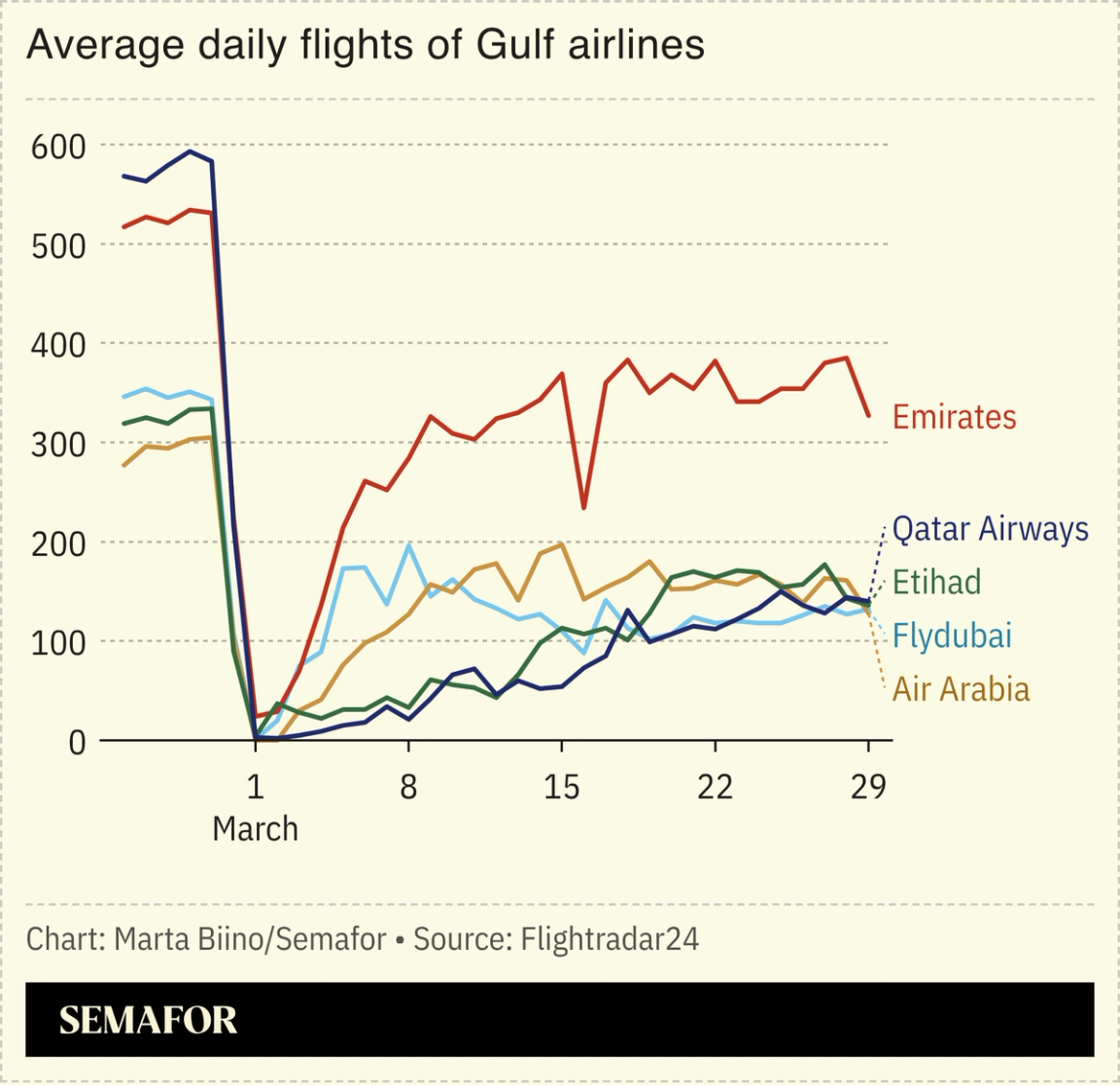 The Iran war is reshaping international aviation, with Gulf carriers forced to cancel tens of thousands of flights while rivals from Europe and Asia pick up some of the slack. Around 1.7 million weekly seats have been removed from the region’s airline schedules so far, equal to around a third of prewar capacity, according to industry analysts OAG. Saudi-based airlines are operating near-normal schedules, but the larger carriers in Qatar and the UAE are not. Qatar Airways is seeking lower aircraft rental payments as a way to reduce costs, Bloomberg reported. Airlines from other regions, including British Airways, Germany’s Lufthansa, and Hong Kong-based Cathay Pacific have cut back on services to the Gulf or pulled out entirely. At the same time, some have increased capacity on direct Asia-Europe routes that bypass the Gulf, although it is hard to make significant additions quickly, and at affordable prices for passengers. — Dominic Dudley |
|
  Staff/Reuters Staff/ReutersThe first month of hostilities has exposed new realities about Iran, the Gulf states, and the nature of modern warfare, Arab News Editor-in-Chief Faisal Abbas writes in a column for Semafor. Gulf countries have intercepted the vast majority of Iranian missiles and drones, but multimillion-dollar interceptors aren’t a cost-effective way to shoot down a $20,000 drone and it is time to consider other technologies, such as those developed by Ukraine. The war has also shown that the region’s reliance on desalination is a vulnerability. “Countries would be well advised to look into contingency planning to ensure thirst is not used as a weapon,” Abbas writes. The war has also offered stark lessons about Tehran’s approach to the region. “What is now evident is that the Iranian strategy is to survive by making this war as expensive as possible for everyone,” he writes. “Any outcome which doesn’t leave Tehran… toothless is a ticking time bomb.” |
|
 This April, global CEOs, officials, and industry leaders will join Semafor World Economy — the largest convening of its kind in the United States — to sit down with Semafor editors for conversations on the forces shaping global markets, emerging technologies, and geopolitics. See the full lineup of speakers, including Global Advisory Board members, Fortune 500 CEOs, and officials from the US and across the G20. |
|
|


