|
Maybe you should have bought an electric car
The Iran War is illustrating the cost of anti-EV nonsense.
|

| |||||||||||||||


 |
“Without fuel they were nothing. They'd built a house of straw. The thundering machines sputtered and stopped.” — “The Road Warrior”
Here is a chart of U.S. gasoline prices:
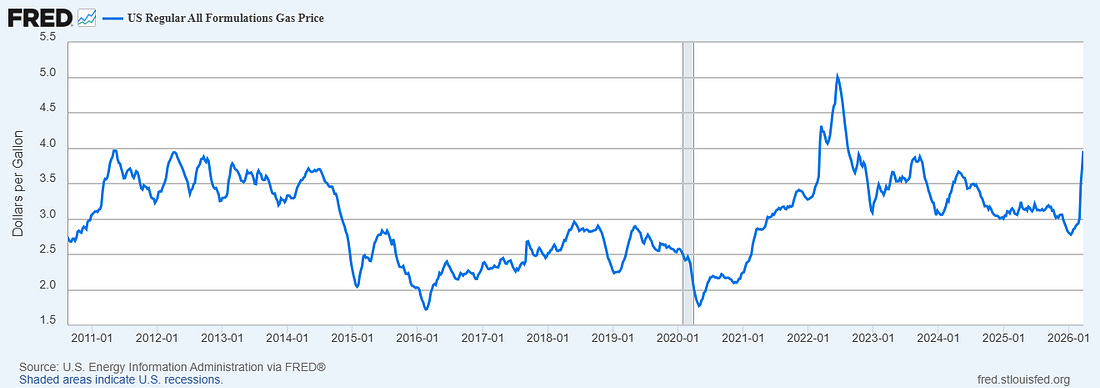 |
$4/gallon gas isn’t historically that high. If you measure relative to typical American incomes, it’s considerably lower now than it was in the early 2010s. But that’s cold comfort to people who have to commute every day to work, and who just saw their weekly gas bill increase by 50%. Those people have every right to be upset about Donald Trump’s war in Iran.
You know who’s not feeling the heat in their daily commute? People who drive electric cars. To them, the war in Iran isn’t a source of daily pain at the pump, because they don’t even go to the pump. Instead, they just park their cars in their driveways and garages every night, and attach a little cable to the back of the car, and in the morning the car is charged and ready to go.
And this means they get to drive around much more cheaply than people who fill up their cars at the pump. Yes, the price of electricity is higher than it was before the pandemic. But even so, an analysis last December by Autoblog found that it cost EV drivers only 5 cents to drive each mile, compared to 12 cents for good old gasoline-powered cars. And that was before the Iran War spiked the price of gas!
For years, whenever I’d say that EVs are the wave of the future, I was met with an absolute torrent of nonsense. “What about range anxiety?”, I’d hear from people who were unaware that EV range has tripled over the last decade. “But it takes so long to charge up,” I’d hear from people who don’t realize that EVs charge up while you sleep. “We’re going to run out of minerals!”, I’d hear from people who had never actually looked up the numbers. And so on.
This sort of nonsense failed to sway Yours Truly, obviously, but it did a number on the United States as a whole. Despite Elon Musk being one of their biggest backers, the Trump administration went on a crusade against EVs, canceling government support for American battery factories and canceling subsidies for EVs. In a free market, the end of those subsidies wouldn’t have mattered, since Chinese batteries and EVs are much cheaper anyway, but U.S. tariffs are so high that they make Chinese batteries and cars extremely artificially expensive. On top of that, Musk’s political antics made people stop wanting to buy Teslas. Ford utterly bungled its own EV rollout. And American consumers became increasingly reluctant to buy EVs in general, probably motivated by the aforementioned blizzard of FUD¹ and nonsense surrounding the technology.
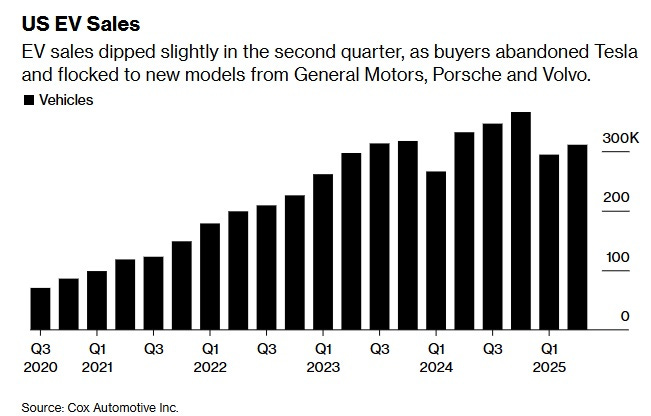
As a result, even as EV sales skyrocketed worldwide, they plateaued and fell in the United States:
 |
Everyone who was paying attention realized that the U.S. was falling alarmingly behind in this crucial technology. Here’s what Hengrui Liu and Kelly Sims Gallagher wrote in January:
Ford and General Motors had recently announced US$19.5 billion and $6 billion in EV-related write-downs, respectively…The message from Detroit was unmistakable: The United States is pulling back from a transition that much of the world is accelerating…
In China, Europe and a growing number of emerging markets, including Vietnam and Indonesia, electric vehicles now make up a higher share of new passenger vehicle sales than in the United States...That means the U.S. pullback on EV production is…an industrial competitiveness problem, with direct implications for the future of U.S. automakers, suppliers and autoworkers. Slower EV production and slower adoption in the U.S. can keep prices higher, delay improvements in batteries and software, and increase the risk that the next generation of automotive value creation will happen elsewhere.
And here’s a very illuminating chart: