| | Iran rejects the US peace plan, Donald Trump faces an oil deadline, and social media giants lose a l͏ ͏ ͏ ͏ ͏ ͏ |
| |  | Flagship |  |
| |
|
The World Today | 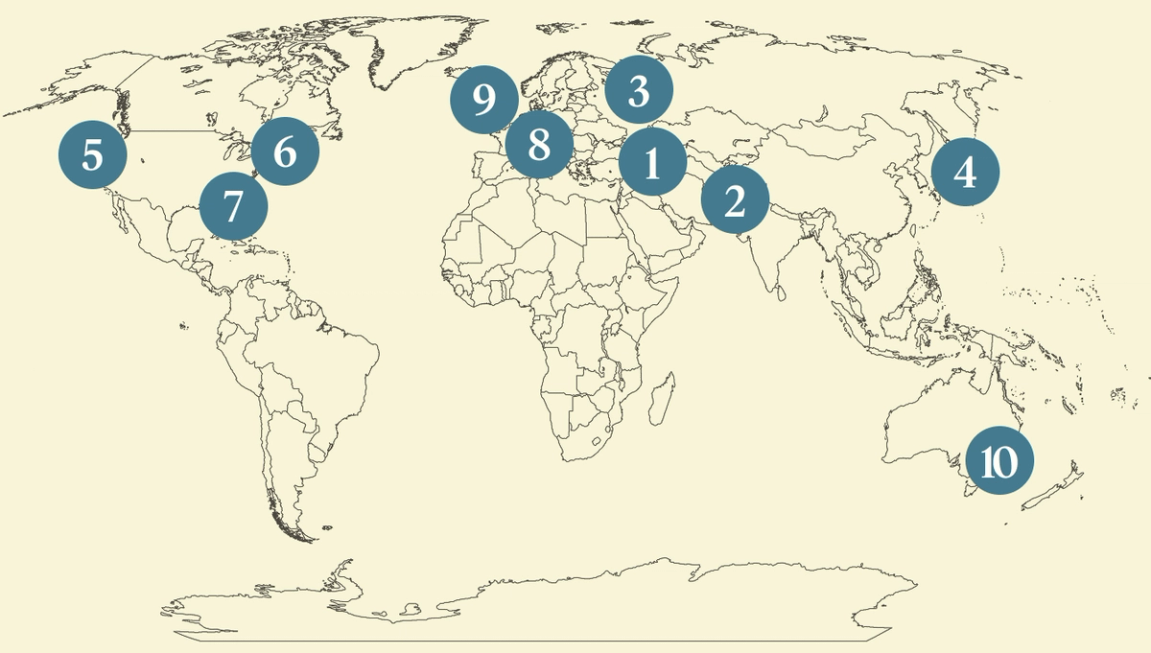 - Iran rejects US peace plan
- Trump’s new oil deadline
- Hormuz impacts beyond oil
- China-Japan tensions flare up
- Tech giants lose addiction trial
- The next AI affordability fight
- JetBlue eyes merger partners
- A record energy imbalance
- US Army recruitment change
- MDMA therapy success
 A biopic centered around Tokyo’s raucous DIY music scene. |
|
Iran rejects US peace proposal |
 Majid Asgaripour/WANA (West Asia News Agency) via Reuters Majid Asgaripour/WANA (West Asia News Agency) via ReutersIran on Wednesday rejected a US peace plan and laid out its own conditions for entering negotiations, setting a high bar. Tehran’s hardball asks include the payment of war reparations and the recognition of Iranian sovereignty over the Strait of Hormuz. Even as the countries pass messages through Pakistan, Iranian officials insisted they were not in talks with Washington to end the nearly month-long conflict, with an Iranian military spokesperson saying the US was negotiating with itself. The contradictions and uncertainty underscore the unusual dynamic that has defined the conflict: The White House threatened to “unleash hell” if a peace deal isn’t reached, while also signaling that the war would end before Trump’s rescheduled visit to China in mid-May. |
|
New energy crunch deadline |
 Stringer/Reuters Stringer/ReutersUS President Donald Trump has managed to keep oil prices largely in check, but he’s running out of time, analysts argued. So far, energy price spikes “have been based more on vibes than actual disruptions to physical supplies,” Semafor’s climate and energy editor wrote. But that will change within days, as the last tankers to have left the Gulf before the Iran conflict began reach their destinations. A Pakistani natural gas terminal will soon “run dry,” its CEO said. Trump’s periodic hints at deescalation in the war have helped keep energy prices within historical ranges, a Bloomberg columnist wrote, but the president’s “oil-market jawboning” will “lose its potency in a longer war.” |
|
Supply shocks give China, Russia sway |
 Russian fertilizer plant. Kirill Braga/Reuters Russian fertilizer plant. Kirill Braga/ReutersThe supply shocks stemming from the Iran war will expand beyond just fuel markets — to the benefit of China and Russia, analysts said. The conflict is imperiling the supply chain for petrochemicals, which are derived from fossil fuels and serve as the building blocks for plastics, an expert told Bloomberg’s Odd Lots podcast. A longer war will strengthen Beijing and Moscow’s “geopolitical leverage across global supply chains,” particularly in petrochemicals as well as fertilizers — another vital commodity impacted by the Strait of Hormuz closure — given the countries’ insulation from disruption in those sectors, Atlantic Council experts wrote. Russia will aim “to position itself as an indispensable supplier that saved the world from starvation” through its fertilizer exports, a Carnegie fellow argued. |
|
Japan, China tensions flare over break-in |
 Kim Kyung-Hoon/Reuters Kim Kyung-Hoon/ReutersTensions between China and Japan flared further this week after a Japanese army officer was accused of breaking into the Chinese embassy in Tokyo. Beijing lambasted Japan over the incident, which Tokyo said was “truly regrettable.” The episode inflames the diplomatic spat between the two countries that began over Japanese Prime Minister Sanae Takaichi’s comments about Taiwan. Japan will reportedly downgrade the description of its relationship with China from “one of its most important” to “strategic” in an annual diplomatic report. In some ways, Tokyo is benefiting from the tensions, as more European leaders are seeking meetings with Takaichi in hopes of “maintaining a balance against ties to China,” Nikkei wrote. |
|
YouTube, Meta lose addiction case |
 Mike Blake/Reuters Mike Blake/ReutersA US jury on Wednesday found Meta and YouTube negligent in a landmark social media addiction trial. The companies must pay a combined $6 million in damages after being accused of harming kids and teens with platforms as addictive as cigarettes and failing to warn them about those dangers. The verdict, The New York Times noted, gives credence to a legal theory that social media sites can cause personal injury, and it may factor into other active cases. It marked Meta’s second legal defeat this week: A jury in a separate case on Tuesday found the Facebook and Instagram owner violated the law by failing to safeguard its young users from child predators. |
|
The next AI affordability battle |
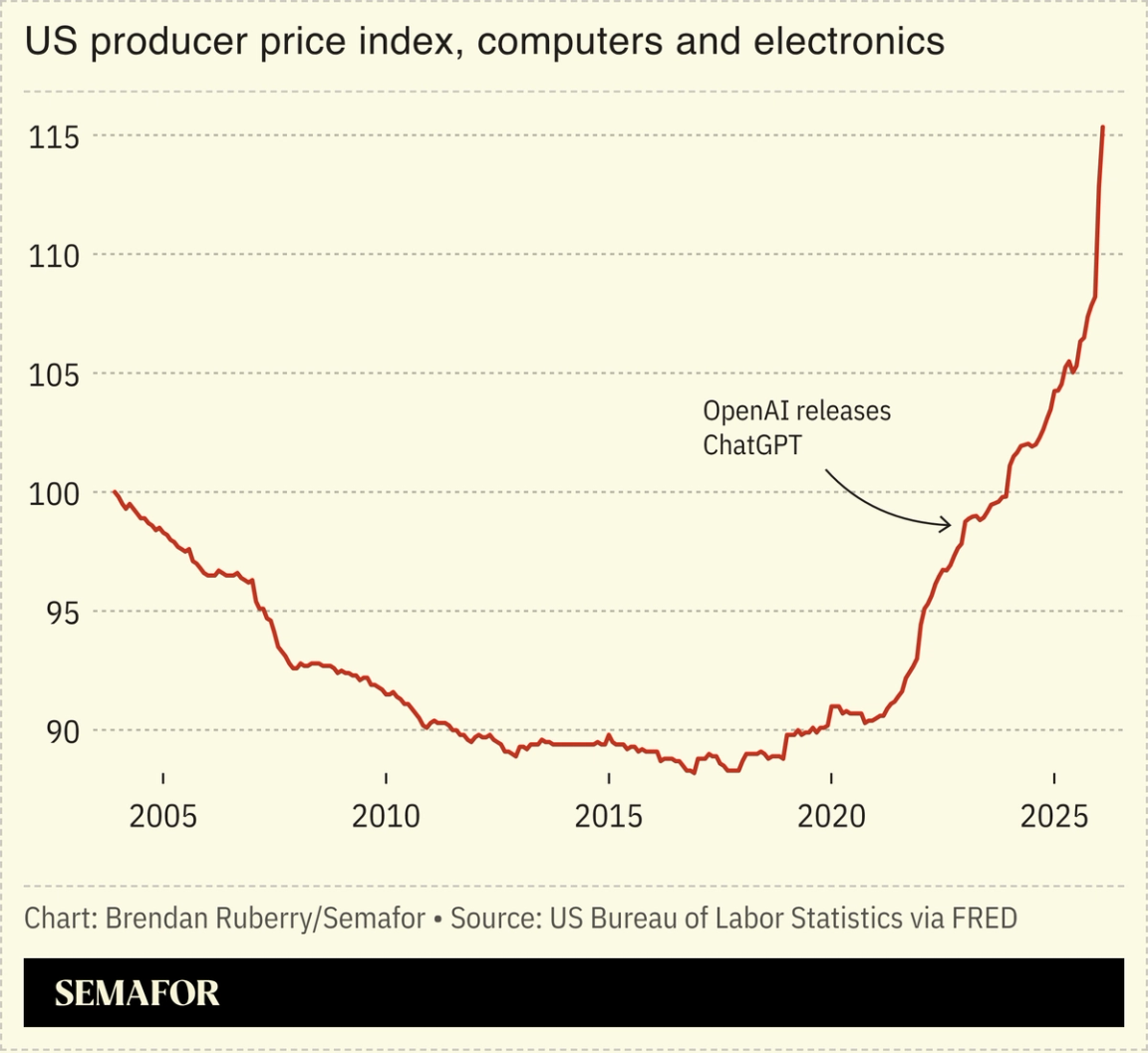 A memory chip shortage triggered by the AI boom will drive up the cost of consumer electronics — potentially causing future headaches for tech companies. AI firms are already in the crosshairs of politicians and voters over high electricity costs stemming from data centers, but the affordability backlash is also “on the brink of exploding” for popular tech like computers, gaming consoles, and data storage systems, Semafor’s tech editor argued. Cost of living is poised to play a major role in US elections this year; while the White House has focused its affordability push on eggs, rent, and electricity, “politicians and technologists alike might want to start worrying about AI’s impact on the price of your smartphone, your PlayStation, and your car.” |
|
JetBlue explores merger partners |
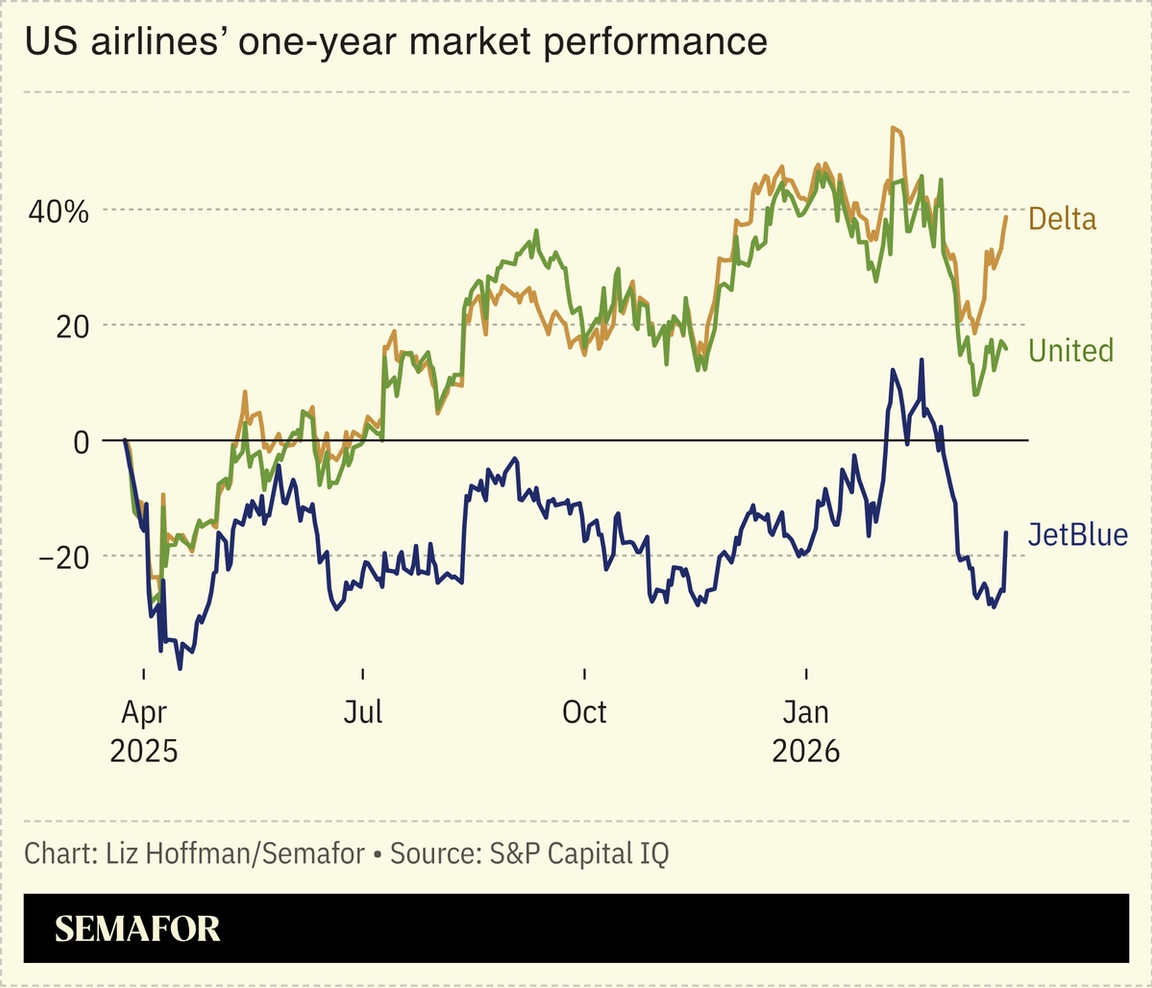 JetBlue has tapped advisers to assess the viability of selling itself to a rival airline, and has scenario-planned how such a deal might play in Donald Trump’s Washington, Semafor reported Wednesday. While the planning remains in preliminary stages, a merger involving two major US airlines would receive close antitrust scrutiny, even from an administration that appears open to consolidation. But deals are getting done, often with a boost from Trump-connected lobbyists whose activities have drawn criticism from progressives and populist Republicans. JetBlue has been on a turnaround mission since its deal to acquire Spirit Airlines was blocked on antitrust grounds in 2024. The report comes as airlines are bracing themselves for a long fallout stemming from the Iran-war fueled oil crisis. |
|
 This April, Howard Lutnick, US Secretary of Commerce, will join global leaders at Semafor World Economy — the largest convening of top global CEOs and government officials in the United States — to sit down with Semafor editors for conversations on the forces shaping global markets, emerging technologies, and geopolitics. See the full lineup of speakers, including Global Advisory Board members, Fortune 500 CEOs, and top elected officials from the US and across the G20. |
|
Earth sees record energy imbalance |
 Eduardo Munoz/Reuters Eduardo Munoz/ReutersThe world’s imbalance between incoming and outgoing energy is growing ever faster, the UN warned. The planet gains energy from the sun and releases it as heat. Under usual circumstances, the two are in equilibrium, but greenhouse gases trap more energy, and as concentrations increase, temperatures rise. The World Meteorological Organization report noted that the imbalance in 2025 was the greatest it’s been since measurement began in 1960. That is unsurprising, however, as it is implicit in the fact that atmospheric CO₂ concentrations are increasing. A more noteworthy fact is that ocean heat rose twice as fast in the last 20 years as in the 40 beforehand. This is the first time the WMO report has included energy imbalance. |
|
Armies struggle with recruitment |
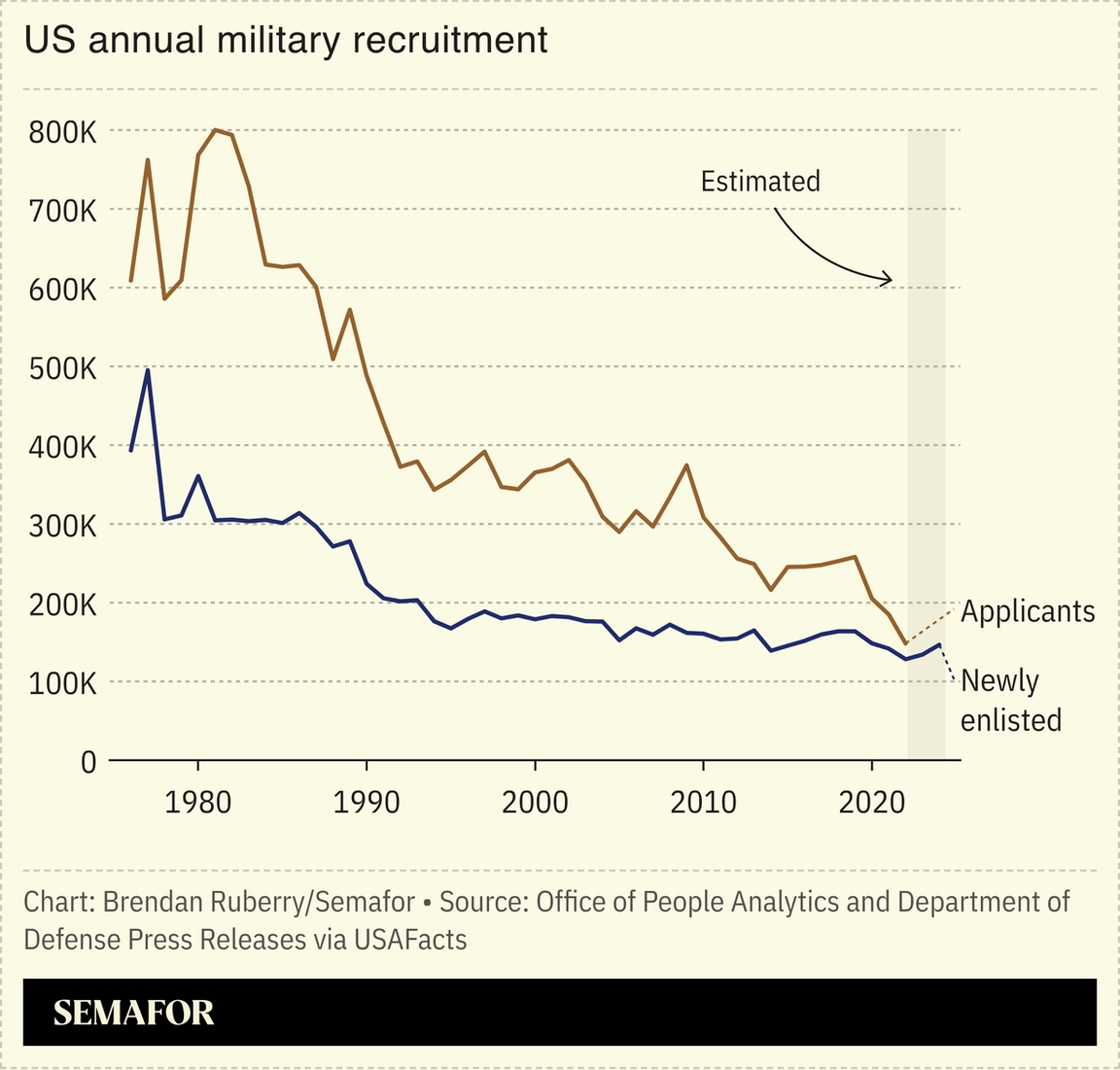 The US Army raised its enlistment age to 42 and eased recruitment restrictions for people with drug convictions. The moves “account for changes in society,” an analyst told Task & Purpose, and bring it in line with other services, but may also be driven by necessity. The Army has repeatedly missed recruiting goals in recent years, as has the wider military, despite a multi-billion-dollar overhaul of the system. The problem is widespread: The British Army has missed recruitment targets every year since 2010; Germany’s Bundeswehr shrank in 2024 despite an enlistment push; France, Italy, and Spain have similar issues. An aging European population, the militaries’ relatively low pay, and falling levels of patriotism are likely factors, ac |
|
|


