|
|
|
|
Good morning. Markets are pricing in a higher possibility the crucial Strait of Hormuz will reopen after Donald Trump postponed attacks on Iran’s energy sector. World leaders, meanwhile, urged caution over hopes of a truce. In focus today, we try to fit the pieces together. |
|
|
|
|
|
|
|
|
|
|
|
|
|
|
|
|
|
|
|
|
|
|
|
|
|
|
|
|
Labour: The future of Canada’s overseas corporate human rights watchdog is uncertain in the Carney government. |
|
|
|
|
|
|
|
|
|
|
|
|
|
|
|
Trump returns to the White House yesterday after visiting Tennessee, where he stopped in at Elvis Presley's Graceland mansion. Chip Somodevilla/Getty Images
|
|
|
|
|
|
|
|
|
|
|
|
|
|
|
|
|
Financial markets are swinging between two outcomes in the war around the Strait of Hormuz. |
|
|
|
|
Either U.S. President Donald Trump is on the verge of securing an opening of a critical energy route, or the world is still facing a prolonged disruption with global economic consequences. |
|
|
|
|
|
|
|
|
Yesterday, after Trump announced he had postponed strikes against Iranian energy infrastructure following “productive conversations” with Tehran, markets moved toward the first path, sending oil prices sharply lower and equities higher as they positioned for a resumption of flows. |
|
|
|
|
If that doesn’t seem to match the messaging from some world leaders,
that’s because the market might believe this is just the beginning of Trump’s reversal – a common feature of the President’s more provocative threats to global destabilization. It could be a more conventional repricing, a focus on elevated war premiums that left prices vulnerable to a sharp reversal, or a rapid, mechanically driven move that settled as investors digested the news. |
|
|
|
|
|
|
|
|
|
|
Whatever the reason, New York City-based Art Hogan, chief market strategist at B. Riley Wealth Management, said Trump’s assurances represent a “significant positive.” |
|
|
|
|
“We’ll have to see what comes of this, but at least for today, you’ve got the potential for constructive conversations happening and perhaps some type of resolution coming in the Middle East, and that’s exactly what the markets want to see when you start in the week.” |
|
|
|
|
But how the week will end is anyone’s guess. And that’s why it’s hard to read too much into oil prices rising or falling on a daily basis, much less hourly. Iranian parliamentary speaker Mohammad Bagher Ghalibaf said no negotiations had taken place, and described reports of talks as an attempt to influence financial and oil markets. Israeli forces reported a new round of strikes on Iran, part of a campaign that has expanded to include energy infrastructure and military leadership. |
|
|
|
|
British Prime Minister Keir Starmer warned against “false comfort” in expecting a quick resolution. While Trump was able to find expedient off-ramps to his most significant “Liberation Day” tariffs, and in his threats of annexing Greenland, backing out of a war with Tehran might prove more difficult. |
|
|
|
|
Still, even if the conditions required for a reopening of the Strait have yet to appear, markets have moved on the prospect that they will. Brent crude, the global benchmark, fell by more than 10 per cent following Trump’s comments. |
|
|
|
|
Measured against what could happen in the event negotiations aren’t effective, any relief in oil prices would help. |
|
|
|
|
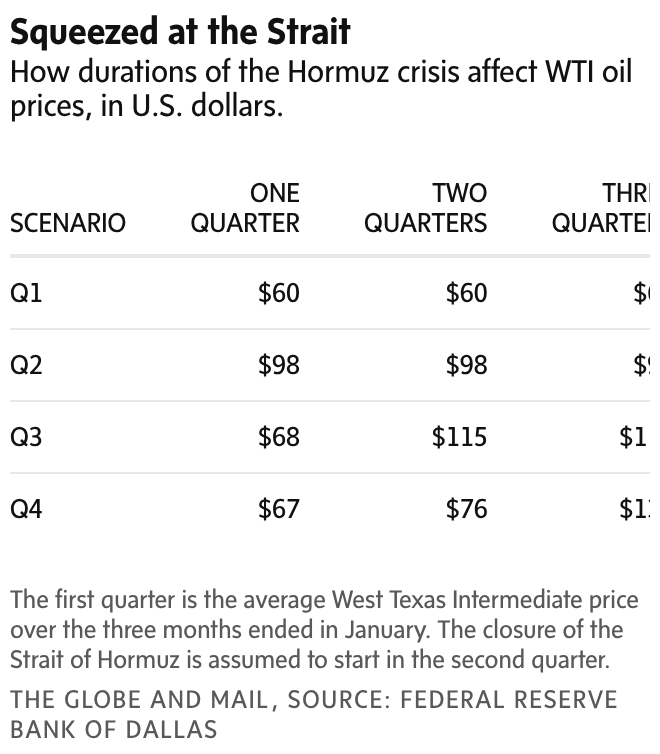
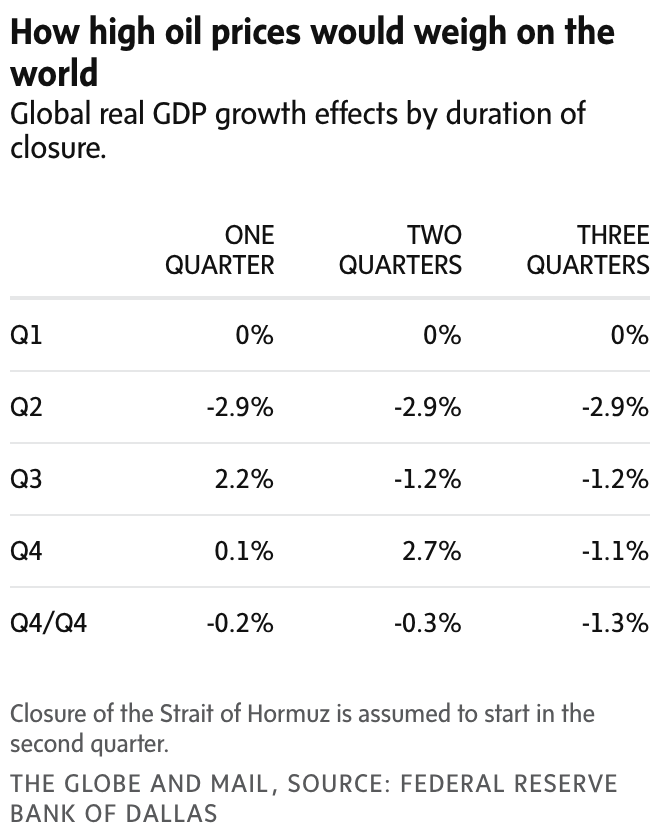
A closure of the Strait, which accounts for a major share of the world’s supply of crude oil and fertilizer, is poised to pull down the global economy, according to new modelling from the Federal Reserve Bank of Dallas. In the first full quarter of oil at about US$98 per barrel, the Fed economists projected, global GDP growth would be reduced by nearly 3 per cent below expectations. |
|
|
|
|
|
|
Longer interruptions would push oil higher and extend the period of weaker growth. Measured year-over-year, global GDP growth would be between 0.2 and 1.3 percentage points lower, depending on whether the disruption lasts one, two or three quarters. |
|
|
|
|
|
|
The shock tied to Hormuz ranks alongside the largest oil disruptions of the past half-century, including the crises of the 1970s and the market fallout following Russia’s invasion of Ukraine. Reopening the Strait remains the most direct path to stabilizing markets, the International Energy Agency said yesterday. |
|
|
|
|
There is little indication that such an outcome is imminent. Even in the event of a truce, a return to normal flows of energy and commodities would take time, leaving the risk of persistent shortages and higher prices stuck across a range of goods. |
|
|
|
|
|
|
|
|
|
|
“That outlook now appears increasingly unlikely,” Kristy Kramer, WoodMac’s head of LNG strategy and market development, said in a report. “A more prolonged outage would further tighten the global supply and keep prices elevated for longer.” |
|
|
|
|
|
|
|
|
|
|