The president is losing control of the messaging

Get full access to Reuters.com for just $1/week. Subscribe now.


Politics U.S.

Politics U.S.


By Trevor Hunnicutt, White House reporter

President Donald Trump’s habit of shooting from the hip verbally may be part of the reason why he is struggling to control the narrative of the U.S.-Israeli war on Iran, despite a raft of tactical military successes. Trump said on Wednesday he “knew nothing” in advance about an Israeli attack on Iran's South Pars gas field, a significant escalation in the conflict. But Israeli officials later told Reuters that the Israeli strike was indeed coordinated with the United States. The attack drew an Iranian aerial assault on energy infrastructure in Qatar and across the Middle East, further compounding fears about soaring world energy prices. 

A path to de-escalating the conflict appears nowhere in sight, nearly three weeks in, with the global economic fallout worsening and the Iranians remaining defiant. 


Latest U.S. politics headlines

  • Iran war boosts Netanyahu, bruises Trump and Gulf states
  • Child vaccination rate drops sharply in Michigan under RFK Jr's influence 
  • TrumpRx lists many medicines at prices higher than paid in UK 
  • Iran war fuels tensions in US Democratic primary races 
  • The complexities of refueling the war in the sky 
 

Minefield

The war memoirist Tim O'Brien once quoted a fellow soldier on his experience traversing booby-trapped South Vietnam. 

“It’s more than the fear of death that chews on your mind,” he wrote in “If I Die in a Combat Zone.” “It’s an absurd combination of certainty and uncertainty: the certainty that you’re walking in mine fields” along with “the uncertainty of your every movement.” 

Three weeks into the military campaign in Iran, the conflict has become both a literal and a metaphorical minefield for Trump. 

Iran has planted mines in the Strait of Hormuz, forcing oil vessels to stay in port, choking off a major source of the world’s energy. Diplomatically, Trump’s pressure on allies to do more to clear the Strait risks backfiring (see this week’s view from Tokyo). And politically, the Republican leader is treading through dangerous territory at home as the costs -- the price of gas at the pump continues to rise -- of an unpopular war mount. 

Before the war, Trump had largely succeeded in shaping his own reality, wielding expansive power as president, refashioning political weaknesses into strengths and bringing potential adversaries to heel. 

Now, he’s struggling to control the message as he works to portray the Iran operation as a success. 

Trump has lashed out at press coverage of the war that often challenges the official version of events. He’s said that his administration was surprised that attacking Iran could trigger retaliation against U.S. Gulf allies, a claim contradicted by U.S. officials. He said he spoke to a former U.S. president who wished they’d bombed Iran, a claim denied by aides to all the four living former presidents.  

Vice President JD Vance on Monday stood alongside Trump in the Oval Office and expressed support for the president’s handling of the war - the latest effort to counter questions about differences within Trump’s inner circle on the war strategy. 

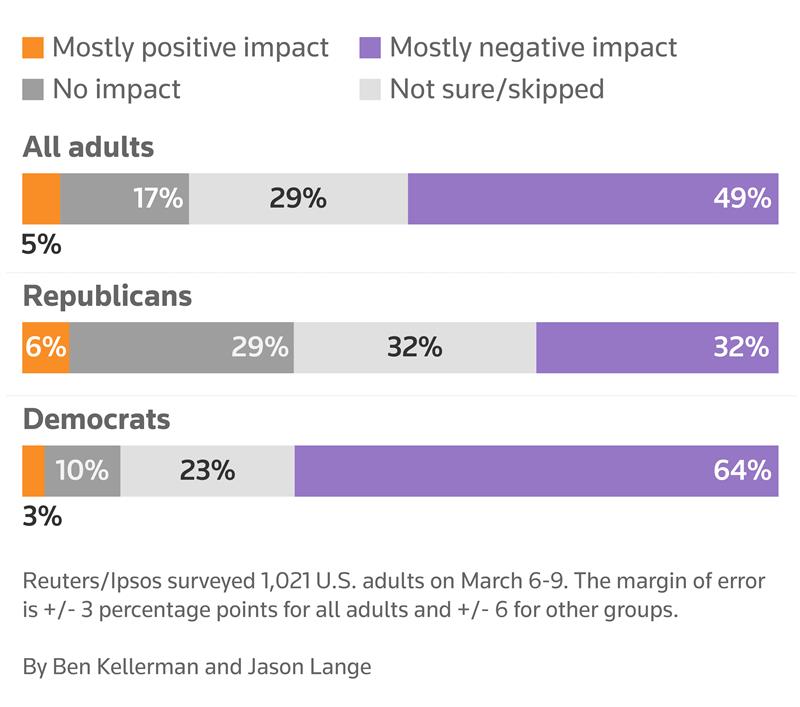
Those efforts have done little to quiet the concerns of Americans, who remain skeptical of the endeavor. 

That makes Trump’s next step more fraught as he resists calls to start ceasefire negotiations and considers deploying thousands more U.S. troops to the Middle East. 


Many Americans expect the war in Iran to have a negative impact on their personal finances


Follow Reuters/Ipsos polling on the president's approval ratings here.


The view from Tokyo

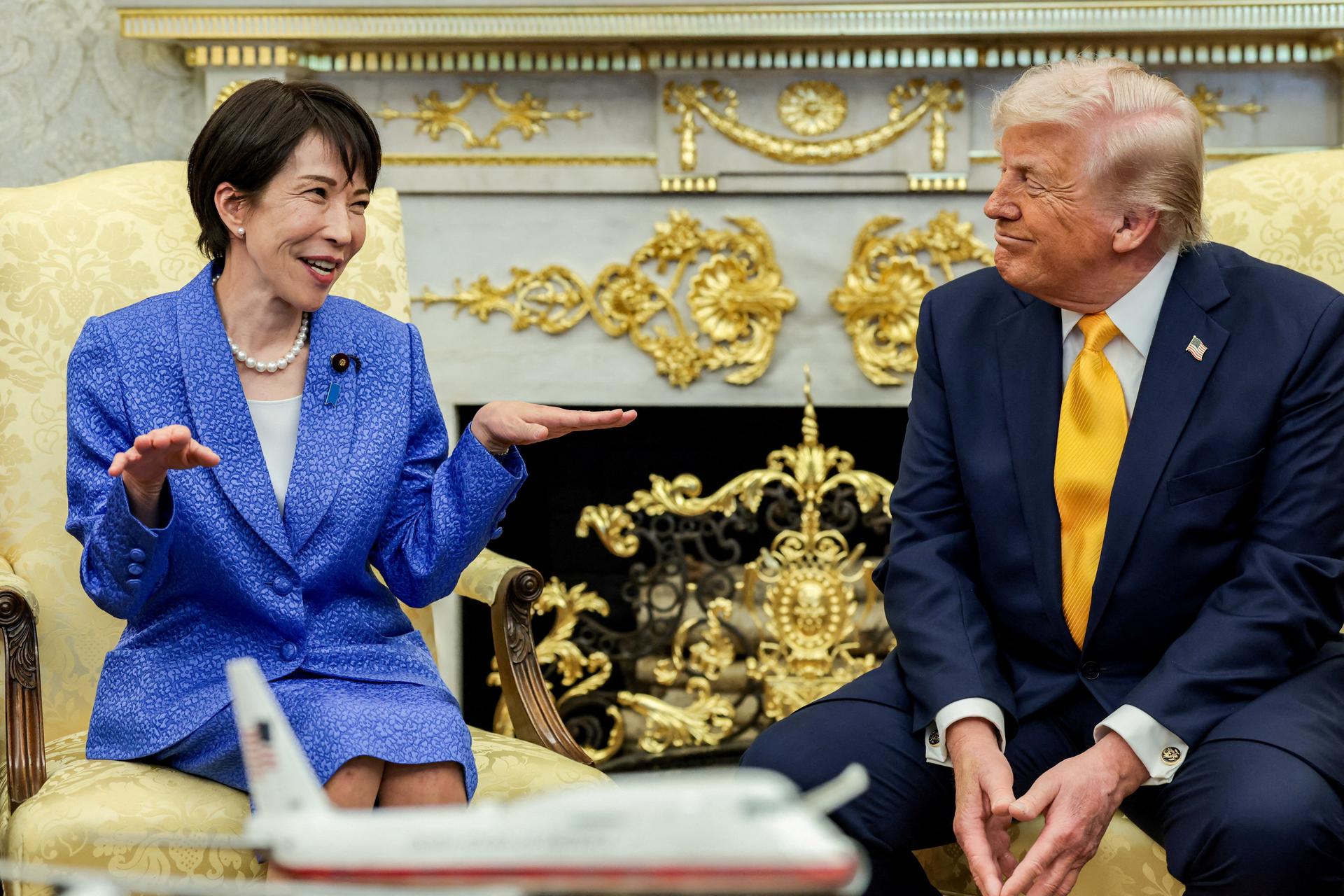
Trump is turning up the heat on allies who are reticent to participate in the conflict. Take Japan, which maintains relations with Tehran but is Washington’s closest ally in East Asia. Prime Minister Sanae Takaichi is at the White House on Thursday for talks that could see Trump press his demand for help clearing mines and escorting tankers through the strait. Takaichi may be limited in what she’s able to do: Japan has a pacifist constitution that restricts its role in armed conflicts. Many European nations have rejected Trump’s demands. German Defense Minister Boris Pistorius put the point bluntly: "This is not our war; we have not started it." Still, ahead of Takaichi’s meeting with Trump, Japan joined leading nations in Europe in a joint statement, saying they would take steps to stabilize energy markets and were ready to join "appropriate efforts" to ensure safe passage through the strait.  


Photo of the week


U.S. President Donald Trump meets with Japanese Prime Minister Sanae Takaichi in the Oval Office at the White House in Washington, D.C., U.S., March 19, 2026. REUTERS/Evelyn Hockstein


What to watch for

  • March 23: Trump expected to visit Memphis, Tennessee 
  • March 24: Judge weighs Anthropic challenge to designation as national security risk 
  • March 24: California Democratic gubernatorial candidate debate 
  • March 25-28: Conservative Political Action Conference meets in Grapevine, Texas 
 

The who, what and when

  • How Trump's long-shot voting bill could hurt his own supporters