| | The US Federal Reserve holds interest rates steady, Israel kills Iran’s intelligence chief, and two ͏ ͏ ͏ ͏ ͏ ͏ |
| |  | Flagship |  |
| |
|
The World Today | 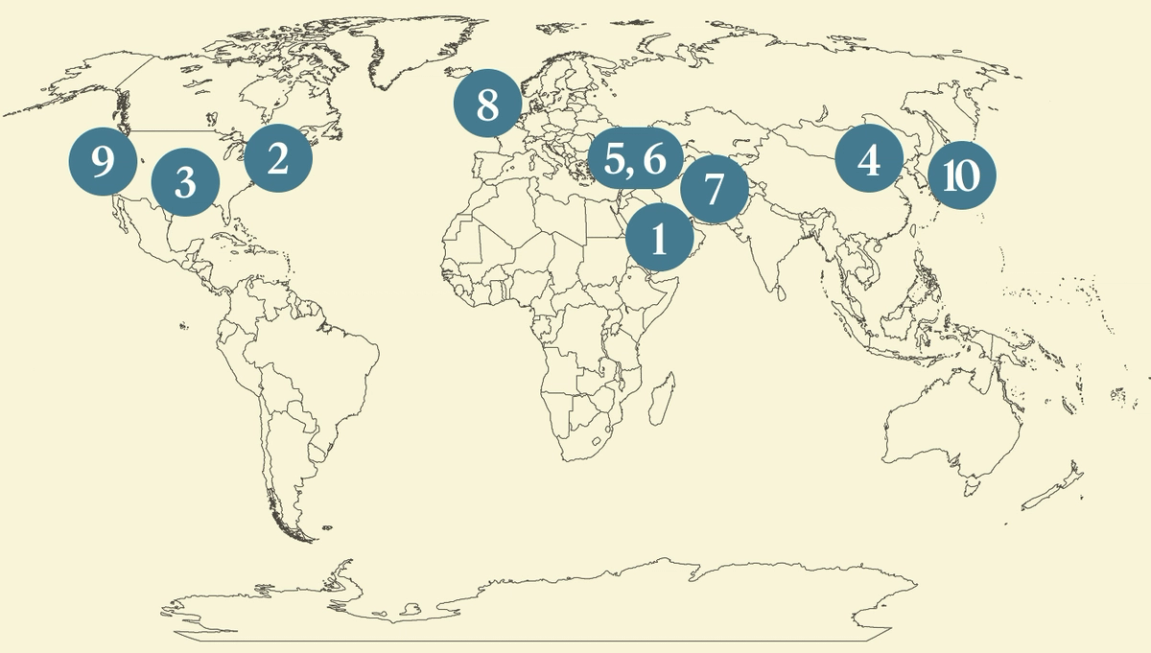 - Oil rises after gas field strike
- US Fed holds rates steady
- How US economy will fare
- China to tap oil reserves
- Israel takes out Iran intel chief
- Humans erred in school strike
- White House gamifies war
- Turing for quantum science
- AI firm seeks actors
- Christie’s first anime auction
 Debunking the popular conspiracy theories behind a notorious art heist. |
|
Oil prices reach $110 a barrel |
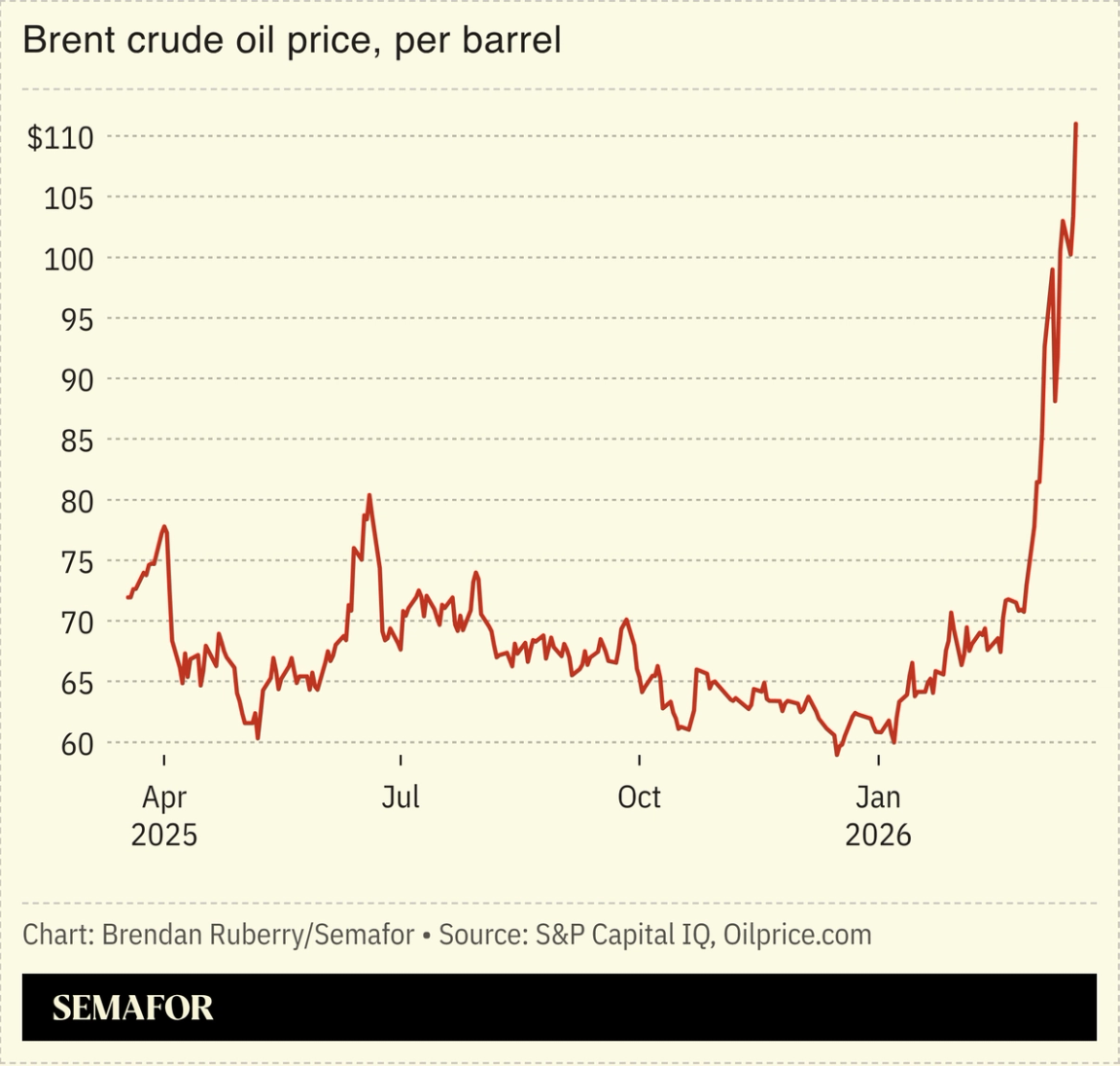 Oil prices ticked up further on Wednesday, reaching a high of $110 per barrel, after Iran and Qatar accused Israel of attacking a vast natural gas field the Gulf countries share. Tehran vowed to retaliate by targeting energy sites in neighboring countries. Strikes on energy infrastructure in the region are compounding the disruptions triggered by the effective closure of the Strait of Hormuz, deepening the strain on the global economy. The White House, under pressure to end the conflict, on Wednesday suspended a law that prohibits foreign vessels from shipping oil and gas between US ports. But analysts say the move will do little to ease rising gas prices, which Vice President JD Vance called a “temporary blip.” |
|
Fed holds interest rates steady |
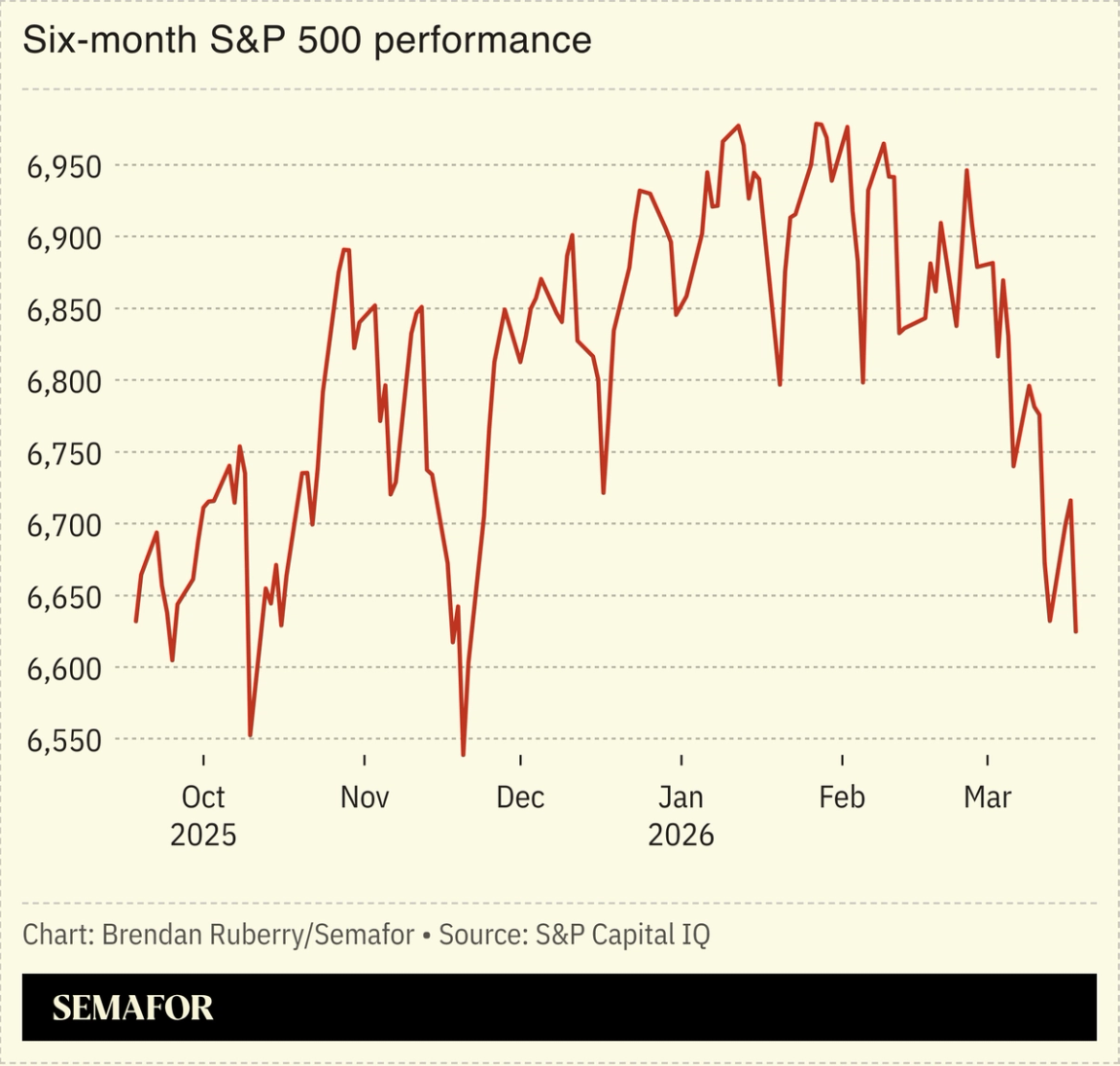 The US Federal Reserve held interest rates steady on Wednesday, as the Iran war clouds the central bank’s outlook and adds to the inflation risks facing the economy. Stocks fell after Fed Chair Jerome Powell struck a somewhat hawkish tone in his remarks. Powell, who is facing a federal probe into Fed building renovations, also said he would keep serving as head of the central bank if a successor isn’t confirmed when his term ends in May. The probe is proving to be an obstacle to the White House’s quest for a new Fed chair, Semafor’s Eleanor Mueller reported, as some Senate Republicans vowed to block the nomination for Powell’s successor unless the Justice Department abandons its investigation. |
|
How US economy will cope with war |
 Ken Cedeno/Reuters Ken Cedeno/ReutersExperts debated over how well the US economy will cope with the Middle East conflict. Moody’s Analytics forecast the probability of a recession in the next year at 49%, driven largely by higher oil prices. And a Donald Trump ally and economist warned the economy won’t “be able to handle $100 a barrel for oil.” Barack Obama’s former economic adviser, though, argued that he doesn’t think the war in Iran will “significantly alter the economy’s direction,” writing: “The American economy, like an ocean liner, is extremely hard to turn.” US Federal Reserve Chair Jerome Powell said Wednesday the impacts from the conflict remain uncertain, but that the situation remains far removed from the “stagflation” of the 1970s. |
|
China could tap oil reserves |
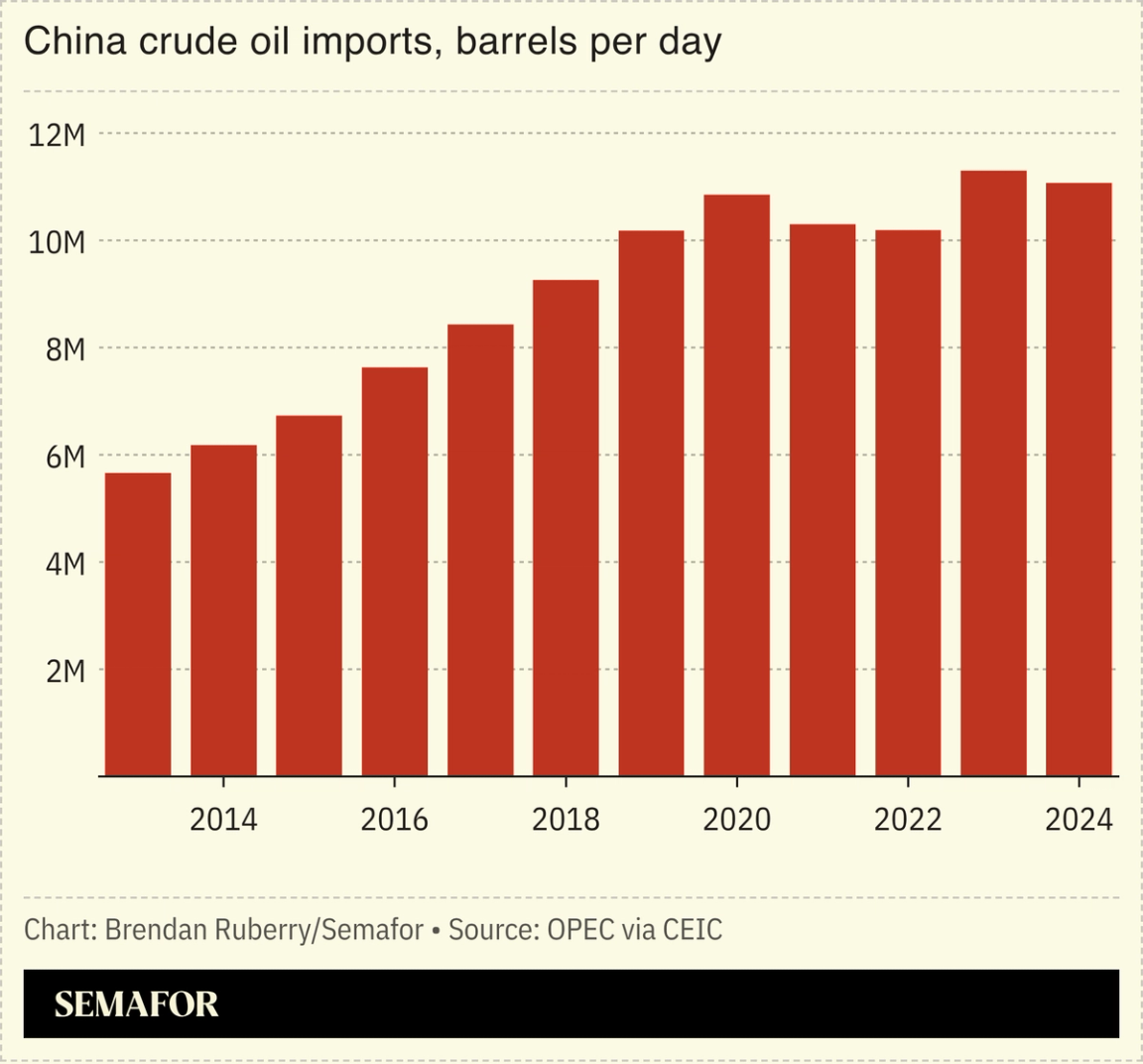 China is close to tapping its vast commercial oil reserves as supply disruptions from the Iran conflict grow more acute, an industry consultant said. Beijing has stockpiled an estimated 1.4 billion barrels of crude reserves, and could draw down about 1 million barrels each day to respond to the crisis, Bloomberg reported. Beijing has taken other steps to weather the shock; it has banned refined fuel exports, and Saudi Arabia is diverting some China-bound oil cargoes through a Red Sea port, though analysts said the alternative route won’t offset the disruption from the Strait of Hormuz closure. “China cannot shield its economy entirely,” The Economist wrote, as higher oil prices raise freight costs and imperil industrial growth. |
|
Israel kills Iran intel chief |
 Majid Asgaripour/WANA (West Asia News Agency) via Reuters Majid Asgaripour/WANA (West Asia News Agency) via ReutersThe Israeli military killed Iran’s intelligence minister, the latest senior Iranian figure to be assassinated in Israel’s intensifying campaign to destabilize the Islamic Republic. Esmail Khatib’s death came within 24 hours of Israeli strikes taking out Iran’s security chief and the head of its feared paramilitary force. Israel has dropped 10,000 munitions on thousands of different targets across Iran’s power structure, chasing security officers out of their headquarters to hideouts “to disrupt their activity and show Iranians that the enforcers are being taken out,” The Wall Street Journal reported. Israeli Prime Minister Benjamin Netanyahu has had a decades-long fixation on Iran, the Financial Times wrote, with the ultimate goal “to anchor the US in a confrontation with Tehran.” |
|
AI not at fault for school strike |
 Abbas Zakeri/Mehr News/WANA via Reuters Abbas Zakeri/Mehr News/WANA via ReutersHumans, not artificial intelligence, are to blame for the deadly US missile strike on an Iranian elementary school, Semafor reported. The US military has embraced AI — the Pentagon used Anthropic’s Claude model in the capture of Venezuela’s leader as well as in planning air attacks against Iran — but in this case, the error was one that AI would not be likely to make: US officials failed to recognize subtle changes in satellite imagery, or analysts missed information about the school’s location or forgot to log it, Semafor’s Reed Albergotti wrote. “AI has its notorious failings, from hallucinations to sycophancy, but it’s also able to take in far more information than current, human-led systems.” |
|
WH hails ‘banger’ Iran war videos |
 WhiteHouse/X WhiteHouse/XThe White House is gamifying the Iran war, using memes and montages borrowed from livestreaming to project strength, analysts argued. Official releases spliced real strikes with footage from Call of Duty, Mortal Kombat, and Hollywood movies; the administration’s communications director hailed the “banger videos,” Axios reported, and the US defense secretary described a torpedo attack on an Iranian vessel as “quiet death.” This “machismo style seems to be the policy,” The Economist wrote. As the White House struggles to articulate a rationale for the war, some former Republican officials criticized the approach, with one telling The Irish Times that the administration should be explaining to Iranians “why you are bombing their country, not how we are blowing stuff up.” |
|
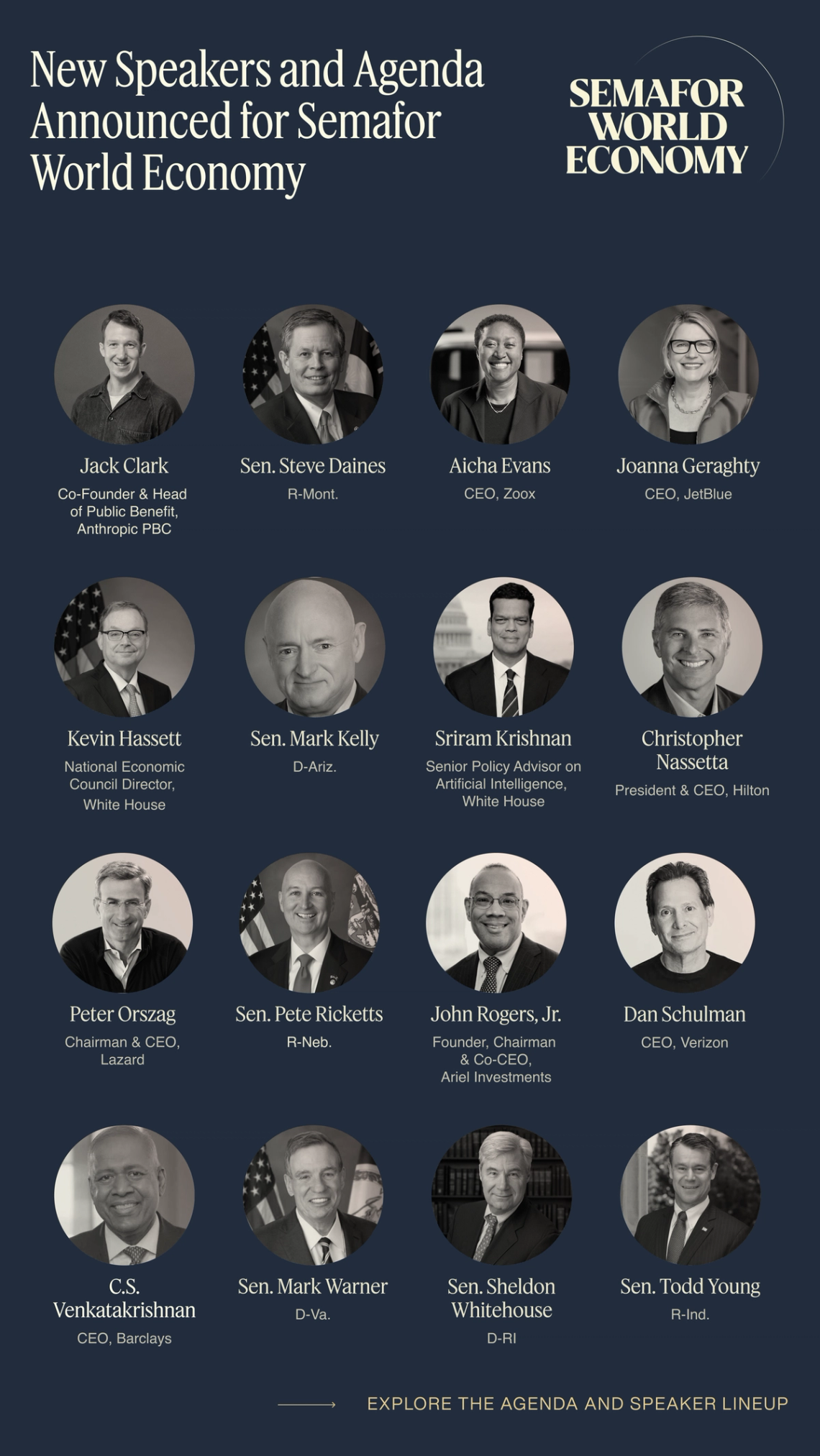 Semafor today announced the agenda and a new slate of CEOs and global leaders joining more than 450 top executives at the 2026 Annual Convening of Semafor World Economy, taking place April 13–17 in Washington, DC. As the definitive live journalism platform on the new economy, the convening will bring together US Cabinet secretaries, central bank governors, finance ministers, and Fortune 500 CEOs for five days of on-stage conversations and in-depth interviews uniting private and public sector leaders to exchange ideas that will shape the future of the world economy. |
|
Turing Award goes to quantum innovators |
 Association for Computing Machinery Association for Computing MachineryComputing’s prestigious Turing Award went to two men who created a way of keeping digital communication safe even in the age of quantum computers. Modern encryption relies on computers’ inability to unpick calculations involving enormous prime numbers, but quantum computers will sidestep that problem. “Quantum cryptography,” proposed by Charles Bennett and Gilles Brassard in the 1980s, relies on a quirk of subatomic physics: That observing a particle changes it. The technique encodes the code’s “key” in individual photons, so if that key is intercepted, the sender and recipient will know. When Bennett and Brassard designed the technique, it was clever but largely useless; now, as quantum computing looms, governments and Big Tech are actively pursuing it to keep their data safe. |
|
AI firm seeks actors to help capture emotions |
 Caitlin Ochs/Reuters Caitlin Ochs/ReutersAn AI data company is seeking “actors, improvisers, and performers” to help train large language models to understand human tone and emotional expression. The rise of sophisticated AI has created a sub-industry of specialist data providers; AI’s capabilities are “jagged,” The Verge noted, meaning they are great at some complex tasks and bad at seemingly easier ones, often because those tasks lack sufficient interpretable, labeled data. One such task is reading human emotions. The growth of AI voice chat means believable emotional expression is increasingly important. The data company, Handshake, has seen a threefold increase in demand since last summer, and has a network of white-collar professionals from chemists to screenwriters providing specialist data. |
|
|


